May 27, 2026

You're probably in one of two places right now. You want into real estate, but rentals feel capital-heavy and flips feel operationally messy. Or you've already watched enough wholesaling videos to notice that every course page sounds easy, every instructor claims a system, and none of them spend much time on what can go wrong.
That's the issue with shopping for a wholesaling real estate course. The beginner pitch is usually simple. Find a distressed seller, get a contract, assign it, get paid. The business itself can be simple on paper. The execution isn't. Bad pricing, weak lead screening, poor contract handling, and local legal mistakes can kill a deal fast.
A course can help. It can shorten the learning curve, give you scripts, explain deal flow, and keep you from making avoidable mistakes. But a course can't replace judgment, market knowledge, or the daily work of finding sellers and buyers. If you evaluate programs like a buyer of education instead of a fan of marketing, you'll make a much better decision.
A new investor gets sold on a simple idea. Lock up a discounted property, pass the contract to a cash buyer, collect an assignment fee. A wholesaling real estate course teaches that transaction model, but the better programs also show where deals fall apart. Spread too thin between seller price and buyer price, bad repair assumptions, unclear title, and state-specific contract rules can turn a promising lead into a wasted month.
At its core, a wholesaling course teaches how to control a property without purchasing it yourself, then transfer your contract position to another investor. That sounds lighter than owning rentals or funding a rehab, and sometimes it is. The trade-off is that you are running an acquisitions business. You need lead flow, seller conversations, pricing discipline, buyer relationships, and a clear understanding of what your paperwork allows in your market.
That legal point gets skipped too often. In some states, the line between assigning a contract and acting like an unlicensed broker is not something to guess at. A solid course should make you ask practical questions early. Are you being taught assignment, double close, or both? Are the contracts state-specific? Is there any discussion of marketing equitable interest, disclosure, earnest money risk, or when an attorney should review the file? If a course sells speed but ignores compliance, that is a problem.
These courses fit people who want to build deal-sourcing and underwriting skills before taking title to property. They also fit agents, contractors, and local investors who want another way to source off-market opportunities. The common thread is willingness to treat wholesaling like sales, analysis, and follow-up work done every week.
They are a poor fit for anyone looking for easy money.
A good course can shorten trial and error. It cannot give you judgment. It cannot make a thin deal profitable. It cannot fix weak seller communication or a weak buyers list. The useful question is not whether a program explains the model. The useful question is whether it teaches you to protect margin, screen out bad leads, and stay inside the legal rules while doing it.
If you need a plain-English explanation of the transaction before comparing programs, this breakdown of understanding wholesale deals is a useful primer. If you also want to see how legitimate education companies structure delivery, support, and member access, this look at an online course creator platform helps you judge whether a course business is built to teach or just built to sell.
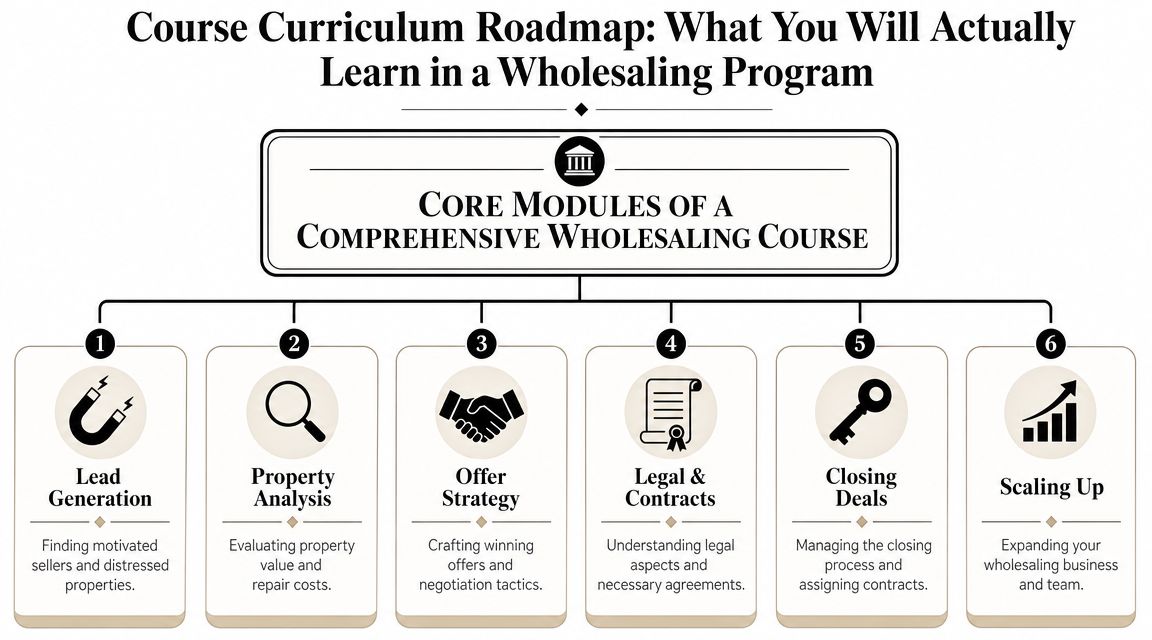
A new student usually expects a wholesaling course to teach one thing. Find a cheap house and assign the contract. A usable program teaches a wider job. It shows you how to source leads, screen sellers, estimate repairs, price for your buyer pool, control a file through contract, and avoid legal mistakes that can wipe out a fee.
That difference matters. Plenty of courses explain the transaction flow. Fewer teach the business math behind it, and even fewer explain where beginners get exposed on contracts, disclosures, marketing language, and earnest money.
Lead generation is usually the first module, but the better programs spend real time on intake. A lead is not an opportunity just because someone answered the phone. A course should teach how to ask the questions that save time early. Why are they selling now? Who owns the property? Is there enough equity for a wholesale spread? Are there liens, probate issues, tenants, or condition problems that change the deal?
Here, students start acting like operators instead of shoppers for course content.
A solid intake lesson also covers follow-up discipline and triage. Some leads need same-day action. Others belong in a longer pipeline. If you want a practical framework for sorting those conversations, this guide to mastering real estate lead qualification fits well beside a wholesaling syllabus.
Look for lessons that cover:
This is the module that decides whether you are learning a business or learning how to sound confident.
A good course teaches students to build a buy price from comps, repair costs, holding risk, closing costs, and the margin their end buyer needs. It should also explain how local buyer demand changes the offer. A rental buyer, flipper, and landlord in a slow market do not look at the same numbers the same way.
Shortcut formulas show up in almost every program. They can help as a rough starting point. They are not underwriting. If a course teaches only a formula and skips comp selection, repair scope, exit assumptions, and fee compression, the lesson is incomplete.
The skill is pricing for resale to another investor, not pricing for your own excitement.
I want to see lessons on spread management. How much room is left after title issues, credits, or buyer retrades? How often do deals die because the repair number was light or the ARV came from the best comp on the block instead of the most relevant one? Strong programs address those questions directly because they connect to the metric that matters most in wholesaling. Contract-to-close rate.
Negotiation training should cover more than rapport and scripts. Students need to learn how to gather facts, set expectations, present an offer cleanly, and avoid saying things that create legal or ethical problems later. If you promise a seller a closing date you cannot control, or market a deal in a way your state does not allow, the issue is bigger than poor sales technique.
Paperwork training should include the purchase agreement, assignment terms, inspection or feasibility periods, earnest money timing, and the handoff to title or closing counsel. The better courses also explain where wholesalers get into trouble. Advertising a property you do not own. Failing to disclose your intent. Using contract language you do not understand. Working in a state where local rules are stricter than the course makes them sound.
That is a serious gap in a lot of entry-level education.
If you are comparing programs, the curriculum itself says a lot. A clean outline of course structure should show more than marketing and motivation. It should show a sequence from intake to analysis to contract control to disposition, with enough detail to tell whether legal risk and unit economics are being taught.
A useful curriculum map usually includes:
That is what you should expect to learn if the program is built by someone who has personally had deals fall apart, not just someone who knows how to sell a course.
A wholesaling real estate course is never the full investment. It's the entry ticket to learning a business that usually requires follow-up systems, seller conversations, market research, and buyer management. If you only budget for tuition and ignore the operating side, your expectations are already off.
That matters because most course marketing highlights the clean part of the business. It talks about finding deals, assigning contracts, and collecting fees. It spends far less time on churn. A lot of leads won't convert. A lot of offers won't get accepted. A lot of accepted contracts won't survive buyer scrutiny if the numbers were weak from the start.
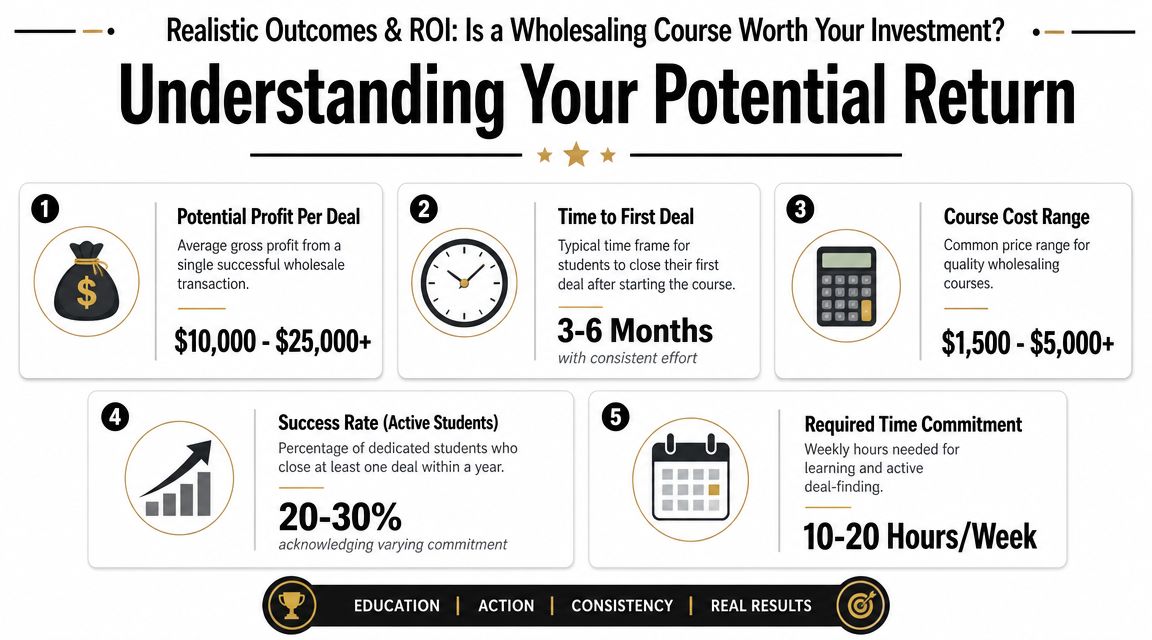
Recent course roundups still frame wholesaling mainly as a beginner-friendly entry strategy, but they rarely quantify how many leads, offers, or contracts are typically needed to produce one assignment fee. They also tend to gloss over how rising competition and thinner spreads affect conversion, as noted in PropertyMob's discussion of wholesaling course coverage.
That gap is a problem because unit economics decide whether this business works for you. Not motivation. Not branding. Not a slick CRM setup.
Ask yourself:
The better way to evaluate return is to separate education value from business performance.
Education value means the course helps you avoid obvious mistakes. It teaches a repeatable intake process, real underwriting logic, and enough transaction flow to keep you from getting lost in your first deal.
Business performance is different. That depends on your market, your effort, your legal setup, your buyer network, and your ability to keep quality high while doing repetitive work.
The video below gives additional perspective on the business model and how people approach it in practice.
Here's the test I'd use before buying any program:
| Question | Why it matters |
|---|---|
| Does the course teach pricing, not just prospecting? | Lead flow without underwriting creates bad contracts. |
| Does it address failed deals? | You need to know what breaks in due diligence and disposition. |
| Does it prepare you for competition? | Efficient markets punish sloppy offers. |
| Will I actually execute the lessons? | A complete course is worthless if you won't make calls, comp houses, and follow up. |
If a course sells certainty, walk away. This business has moving parts, and competent operators respect that.
A course is worth it when it gives you better judgment and a faster path to disciplined action. It's not worth it when it replaces analysis with hype.
The fastest way to waste money in wholesaling education is to judge a course by energy instead of evidence. A polished sales page doesn't mean the material is practical. Loud testimonials don't mean the training is current. And a big promise about “starting with nothing” says nothing about whether the instructor teaches you how to avoid legal trouble.
That last point is the one most buyers miss. Mainstream wholesaling course content still centers on sourcing deals, buyer lists, and basic contract workflow, but it often gives too little attention to how rules vary by state and how assignment, licensing, advertising, and disclosure issues can create legal risk. That gap is highlighted in Coursesity's review of wholesaling course coverage, and it should be one of your first screening criteria.
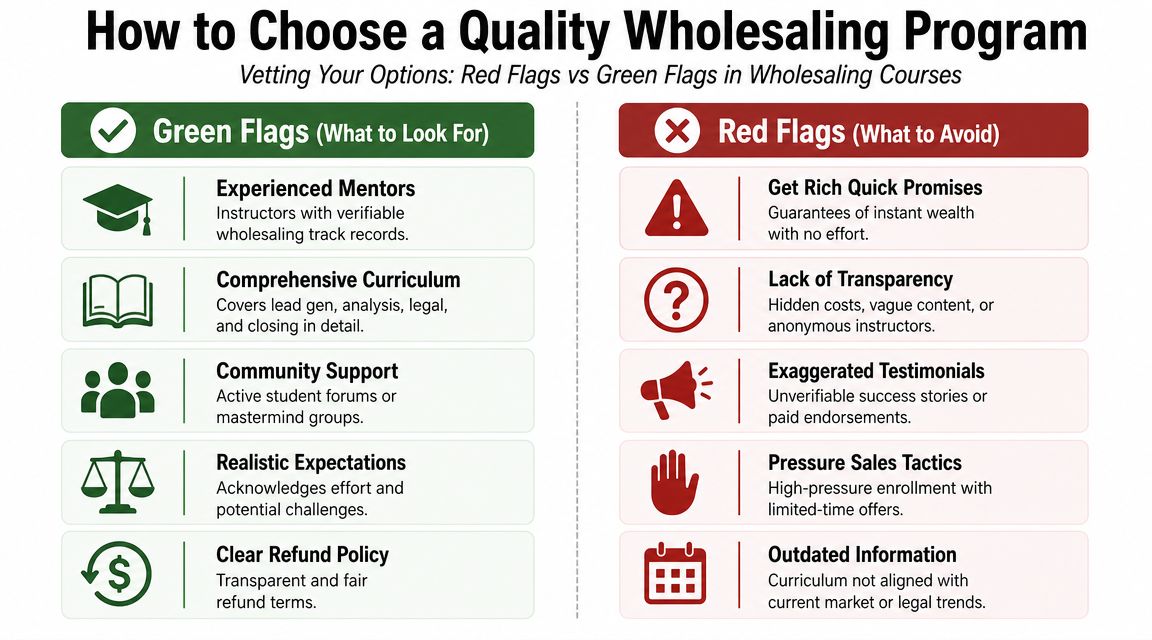
A weak course usually reveals itself before you buy.
The better programs don't feel flashy. They feel usable.
A green flag isn't that the instructor sounds confident. It's that the instructor sounds careful where care is required.
| Red Flag 🚩 (Proceed with Caution) | Green Flag ✅ (Sign of a Quality Program) |
|---|---|
| Claims wholesaling works the same way everywhere | Explains that assignment, advertising, licensing, and disclosure can vary by market |
| Focuses on motivation and mindset but barely covers numbers | Shows how to comp property, estimate repairs, and protect spread |
| Uses contracts as a selling prop | Teaches what contract clauses do and when legal review is needed |
| Pushes urgency to buy the course | Gives you enough detail to assess the curriculum calmly |
| Centers the brand of the instructor | Centers the decision process of the student |
Send these questions before buying. The response tells you a lot.
How do you teach local compliance issues?
If the answer is vague, assume the coverage is thin.
Do you teach students how to reject bad deals?
A real acquisitions process includes saying no.
What happens when the end buyer re-prices during due diligence?
That's where weak underwriting gets exposed.
Do students get examples of real deal analysis?
Not screenshots of wins. Actual analysis.
If you compare providers through the lens of educational delivery itself, this guide to the best online course platforms with certificate is useful for spotting whether a program is built like a serious training product or just a sales funnel with videos attached.
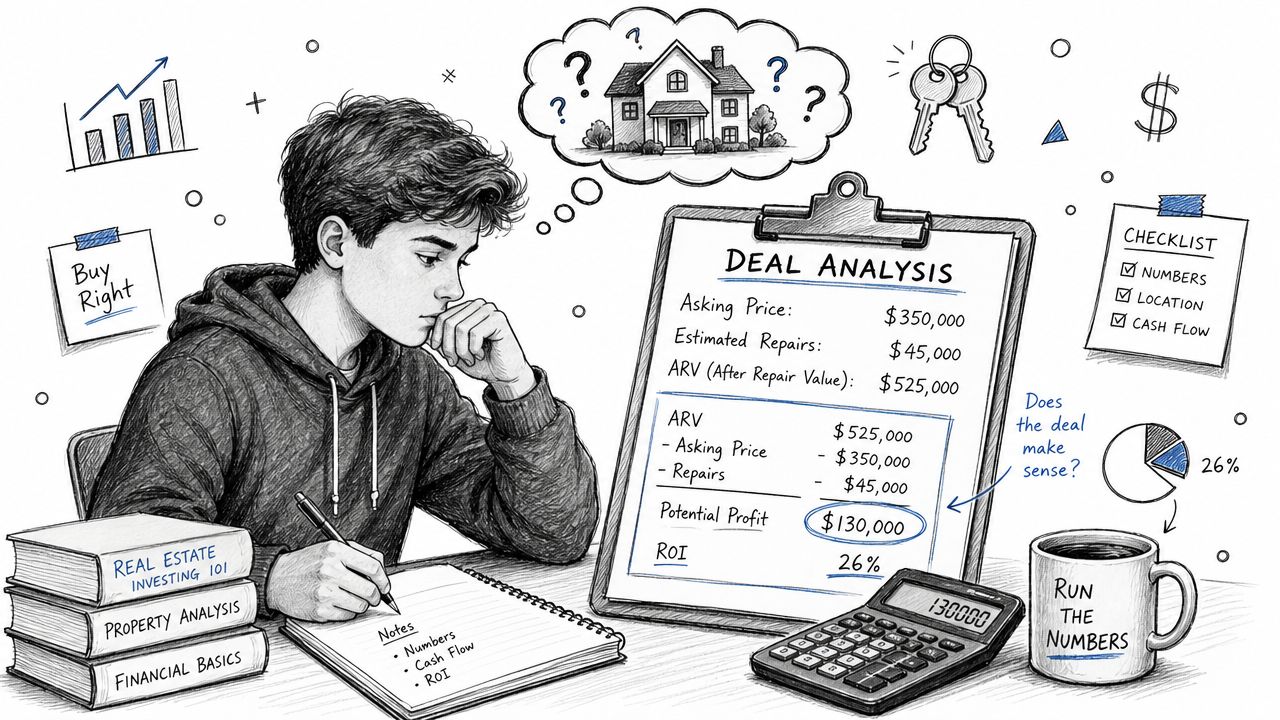
The best lesson inside a wholesaling real estate course is usually not motivation, list pulling, or scripting. It's underwriting. If the instructor can teach you how to analyze a property conservatively, you can survive a lot of other mistakes. If they can't, you'll end up contracting houses that no serious buyer wants.
A technically competent course should teach the offer model built around ARV minus estimated repairs, carrying costs, and the wholesaler's margin because those variables determine the maximum allowable offer (MAO). Better underwriting protects deal economics and reduces the chance that the buyer will blow up the assignment during due diligence, as described in PropertyScout360's guidance on wholesaling course fundamentals.
Say a seller has a dated house with deferred maintenance. You pull nearby renovated comparable sales to estimate the likely resale value after repairs. Then you inspect the property and build a repair assumption that includes the obvious items and a cushion for what you may have missed.
Now you start backing out what matters:
What's left is the range where an offer might make sense.
The point of MAO isn't to win every deal. The point is to avoid winning the wrong one.
A weak course says, “Use this formula.” A strong course says, “Here's how this formula breaks when your inputs are wrong.”
That means the lesson should force students to question:
This is also where data gathering matters. When students start sourcing pre-foreclosure or distress signals, they often need cleaner records and ownership context before making contact. Resources like BatchData's property data insights can help you understand how operators think about identifying and filtering distressed opportunities before they ever become offers.
By the end of a sample deal analysis, a student should be able to say one of three things with confidence:
That third answer is the one beginners need most. A course that teaches restraint is usually better than one that teaches enthusiasm.
If you're building your own training workflow or documenting acquisitions lessons for a team, this guide to training video creation is a useful reference for how complex topics like comping and MAO should be explained clearly.
Finishing a wholesaling real estate course doesn't mean you're ready because you watched the videos. It means you're ready to build a routine. The operators who stick with this business usually move fast on setup and stay disciplined on the boring parts.
Start with your operating foundation.
Then move into market-facing work.
Most beginners stall because they keep consuming content after they already know enough to start. That's a confidence problem disguised as preparation.
Use a simple operating rhythm:
You don't need a perfect launch. You need enough structure to keep taking the next action without guessing.
The course should have given you a map. The business starts when you test that map against real sellers, real properties, real buyers, and real local rules. That's where your judgment gets built.
If you run an investor group, professional association, or education-based community and want one place to host courses, events, memberships, and ongoing discussion, GroupOS is built for that kind of organization. It gives you a branded hub for content delivery, member engagement, registration management, and communication so your training operation doesn't live across scattered tools.