June 27, 2026
Is your current pricing model doing two jobs at once, or failing at both? Many associations set a ticket price to cover costs, then wonder why registration starts late, sponsor value feels thin, and non-members have no reason to join. Ticket pricing strategies work best when each price point has a clear purpose.
For professional associations and conference teams, pricing isn't just revenue math. It's positioning, segmentation, and behavior design. The right structure can reward early commitment, protect access, create premium upsell paths, and support membership growth without turning registration into a maze.
The mistake I see most often is treating ticket price as a single decision. In practice, it's a system. A member rate affects renewal conversations. A VIP pass changes sponsor expectations. A late registration premium can improve forecasting, but only if your audience accepts it as fair. Even strong events underperform when pricing and operational setup don't match.
The good news is that you don't need a complicated model to get better results. You need a deliberate one. Start with audience segments you already know exist: members and non-members, first-timers and loyal attendees, solo registrants and teams, budget-conscious buyers and buyers who want access, convenience, or status.
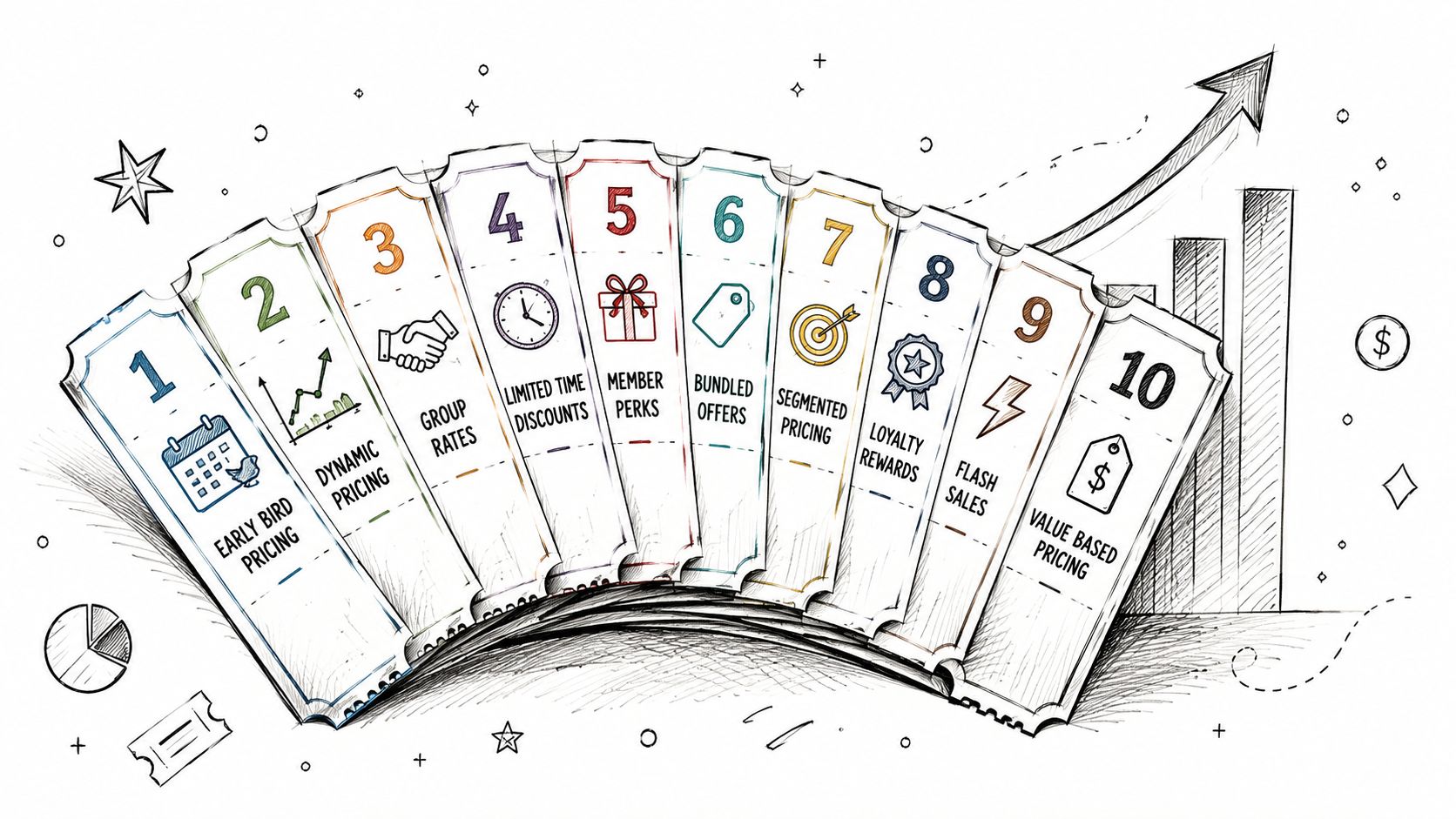
The ten approaches below are the ticket pricing strategies I'd consider first for membership-based organizations. Each one includes where it fits, how to execute it, and where planners usually get into trouble.
Dynamic pricing changes ticket prices in response to demand, timing, and inventory. In sports and live events, organizers use AI-driven systems to adjust pricing in real time based on factors such as event timing, competition, buyer behavior, and other demand signals, rather than holding prices static throughout the sales cycle. A practical summary of how that works appears in Eventori's discussion of dynamic pricing for sports and events.
That sounds attractive, but associations should use it carefully. Dynamic pricing works best when demand is active, inventory is meaningful, and your audience already expects prices to move. Major concerts and high-profile sports events fit that pattern. A recurring annual conference with a relationship-driven audience often doesn't.
A quick explainer helps:
Use dynamic pricing when you have a historically strong event, fast-moving registrations, or premium inventory that buyers compete for. It's especially useful for add-ons, limited workshops, and special access tiers where demand fluctuates visibly.
For membership organizations, I'd rarely put the entire event on a fully fluid price model. I'd reserve it for selected categories, then keep member pricing, student access, and sponsor allotments more stable.
Practical rule: If your audience expects fairness more than market-style price movement, use guarded automation rather than pure dynamic pricing.
The downside is audience trust. Research on dynamic ticket pricing highlights that outside high-demand sports settings, price volatility can feel unfair and can discourage attendance in some event contexts, especially where buyers don't want to monitor shifting prices as discussed in this academic analysis.
Tiered pricing is usually the most reliable starting point for associations. Instead of changing prices constantly, you establish planned stages such as early bird, standard, and late registration. Buyers understand it quickly, your team can market it easily, and finance gets cleaner forecasting.
This model also reflects how buyers behave in real life. Some need a reason to commit early. Others wait until internal approvals are done. Tiered pricing captures both groups without introducing the unpredictability of live market pricing.
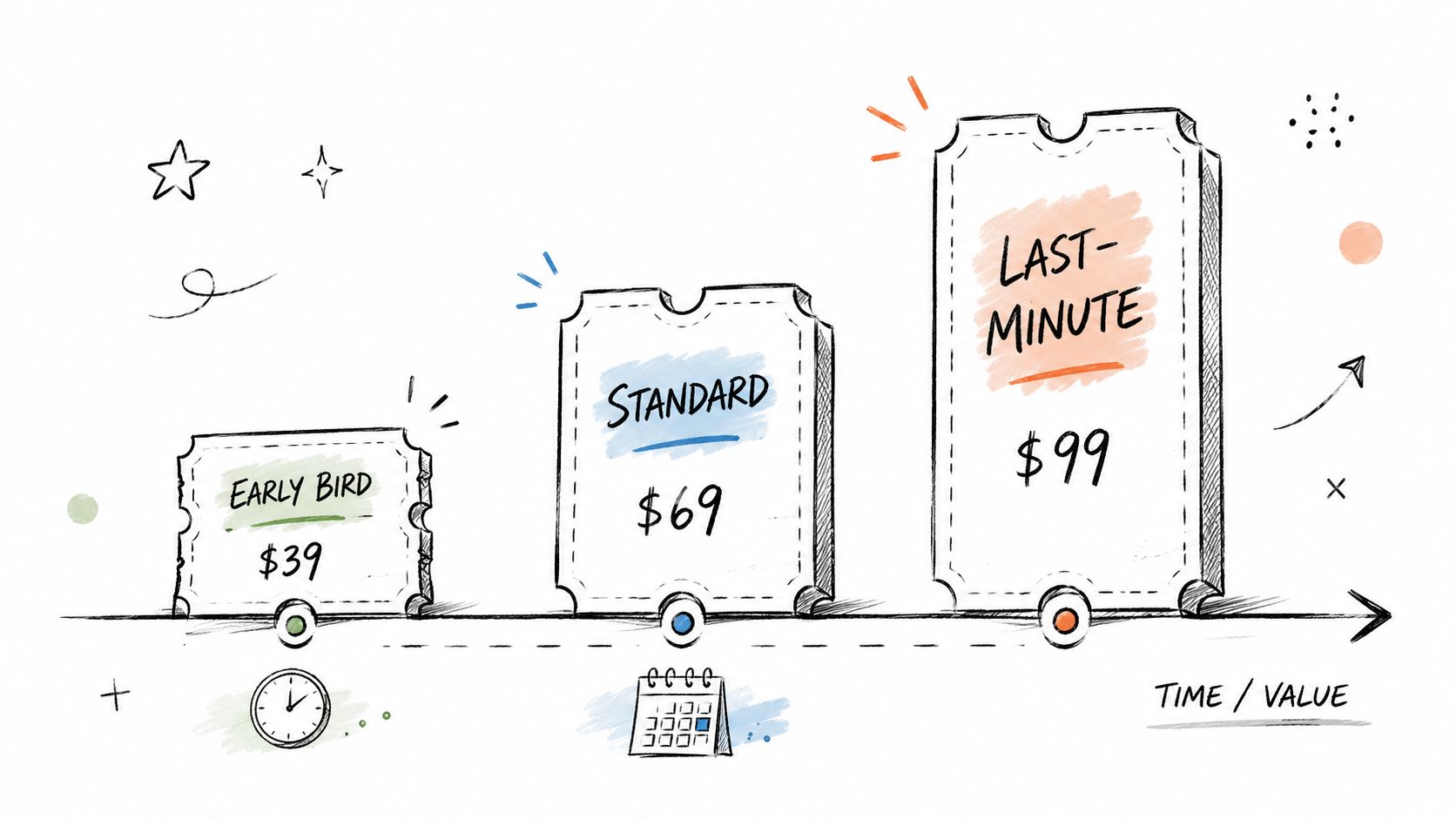
The long-run concert market offers a useful lesson. Over the period from 2000 to 2020, North American concerts shifted heavily toward tiered pricing, with more artists adopting it, stronger differentiation between ticket categories, and a much wider spread between the lowest and highest ticket options. The most affordable tickets stayed relatively stable while premium options rose sharply, showing how tiered structures can expand revenue without removing lower-cost access according to this analysis of concert pricing trends.
Associations can apply the same logic without copying concert economics directly. Keep your entry point accessible. Charge more for timing, access, convenience, or added value.
One common mistake is opening early bird too long and forgetting to promote the deadline. If the audience doesn't feel the transition, the tier exists in your backend but not in the buyer's mind.
Premium pricing works when the upgrade is tangible. If the “VIP” label only adds a ribbon on the badge, people notice. If it adds time-saving access, better seating, a private networking space, or curated introductions, buyers will evaluate it as a different product, not just a more expensive ticket.
That distinction matters. Premium tiers should serve attendees who value access, convenience, or status, while protecting the affordability of your standard pass. For associations, that often means executive roundtables, speaker meet-and-greets, hosted receptions, concierge support, premium seating, or members-only leadership sessions.

Most premium buyers aren't paying for abstract exclusivity. They're paying to remove friction or gain access they can't easily create on their own. At a conference, that can mean faster check-in, better sightlines, smaller rooms, quieter spaces, or higher-quality interactions with speakers and peers.
If you want to build this tier well, study how other organizers package upgrades, then map each perk to an operational owner. GroupOS users planning that structure can review how to level up ticketing with upgrades and experience design.
Better premium pricing starts with better product design. Don't ask attendees to pay more until you've made the upgrade obviously more useful.
This model is especially strong for destination events, where attendees may already be spending significantly on travel. In that context, premium transport or hospitality add-ons can support the package. For example, conference teams arranging executive arrivals might also think about attendee expectations around finding the best SeaTac car service.
For associations, this is one of the most important ticket pricing strategies because it links event revenue to membership value. A member rate isn't just a discount. It's a visible benefit that helps justify dues, encourages renewal, and gives non-members a reason to join before checkout.
Done well, this model creates a simple decision for the buyer. Register as a non-member, or join and access the lower rate plus year-round benefits. That's far more persuasive than promoting membership in a separate campaign weeks later.
Some organizations hide the member advantage on the pricing page and only mention it in small print. Others make membership verification so clunky that eligible members abandon the process or contact support. Both problems kill conversion.
The fix is operational, not theoretical. Your registration flow should recognize members automatically, present the correct rate without friction, and give non-members a clear “join now” path during checkout. If your system can't do that cleanly, the strategy loses much of its power. Teams comparing tools for that workflow can look at what matters in a membership platform built for associations and event-driven communities.
This strategy also gives you flexibility that pure discounting doesn't. You can keep a healthy public price while preserving goodwill among members who expect tangible value from the organization.
If your event serves employers, chapter leaders, university programs, or multi-office member firms, group pricing can outperform one-off discount codes. It raises order size, spreads attendance through internal advocates, and brings in people who wouldn't have registered alone.
This works especially well for conferences with practical training tracks, certification prep, or team-based learning goals. One registrant often becomes the organizer for several colleagues. If you make that person's job easier, group volume grows naturally.
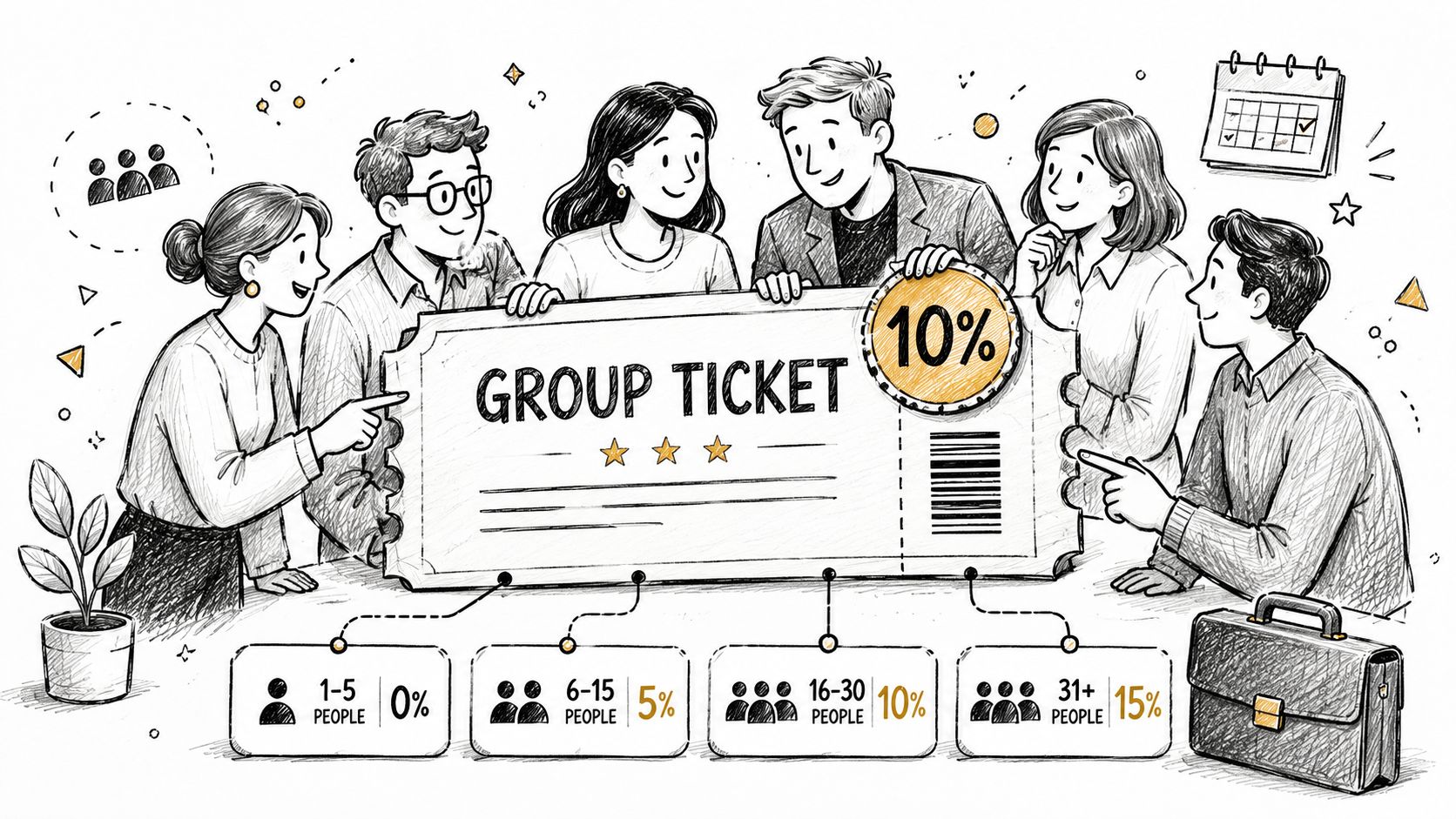
Group buyers care less about clever pricing and more about process. They need one invoice, easy name replacement, seat management, and confidence that the team will check in smoothly on site. If your backend makes substitutions painful, the discount won't save the sale.
A strong group offer usually includes reserved blocks, flexible attendee assignment, and a direct support contact for larger organizations. Corporate learning managers often decide based on administration effort as much as price.
Group pricing is an operations product. If the purchase is easy but roster management is hard, teams won't come back.
The biggest risk is underpricing large blocks without controlling terms. Define who qualifies, set purchase rules early, and decide in advance how refunds, substitutions, and no-shows will be handled.
Sponsor pricing should support sponsorship strategy, not sit beside it as an afterthought. Complimentary passes, discounted staff tickets, client invitations, and hosted access all shape how sponsors experience the event. If the package is vague, sponsors ask for exceptions. If it's clear, they activate faster and your team spends less time negotiating.
This is especially important for associations because sponsors often care about two things at once: visibility and access. Ticket allocations help deliver the access side. A sponsor that can bring sales staff, clients, or subject matter experts gains more value than one that only gets a logo on a slide.
Your prospectus should spell out exactly what each sponsor level receives. Don't leave room for assumptions about who counts as booth staff, who gets full conference access, or whether sponsor guests can attend receptions and education sessions.
If you're building or revising those bundles, it helps to start with a framework for creating a sponsorship package that matches benefits to partner goals.
This section also connects to accessibility models. In some cases, outside funding can support attendee access directly. For example, research on pay-what-you-will event pricing notes that organizations often need corporate or foundation sponsors to offset revenue gaps and sustain the model as explained in this discussion of accessible ticket pricing. Even if you're not using PWYW, the underlying lesson holds: sponsors can underwrite access when you design for it intentionally.
Regional pricing is often overlooked by associations with national or global audiences. Yet a single price can create uneven barriers, especially when your audience includes international chapters, emerging professionals in different markets, or hybrid attendees choosing between virtual and in-person participation.
This strategy works best when your mission supports broader access and your audience spans materially different local conditions. It can also help when travel burdens differ sharply by region. A local attendee buying an in-person pass isn't making the same decision as someone adding flights, visas, and hotel costs.
Global associations, credentialing bodies, and federated member networks are the clearest fit. You can also use regional pricing for chapter-led events where the central office wants one registration framework but needs local flexibility.
The key is consistency. You need a documented rationale for region-based variation, not ad hoc exceptions. Otherwise people assume favoritism.
One caution: this model adds administrative complexity fast. Currency display, tax handling, chapter relationships, and verification all need attention. Keep the logic simple enough that your team can explain it in support emails without escalation.
Late registration premiums can be effective, but only when they reflect real operational cost and planning pressure. Last-minute attendees create staffing, catering, badge production, seating, and reporting problems. Charging more close to the event date is often justified. What matters is whether attendees see the rule as understandable.
In many professional events, this is less about squeezing buyers and more about protecting forecast accuracy. Associations need cleaner counts for food and beverage guarantees, room layouts, volunteer staffing, and sponsor planning. A higher same-week or on-site rate reinforces that earlier commitment helps everyone.
The best version is straightforward. Publish the deadline, state that rates rise after that date, and remind people repeatedly. Don't surprise them with a higher price at checkout they hadn't seen before.
For teams selling online and on site, your registration system also needs to keep up. Mobile checkout, QR workflows, and on-site support matter much more when late buyers are part of the model. If you're refining that stack, this guide on how to sell event tickets online is a useful operational reference.
Avoid this strategy if your audience typically depends on slow internal approvals and resents penalties they can't control. In those cases, tiered pricing paired with invoice-based registration often works better.
This pricing model matters because it shapes your future membership base. Students, trainees, residents, junior staff, and early-career professionals often become long-term members, speakers, committee volunteers, and chapter leaders. If the event is financially out of reach too early, you lose more than a ticket sale.
For associations with educational missions, this isn't just a concession category. It's pipeline building. But the discount has to be matched with intentional event design, or students show up and feel peripheral.
Student pricing works best when the event includes programming and support that make attendance worthwhile. Career sessions, mentorship opportunities, networking introductions, and curated first-timer content all increase the value of the lower-priced pass.
Verification matters too. Eligibility should be clear, documentation should be simple, and customer support should know how to resolve edge cases quickly.
Lower pricing attracts students. Better event design makes them return as full-paying professionals later.
This model can create tension with other affordability structures. That's especially relevant if you're considering broad access alternatives like pay-what-you-will. As noted earlier, PWYW can remove traditional distinctions such as student and senior discounts, which changes how organizations support affordability and may require other funding support.
For most associations, I'd keep student and early-career pricing as a defined category rather than replacing it with open-ended pricing. It's easier to administer, easier to explain, and easier to align with member development goals.
Bundle pricing is one of the most underused strategies in association events. Instead of selling one registration at a time, you combine multiple touchpoints into a stronger offer. That might mean annual conference plus workshops, conference plus membership, or a season pass across several chapter events.
The advantage is strategic, not just transactional. Bundles increase share of wallet, improve retention, and give buyers a reason to commit to more than one interaction with your organization.
Associations have several natural bundle paths. An annual meeting can be bundled with pre-conference training, post-event recordings, chapter roundtables, or next-quarter virtual programs. Member onboarding can also be bundled with event access to create a clean first-year experience.
This approach aligns with where the market is going operationally. The market for dynamic ticket pricing solutions reached USD 1.57 billion in 2024 and is projected to grow by 2033, driven by AI-enabled forecasting, competitor monitoring, and increasingly autonomous pricing systems according to this market report on dynamic ticket pricing solutions. Even if you aren't adopting advanced automation immediately, the broader lesson is clear: platforms are getting better at managing more complex pricing combinations, including bundles, upgrades, and segmented offers.
Bundle pricing is especially useful when your event program extends beyond a single date. It lets you sell continuity, not just attendance.
| Pricing Strategy | Implementation Complexity 🔄 | Resource Requirements ⚡ | Expected Outcomes 📊 | Ideal Use Cases 💡 | Key Advantages ⭐ |
|---|---|---|---|---|---|
| Dynamic Pricing | High, real-time algorithms, forecasting and continuous tuning | High, data science, integrations, monitoring systems | Maximizes revenue and yield; may cause variable consumer sentiment | Large conferences, concerts, high-demand events | ⭐ High revenue capture; better inventory utilization |
| Tiered Pricing (Early/Standard/Last-Minute) | Moderate, fixed time windows and cutoffs | Low–Moderate, scheduling, marketing, simple automation | Predictable revenue segmentation and stronger early sales | Professional conferences, association events, multi-month sales cycles | ⭐ Simple to communicate; encourages early commitment |
| VIP and Premium Tier Pricing | Moderate–High, requires distinct experiences and operations | High, premium logistics, dedicated staff, exclusive amenities | Higher per-ticket revenue and perceived event quality | Executive conferences, luxury experiences, sponsor-facing events | ⭐ Significant ARPU increase; attracts high-value attendees |
| Member vs. Non‑Member Pricing | Moderate, member verification and rule management | Moderate, membership system integration and verification | Drives membership sign-ups and recurring revenue; may complicate pricing | Associations, membership-based organizations, communities | ⭐ Boosts retention and lifetime value; incentivizes subscriptions |
| Group and Bulk Discount Pricing | Low–Moderate, quantity rules and group management | Low–Moderate, group codes, coordinator support | Increases average order size and corporate attendance | Corporate training, team events, professional development | ⭐ Higher transaction value; simplifies group registration |
| Sponsor and Partner Pricing | Moderate, allocation rules and sponsor portals | Moderate–High, sponsor management tools and coordination | Enhances sponsorship value and attendance from partners | Trade shows, sponsored conferences, exhibitor-driven events | ⭐ Strengthens sponsor ROI; simplifies sponsor logistics |
| Geographic and Regional Pricing | High, multi-currency, geo-detection and localization | Moderate–High, currency handling, compliance, localization | Improves global accessibility and conversion across markets | Global/hybrid events, international associations | ⭐ Better market fit; increases international participation |
| Day‑of and Last‑Minute Pricing | Low, time-based surcharges and on-site setup | Low, reliable on-site processing and staff | Captures last-minute demand at premium prices; creates urgency | Festivals, single-day events, high-variability attendance | ⭐ Quick revenue uplift from committed late buyers |
| Student / Academic / Professional Dev Pricing | Moderate, credential verification systems needed | Low–Moderate, verification tools, program partnerships | Expands reach and builds future community; lowers per-ticket revenue | Academic conferences, professional development programs | ⭐ Increases diversity and long-term community growth |
| Package and Bundle Pricing | Moderate–High, inventory, access rules and tracking | Moderate, bundling logic, reporting and fulfillment | Higher lifetime value and multi-session engagement; complex tracking | Multi-day conferences, event series, season passes | ⭐ Simplifies purchase process; boosts cross-event attendance |
The most effective ticket pricing strategies aren't the most complicated ones. They're the ones your team can explain, your platform can support, and your audience can accept as fair. For associations, that usually means building around a small number of core goals: drive earlier registration, strengthen membership value, expand access where it matters, and create premium paths for buyers who want more.
A practical pricing blueprint starts with role clarity. Decide what your base pass is supposed to do. It may cover the core event experience and remain broadly accessible. Then decide what each additional pricing layer is responsible for. Tiered pricing rewards early commitment. Member pricing supports retention and acquisition. VIP pricing monetizes access and convenience. Group pricing helps companies and chapters bring more people. Bundles increase lifetime value across the calendar.
That sequence matters because many organizations launch ticket structures in reverse. They add discounts, promo codes, and exception requests before they've defined the core architecture. The result is a registration page full of options that buyers don't understand and staff can't manage cleanly. Simpler models usually perform better because they reduce hesitation and support cleaner communication.
Execution also depends on context. Dynamic pricing can be powerful in demand-heavy environments, but it can also create fairness concerns outside those settings. Sponsor-supported access can open doors, but only if those benefits are built intentionally into packages. Student pricing can grow your future member base, but only if the event experience helps those attendees participate meaningfully. Every strategy has a trade-off. Strong pricing teams acknowledge those trade-offs up front instead of pretending one model solves everything.
For most membership organizations, I'd recommend starting with a core stack: member versus non-member pricing, three-stage tiered pricing, one premium upsell, and one team or bundle option. That's enough to shape behavior without overwhelming the audience. Once that foundation works, add more sophistication only where the demand and operations justify it.
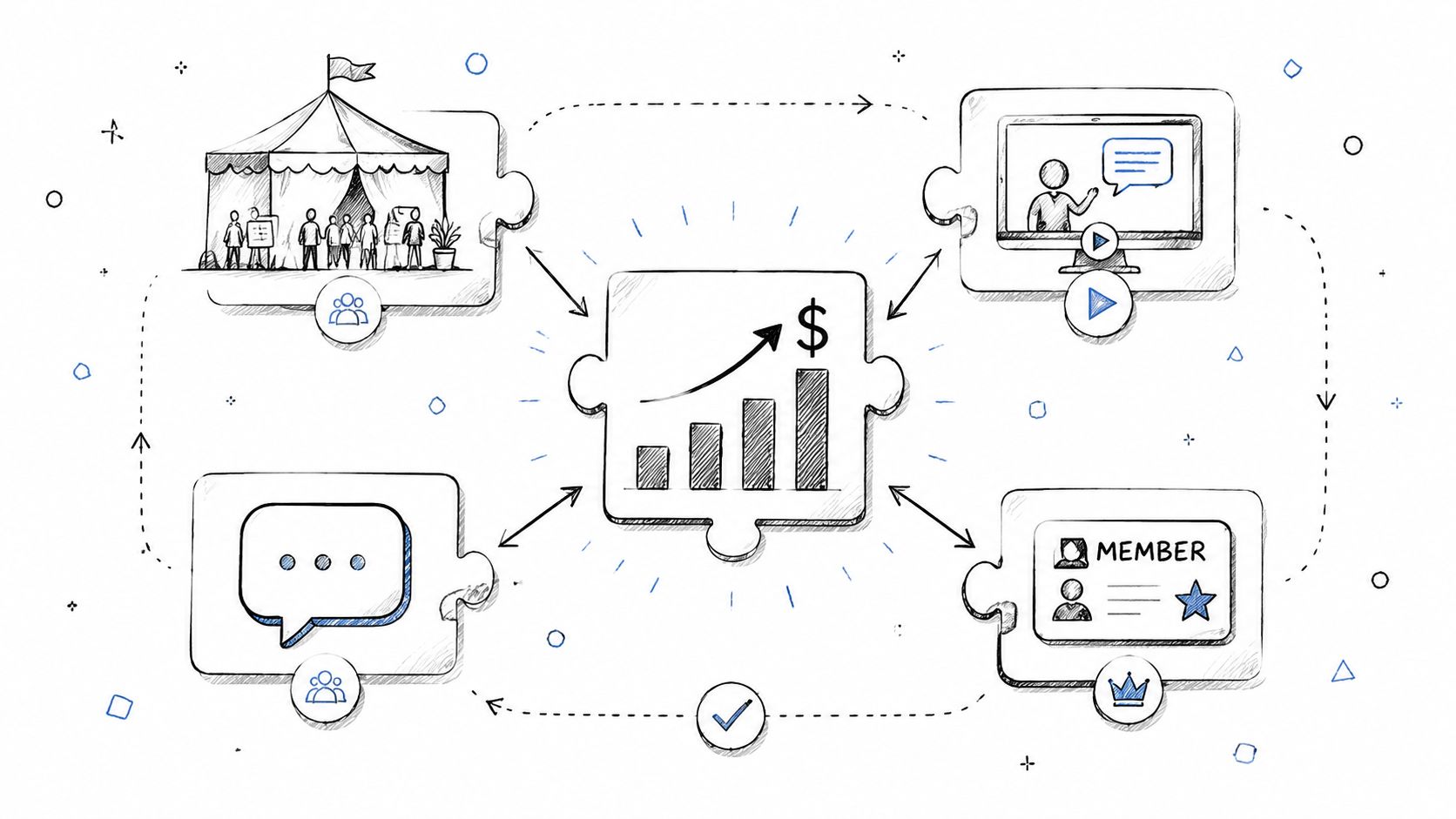
Platform capability matters here. If your system can't support segmented rates, clean upgrade paths, sponsor allocations, and flexible bundles, your strategy will stay theoretical. That's why organizations often need an event and membership platform that connects pricing logic to registration, communication, reporting, and post-event engagement in one workflow.
As you refine your next event, don't ask only, “What should the ticket cost?” Ask what each price is designed to accomplish. That shift changes everything. It turns pricing from a static number into a growth system. If you're evaluating the budget side of that system, it also helps to compare our pricing options alongside the operational requirements your team needs to support.
If you want to put these ticket pricing strategies into practice without stitching together separate tools for membership, registration, sponsor management, and communications, explore GroupOS. It gives professional associations and event teams one place to manage member pricing, VIP upgrades, bundles, sponsor access, custom forms, analytics, and branded community experiences.