January 29, 2026
Imagine buying a top-tier, unbranded suit off the rack and having your personal tailor fit it perfectly, adding your own custom monogram.That's the essence of a white label community platform. It’s a powerful, pre-built software that your organization can completely rebrand and present as your very own.
At its core, a white label community platform lets you launch a polished, professional digital home for your members without the astronomical cost and time commitment of building one from scratch. Instead of getting bogged down in a multi-year development project, you can get a feature-rich, fully branded environment up and running in a matter of weeks.
This strategy gives you the best of both worlds. You get the speed and proven reliability of an existing product, but with the look and feel of a custom-built solution that's 100% your brand. The immediate benefits are a professional appearance, a much faster path to launch, and access to sophisticated features that have already been tested and perfected in the real world.
When you decide to create a digital space for your members, you’re generally looking at three main options. Each has its own distinct pros and cons when it comes to control, cost, and overall complexity.
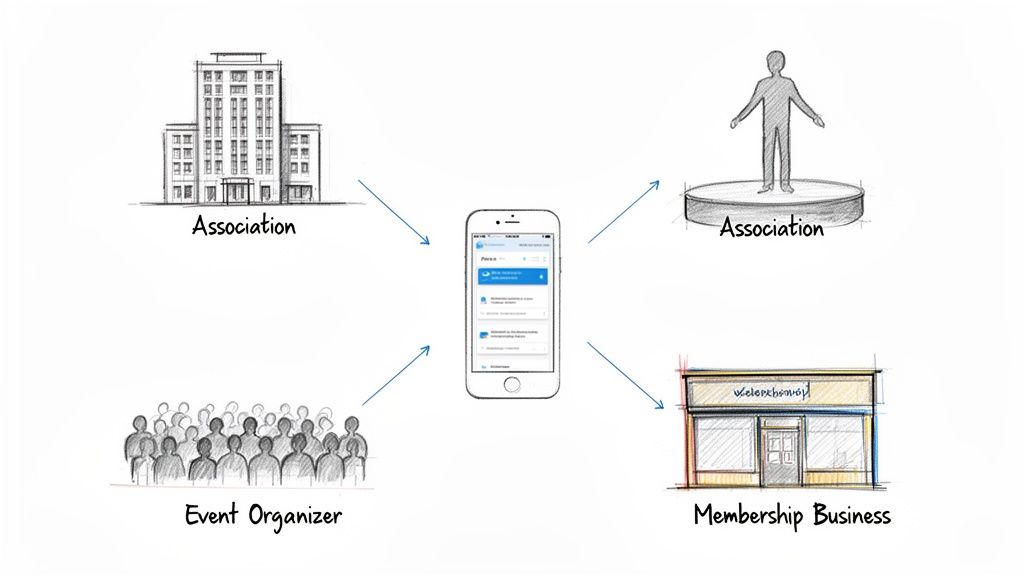
A white label platform lets professional associations, event organizers, and membership groups focus on what they actually do best—fostering connection and engagement—while leaving the complex technology to the experts.
To get a better sense of the business model, it's helpful to see how white labeling is used in other industries. The fundamental concept of putting your brand on a proven, third-party product is a powerful strategy used across the board.
The image below gives a great visual breakdown of how these three paths stack up against each other.
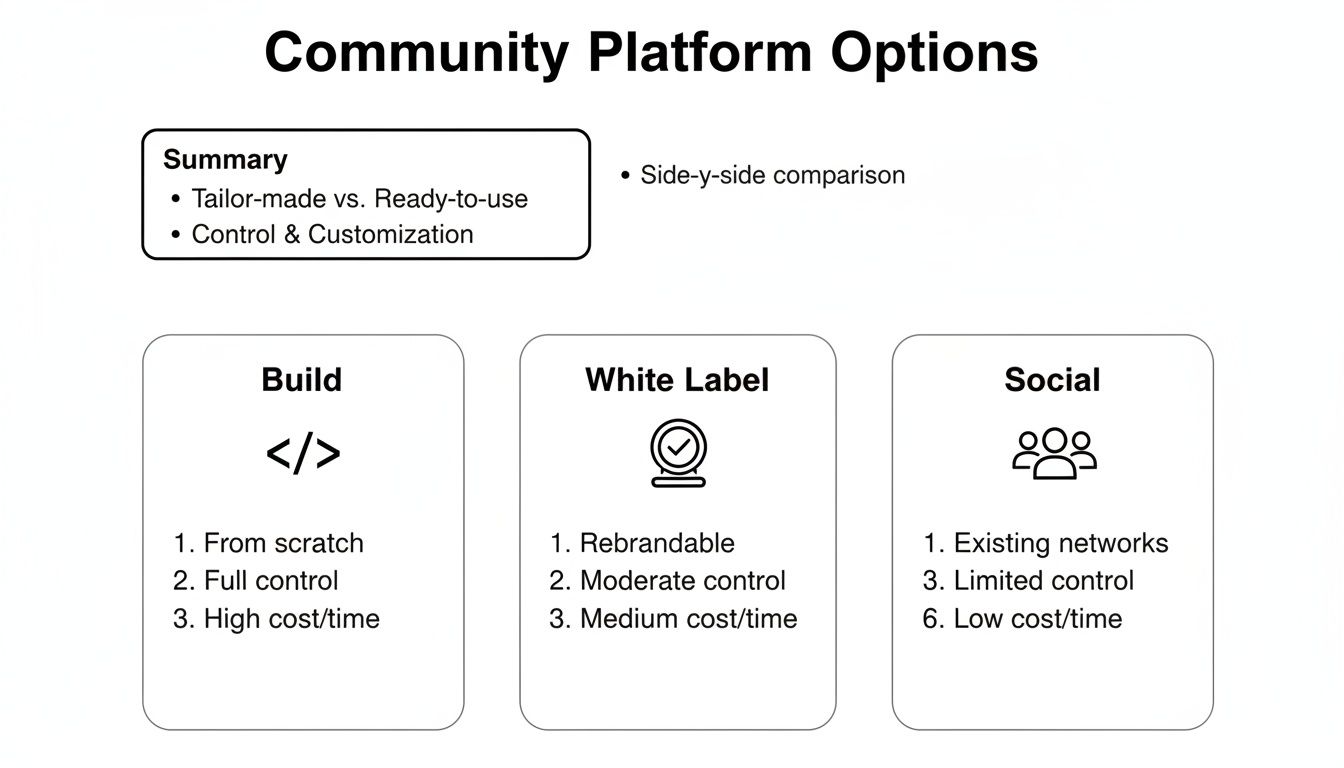
As you can see, the white label option hits that sweet spot of high brand control for a manageable, predictable investment. This model is quite similar to how a white label app can serve as a dedicated mobile experience for your brand, built on a proven framework.
To make the choice even clearer, here’s a quick comparison of the three options.
Ultimately, the decision comes down to your organization's specific goals, budget, and timeline. For most, a white label solution provides the most strategic and efficient path to launching a successful branded community.
When you choose a white-label solution, you're not just adding another piece of software to your tech stack. You're building a professional, dedicated ecosystem that puts your brand at the absolute center. It’s a strategic move to pull your community out of the distracting chaos of public social media and into a focused space that you own and control.
Think of it like this: you could rent a small booth at a massive, noisy street market, or you could open your very own flagship store. That flagship store reinforces your identity, builds serious trust, and provides a curated experience that turns casual shoppers into devoted fans. A branded community platform does exactly the same thing for your members.
One of the most immediate payoffs is a huge boost in brand authority and credibility. When members open a mobile app or log into a portal that features your logo, your colors, and your distinct voice, the experience feels cohesive and professional. This consistency inherently builds trust and solidifies your organization as the go-to hub in your industry.
This polished presentation naturally encourages deeper engagement. People are far more likely to participate, share ideas, and connect with each other when they feel they're in a secure, purpose-built environment. Unlike generic platforms where your group is just one among thousands, a white-label community platform makes your brand the main event.
A branded online community is one of the most effective ways to humanize and strengthen your brand. It allows you to share targeted information and create deeper connections with your customers, members, and prospects.
By creating a central place for everything—from event sign-ups and content libraries to private messaging—you remove friction and keep members locked into your world. This unified experience is something a patchwork of third-party tools can never match, and it leads to much higher member retention over the long haul.
Beyond just boosting engagement, a white-label platform gives you direct, powerful ways to generate revenue that you completely control. You're no longer playing by another company's rules or limited by their platform's features. You get to create and manage your own income streams.
This turns your community from a simple communication channel into a legitimate business asset. You can directly connect the value you provide to members with revenue generation in several smart ways:
Having these tools integrated means you can finally stop duct-taping different systems together for payments, events, and member management. Everything just works, which simplifies your operations and creates a much smoother experience for your members and your team.
This might be the most important benefit of all: you gain complete ownership and control over your member data. On public social networks, your analytics are superficial, and the platform ultimately owns the relationship with your users. They dictate the algorithm, the ad exposure, and the data itself.
With a white-label community platform, every single data point is yours. This control gives you priceless, first-party insights into what your members are actually doing. You can see which content is a hit, identify your super-users, and spot the topics that spark the best conversations. This insight empowers you to make smart, data-driven decisions that genuinely improve the member experience, prove ROI to your stakeholders, and strategically guide your organization's growth.
When you start looking at white label community platforms, the long list of features can feel like a tidal wave. It’s easy to get lost. The best way to cut through the noise is to start with your problems. What daily headaches are you trying to fix? What big opportunities are you trying to grab?
Think of it like outfitting a professional kitchen. You don't just go shopping for "a stove." You need a convection oven for consistent baking, a high-capacity walk-in fridge for fresh ingredients, and a smart layout that keeps everything moving smoothly during the dinner rush. Your platform's features should work the same way—directly supporting what you do every day, from keeping members engaged to bringing in revenue.
This practical mindset is what’s fueling a massive shift in the market. The global online community platform space is exploding, jumping from $408.587 million in 2021 to a projected $736.9 million by 2025. Organizations are tired of juggling a dozen different tools and are now demanding all-in-one solutions that just work.
Here’s a look at the core features that truly make a difference.
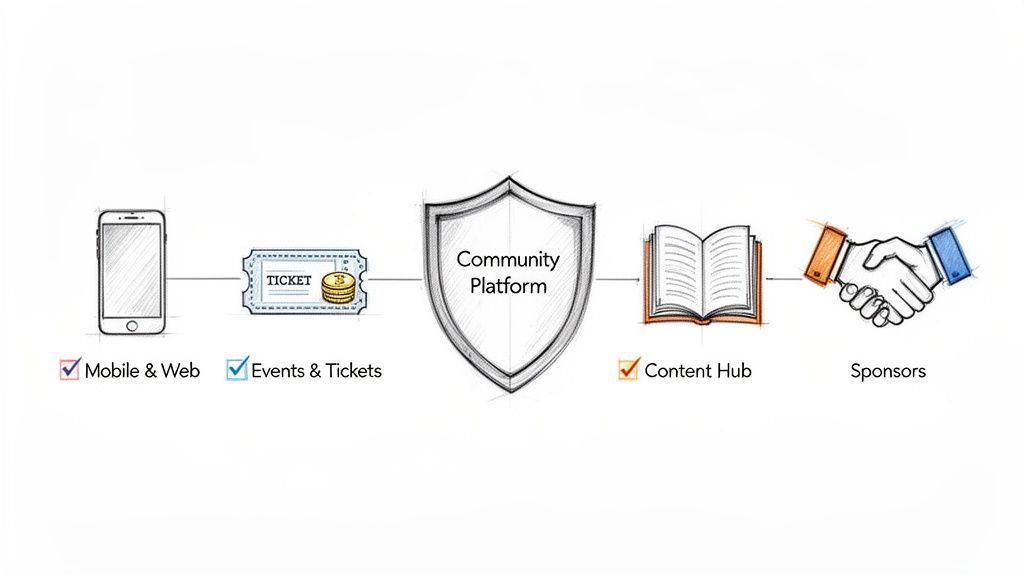
This is the bedrock of your entire community ecosystem. A custom app isn't just about slapping your logo on something; it's about carving out a dedicated, private space for your people that you own completely. It puts your brand right on your members' home screens, miles away from the chaos and algorithm games of social media.
Your members should be able to jump into the community without a second thought, whether they're at their desk or on their phone at a conference. This makes your community a single tap away, ensuring it becomes a natural part of their daily routine.
For so many organizations, events are where the magic happens. A top-tier platform has to come with powerful, built-in event management tools. This is a non-negotiable. It stops you from having to stitch together separate systems for registration, payments, and communication—a process that almost always leads to a clunky and frustrating experience for attendees.
You should be looking for a platform that lets you:
Bringing event management under one roof creates a single source of truth. It radically simplifies your team's workflow and massively improves the entire attendee journey from the moment they buy a ticket to the final session.
A great community platform should be an engine for your business, not just another line item on your expense report. The ability to create and manage different membership tiers is absolutely critical for turning your community into a reliable source of revenue.
You need the power to easily set up different membership levels, each with its own price point, renewal cycle, and set of permissions. This is how you automate recurring revenue, fight churn, and ultimately increase the lifetime value of every single member. It’s what transforms your community from a simple gathering place into a sustainable, scalable business asset.
People join a community to connect, but they stay for the value. Your platform needs a central library where you can organize all your amazing resources, whether that’s formal training courses, on-demand video sessions, official documents, or even content created by your members themselves.
When you bring all of your valuable content into one easy-to-find place, you cement your organization as an indispensable authority in your field. To learn more about this, check out our guide on essential tools for community engagement. This feature not only keeps members coming back for more but also gives them a concrete reason to renew their membership year after year.
Let's break down some of these core features and the direct value they bring to your organization.
Ultimately, a platform is only as good as the problems it solves. This checklist helps you connect the dots between a feature on a sales page and the real-world impact it will have on your community's success.
Last but certainly not least, your platform has to deliver real, measurable value to your partners. Too many generic community platforms treat sponsors like an afterthought. A truly great white label solution, on the other hand, gives sponsors and exhibitors the specific tools they need to achieve their number one goal: generating qualified leads.
Look for things like dedicated sponsor profiles, rotating banner ads, and virtual product showcases. These features give your partners a direct, high-impact channel to reach your members, making your sponsorship packages far more attractive and much easier to sell. It effectively turns your community into a valuable marketplace where real business gets done.
Picking a white-label community platform isn't just about buying a piece of software. It’s more like finding a business partner. While a long list of features looks great on paper, the relationship you have with the vendor is what will ultimately make or break your community's success. Let's get past the basic checklists and dig into the questions that really matter when you're evaluating your options.
The market for these platforms is exploding, and for good reason. It signals a huge shift in how organizations build their own digital spaces. In fact, the market is on track to hit $99.19 billion by 2026. This isn't just a trend; it shows that organizations are choosing to build on proven, brandable technology that helps them keep clients and members longer.
It's one thing for a platform to run smoothly with a hundred members. But what happens when you have 10,000 people logging in during a major virtual event? Your community is going to grow, and your platform needs to be ready for it without slowing to a crawl.
This is a critical conversation to have with any potential vendor. Ask them directly about their infrastructure and how they handle big traffic spikes. Better yet, ask for proof. Can they show you case studies from other large-scale communities they support? This isn't just a technical detail—it’s a direct look at whether the platform can support your long-term vision or if it will become a frustrating bottleneck.
Your community platform can't live on an island. It has to talk to all the other tools you already use, like your CRM, email marketing system, and payment processors. If it doesn't, you’re setting your team up for a nightmare of manual data entry and disconnected information.
A platform with weak integration options creates more work, not less. When you're in the demo phase, ask vendors to show you exactly how their platform connects with the tools you can't live without. A good way to frame this is by looking at how other complex systems are evaluated, much like in an event management software comparison where connectivity is key.
Here’s what to look for:
The best technology in the world is useless if you don't have good people behind it. The quality of a vendor’s support team and how they handle onboarding says everything about their commitment to you. A great onboarding process ensures your team feels confident from day one.
The best technology is useless without great people to support it. The level of partnership you receive during setup and beyond is one of the most critical factors in achieving a positive ROI.
Don't be shy about asking the tough questions. What are their standard response times for support tickets? Do they provide training resources? Will you have a dedicated success manager to help you think strategically? A true partner does more than just fix bugs; they invest in your growth by sharing best practices to help you succeed. You can get a feel for what this looks like by exploring some of the best online community platforms and what makes them stand out.
Finally, a white label community platform has to be truly yours. This is about more than just slapping your logo on a pre-made template. The platform needs to be flexible enough to bend to your organization's unique way of doing things.
Look for deep customization that gives you real control. Can you build custom pages with a drag-and-drop editor? Can you create unique registration forms or content modules? The less you have to rely on code to make the platform fit your needs, the more agile you can be. The goal is a partner who gives you a powerful, solid foundation that you can shape into a one-of-a-kind home for your community.
Theory is great, but let's talk about what really matters: results. It’s one thing to read a list of features, but it’s another thing entirely to see how these platforms solve real-world problems for organizations just like yours.
Let's look at a couple of classic scenarios where a white-label community platform can completely change the game.
Picture a national trade association struggling to keep its members engaged. Their online presence was a mess—a patchwork of disconnected systems that felt cobbled together. They had a clunky website for news, a separate portal for continuing education courses, and what felt like a million different email threads to manage their annual conference.
Engagement was in the gutter. Why? Because there was no central place for members to gather. If someone wanted to find a colleague, they had to sift through a static PDF directory. Registering for an event meant being punted to a generic third-party site. It was frustrating and felt anything but premium.
Then, they brought in a white-label community platform and unified everything under their own brand.
The impact was immediate. Member satisfaction shot up, and retention improved significantly. The association finally had a modern, professional home that delivered real value, turning the annual membership renewal from a question into a no-brainer.
Now, think about an event organizer planning a huge industry conference with multiple tracks. In the past, this was a logistical headache. They were juggling one tool for ticket sales, another for email blasts, a separate app for the schedule, and a clunky lead-capture system for exhibitors that nobody liked using.
This disjointed mess created a confusing experience for attendees and offered almost zero measurable value to sponsors. The data was trapped in different silos, making it impossible to understand attendee behavior or prove ROI to their partners.
Switching to a white-label community platform transformed the entire event lifecycle from start to finish.
A unified platform turns a one-off event into a year-round community. It provides a persistent space for attendees, speakers, and sponsors to connect before, during, and long after the event concludes.
The new platform became the command center for the entire conference.
This wasn't just about making operations smoother. It created a far more engaging and valuable experience for everyone involved, cementing the conference's reputation as the must-attend event in their industry.
Getting your new community platform live is a fantastic achievement, but let's be honest—it's just the starting line. Now comes the real work: proving its worth. The only way to do that is by digging into the data to measure success and calculate your return on investment (ROI). This is how you shift the perception of your community from a "cost center" to what it truly is: a powerful engine for growing your organization.
To pull this off, you need to be tracking the right key performance indicators (KPIs). It's easy to get sidetracked by vanity metrics, so focus on the numbers that tie directly back to your core business goals. The good news is that most modern platforms come with built-in analytics dashboards that make this much easier.
Engagement is the pulse of your community. It tells you how active, involved, and genuinely interested your members are. When engagement is consistently high, it’s a clear sign that your community is healthy and that your members are finding value.
Here's what to keep an eye on:
Bringing new members in the door is great, but keeping the ones you have is far more efficient and profitable. These metrics show you how well you’re delivering on the promise of your brand and keeping people happy for the long haul. If you're looking for a deeper dive, you can learn more about key community engagement metrics that are critical to get right.
A thriving community doesn't just attract users; it keeps them. Strong retention metrics are direct proof that your platform is delivering consistent, indispensable value to your members.
These are the retention KPIs that really matter:
Finally, you have to draw a straight line from community activity to your bottom line. This is how you demonstrate tangible ROI to your leadership and make the case for continued investment in your community strategy.
Look for these clear financial indicators:
Even after seeing all the benefits, it's completely normal to have a few lingering questions. I get it. Moving to a new platform is a big decision, and you need to be sure about every detail. This section is here to tackle the most common questions we hear from organizations just like yours when they're thinking about a white label community platform.
Let’s get straight to the point and cover the practical realities of getting started, making the platform your own, and bringing your existing data along for the ride. These are the details that ultimately tell you if a platform is the right strategic move for the long haul.
This is where white label solutions really shine: speed. If you were to build a custom community platform from scratch, you’d be looking at a timeline of many months, sometimes even years. A good white label partner can get you live in just a few weeks.
The whole process is designed to be incredibly efficient. The goal is to get your community up and running without a lot of fuss or downtime.
A typical launch plan breaks down into a few clear stages:
This structured approach makes for a smooth, predictable launch. You can start bringing real value to your members much faster than you ever could with a custom build.
Modern platforms offer way more flexibility than you might think. We're long past the days of just slapping your logo on a template and calling it a day. Today's platforms allow for deep customization, letting you create a digital home for your members that is truly unique.
True white labeling isn't just about surface-level branding. It’s about having the power to shape the user experience, control workflows, and build a digital environment that perfectly reflects your organization's identity and how you operate.
Look for a platform that gives you tools like drag-and-drop page builders, the ability to create custom event registration forms, and flexible content tagging. Features like these put you in the driver's seat, letting you build a bespoke community hub without needing an army of developers. The platform should adapt to you, not the other way around.
Yes, absolutely. Any reputable white label provider will tell you that a seamless migration is a non-negotiable part of the deal. They know that your member data, existing content, and all those past conversations are priceless assets. You can't afford to lose them.
A solid partner will give you both the tools and the hands-on help needed to bring everything over. This includes member profiles, subscription details, and all your historical content. The whole point is to make the transition so smooth that when your members log in for the first time, it feels like they never left—all their information is right there waiting for them.
Ready to build a powerful, branded community that you completely own and control? GroupOS provides an all-in-one platform to manage your members, events, content, and sponsors in a single, elegant solution. Schedule a demo today and see how GroupOS can transform your organization.