January 27, 2026

Thinking about starting a subscription service for your association? The idea is pretty simple: you're shifting from one-off transactions to building long-term relationships by giving people continuous value they're happy to pay for. It’s all about defining what makes your membership a must-have, setting up your pricing, getting the right tech in place, and then, of course, figuring out how to bring in new members and keep them around.
This whole approach is about creating a resilient, year-round community, not just banking on a few big events to carry you through.
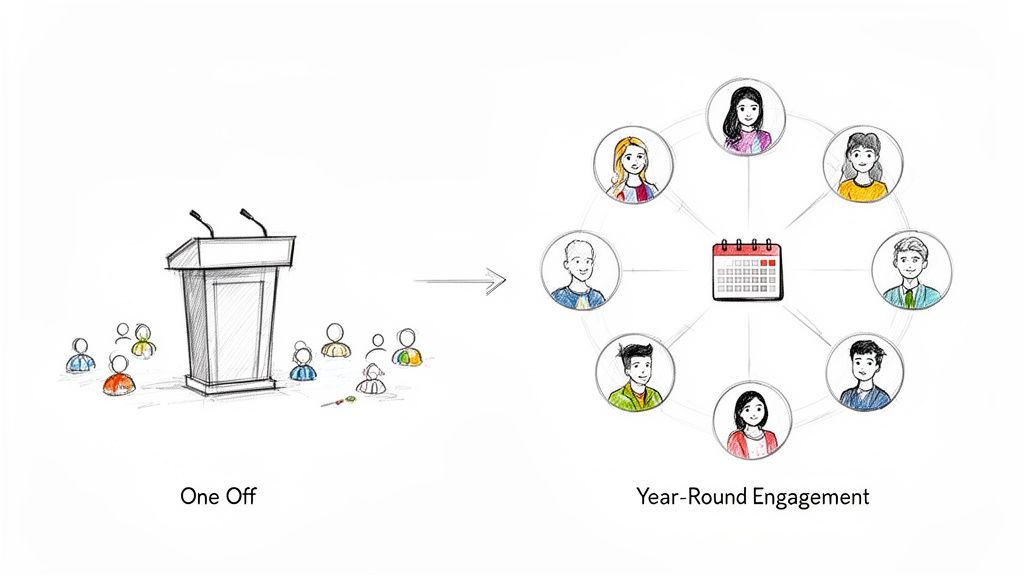
For decades, the business model for many professional associations was transactional. The big annual conference or a flagship training event was often the main revenue driver and the primary touchpoint for members. It worked, but this model leaves a ton of value—and potential revenue—on the table for the other 11 months of the year.
The move toward a subscription or membership model is a direct answer to that gap. It's about swapping a single, intense burst of engagement for a steady, year-round conversation. This isn't just some passing trend; it's a fundamental pivot in how associations are building loyalty and securing their financial footing.
Picture a typical conference-goer. They show up, soak up some great insights, do some networking, and then head back to their day job. After that? Radio silence, for the most part, until the marketing emails for next year's event start rolling in. A subscription service completely flips that dynamic.
Instead of a one-time ticket purchase, members pay for ongoing access to an entire ecosystem of resources, community, and connections. This creates a much deeper, stickier relationship. And the market reflects this shift—the global subscription economy hit $492.34 billion in 2024 and is on track to triple to over $1.5 trillion by 2033. That’s because subscription businesses have grown an incredible 435% in the last decade, showing a clear preference for continuous access over one-off purchases.
The real power of a subscription service is turning those passive event attendees into active, year-round community members. Your organization stops being an annual destination and becomes a daily professional resource.
Switching to a subscription model isn't just about changing how you collect money; it's a strategic move that can secure your organization's future and seriously deepen its impact.
Here are the big wins:
Honestly, launching a sophisticated subscription service is more doable than ever before, especially with platforms like GroupOS that bring all the necessary tools together. Once you really grasp the principles behind recurring revenue business models, you can set your association up for genuine, long-term success.

Before you even think about tech stacks or payment gateways, you have to nail your Unique Value Proposition (UVP). This is the bedrock of your entire subscription service. It's the core promise you make to a potential member—the one, clear reason they should hand over their credit card details every month or year.
If you don't get this right, even the slickest marketing campaign will fall flat.
Your UVP has to answer a simple question from your audience's perspective: "What's in it for me?" And "access to content" is not a good enough answer. Your value prop needs to solve a real, nagging problem or fill a professional gap they can't easily fix on their own.
The good news? The subscription market is booming, but it's also incredibly fragmented, which is a massive opportunity for associations. The market is set to grow by USD 388.9 billion between 2024 and 2029. This means there's plenty of room for niche services that truly get their audience. For a deeper dive into these numbers, check out this detailed market analysis on subscription services.
Guessing what members want is the fastest way to build something nobody will pay for. To craft a value proposition that actually hits the mark, you have to stop assuming and start listening. It’s all about doing the groundwork to understand the real-world challenges your members face every day.
The best place to start is with the people you already know. Your current members, email subscribers, and past event attendees are sitting on a goldmine of insights.
The goal isn't just to find out what members like. You need to find out what they would feel a professional loss without. That's the sweet spot for a paid subscription.
Once you have that research in hand, it's time to translate those needs into tangible, exclusive benefits. These will be the pillars of your subscription service. Forget generic perks and focus on creating value that is either difficult or downright impossible to find for free.
Here are some powerful benefit categories we've seen work time and time again for professional associations:
By weaving these elements together, you can build a story that makes joining feel like an obvious career move. Your value proposition shifts from a boring list of features to a clear path toward professional growth and success. This is absolutely foundational when learning how to start a subscription service that lasts.
Figuring out what to charge can feel like guessing in the dark, but it doesn't have to. Your pricing structure is much more than just a number—it’s how you communicate the real-world value of your membership. Get it right, and you create a clear path for members to get more involved over time.
This is where you stop talking about your value proposition and start putting a concrete offer on the table. The sweet spot is a model that’s not only profitable for you but feels like an absolute no-brainer for your members. It's less about a single "perfect" price and more about building a smart framework that can evolve with your community.
For most professional associations and membership groups, a tiered model is the way to go. It’s a classic for a reason. This approach lets you serve different segments of your audience with specific benefits at price points that make sense for them.
You can make your membership accessible to everyone, from a student just starting out to a C-suite executive at a major corporation. A well-designed tiered structure also has a built-in upgrade path. As a member’s career takes off or their needs change, moving up to the next tier feels like the next logical step.
A common setup looks something like this:
The key is to make each tier a stepping stone. The benefits of the next level up should be so compelling that a member starts thinking, "For just a little more, I could get access to that."
To help you find the best fit, let's break down the most common pricing models you'll encounter.
A comparison of common pricing models for membership organizations to help you select the best fit for your value proposition and audience.
Ultimately, the model you choose needs to align perfectly with what you offer and who you serve. For most, the flexibility of a tiered structure is unbeatable.
How you frame your pricing is just as important as the numbers themselves. A few small tweaks in presentation can completely change how a potential member sees the value you're offering. One of the most powerful tools in your playbook is the annual discount.
Offering a discount for an annual subscription—think "Pay for 10 months, get 12"—is a classic win-win.
The data backs this up. Research shows that annual plans have far higher retention rates—44.1% compared to just 17.0% for monthly plans. That’s a massive difference.
Don’t forget to anchor your pricing by highlighting a "recommended" or "most popular" tier. This simple psychological nudge guides new members toward the option that offers the best balance of features and cost, which is usually your core "Professional" tier.
If you want to go deeper, you can find a ton of advanced ideas in our complete guide to subscription pricing strategies. Nailing your pricing is a critical step in building a subscription service that will be profitable for years to come.
With your pricing and value proposition locked in, it's time to tackle the tech. This is where the rubber meets the road. The right technology should feel completely invisible to your members, creating a smooth, professional experience from the moment they sign up. The wrong tech? It becomes a constant source of headaches for everyone—your team and your members.
This isn’t about chasing the shiniest new software. It’s about building a reliable, integrated system that handles the grunt work so you can focus on what you do best: delivering incredible value to your community.
Every subscription service, especially for professional associations, needs a few key pieces of technology to function. You can try to stitch these together yourself or find a platform that does it all under one roof.
Here’s what you absolutely can't do without:
The danger of piecing these together from different vendors is creating "software spaghetti"—a tangled mess of disconnected tools. This inevitably leads to clunky member experiences, endless manual data entry, and a mountain of administrative work for your team.
This is where an integrated, all-in-one platform really shines. It solves the software spaghetti problem by bringing all those core functions into one unified system. For anyone just learning how to start a subscription service, this approach radically simplifies your operations from day one.
Instead of fighting with integrations and juggling multiple logins, your team manages everything from a single dashboard. This doesn't just save a ton of time; it gives you a much clearer, holistic view of your members' engagement and overall health. For your members, a system like GroupOS gives them one central place to log in and access everything they’re paying for. Simple.
Here’s a great visual of how you can structure different membership tiers within a single platform.
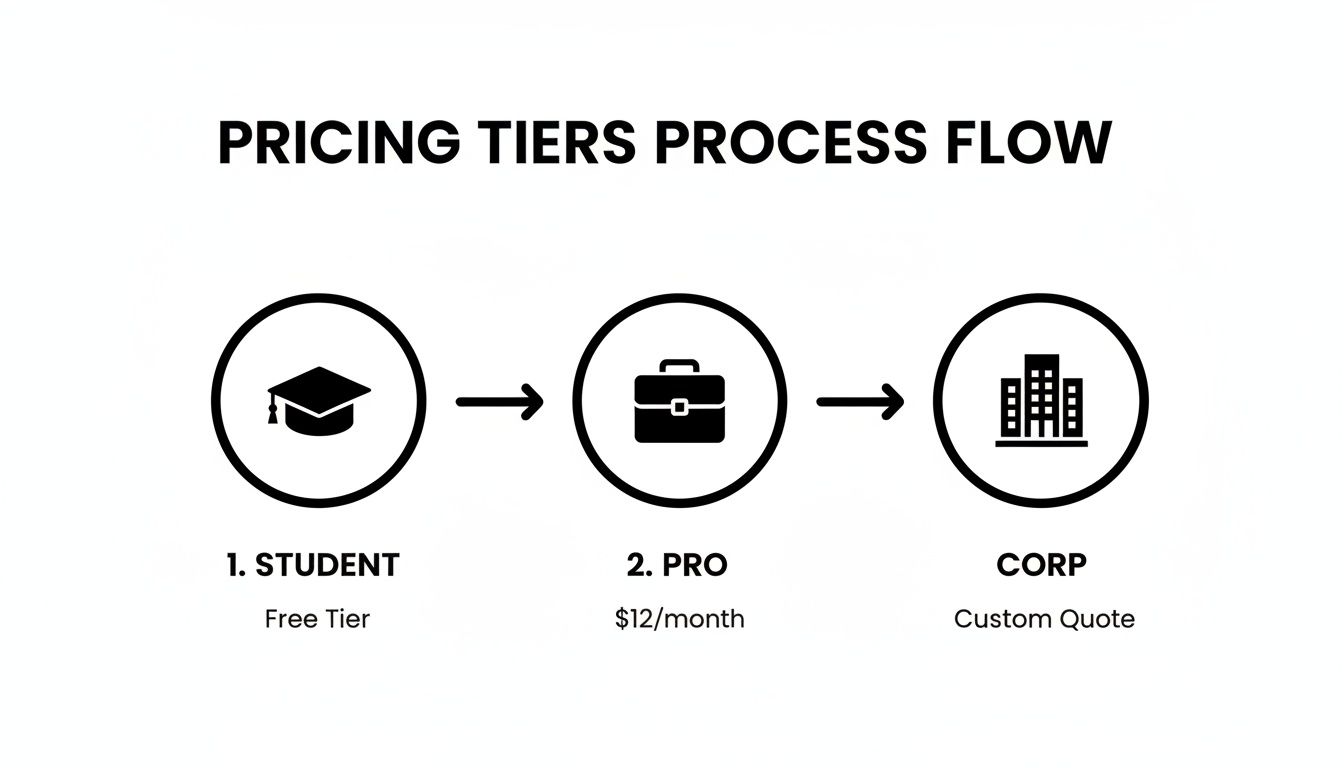
This kind of flow chart makes it crystal clear how a member can progress through your offerings, creating an obvious growth path within your organization.
When you're shopping for technology, it's easy to get distracted by fancy features you'll never use. Cut through the noise and focus on what will actually make a difference in your day-to-day and for your members. If you want to go deeper, our guide to the best membership management software breaks it all down.
At a minimum, your checklist must include:
Your technology isn't just a backend tool; it's a direct reflection of your brand's professionalism and commitment to member experience. A seamless system tells members you have your act together.
Finally, your technology has to support your real-world processes. A great platform can automate a lot, but you still need to design the human side of the experience.
Walk through the entire member journey, from their perspective, and map out the critical touchpoints.
By being deliberate about your tech choices and thoughtful in designing your workflows, you're building a foundation that can actually support your growth. This operational backbone is what allows you to scale smoothly without ever sacrificing the quality of your member experience.
You've done the hard work—you’ve defined your value, nailed down your pricing, and put the tech in place. Now for the fun part: opening the doors and welcoming your very first members. A successful launch isn't just flipping a switch; it's a carefully orchestrated campaign built to generate buzz, create real momentum, and drive a powerful wave of initial sign-ups.
This is definitely not a "build it and they will come" scenario. Your launch plan is the roadmap that turns curiosity into commitment. It requires a smart mix of pre-launch hype, an irresistible launch-day offer, and a solid strategy for attracting new members long after the initial confetti settles.
The groundwork for a stellar launch begins weeks, or even months, before you officially go live. The entire goal of this pre-launch phase is to cultivate an audience of warm, interested prospects who are practically waiting with their credit cards out. It’s all about capturing that early interest and making potential members feel like they're part of an exclusive inner circle.
First thing's first: get a simple "coming soon" landing page up. This page needs to clearly and concisely state your value proposition. Most importantly, it must feature a can't-miss sign-up form for a waitlist. That waitlist will become your single most valuable pre-launch asset—it's your direct line to the people who are most excited about what you're building.
Once you start collecting emails, you need to nurture that list. Don't just let it sit there.
This kind of consistent communication keeps your upcoming launch top-of-mind. It transforms passive observers into engaged followers who are genuinely counting down the days until they can join.
When the big day finally arrives, your job is to make an offer that feels impossible to refuse. The audience you’ve been warming up needs to feel a jolt of urgency and exclusivity. This is your chance to convert all that anticipation into actual paying members.
One of the most effective tactics I've seen is offering a special "founding member" deal. This isn't just a simple discount; it's a badge of honor. You can structure this in a few different ways:
A time-sensitive offer also works wonders. An "early-bird" price that's only good for the first week creates a clear deadline, forcing people who are on the fence to make a choice. The key is to make the offer feel both incredibly valuable and genuinely scarce.
Your launch day offer should do more than just attract members; it should make them feel like they are part of the very beginning of something special. This creates a powerful sense of ownership and loyalty from day one.
A huge launch is fantastic, but sustainable, long-term growth is what truly builds a thriving membership. To keep the momentum going, mastering how to generate leads is non-negotiable. For professional associations and similar organizations, a few acquisition channels consistently deliver the best results.
Your single most powerful tool is your existing database. These are people who already know you, trust your brand, and value your work. A targeted email campaign to your current and past members, event attendees, and newsletter subscribers should be at the top of your list. For best results, segment this list and tailor your messaging to their specific interests and history with your organization.
And please, don't overlook the power of your flagship events. Your annual conference is a goldmine for recruitment. Set up a dedicated booth, host an exclusive info session for prospective members, and find ways to weave the benefits of the new subscription into your main stage presentations. Throwing in a special "conference-only" sign-up bonus can drive a massive number of new members in a very short amount of time.
Getting a new member to sign up is only half the battle. The real work—the stuff that builds a sustainable organization—is convincing them to stay. A solid retention strategy is the engine that drives your subscription service, turning that initial curiosity into genuine, long-term loyalty.
Once you’ve acquired a new member, the clock starts ticking. You have to figure out how to increase user retention and keep them genuinely engaged. That first month is a make-or-break period where they're actively deciding if they made the right call.
The stats don't lie. Nearly 30% of annual subscriptions get canceled within the first month. The good news? Yearly plans are much stickier, boasting a 44.1% retention rate that trounces the 17.0% for monthly plans. For professional networks, where annual renewals can top 85% in high-value categories like business tools, that initial engagement is everything. It's your best defense against those early drop-offs.
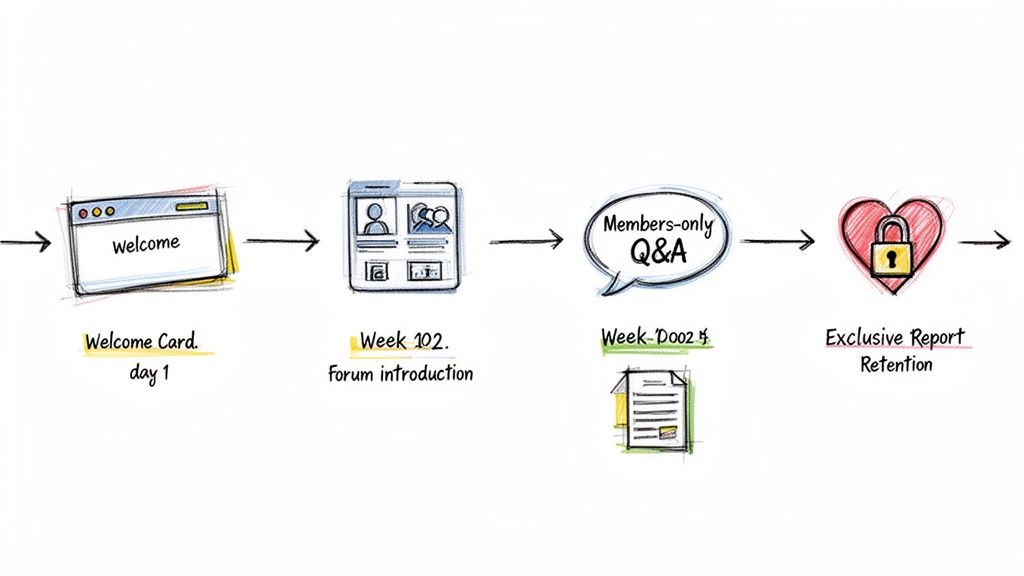
Those first 30 days are your golden opportunity to prove your value and get members hooked. A well-planned onboarding sequence isn't about spamming their inbox; it’s about guiding them to their "aha!" moment—that instant they truly get the value of their membership.
Your goal is to become an indispensable part of their professional life. Here's a simple framework to make that happen:
The best onboarding programs don’t just tell members about the value—they actively guide them to experience it firsthand. Make them feel seen, supported, and successful right out of the gate.
After a great onboarding experience, your focus shifts to keeping the momentum going. This means creating a steady rhythm of value that keeps people coming back. Think beyond just pushing out content; it’s about building a real community.
Hosting regular Q&As, facilitating thoughtful discussions in your forum, or dropping exclusive reports are all great tactics. Consistency is what matters most.
To get ahead of cancellations, you need to turn retention from a guessing game into a science. That means tracking the right engagement metrics—your early warning signs for potential churn.
By keeping an eye on these signals, you can proactively reach out to members who are drifting away before they hit the cancel button. A simple, personal email is often all it takes to bring them back. If you want to really dig in, our guide explains in detail how to reduce churn rate for your subscription service.
When you're gearing up to launch a new subscription service, it's natural for questions to pop up. Let's be honest, a few common worries tend to keep association leaders up at night. Getting these sorted out early on can save you a world of headaches down the road.
I've seen it time and time again: organizations get completely fixated on the technology and forget about the actual value they're supposed to be offering. They'll spend months comparing software features, debating integrations, and getting lost in the weeds of platform capabilities.
But they never nail down the core promise. What ongoing, exclusive benefit will members actually open their wallets for, month after month? Your tech is just the vehicle; it's not the destination. Before you spend a single dollar on software, you absolutely must be able to clearly state the unique value members can't get anywhere else.
Way less than you probably think. The goal isn't to build a massive, all-encompassing library before you open the doors. Instead, you need to launch with a few high-impact, "pillar" pieces of content that deliver a ton of value the second someone signs up.
Think about starting with just one of these knockout assets:
From there, just publish a clear content calendar showing what's coming over the next 3 to 6 months. This signals to potential members that you're committed for the long haul and gives them the confidence to invest in a subscription that will keep delivering.
This really depends on what you're selling. If your main draw is a big library of content, a 7-day or 14-day free trial can work wonders. It gives people just enough time to get a taste of the quality and depth you offer.
But if your model is more about the community and connection, a "freemium" approach might be more effective. This is where you give non-paying users limited access, maybe to one or two discussion channels. It's a powerful way to let them experience the collaborative energy firsthand, which is often what convinces them to upgrade.
No matter which path you choose, the trial experience has to be compelling enough to make them want more. And a pro tip: if you do offer a trial, always require a credit card upfront. It dramatically reduces the friction when it's time for them to become a paying member.
Ready to build a thriving subscription service without the technical headaches? GroupOS provides the all-in-one platform to manage your members, events, and content seamlessly. Launch your community with a free trial today.