January 28, 2026
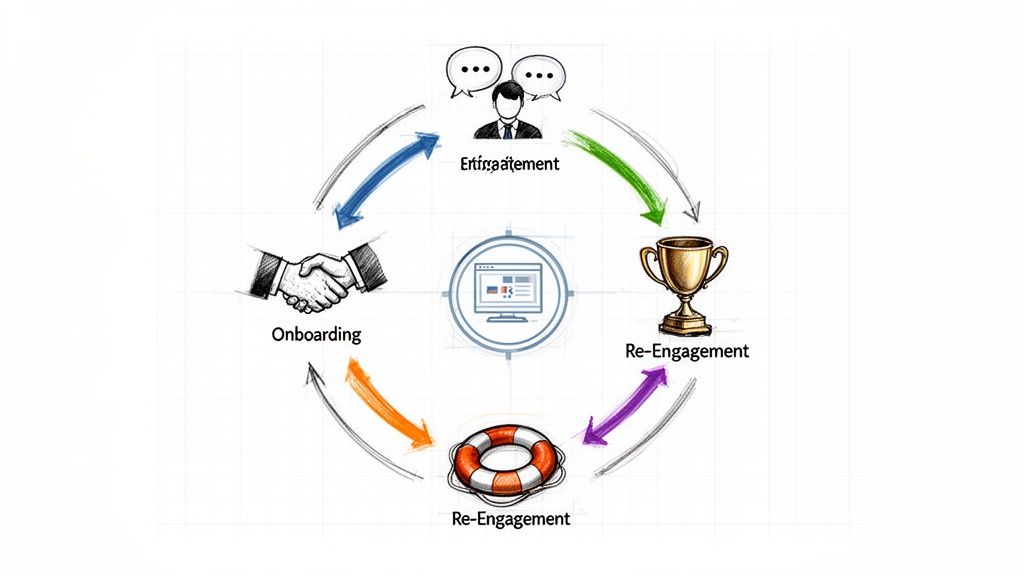
Let's be honest: constantly chasing new customers is exhausting and expensive. It's a never-ending cycle that often leaves you feeling like you're just treading water. A customer retention program is your strategic shift away from that grind. It’s a deliberate plan to keep your existing members and customers happy, engaged, and invested in your community for the long haul.
Think of it less as a defensive tactic and more as a proactive strategy for building lasting relationships, not just one-off transactions.
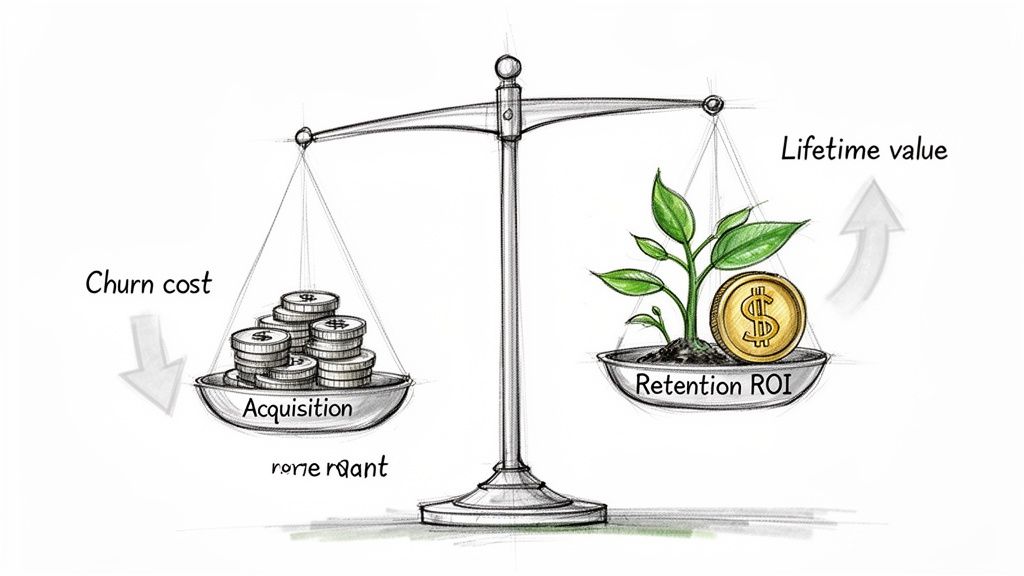
You’ve heard it a million times: it costs more to win a new customer than to keep an old one. For those of us running professional associations, organizing events, or managing communities, this isn't just a business cliché—it's a fundamental truth that hits the balance sheet. Every member who leaves takes a piece of your predictable revenue with them.
When a member walks away, you lose far more than their next subscription payment. You lose their future potential, their word-of-mouth referrals, and the stability they add to your financial forecasts. This is why a well-thought-out retention program isn't just a "nice-to-have." It's an essential part of your business's immune system.
The financial bleed from customer churn is real, and it’s getting worse. Projections show that by 2025, US brands could lose an eye-watering $168 billion annually simply because customers don't stick around. It’s a massive problem.
Some industries feel this more acutely than others. Hospitality and travel, for instance, struggle with retention rates as low as 55%, while retail isn't much better at 63%. These numbers aren't just statistics; they represent a huge, untapped opportunity for anyone willing to focus on loyalty.
This is where you can gain a serious competitive edge. Instead of constantly trying to fill a leaky bucket, you can focus on building a loyal base of advocates. For any community leader or business owner, truly understanding the power of retention is a game-changer. A great place to start is by learning about maximizing customer retention with a small business loyalty program.
A 5% increase in customer retention can boost profitability by anywhere from 25% to 95%. This isn't a minor tweak; it's one of the most powerful levers you can pull to improve your financial health.
A strong retention program, especially one powered by a platform like GroupOS, flips the script entirely. You stop reacting to cancellations and start proactively creating an experience that people don't want to leave. It all comes down to a few key actions:
Ultimately, this proactive approach creates the stable, engaged base every community needs to thrive. This stability is the bedrock for building sustainable, recurring revenue business models that can weather just about any storm. You’re no longer just processing payments; you’re building a community.
Before you dive into building a customer retention program, you have to know what a win actually looks like. Vague goals like “improve loyalty” are nice sentiments, but they’re not actionable. You need to define success with specific, measurable Key Performance Indicators (KPIs) that tell you whether your efforts are truly paying off.
This is all about getting comfortable with data from the very beginning. Instead of just trying things and hoping for the best, you’ll be tracking real progress, proving your program's value, and making smart decisions based on hard numbers.
For a professional association, a win might be a higher membership renewal rate. If you're an event organizer, it could be a jump in the number of people who come back year after year. The key is to connect your goals to the health of your organization.
First things first, you need to pick the right KPIs. Not every metric will be useful, so focus on the few that genuinely reflect the health of your member base. It's better to track a handful of meaningful numbers than to get lost in a sea of data.
Here are the heavy hitters that form the bedrock of almost every successful retention program:
Understanding and calculating your SaaS Customer Lifetime Value is a game-changer. It forces you to look beyond this month's revenue and focus on the long-term health and profitability of your member relationships.
Once you've chosen your KPIs, it's time to set some realistic goals. This is where benchmarking comes in. If you have no historical data, your first goal is simple: establish a baseline. If you discover your annual churn rate is 15%, a great first-year goal might be to knock it down to 12%. Don't aim for zero right out of the gate.
Let's walk through a real-world scenario. Imagine a trade association with 1,000 members decides it’s time to get serious about retention. They pick three core metrics to track over the next 12 months.
Suddenly, a vague idea has turned into a concrete action plan. Every goal is specific, measurable, and directly tied to a business outcome. If you're new to this, a great place to start is learning how to begin calculating retention ratio for your organization.
Tools like GroupOS are built to make this tracking process feel effortless. You can use the analytics dashboard and engagement tracking features to monitor your progress against these goals in real-time. This means you can see what’s working, spot what isn’t, and adjust your strategy on the fly instead of waiting for an end-of-year review. That continuous feedback loop is the real engine behind a powerful customer retention program.
A solid customer retention program isn't about guesswork. It’s built on a crystal-clear understanding of the member experience, from the moment they sign up to the day they become your biggest fan.
To see where you can really make a difference, you need to map out that entire journey. Think of it as creating a blueprint of every single interaction someone has with your organization. This process lets you zoom in on the specific moments—both big and small—that shape a member's perception of your value.
By mapping these touchpoints, you can pinpoint the exact spots where friction causes people to leave and, just as importantly, the moments of delight that build true, lasting loyalty.
Every member's experience can be broken down into three critical phases. Knowing what happens in each one is the key to spotting opportunities to step in and improve things.
Onboarding: This is your first impression, and you only get one. It starts the second someone signs up and covers their welcome email, their first login to your member portal, and any introductory materials they get. A clunky, confusing onboarding process is a fast track to early churn.
Engagement: This is the long middle stretch where the real relationship is built. It’s everything from attending events and reading newsletters to posting in online forums and using member-only resources. This is where people decide if their membership is actually worth the investment.
Renewal and Advocacy: This is the moment of truth. It covers the lead-up to their renewal date, the process itself, and what happens right after they recommit. If you’ve done your job in the first two phases, this is also where your most loyal members turn into powerful advocates.
So many organizations make the mistake of pouring all their energy into the renewal phase. By then, it's often too late. The real work of a customer retention program happens during onboarding and ongoing engagement, making the renewal decision a no-brainer for the member.
Once you’ve outlined these basic phases, it’s time to get granular and identify the specific touchpoints within each one. This is where having a tool like GroupOS is a game-changer. The platform's engagement tracking gives you hard data, showing you exactly where members are active and where they’re falling off.
Let’s walk through what this looks like for a typical professional association.
By carefully examining each of these moments, you move from a vague strategy to a targeted action plan. You’ll know exactly where to focus your efforts to strengthen relationships at every critical point in the journey.
Once you’ve mapped out your member journey, it’s time to move from strategy to action. A truly effective retention program isn’t a single silver bullet; it's a mix of thoughtful tactics designed to make members feel valued every step of the way. Let's dig into the four pillars that matter most: smart onboarding, continuous engagement, proactive re-engagement, and rewarding loyalty.
Executing these well is what turns a passive member into an active participant—and eventually, a loyal advocate for your community. It’s all about creating an experience so indispensable they can't imagine being without it.
The member journey really boils down to this flow, from their first welcome to the moment they decide to renew.
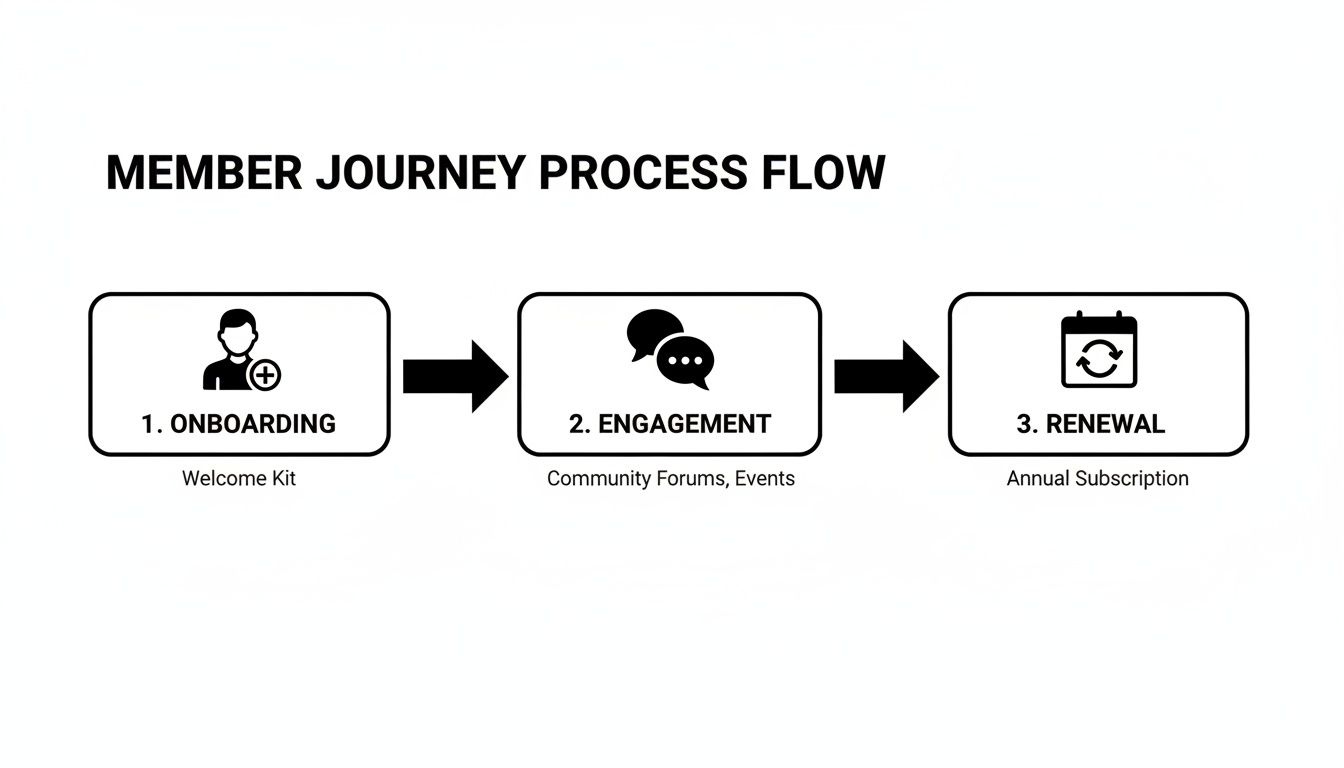
You can see how each stage builds on the last. This highlights a crucial point: retention is a continuous cycle, not a one-off campaign.
A member’s first 90 days are make-or-break. This is your window to prove the value of their membership. A great onboarding process sets the right tone from the start and gets them to that "aha!" moment as quickly as possible.
Forget the single, generic welcome email. You need a multi-touch sequence.
This isn’t just about flooding their inbox; it’s about strategically guiding new members toward meaningful engagement, one small step at a time.
Once someone is settled in, the real work begins. This is the long game of consistently delivering value that keeps your organization top-of-mind. The trick is to create exclusive experiences they simply can't find anywhere else.
I can't stress this enough: don't underestimate the power of community. A private channel or forum for members to connect with peers is often the stickiest benefit you can offer. It transforms your organization from a service they use into their professional home.
One of the best ways to keep people coming back is with a dedicated member hub. By centralizing exclusive content—like on-demand event recordings, industry reports, or a member directory—you give them a powerful reason to log in regularly. If you're looking for more inspiration, we have a whole list of proven member engagement strategies you can explore.
No matter how great your program is, some members will inevitably go quiet. A strategic re-engagement plan is your safety net. By using engagement tracking tools, you can spot members whose activity has dropped off—for example, anyone who hasn't logged in or attended an event in 90 days.
Once you've identified them, you can launch a targeted "win-back" campaign.
The key is to be proactive. Don't wait until their membership is a week from expiring to remind them why they joined in the first place.
If there's one tool that stands out in the retention arsenal, it's a solid loyalty program. The data doesn't lie. Recent surveys show 59% of sales leaders see loyalty programs as their top strategy for long-term success.
The proof is everywhere. At Costco, executive members drive over 73% of sales. For Starbucks, their Rewards members account for a staggering 60% of revenue. These programs work because they make your most valuable members feel seen, appreciated, and rewarded.
A successful loyalty program is all about offering perks that feel genuinely valuable. Think beyond a simple discount and consider what would truly move the needle for your members.
By weaving these four pillars—onboarding, engagement, re-engagement, and loyalty—into your strategy, you create a comprehensive customer retention program that covers the entire member lifecycle. This isn't just about plugging leaks; it's about building a thriving community of dedicated, long-term advocates.
You've got the strategy and the tactics mapped out. Now comes the fun part: making it real. This is where your customer retention program moves from the whiteboard into the hands of your members. Juggling a dozen different tools to pull this off is a recipe for disaster. An integrated platform like GroupOS is built to bridge that gap, letting you launch, manage, and measure your entire program from one place.
Let’s get practical and walk through how you can use the GroupOS ecosystem to turn your plans into measurable results and create an experience your members will love.
Every great retention program starts with a clear, compelling membership structure. This is your foundation. Inside GroupOS, you can build flexible membership plans designed for different segments of your community, whether you're creating loyalty tiers or offering special access for conference attendees.
A good starting point is to define a few distinct tiers. Think about what makes sense for your community. For instance:
Setting these up is dead simple. You just define the benefits, set the pricing (if any), and let the system handle automated renewal reminders. This instantly gives members a clear path to deeper engagement and rewards them for their loyalty.
Nothing kills retention faster than a scattered, confusing member experience. If people have to hunt across five different websites to find content, register for events, and connect with each other, they’ll just give up.
GroupOS lets you build a dedicated, branded member hub using a simple drag-and-drop editor. This becomes the single source of truth for your community. You can pull all your key resources into one spot:
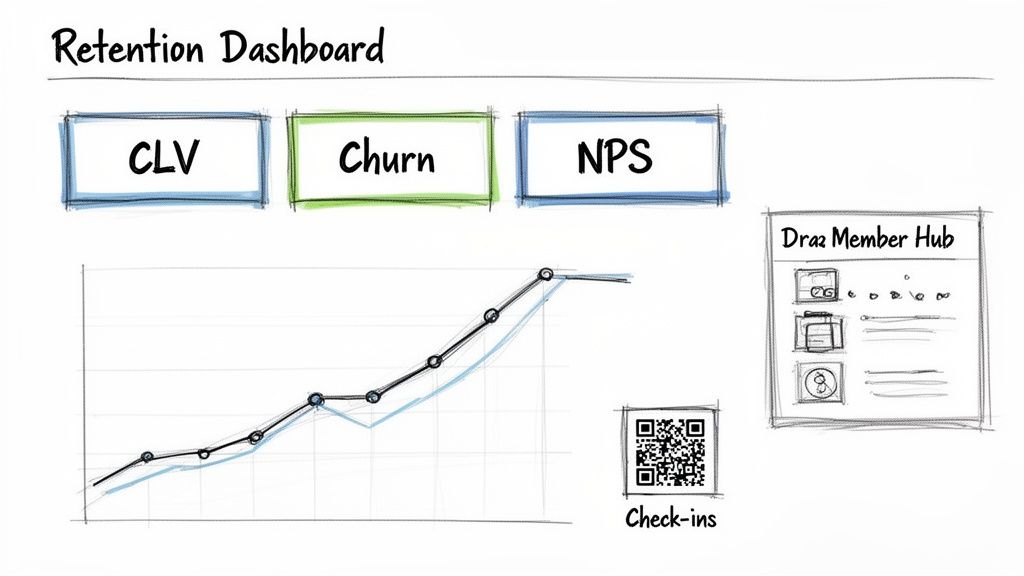
Want to capture real-world interaction data? Use features like QR code check-ins at your events, both virtual and in-person. Every scan is a valuable data point, telling you exactly who showed up for which session. That kind of information is gold when it comes to personalizing future communication and understanding what your members really care about.
Getting your program off the ground is one thing, but knowing if it's actually working is another. This is where the GroupOS analytics dashboard becomes your command center. Instead of guessing, you can track your most important KPIs in real time.
The dashboard gives you an at-a-glance view of all the metrics you defined in your strategy. You can immediately see your Churn Rate, monitor your Net Promoter Score (NPS) with integrated surveys, and watch your Customer Lifetime Value (CLV) climb.
A common mistake I see is treating measurement as an afterthought. You should be in your retention dashboard weekly, not quarterly. It allows you to spot a negative trend—like a sudden drop in engagement after an event—and fix it before it snowballs into churn.
This data-first approach lets you draw a straight line between your retention activities and business outcomes. You can pull clear, simple reports to show stakeholders the program's ROI and confidently answer the question, "Is our customer retention program actually working?"
Generic, one-size-fits-all emails are just noise. True retention is built on sending the right message to the right person at the right time. All the engagement data you collect in GroupOS—from event attendance to content downloads—allows you to segment your audience with surgical precision.
Imagine you just wrapped up your annual conference. You can instantly create a segment of members who attended but haven't logged into the hub since. Send them a personalized follow-up with links to the session recordings and an invitation to a private discussion group to keep the conversation going. That’s how you show people you’re paying attention.
This integrated approach is what makes a retention program stick. The numbers don't lie; research shows that repeat customers often spend 67% more in their third year than in their first six months. They are your most valuable asset. Using a unified platform lets you seamlessly execute, track, and analyze your strategy, creating a powerful feedback loop that constantly strengthens member loyalty. To see more data behind these strategies, you can discover more insights about customer loyalty statistics at SellersCommerce.com.
When you're in the weeds building a customer retention program, you move past the big-picture strategy and start hitting real-world roadblocks. It's one thing to talk theory, but execution is where the tough questions pop up. Let's get straight to the answers for the issues that come up most often in the field.
This is the big one, isn't it? Everyone wants to know when the needle will move. The honest answer is that you need to think in terms of months, not weeks.
You might see a few quick wins in the first quarter—a small dip in churn right after someone joins or a little bump in your email open rates. But the results that really matter, the ones that impact the bottom line, take time to build.
You'll likely start seeing a meaningful lift in major KPIs, like Customer Lifetime Value (CLV), after about 6 to 12 months of consistent work. Think of it like planting a tree; you don't see the real growth overnight.
Early signs that you're on the right track include:
Patience is everything. A great retention program is built on consistent, genuine relationship-building, not a few flashy campaigns. You're playing the long game for loyalty, and that means constantly measuring, listening, and tweaking your approach.
It's easy to get so excited about building a loyalty program that you stumble right out of the gate. I've seen it happen time and again. The single most common mistake is making the program way too complicated. If your members need a PhD to figure out your points system, they'll just tune it out. Simplicity is always your best friend.
Another classic pitfall is the one-size-fits-all approach. Your die-hard, long-term members are not the same as someone who just signed up last week. They have completely different needs and expectations. If you don't segment your audience and personalize the experience, your program will feel generic and impersonal. Your top-tier advocates deserve to feel special.
Finally, please don't "set it and forget it." A retention program is not a crockpot meal. It needs constant attention. You have to promote it, talk about it, and actively get feedback from members. Without ongoing care, even the most brilliant program will slowly fade into irrelevance.
Absolutely. In fact, smaller organizations often have a secret weapon: the ability to get incredibly personal. A program’s success isn’t measured by its budget but by the strength of the connections it forges. You don’t need a huge team to make people feel seen and valued.
Start with low-cost, high-impact tactics that lean into your strengths:
This is where having an all-in-one platform becomes a game-changer for lean teams. Tools like GroupOS let smaller organizations punch way above their weight class by automating the tedious work—like tracking renewals, sending event follow-ups, and messaging specific member groups—that can totally swamp a small staff. The key is to be smart and focus your limited energy on what delivers the most authentic value to your people.
Ready to stop juggling tools and start building a community that lasts? GroupOS provides the all-in-one platform you need to manage memberships, host events, and deliver exclusive content seamlessly.
Start your free trial and see how easy it is to build your customer retention program today.