February 7, 2026
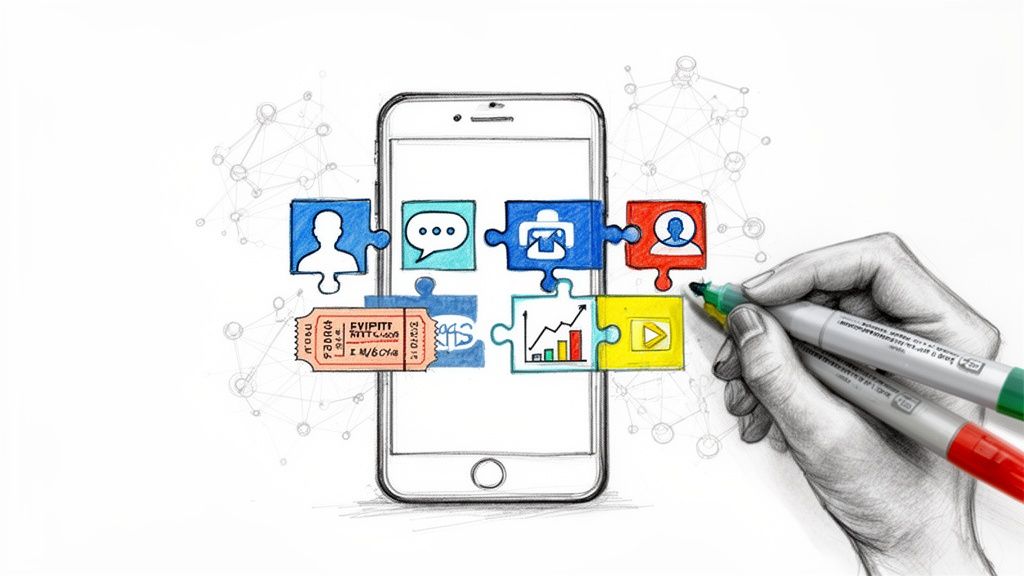
A white label community app is essentially a ready-made, fully-featured application that you can put your own brand on. You get to add your logo, match your company colors, and present it to your members as if you built it from the ground up.
Think of it as the difference between building a house from scratch versus buying a professionally designed, move-in-ready home. You get to skip the headache of laying the foundation and instead focus on the fun part—making it your own.
Let's stick with the house analogy. Building a custom app is like hiring architects, pouring concrete, and framing walls. It's a massive project that costs a fortune and takes forever.
A white label app is like finding that perfect, pre-built house in the ideal neighborhood. The plumbing works, the electricity is on, and it has all the modern amenities. All you have to do is hang your pictures on the wall and move your furniture in. You get a world-class space without the stress and expense of construction.
This is exactly how a white label community app works. A specialized provider builds and maintains the core technology. You lease it, rebrand it, and launch it as your own. It gives you a powerful, professionally developed platform without writing a single line of code.
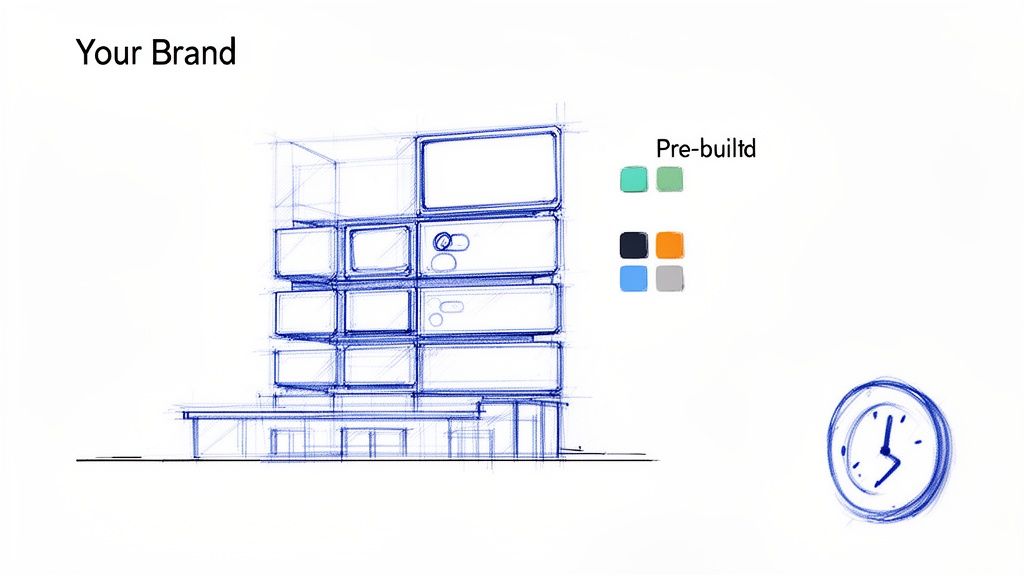
The term "white label" actually comes from the retail world. Manufacturers would produce goods with a blank white label so that stores like Target or Walmart could slap their own branding on them. It’s the same idea in software—the app is a blank canvas waiting for your identity.
This approach is a game-changer for businesses that want to create a professional community hub without breaking the bank or waiting a year to launch.
The advantages are pretty clear:
A true white label solution gives you the tools to completely remove branding from the original provider, creating an immersive and seamless world for your members.
To get a more detailed look, check out our guide on the topic: https://groupos.com/blog/what-is-a-white-label-app
Think of building your community on platforms like Facebook Groups or Slack as setting up shop in a crowded, noisy market you don't own. It's easy to get started, but you're ultimately playing by someone else's rules. The landlord can change the layout, hike the rent, or even close up shop without warning, leaving your business scrambling. You’re in a constant fight for your members' attention against a firehose of distractions and algorithm changes you have zero control over.
That's the fundamental problem with using third-party platforms. Your brand gets lost in the noise, you don't own your member data, and every interaction you have is filtered through a system built to serve someone else's goals—not yours. A dedicated white label community app is your ticket out of that chaotic marketplace and into your own custom-built, branded headquarters.
When you have your own app, you own the entire experience. You set the rules, control the conversation, and create a focused space where real connections can actually happen. This move from "renting" to "owning" isn't just a nice-to-have; it's a strategic shift that lays the groundwork for sustainable, long-term growth.
Relying on social media giants for your community comes with some serious risks. Your ability to reach your own members can be crippled overnight by an unexpected algorithm update. Worse, you're handing over your most valuable asset—member data—and losing the insights needed to truly understand and serve your audience.
A dedicated app puts you back in the driver's seat. You get:
This controlled environment is the secret to building deeper, more authentic relationships that lead directly to better retention and unwavering loyalty. You can dive deeper into this comparison in our article on the best community app solutions.
Putting resources into a branded app is a direct investment in a more predictable and profitable future for your organization. It transforms your community from a passive audience into a powerful business asset that actively drives revenue. By creating an exclusive, central hub, you unlock benefits that are simply out of reach on public social platforms.
The market itself tells the story. The global community platforms market, which includes white label apps, skyrocketed from $454.112 million in 2021 and is on track to hit $819.401 million by 2025. This explosive growth shows a clear trend: organizations are moving away from rented platforms and toward owned, branded experiences. White label solutions make this possible without the hefty $50,000 to $120,000 price tag of custom development, and an incredible 90% of businesses using them report major gains in efficiency.
Owning your app isn't about technology; it's about owning the relationship with your audience. It gives you a direct, unfiltered channel to deliver value, foster loyalty, and build a sustainable business model around your community.
A dedicated app doesn't just boost engagement—it opens up a whole new world of monetization strategies that you can't properly execute on generic platforms. You stop being just another content creator on someone else's turf and become a business owner with multiple income streams.
Just think about what a white label community app makes possible:
By bringing all these functions under one roof, you create a frictionless experience for your members and a profitable ecosystem for your business. Your community becomes a self-sustaining engine for growth, ensuring its financial health for years to come.
Picking a white label community app is a lot like choosing the right tools for a big project. A beautiful, branded app is a great start, but its real value comes from what's under the hood. What can it actually do to help you manage members, deliver value, and drive revenue? The best platforms aren't just a random collection of features; they're a cohesive system where every tool works together to create a powerful, self-sustaining community engine.
Let's be honest, not all platforms are built the same. Some are fantastic for content but weak on event management. Others might have great messaging tools but offer very little in the way of monetization. To make a smart choice, you need a clear checklist of the core functions that turn a simple app into the go-to hub for your members. We’ll break down the essentials into a few critical categories to help you figure out what you really need.
This diagram shows why having your own app is such a big deal. It’s the difference between renting space on someone else's platform and owning your own property.
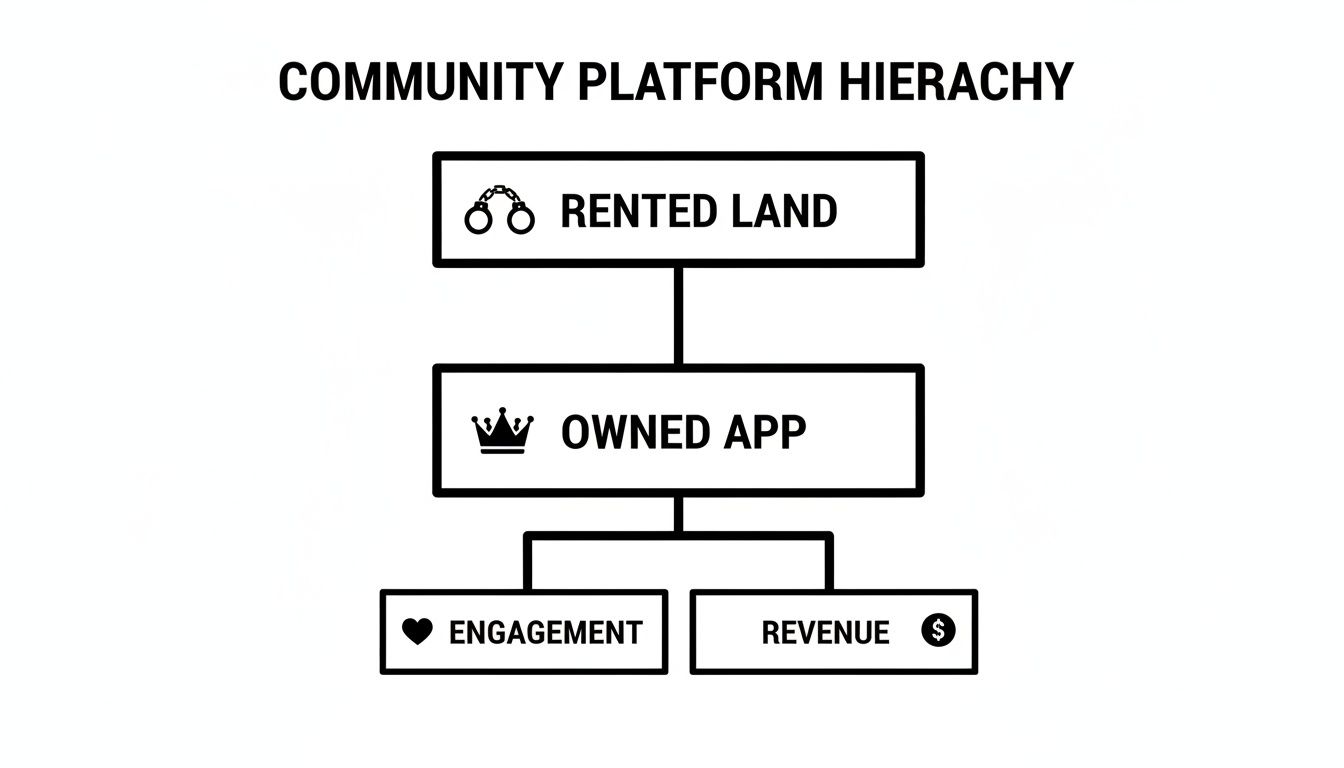
When you move to an owned app, you build the foundation for genuine member engagement and create reliable revenue streams that you control.
Before we dive into the specifics, let's look at the big picture. The table below outlines the must-have feature categories and explains why each one is so crucial for building a successful community, membership, or event platform.
This breakdown should give you a solid framework for evaluating different solutions. Now, let's get into the nitty-gritty of what these features look like in action.
At the end of the day, a community is all about its people. Your app has to make managing members effortless—from the moment they sign up to their annual renewal. These features are the operational backbone, automating the tedious admin work so you can focus on what matters: building relationships.
You'll want a complete set of tools that make life easier for you and add value for your members.
These core features ensure your community can grow without drowning you in administrative tasks.
For many organizations, events are the main attraction—a major driver of both engagement and revenue. Your app should act as a complete event command center, pulling everything from registration to post-event feedback into one place. This stops the clunky user experience of forcing members to go to a separate website to buy a ticket.
An integrated event system doesn't just list what's happening. It elevates the entire attendee experience—from discovery and registration to live polling and post-event networking—all inside your branded app.
Here’s what to look for in event functionality:
Centralizing your event management makes life easier for everyone and opens up powerful new ways to monetize your gatherings.
Your app is the perfect home for all your valuable content. Whether it's industry reports, training videos, or full-blown courses, the platform should make it easy to organize, deliver, and even sell access to this knowledge. This is how you transform your app from a social channel into an indispensable professional resource.
Good content delivery is more than just a place to dump files. It's about creating structured learning experiences.
These features establish your organization as a thought leader and give members a compelling reason to open your app every single day. You can get more ideas by checking out our guide on the top tools for community engagement.
A community is nothing without interaction. The best platforms provide a whole toolbox of features that get people talking—to each other and to you. These are the tools that make your app feel alive, turning a passive audience into a thriving, active community.
The goal is to offer multiple ways for people to connect, since not everyone likes to communicate the same way.
When you equip your platform with these tools, you lay the groundwork for a dynamic and valuable community that members simply can't live without.
Let's be honest: a powerful white label community app should be a profit center, not just another line item on an expense report. The key to long-term success is shifting your mindset from viewing community as a cost to seeing it as a core revenue driver. When you move beyond simple membership fees, you can transform your branded platform into a dynamic economic engine for your entire organization.
The real opportunity isn't just in one revenue stream, but in creating several layered sources of income that provide immense value to members and partners. This approach makes your financial model far more resilient. You're building an ecosystem where every feature, every event, and every piece of content can contribute to your bottom line.
The most direct path to predictable, recurring revenue is a well-thought-out membership program. But a one-size-fits-all model almost always leaves money on the table. The solution is to create tiered plans that speak to different segments of your audience, each with its own set of exclusive perks and a matching price point.
Think about it in a few distinct levels:
By segmenting access like this, you create compelling, natural reasons for members to upgrade, turning casual participants into dedicated financial supporters. Exploring different mobile app monetization strategies is a great way to refine this model and keep it profitable for the long haul.
Events are often the lifeblood of a community, and your app should be the central command for turning them into major revenue generators. An integrated ticketing system removes all the friction, letting you sell tickets directly within the branded experience your members already know and trust.
And you can get really creative here. Don't just sell a standard admission ticket. Your white label community app should empower you to create a dynamic ticketing experience.
By bundling tickets with exclusive digital content or premium memberships, you create high-value packages that drive both event attendance and recurring revenue. This transforms a one-time transaction into a long-term relationship.
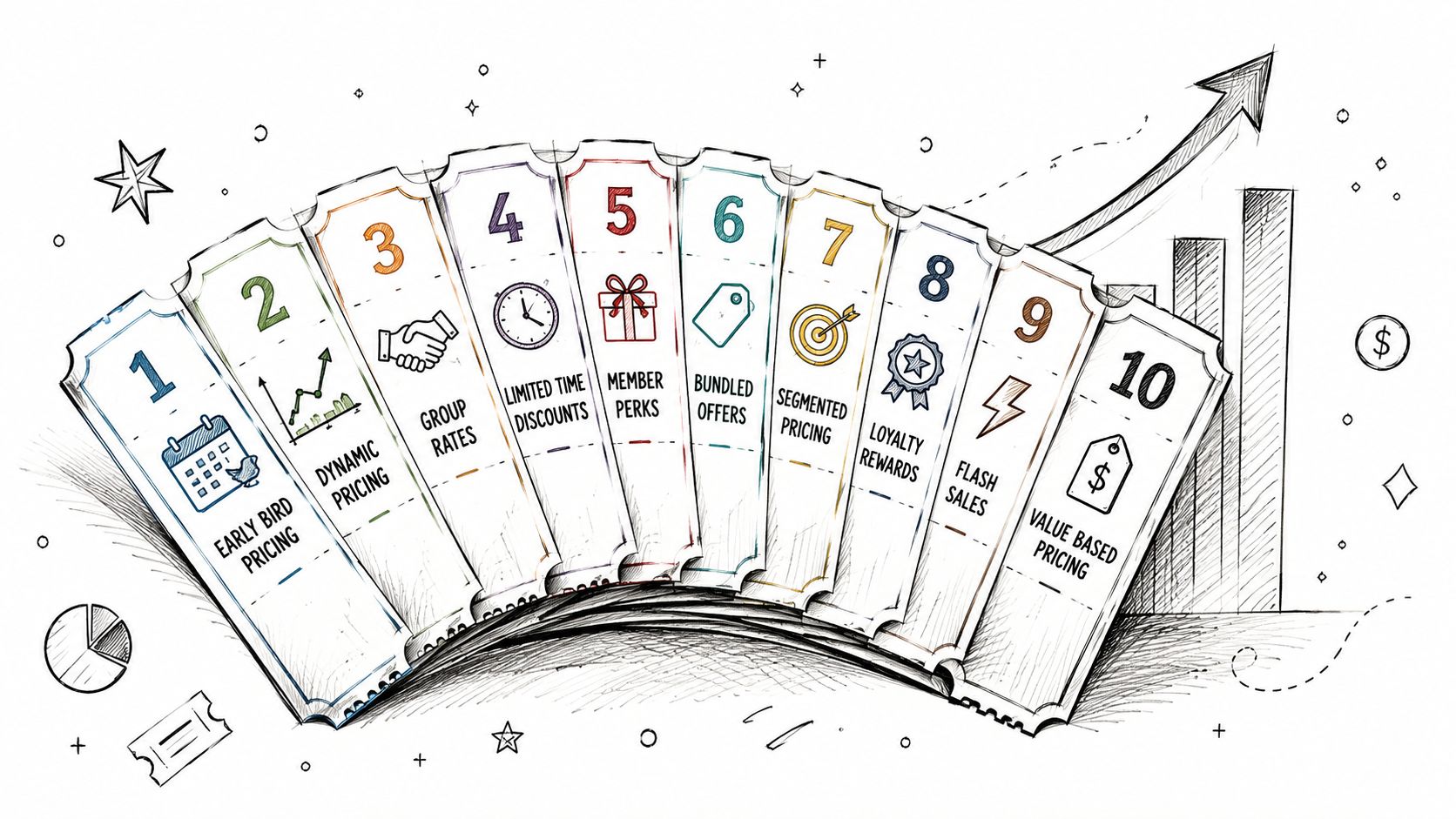
Offer early-bird discounts to spark initial sales, create member-only pricing to reward loyalty, and sell high-value VIP packages that include perks like front-row seating or a private Q&A with the speakers. Suddenly, each event becomes a multi-faceted commercial opportunity.
The focused attention of your community is an incredibly valuable asset. Sponsors know this, and they are willing to pay for direct access to your members. A modern community platform gives you a whole suite of tools to create compelling, measurable sponsorship packages that deliver a clear return on investment for your partners.
The broader white-label marketing market is projected to hit $99 billion by 2026, with community engagement apps forecasted to reach $2,302.62 million by 2032. This explosive growth is fueled by effective monetization. While custom app development can cost $50,000-$120,000, a white label model slashes this entry barrier, making it possible to become profitable by reselling services to just a couple of clients.
Here are just a few high-impact sponsorship assets you can sell right from your app:
By building a robust sponsorship program, you create a powerful win-win. Your partners get targeted exposure to their ideal audience, and your organization secures a vital revenue stream to support and grow the entire community. For even more ideas, check out our guide on successful content monetization.
Picking a technology provider for your white label community app is a lot more like choosing a business partner than just buying some software. Sure, the features on the pricing page matter, but the real success of your community hinges on the people and the philosophy behind the code. A great partner will feel like an extension of your team, helping you grow. A bad one? They’ll become a massive headache and a roadblock to everything you’re trying to build.
To make the right call, you have to look past the shiny marketing and dig into what really counts for the long haul. This means asking some tough questions about their tech, their commitment to your success, and whether they can actually keep up with your vision. Let's break down the essential criteria you should be looking at.
Picture this: your community blows up. You go from 100 dedicated members to 10,000 in a year. That’s amazing, right? But will your app actually handle that surge in traffic, data, and conversations without crashing or slowing to a crawl? That's the million-dollar scalability question.
A platform that isn’t built for growth can kill your momentum just as you’re hitting your stride. Don't just ask if they can scale—ask for proof. Look for case studies or performance stats from communities that are the size you want to be, not just the size you are now.
Your community app isn't an island. It has to talk to the other tools you rely on to run your organization, like your CRM and email marketing software. If it doesn't, you're signing up for a world of pain filled with manual data entry and disjointed systems.
A solid partner will have dead-simple integrations with your core stack:
The right white label community app should be the central hub of your tech, not some walled-off garden. Its ability to play nice with your other tools is a direct reflection of its long-term value.
Moving to a new platform is a big lift. A great partner gets that. They don't just hand you a login and point you to a help doc; they act as a strategic guide to make sure your team is confident and your launch goes off without a hitch. Bad support, on the other hand, leaves you high and dry when things inevitably go wrong.
Get specific about their process:
A partner who’s truly invested in your success will have clear, structured answers to all of these questions.
The whole point of a white label app is to make it feel like your app. But "customization" can mean very different things to different providers. For some, it’s just swapping out a logo and changing a color scheme. For others, it means deep control over the entire user experience.
You need to dig in here. Can you change the navigation menus? Create completely unique page layouts? Fully brand the app store listing? The more control you have, the more you can shape the platform to fit your brand and serve your members' specific needs.
This is the big one. You're entrusting this company with your community's most valuable asset: their personal data. A security breach can do permanent damage to your brand's reputation and destroy the trust you've worked so hard to build. Don’t just take their word for it on security.
Make sure they can clearly explain their approach to data protection. Ask about encryption, security audits, and how they comply with regulations like GDPR. A transparent, proactive stance on security isn't just a nice-to-have; it's an absolute must to protect your community and your organization.
Choosing the right partner involves looking beyond the surface-level features. The table below provides a practical checklist to help you compare vendors on the criteria that foster a successful, long-term partnership.
Using a structured framework like this helps ensure you're making a decision based on a complete picture. The partner you choose will have a massive impact on your community's trajectory, so taking the time to vet them thoroughly is one of the most important investments you can make.
Getting your new white label community app off the ground is a huge step forward. But to really stick the landing, you need a solid plan. Thinking about the launch as a series of manageable phases turns a massive project into a clear, actionable roadmap. This approach guarantees a smooth transition for your members and gets them engaged right from the start.
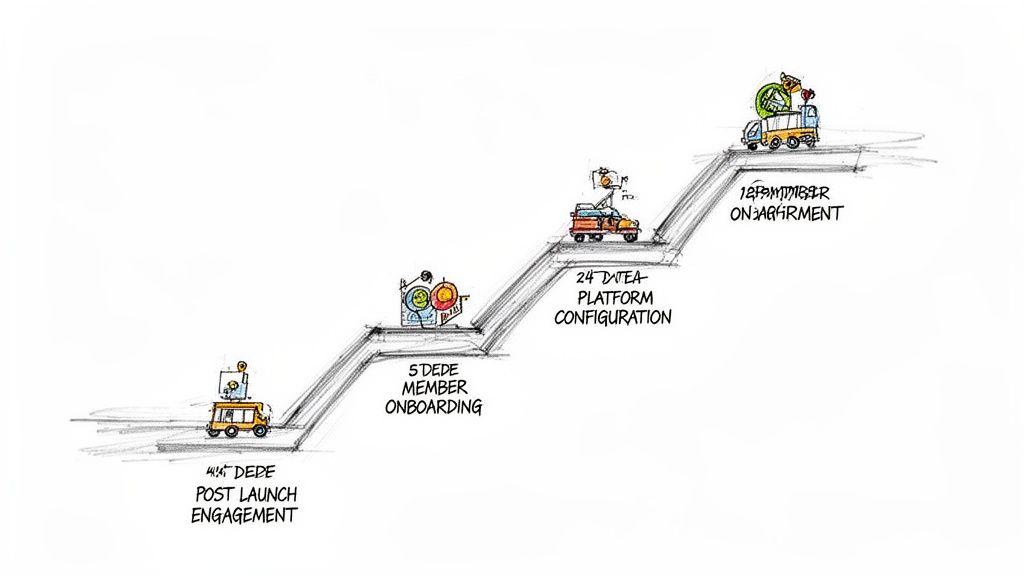
Don't see this as a one-and-done event; it's more like a four-stage journey. Each step builds on the one before it, taking you from the initial technical setup to a buzzing, active community. A great technology partner should be with you every step of the way, making sure the whole process is seamless.
First things first, you have to build the foundation. This means getting your existing member data into the new system and tweaking the app so it looks and feels exactly like your brand.
Once this groundwork is done, the app will feel familiar and professional to your members, instantly recognizable as your community's space.
With the app ready to go, the spotlight turns to your members. You can't just flip a switch and expect everyone to show up; you need a thoughtful communication plan to get them excited and show them the ropes.
A smart onboarding strategy involves a few key touchpoints:
A successful launch isn't just about technology. It's about crafting a compelling story that makes members want to join, explore, and start connecting from day one.
Those first 30 days are everything. This is your window to help members form new habits and see the app's value for themselves. Plan a calendar of activities that will create immediate momentum and spark conversations.
You could host a virtual launch party, run an "ask me anything" session with key leaders, or kick off a simple "introduce yourself" thread in the main discussion forum. By offering immediate value and easy ways to connect, you make a fantastic first impression. This initial flurry of activity is what turns your new white label community app from just another tool into the true digital hub for your members.
Thinking about a white label community app for your organization? Smart move. But it's natural to have questions about the practical side of things—cost, timelines, and whether it will really feel like your own brand. Let's break down the most common questions we hear from leaders just like you.
Here’s the great news: you’re not looking at the six-figure price tag that comes with building a custom app from scratch. A white label community app works on a subscription model, which makes it far more accessible and predictable for your budget.
Your final cost usually depends on a few things, like the size of your community and the specific features you need. This flexible approach means everyone from a growing professional network to a large-scale event series can get access to top-tier community technology without a massive upfront investment.
This is where white label solutions really shine. Building an app from the ground up is a long haul—we’re talking 6 to 12 months of development, testing, and bug-fixing.
With a white label platform, the core engine is already built, tested, and ready to go. You’re essentially just applying your brand, configuring your features, and loading your content. This means you can get your fully functional, branded app into the hands of your members in a matter of weeks, not months. You start delivering value almost immediately.
An app should feel like it was built exclusively for your members. Leading white label platforms ensure this by offering deep customization, creating an experience that is completely native to your brand and indistinguishable from a custom-built product.
Yes, one hundred percent. The whole point of a "white label" is to make the platform provider invisible and put your brand front and center. The best platforms are built for deep customization.
This goes way beyond just slapping your logo on a template. You’ll be able to set your exact primary and secondary brand colors, choose custom layouts, and create an experience that looks and feels like a natural extension of your organization. Most importantly, it includes getting your app listed under your name in the Apple App Store and Google Play Store, creating a completely seamless and professional journey for every single member.
Ready to build a powerful, branded hub for your members and events? GroupOS provides an all-in-one platform to launch your white label community app with features for membership, ticketing, and content delivery. Schedule a demo today and see how it works.