March 29, 2026
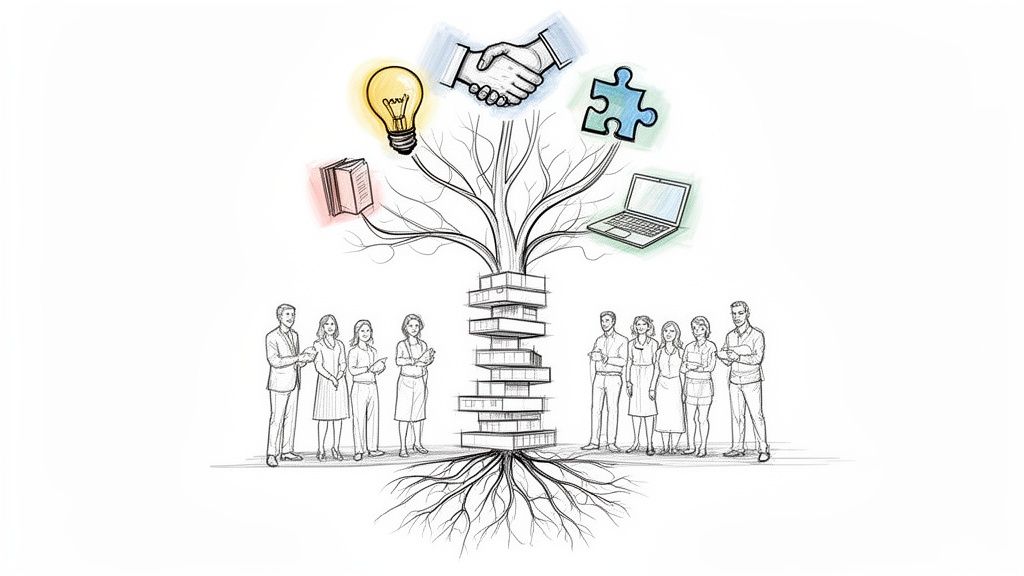
Community Based Learning (CBL) is about rolling up your sleeves and learning by doing. It takes education out of the lecture hall and puts it right into the real world, where people learn by tackling actual community challenges. Think of it less like a course and more like an apprenticeship for making a tangible impact.
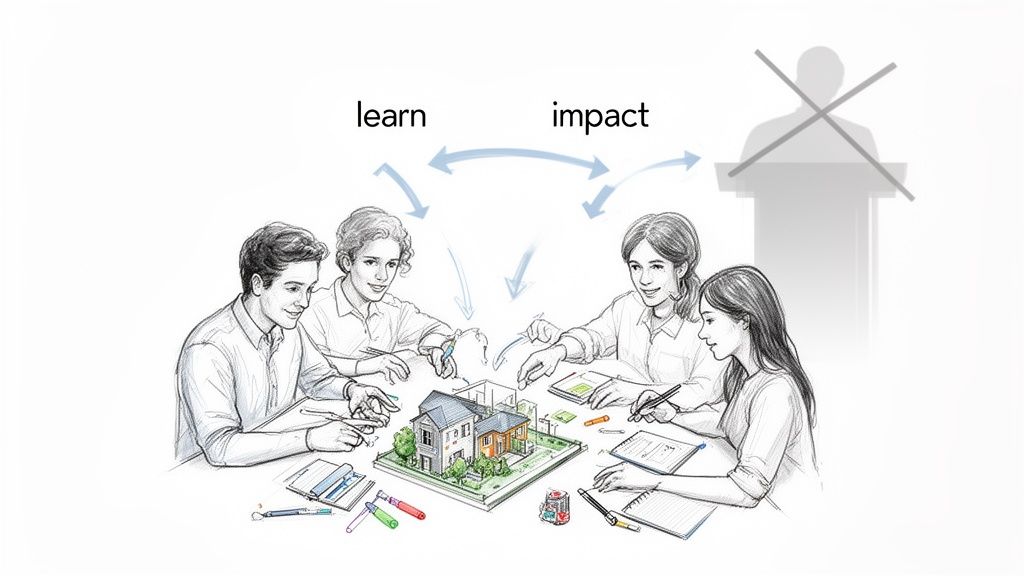
When we talk about community based learning, we're talking about a thoughtful strategy that links learning goals directly to community service. This isn't just a side project or volunteer work; it's the main event. For instance, members of a professional community might use their specific skills to help a local partner solve a real problem, then reflect on that experience together to truly absorb the lessons.
It’s a powerful shift. Instead of knowledge just flowing one way from an expert to a learner, CBL forges a true partnership. The community gets a real solution, and the member gains practical skills. It’s a cycle of mutual growth.
So many traditional learning models put people in a passive seat, where they’re expected to absorb information from webinars or articles. While there's a place for that, it often leaves a gap between what someone knows and what they can actually do. Community based learning is designed to fill that gap.
The goal is to bridge the gap between knowing something and being able to do something with that knowledge. It's about building practical competence, not just theoretical expertise.
This hands-on approach is especially powerful for professional communities that thrive on engagement and results. Fostering this kind of active, collaborative environment is a core part of effective community leadership. To learn more about creating this dynamic, check out our guide on what is community management.
To see the difference clearly, let’s compare the two approaches side-by-side.
This table breaks down how CBL stacks up against more conventional learning models, highlighting what makes it so different.
| Characteristic | Community Based Learning | Traditional Learning |
|---|---|---|
| Learning Role | Active participant and problem-solver | Passive recipient of information |
| Focus | Application of skills to real needs | Memorization and theoretical knowledge |
| Location | In the community, on-site | Classroom, webinar, or online course |
| Outcome | Tangible community impact and skill growth | Test scores and certifications |
| Driver | Real-world problems and partnerships | Fixed curriculum and instructor-led content |
As you can see, the entire model is oriented around action and practical outcomes, making learning a much more integrated and meaningful experience.
And this isn't just a theory; the results speak for themselves. One detailed study found that after a CBL course, participants’ content knowledge jumped by 25%.
Even more impressive, their ability to explain complex ideas to non-experts—a vital professional skill—shot up by 28%. On top of that, their commitment to civic engagement grew by 22%, showing that this model doesn't just build skills, it builds a deeper connection to the community.
So, what separates a community learning program that fizzles out from one that truly thrives? It isn't about fancy software or a massive budget. It comes down to a few foundational ideas that have to be there for the magic to happen. Think of these not as academic theories, but as the ground rules for building something that actually works for everyone involved.
The entire system is built on reciprocity. This is non-negotiable. Community learning can't be a one-way street where members just show up and extract value. It has to be a true partnership where the community itself gains just as much as the learners do. This isn't charity; it's a balanced exchange.
Picture a professional community of software developers partnering with a local startup. The developers get to sharpen their skills on a new, challenging project, while the startup receives critical technical support they couldn't otherwise afford. Both sides walk away with something tangible, creating a healthy, sustainable relationship.
Next up is reflection. Simply doing a task isn't the same as learning from it. The real growth happens when members pause to consciously think about the experience. Without that intentional step, a project is just work. With it, that same work becomes a powerful learning moment.
This means creating specific times and places for members to talk through what they did, what went right, what went wrong, and—most importantly—why. A key part of making this work is implementing solid knowledge management best practices so that these hard-won insights are captured and shared, not lost.
The most effective community learning follows a simple cycle: Act, Reflect, Apply. Members jump into an activity, step back to analyze the lessons, and then carry that new wisdom into their next challenge.
Finally, everything has to be grounded in real-world impact. The learning activities can't exist in a vacuum; they must be tied to solving a genuine community need. This authenticity is the fuel for engagement.
When members see their skills and effort making a real, tangible difference, their investment in the process skyrockets. They aren't just completing a task—they're contributing to something meaningful.
These principles all feed into one another. When you get them right, you create an environment where people are excited to participate and grow. To put these ideas into motion, it helps to review some proven community building strategies that will help you set the stage for this kind of collaboration.
Here’s a simple breakdown of the three core principles:
When you bring community-based learning into your professional group, the benefits ripple out far beyond the project at hand. It's not just about getting something done; it's about creating value that touches every single person involved—from your members to your organization and even your external partners. Think of it as an engine for genuine growth and engagement.
For the members themselves, the experience is incredibly valuable. They aren't just passively consuming information from a webinar. They're taking what they learn and immediately putting it to work in a real-world context, building confidence as they see their knowledge translate directly into practical skills.
One of the biggest wins is how CBL deepens professional relationships. Members work side-by-side with a diverse group of their peers and connect with leaders in the partner organization. This creates a powerful and organic way to build a network—far more meaningful than just swapping LinkedIn profiles at a mixer.
Community-based learning transforms passive members into active contributors. It gives them a tangible reason to show up and invest their energy, turning a transactional relationship into a deeply personal one.
And this isn't just a feeling; the data backs it up. A major meta-analysis that looked at over 12,000 people in similar programs found a significant positive impact on their development. These initiatives led to a 10-15% improvement in civic actions like volunteering, while also boosting personal traits like resilience and self-belief. You can dig into the powerful findings from this study yourself.
The benefits for your organization are just as concrete. When members feel like they're gaining real skills and making a difference, their sense of loyalty shoots through the roof. This has a direct, positive effect on what might be the single most important metric for any professional association: member retention.
A community that provides these kinds of impactful learning experiences is one that people are proud of and happy to pay for, year after year. These projects also give you incredible stories to tell, which can attract new members and sponsors, boosting your organization's bottom line and its reputation in the industry.
And let's not forget the community partner. They get access to a team of dedicated, skilled professionals to help tackle a problem they might not have the resources to solve on their own. It’s a true win-win.
Here’s how the benefits break down for everyone involved:
For Individual Members:
For the Organization:
For Community Partners:
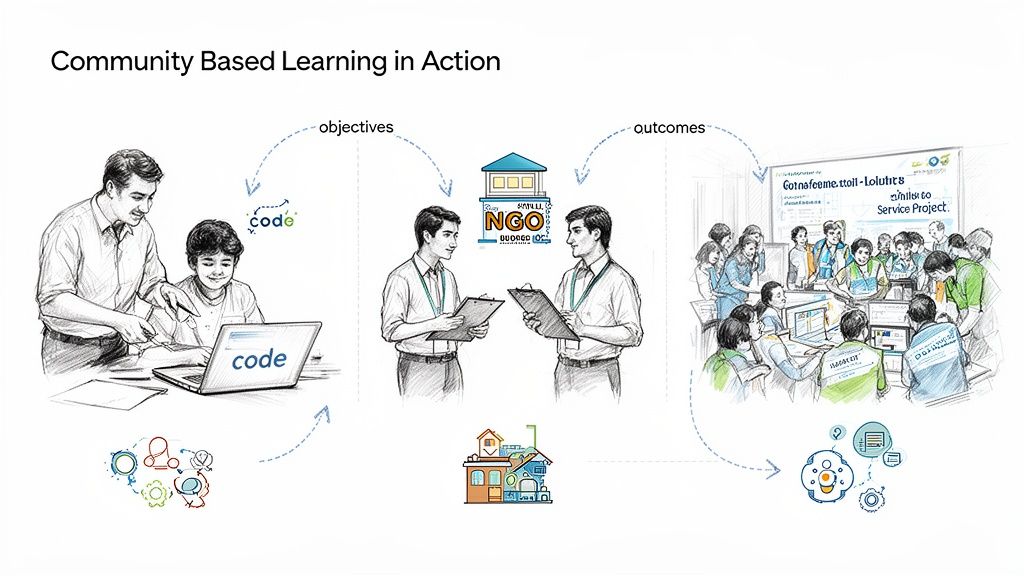
The theory behind community-based learning is solid, but seeing it work in the real world is what really drives the concept home. The beauty of this model is its flexibility—it can be adapted to almost any professional group or company goal. Let's walk through a few scenarios to get a feel for how you might put it to work.
Take a national tech association that’s looking to cultivate its next generation of talent. Instead of just hosting mixers, they partner with a local coding bootcamp for underrepresented youth. The association’s senior developers volunteer to mentor students as they tackle a capstone project—one that solves a genuine problem for a local nonprofit.
Everyone wins. The students get hands-on technical guidance and a foot in the industry door. The senior developers sharpen their own mentoring and leadership abilities. The nonprofit gets a much-needed tech solution, and the association solidifies its reputation as a community-minded organization. It’s a perfect example of a community of practice in action, where sharing knowledge creates real-world value.
Now, picture a large corporation that needs to train its rising stars. Rather than sending them to a typical management seminar, the company launches a community-based learning initiative. They assign a group of mid-level managers a complex challenge: help a humanitarian NGO optimize its supply chain for disaster relief.
Suddenly, these managers aren't just reading case studies. They're on the ground, collaborating to solve an urgent problem with real-world constraints. They have to lead a project where the stakes are incredibly high.
The results are tangible and easy to track:
You can even weave community-based learning into a standard industry conference. Imagine an event organizer adding a "day of service" where attendees apply their professional skills to benefit local organizations in the host city.
For example, marketers attending a conference could spend a day building campaign strategies for local small businesses that can't afford a big agency. This pulls the learning out of the session rooms and puts it directly into the community.
These programs aren’t just feel-good initiatives; they deliver powerful results. A major research synthesis that reviewed 78 separate studies found community-based learning improved vocational outcomes by 42% and boosted personal empowerment by 35%. In another striking example, Cambodian programs using this model maintained an incredible 95% training continuity during the pandemic, highlighting its resilience. You can explore the full research findings on these impressive outcomes.
These examples show that with a bit of creativity, any organization can transform learning from a passive activity into meaningful, impactful action.
While the principles behind community-based learning are powerful, the reality is that they can be incredibly messy to manage. Without the right system, you're left juggling spreadsheets, endless email threads, and a dozen different chat apps. It’s chaotic.
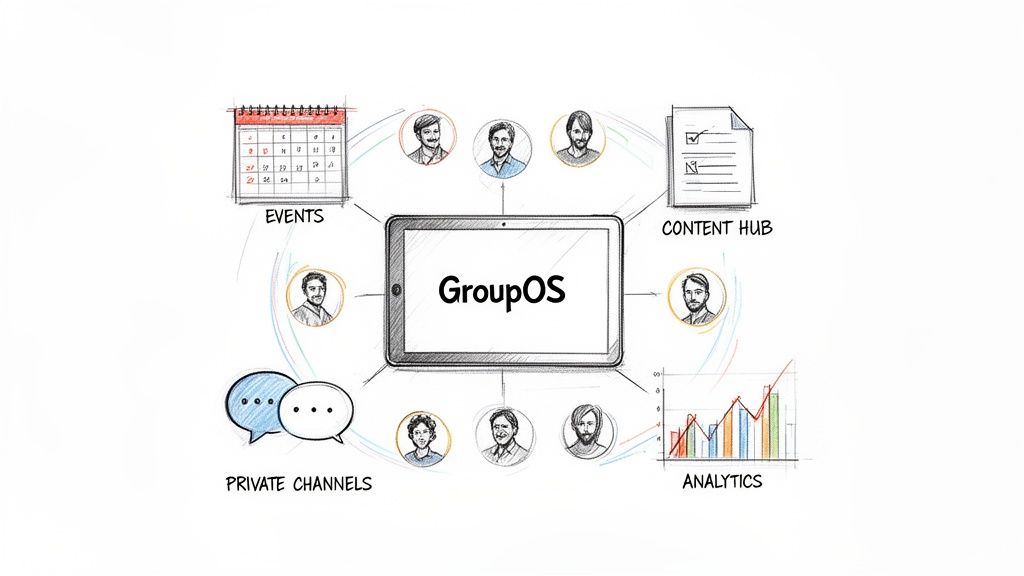
This is where a dedicated community platform like GroupOS comes in. It acts as the central hub for your entire learning program, turning great ideas into something you can actually manage, measure, and scale. Think of it as trading a messy toolbox of mismatched tools for a purpose-built workbench where everything has its place.
A platform provides the backbone for your community-based learning projects. It’s the single place where you can coordinate schedules, share essential resources, keep conversations on track, and see what’s actually happening. Without this central hub, vital details fall through the cracks, and you end up with disorganized efforts and missed learning opportunities.
A great platform doesn't just add more work; it integrates all the administrative tasks so they support the learning instead of getting in the way. This frees you up to focus on what really matters: creating an impact for your members.
GroupOS was specifically designed to handle the practical needs of a learning community. Here’s how it works:
Ultimately, the right technology gives you the foundation to grow your programs effectively. It’s what helps you move from running a single, manual project to developing a full portfolio of impactful learning initiatives.
While GroupOS offers a robust suite of features for this, you might also discover how our app can support your community learning and engagement efforts as another helpful tool in your stack.
Choosing the right platform is a critical decision. To help with your research, you can explore our detailed breakdown of the best online community platforms on the market today. By putting the proper system in place, you can build programs that are organized, engaging, and capable of delivering real, measurable results for everyone involved.
So, you’ve launched your community-based learning program. The energy is high, people are showing up, but how do you really know if it’s working? Counting heads at an event or tallying content downloads only tells you a fraction of the story.
To prove the real value of your efforts, you need to measure what actually matters: skill growth, behavioral change, and tangible business results. It’s the difference between knowing people attended a workshop and knowing they can now do their jobs better because of it.
Think of it like a fitness tracker. It doesn't just count your steps; it monitors your heart rate, sleep quality, and active minutes to give you a complete picture of your health. A smart measurement strategy for community-based learning does the same. It blends the "what" (quantitative data) with the "why" (qualitative stories).
This is where a community platform like GroupOS becomes essential. It automates the tracking of digital engagement, giving you the hard data you need without the manual headache.
To get that complete picture, you need to track metrics across four key areas:
When you can draw a straight line from a member learning a new skill to them renewing their membership, you've found the holy grail. You're not just running programs; you're proving undeniable business value.
To help you get started, here’s a simple framework for building your own dashboard. Think of this as your command center for tracking the impact of your learning initiatives and reporting on your success.
This table provides a starting point for defining the Key Performance Indicators (KPIs) that connect daily community activities to high-level business objectives.
| Metric Category | Key Performance Indicator (KPI) | How to Measure (Example) |
|---|---|---|
| Learning Outcomes | Skill Proficiency Growth | +25% score increase on post-program skill tests. |
| Engagement | Active Participation Rate | 70% of enrolled members attended at least two project meetings. |
| Community Impact | Partner Satisfaction Score | 9/10 average rating from community partner feedback surveys. |
| Business KPIs | Member Retention Lift | 15% higher renewal rate among program participants vs. non-participants. |
By consistently tracking these interconnected metrics, you move beyond simple activity reports. You start telling a powerful story about how your community drives growth, retention, and real-world results for both your members and your organization.
Thinking about launching a community-based learning program can bring up a lot of questions. It's a new approach for many, and it’s natural to wonder about the practical details. Let's walk through some of the most common questions community leaders ask when they're getting started.
You don't need a year of planning to get this off the ground. While the timeline depends on your ambition, you can realistically launch a focused, smaller-scale program in as little as 4-6 weeks.
That timeframe covers the essentials: finding a great partner, hashing out a clear and achievable project, and putting together the basic materials your members will need, like project briefs or guides for reflection. The key is to start small. This lets you learn the ropes, build some early wins, and refine your process before you tackle something bigger.
The best partnerships click because your missions align. A great place to start is with local non-profits, interesting startups, or even educational institutions whose work connects with your members' skills and your community's overall purpose. Think of it as a two-way street—a successful partnership benefits everyone involved.
Before you even start sending emails, get clear on what your community brings to the table and what you want to get out of the collaboration. Walking into that first conversation with a clear vision makes it infinitely more productive and sets you up for a strong start.
This is the most important question of all. The answer is to make sure every single activity is directly tied to a clear outcome. Real value isn't just about feeling good; it’s about creating measurable results for your members and your business.
We like to think of it as a success hierarchy. It’s a simple model that shows how to connect the dots between learning, engagement, and business impact.
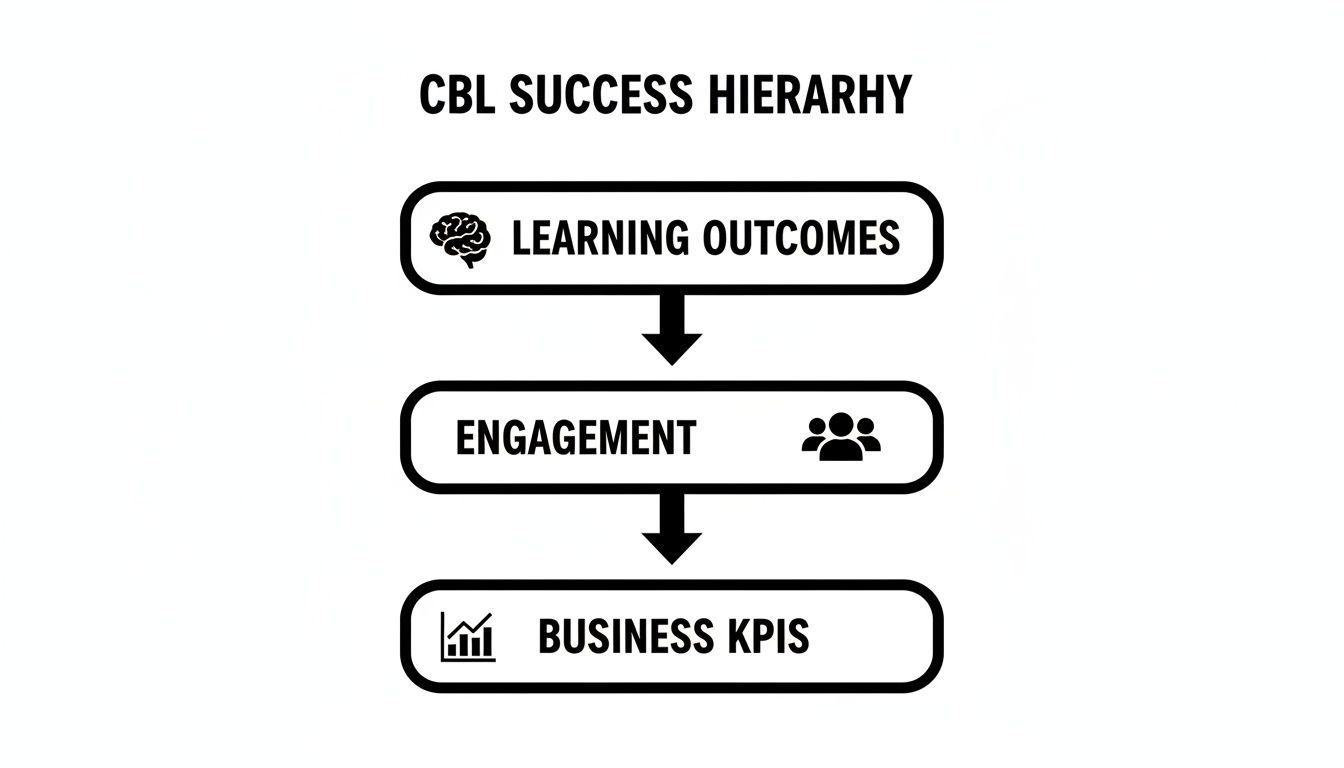
As you can see, it all starts with delivering tangible learning outcomes. When members feel they are genuinely growing and gaining skills, their engagement naturally follows. That increased engagement, in turn, directly fuels the business KPIs that prove your community's value.
Ready to build, manage, and scale your own community-based learning programs? GroupOS provides all the tools you need in one unified platform. Start your free trial today.