April 2, 2026
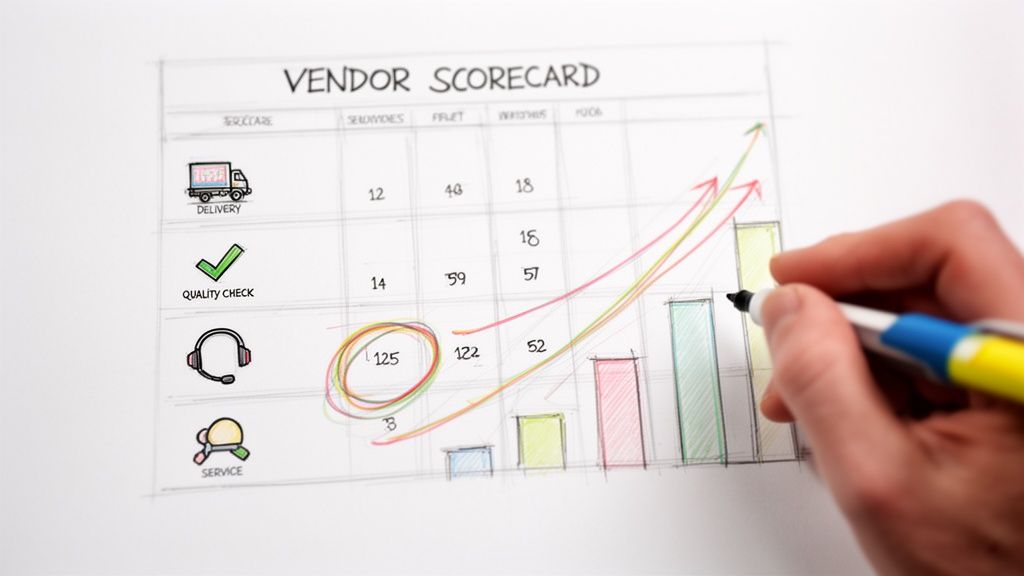
If you’re managing vendor relationships based on gut feelings, you’re setting yourself up for a world of risk. I’ve seen it happen too many times. A vendor scorecard template is one of the most powerful tools you can have in your arsenal, because it pulls your evaluations out of the realm of opinion and into the world of objective, actionable data. This isn't just about grading your suppliers; it’s about creating a shared roadmap for success.
Let's be real—trying to manage critical partnerships with a mix of intuition and scattered notes is not just inefficient, it's dangerous. A vendor scorecard template brings a formal, consistent process to the table. Whether you're an event planner juggling dozens of sponsors or a community manager vetting a new tech partner, a scorecard provides the clarity and consistency you need to operate effectively.
The shift in communication is immediate and powerful. Instead of having a vague conversation about "poor service," you can point to a specific, agreed-upon metric. For example, "Support response time slipped from an average of 4 hours in Q1 to 12 hours in Q2." That kind of objectivity is what builds strong, transparent partnerships.
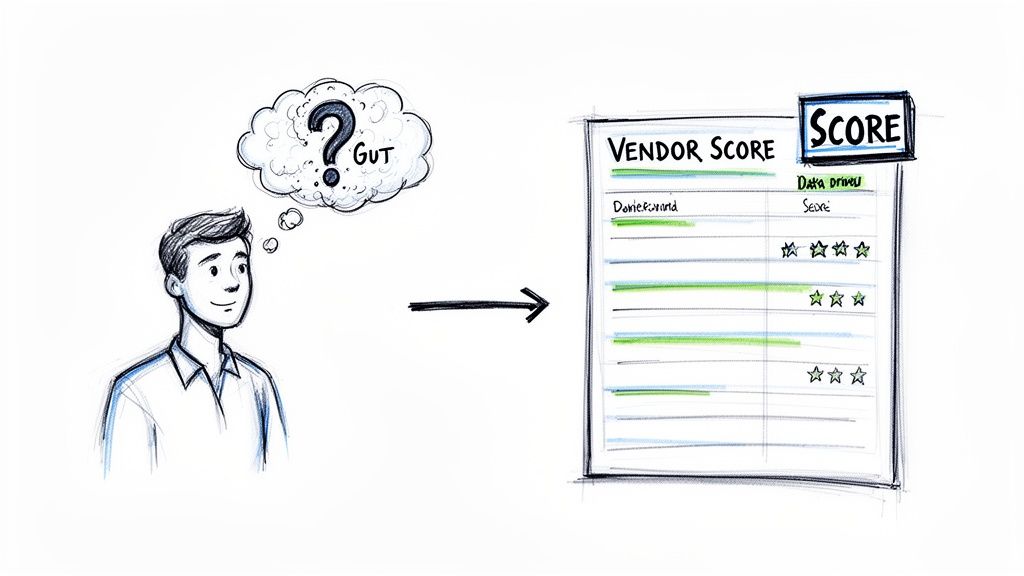
A well-designed scorecard is far more than a report card; it's a proactive management tool. It helps you catch downward trends long before they become catastrophic failures, giving you the chance to step in and work on a solution with your vendor. This approach fosters a culture of accountability where expectations are crystal clear and performance is measured fairly.
The data backs this up. In my world of professional associations and event management, I’ve seen companies using structured scorecards achieve up to a 15% improvement in supplier performance within the first year alone. Critical metrics, like on-time delivery, can jump from a shaky industry average of 85% to a solid 95% or more. What’s more, Ramp.com reports that 78% of organizations that segment vendors with scorecards see 20% better contract compliance.
A vendor scorecard is a conversation starter, not a final judgment. Its real purpose is to align expectations and build a framework for continuous improvement, turning reactive fire-fighting into proactive partnership management.
At the end of the day, the goal is to create a shared definition of what "good" actually looks like. When both you and your vendor are looking at the same data, the entire dynamic changes. Conversations become collaborative instead of confrontational. For any organization, it's also vital to understand the distinct roles your partners play, such as a dedicated Managed Service Provider.
A scorecard system gives you a clear path to:
By implementing a vendor scorecard, you move past guesswork and establish a system that drives quality across your entire network of partners. This is fundamental for making informed decisions, especially when you integrate that data with platforms like GroupOS to get a full view of partner performance. You can learn more about how to power your decisions with the right analytics and insights in our related guide.
Your scorecard is only as good as the data you put into it. Grabbing a generic template is a fine starting point, but the real magic happens when you customize it to what success truly means for your organization. A one-size-fits-all approach just falls flat when you're comparing partners as different as night and day.
Think about it: the KPIs for your annual conference's AV provider are worlds away from those for the SaaS vendor running your online community. You're grading the AV team on their on-site responsiveness and whether the mics cut out mid-keynote. For the software company, you’re laser-focused on uptime, data security, and how quickly they roll out new features.
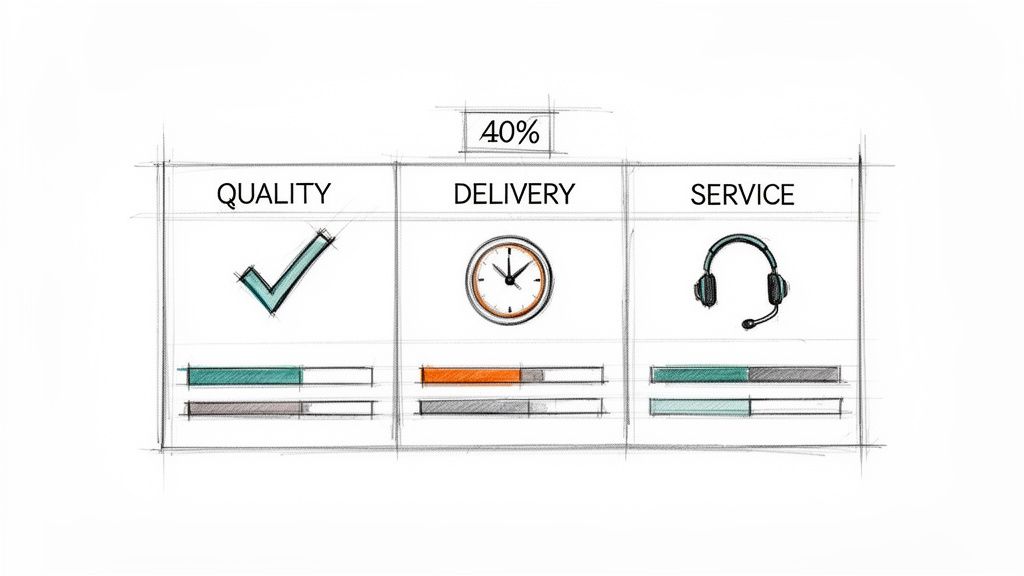
To avoid drowning in a sea of data points, it's best to group your metrics into a few high-level categories first. This gives your evaluation a solid structure and keeps you from getting tunnel vision on just one aspect of performance. Most vendor partnerships can be boiled down to three essential pillars:
For membership organizations, a sharp, data-driven scorecard is a massive advantage. In fact, research from Ivalua in 2026 shows that teams who automate their scorecards report 28% higher innovation scores. They do this by zeroing in on strategic KPIs like SLA compliance and setting concrete targets—for instance, a sub-three-day issue resolution time. This level of detail is exactly what you need to pick partners who will grow with you.
The goal isn’t to track everything; it's to track the right things. A scorecard with five highly relevant metrics is infinitely more useful than one with twenty generic ones that don't align with your goals.
Once your categories are set, it’s time to get specific. Ambiguous criteria like "Good Support" are a recipe for subjective scores and useless data. You need to define exactly what "good" looks like for every single metric, making it as quantitative as possible.
Let’s take that vague "Responsiveness" metric and make it work. Instead of just giving a gut-feeling score, build a clear rubric:
Suddenly, there's no room for guesswork. This creates a clear, objective standard for everyone on your team and ensures every score is backed by real data.
This is also how you start connecting vendor performance to your bigger organizational goals. Tracking a vendor's ticket resolution time is one thing, but understanding how that impacts member satisfaction is another. After all, these KPIs are just one piece of the puzzle. You can learn more about the broader picture by exploring key community engagement metrics.
To help you get started, we've broken down some of the most critical KPIs you can use. The key is to see these as a starting point and adapt them to your specific needs.
| Category | Example KPI | Measurement Method | Good vs. Bad Example |
|---|---|---|---|
| Quality | Product Defect Rate | Number of defects or bugs reported per 100 units or per month for software. | Good: <1% defect rate. **Bad:** >5% defect rate requiring constant patches. |
| Delivery | On-Time Delivery (OTD) | Percentage of orders or project milestones delivered on or before the agreed-upon date. | Good: 99% OTD. Bad: Consistently missing deadlines, causing project delays. |
| Service & Comms | First Response Time (FRT) | Average time taken to provide an initial response to a support ticket or inquiry. | Good: Under 1 hour for critical issues. Bad: Taking 24+ hours to acknowledge a problem. |
| Financial Health | Price Competitiveness | The vendor's pricing compared to market averages for similar quality and service. | Good: Pricing is at or below market rate with clear value. Bad: Hidden fees and frequent, unexplained price hikes. |
This table should give you a solid foundation. Remember to sit down with your team to determine which of these—or which new ones you create—truly reflect what your organization values in a partner.
You've got your list of criteria. Now comes the part that turns a simple checklist into a powerful decision-making tool: assigning scores and weights. It’s a common mistake to just average the scores for each vendor. The reality is, not all criteria carry the same weight.
Think about it. When you're vetting a tech partner for your big annual conference, is their hardware delivery speed as critical as their price? For some, flawless reliability is worth a premium. For others, a tight budget is the number one constraint. This is exactly why a weighted system is so important. It forces you to define what truly matters.
The best way to do this is to get your key stakeholders in a room and ask a blunt question: "What does success look like for this partnership?" This conversation is where you'll figure out how to distribute your 100 percentage points across the criteria you chose. Treat it like a budget—you only have so much "importance" to go around, so you have to spend it wisely.
Let’s say you’re building out a vendor scorecard template for a new software platform you need. After talking with your team, your priorities might shake out like this:
This simple breakdown immediately tells a story. A vendor could be the cheapest on the market, but if their product is a mess and their support is MIA, their score will take a nosedive. This weighted score gives you a much more honest assessment of their potential value to your organization.
A weighted system ensures your final score isn't just a number, but a true reflection of your strategic goals. It moves your scorecard from a simple audit to a genuine decision-making asset.
Once your weights are set, you need to tackle ambiguity head-on. What's the real difference between a '3' and a '4' on your scale? If you don't define it, everyone on your team will have their own interpretation, and your data will be all over the place.
This is where a scoring rubric becomes your best friend. A rubric is just a simple chart that spells out what each score means for every metric. It’s how you turn gut feelings into consistent, objective data.
Here's a quick example of a rubric for "Customer Support Response Time" using a 1-5 scale:
| Score | Definition |
|---|---|
| 5 (Excellent) | We get an initial response in under 30 minutes. |
| 4 (Good) | The initial response lands in our inbox within 30-60 minutes. |
| 3 (Average) | We hear back within 1-4 hours. |
| 2 (Poor) | It takes 4-8 hours for them to get back to us. |
| 1 (Unacceptable) | We're waiting more than 8 hours, or we get no response at all. |
By building out a simple guide like this for all of your KPIs, you ensure that anyone evaluating a vendor—whether it's you, a project manager, or a new hire—will arrive at the same score for the same performance. This level of consistency is what makes a vendor scorecard system trustworthy and, ultimately, incredibly effective.
Alright, let's get our hands dirty and build the actual scorecard. The good news is you don't need any fancy or expensive software for this. The tools you already have—Excel or Google Sheets—are perfectly capable of creating a smart, automated scorecard that does the heavy lifting for you.
The trick is to build a living document, not just a static checklist. By setting up a few simple formulas, your sheet will automatically calculate weighted scores and final ratings as you input your data. This immediately removes any chance of manual math errors and gives you instant, reliable results.
First things first, we need to structure the spreadsheet. A clean layout is the backbone of a good template. I always start with four essential columns.
For that "Weighted Score" column, the formula is as straightforward as it gets: =B2*C2. This just multiplies the weight you assigned by the score you gave. Then, at the very bottom of this column, a SUM formula will tally up all the weighted scores to give you a final, definitive number for that vendor.
If you're starting completely from scratch and need a little inspiration, it can be helpful to see what others have done. You can often find great ideas for layouts and formulas in existing templates like these 12 Google Sheet Templates.
The basic logic behind this entire process is quite simple, and it’s what makes a scorecard so effective.
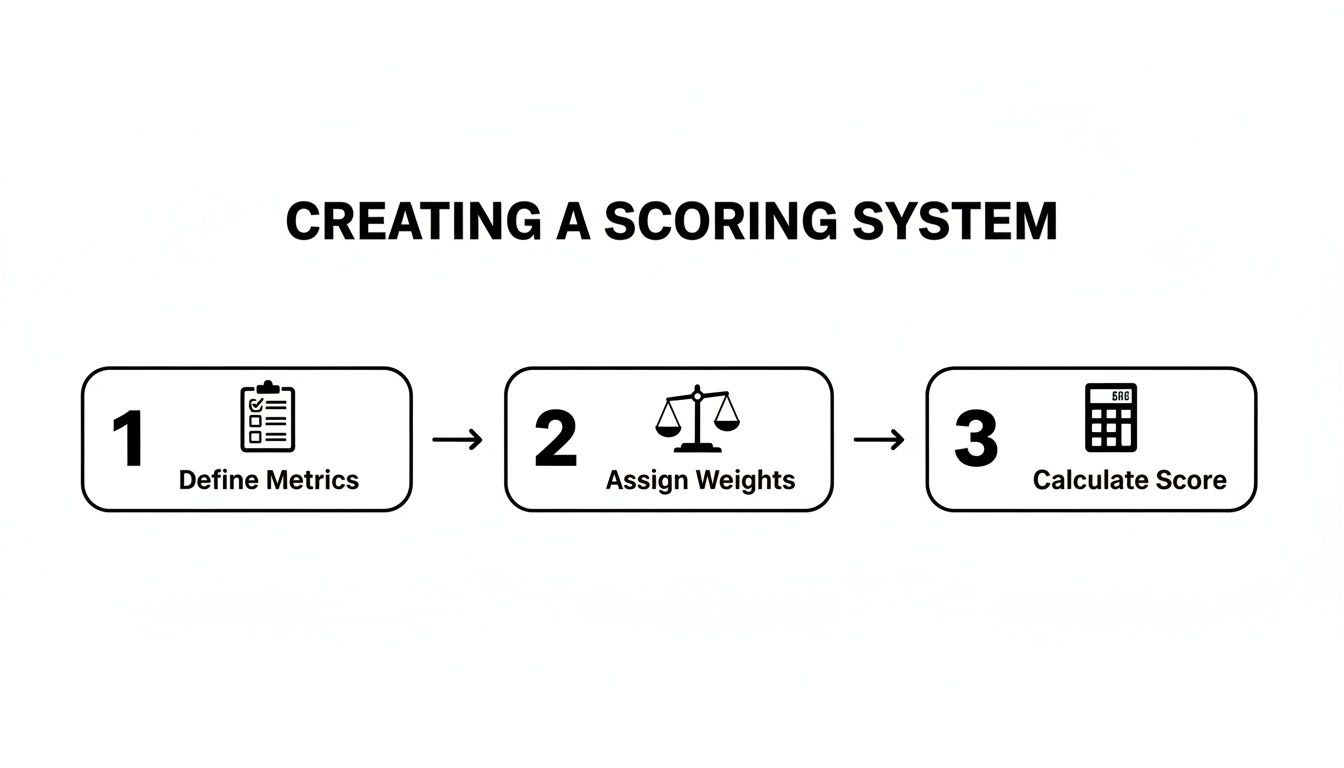
This cycle—defining what matters, deciding how much it matters, and then scoring it—is the core of any solid evaluation system. The best part is how easily it translates to a simple spreadsheet.
With the basic structure in place, a couple of small tweaks can make your scorecard much more powerful and easier for your whole team to use.
I highly recommend using Data Validation in your "Score" column to create a dropdown menu. This forces everyone to use the exact same scale (like 1, 2, 3, 4, 5) and eliminates typos. It's a simple move that keeps your data clean and consistent, which is absolutely vital for fair comparisons. Data consistency is a huge topic, and if you've ever struggled with it, you know how tricky overcoming data integration challenges can be.
Next, use Conditional Formatting on your "Score" and "Final Score" cells. This feature automatically changes a cell's color based on its value, turning your sheet into a visual dashboard.
A great way to use conditional formatting is the classic traffic light system. I set mine up so high scores (4-5) turn green, average scores (3) turn yellow, and low scores (1-2) turn red. It gives you an instant, at-a-glance read on vendor performance.
This visual feedback is incredibly useful. Instead of getting lost in a sea of numbers, your eyes are immediately drawn to the red flags. It transforms your scorecard from a data sheet into a true decision-making tool. To give you a head start, we've put together a downloadable 2026 Vendor Scorecard Template with all of these formulas and formatting already built in.
So you’ve crunched the numbers and filled out the vendor scorecard template. What now? A lot of people treat that final score like the end of the story—a pass or fail grade. But that's where they miss the point.
The real power of a good scorecard isn't in judging past performance; it's in shaping a better future. Think of it less as a report card and more as a conversation starter. It’s your best tool for turning a simple vendor relationship into a true partnership built on continuous improvement.
When you shift your mindset this way, you transform those dreaded performance reviews. They stop being tense, one-sided critiques and become collaborative sessions where everyone is focused on the same goal: making things better for both of you.
Bringing up a scorecard for the first time, especially with a long-term partner, can feel a bit awkward. You can't just email it over with a "see attached" and expect a good outcome. That's a recipe for a defensive, unproductive conversation.
You need to frame it carefully. Schedule a dedicated meeting and present the scorecard as a tool for transparency and mutual success. It’s not about policing them; it’s about clarity.
Try opening with something like, “We’re rolling out a new feedback process to help us strengthen our most important partnerships, and we wanted to walk you through it first.” This shows respect and positions them as a key partner, not a subordinate.
The most successful vendor reviews are dialogues, not monologues. When a vendor sees their scorecard as a fair, data-backed tool for alignment, they become an active participant in their own improvement.
Walk through each criterion, explaining how you landed on each score. This transparency is non-negotiable. It proves the evaluation is rooted in objective data, not just someone's opinion, which immediately defuses tension and opens the door for a real discussion.
Once you've reviewed the scores, the conversation should pivot immediately to what's next. Don’t get stuck dwelling on past mistakes. Use the scorecard's data to look forward and set clear, collaborative goals.
Let's say their score for "Issue Resolution Time" was lower than you'd like. Instead of just pointing it out, work with them to define what a realistic, improved target would look like for the next quarter.
This often means getting your own house in order, too. Getting meaningful results requires input from different teams within your own company. If you're looking for ways to get everyone on the same page, our guide on improving cross-departmental collaboration has some great, practical tips.
Here’s a simple framework for setting those goals together:
Identify 1-2 Focus Areas: Don't overwhelm them by trying to fix everything at once. Pick the one or two areas from the scorecard that are either the lowest-scoring or would have the biggest positive impact.
Define a SMART Goal: Get specific. A vague "do better" doesn't help anyone. A great goal is Specific, Measurable, Achievable, Relevant, and Time-bound. For instance, "Let's work together to improve the on-time delivery rate from 92% to 97% by the end of Q3."
Co-create an Action Plan: This is the most crucial part. Ask them directly: "What steps can we take together to achieve this?" They are the experts on their own processes and often have the best insights into the root causes of any issues.
By using the scorecard to build a forward-looking action plan, you completely change the dynamic. The review becomes a strategic working session, solidifying your partnership and driving real, measurable improvements for your business.
As you start putting scorecards into practice, a few questions always seem to come up. Let's walk through some of the most common ones I hear from teams who are just getting started. Getting these answers straight will help everyone on your team feel confident and ready to go.
There’s no single right answer here—it really comes down to how critical the vendor is to your success.
For your most important partners, think quarterly. I'm talking about the software platform that runs your community or the A/V company that handles your flagship annual conference. A quarterly review gives you a regular rhythm to catch any performance issues before they snowball into major headaches.
On the other hand, for a vendor you only use for a specific project, like the printer for your event signage, a single review after the job is done is probably all you need. An annual check-in can also work for less-critical, ongoing suppliers. The goal is to set a predictable schedule so these performance chats become a normal part of doing business together.
Hands down, the most common mistake I see is making them way too complicated. It’s easy to fall into the trap of wanting to measure everything, but I’ve seen teams create scorecards with 30 or 40 different metrics. The result? Nobody wants to fill them out, and the data is too noisy to mean anything.
Your scorecard's power lies in its simplicity. Stick to the 5-10 KPIs that truly define success for that specific partnership. A focused scorecard that actually gets used is infinitely more valuable than a perfect, comprehensive one that sits in a folder collecting dust.
This is a great question because it requires a bit of finesse. You don't want a long-term partner to feel like they're suddenly on probation. The key is to frame this as a positive step forward for the relationship, not a new way to micromanage them.
I suggest opening the conversation with something like, "We're working on being more intentional with our feedback for key partners to make sure we're both set up for success, and we'd love to get your thoughts on this."
Show them the scorecard, explain the criteria you chose, and genuinely ask for their input. When you position it as a tool for transparency and mutual growth, most vendors will welcome the clarity it provides. It shows you value the partnership enough to invest in making it better.
Ready to bring your vendor management, member engagement, and event planning under one roof? GroupOS gives you the integrated tools to stop juggling spreadsheets and start building a stronger professional network. See how you can streamline your operations with a single platform.