May 9, 2026
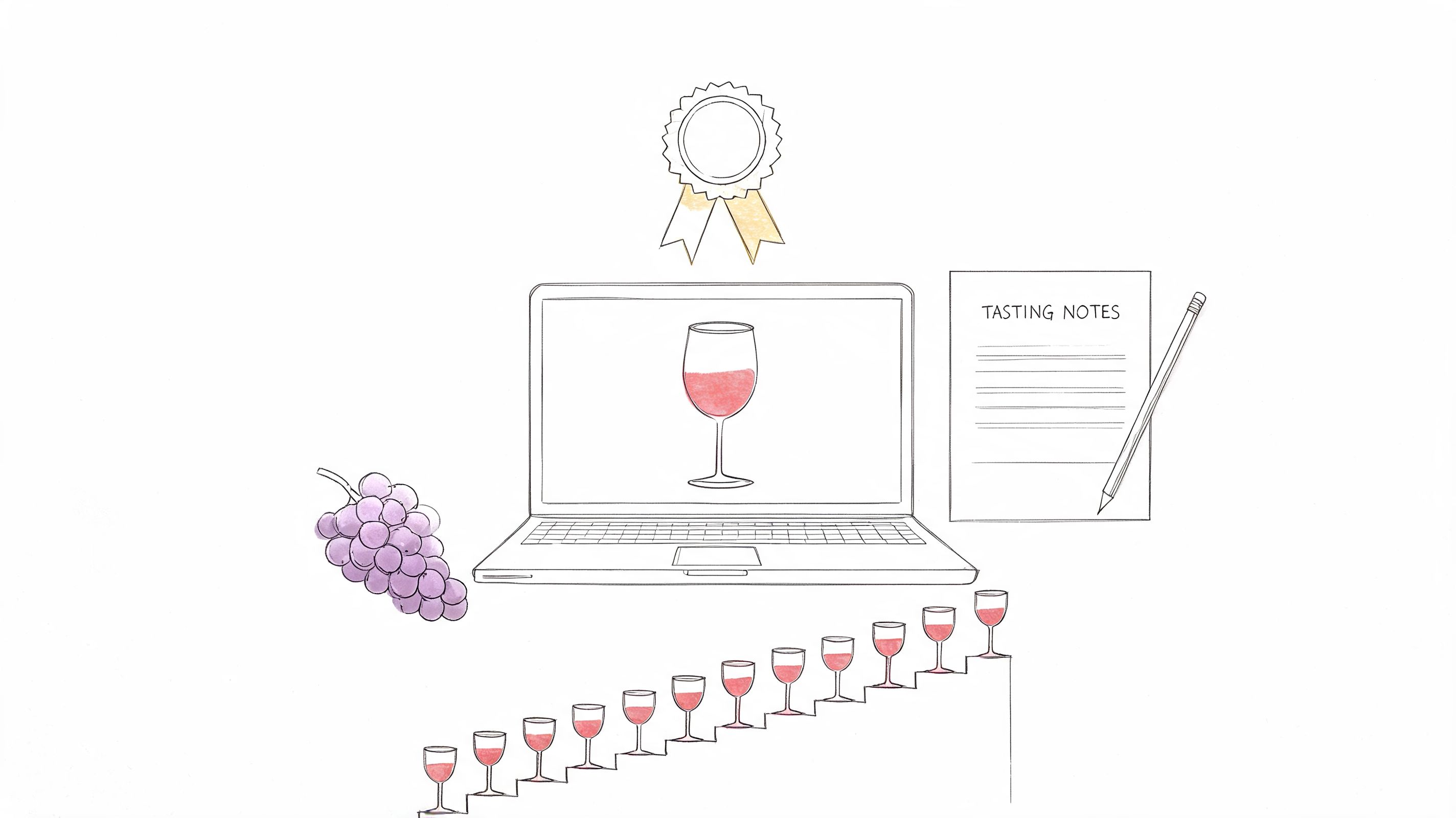
You're probably here because wine stopped being “just an interest” a while ago.
Maybe you're the server who keeps getting handed the Burgundy table. Maybe you run a bottle shop and want more authority when customers ask why one Rioja costs more than another. Maybe you've been the unofficial wine person in your friend group for years, and now you're wondering whether that curiosity could become a real credential, or even a career.
That's where sommelier certification online gets appealing. It promises a way to study seriously without quitting your job, moving cities, or waiting for the right in-person course to appear. But once you start searching, the options blur together fast. Some programs are built for restaurant service. Others are better for retail, education, or trade roles. Some are tightly proctored. Others are more flexible. And many guides talk as if there's one “best” path, when the better question is simpler: best for what job?
I've trained young floor staff, worked with retail teams, and watched talented people waste time on the wrong credential for their goals. The right course can sharpen your palate and your résumé. The wrong one can leave you with a pile of flashcards and no clear next move.
At the end of a busy Saturday shift, a young server stays behind to ask the question that starts a lot of wine careers: “I know I love this. How do I know if I should study it professionally?”
The answer is usually less romantic than people expect. You are ready when curiosity starts asking for structure.
Liking Barolo, Champagne, or old-vine Zinfandel is a good beginning. Professional wine study asks for a different kind of discipline. You need to explain why a wine tastes the way it does, recommend it to the right guest at the right price, pair it with food under pressure, and handle service moments with calm judgment. Passion gets you to the door. Training teaches you how to work inside the room.
Online certification appeals to people at exactly this stage because it lets you test whether your interest can hold up under routine, deadlines, and tasting practice. WSET's 2022 annual report shows the scale of that interest, with more than 108,000 candidates sitting a WSET exam worldwide that year. That number matters for a simple reason. You are not odd for wanting to turn wine enthusiasm into a serious skill set while keeping your current job.
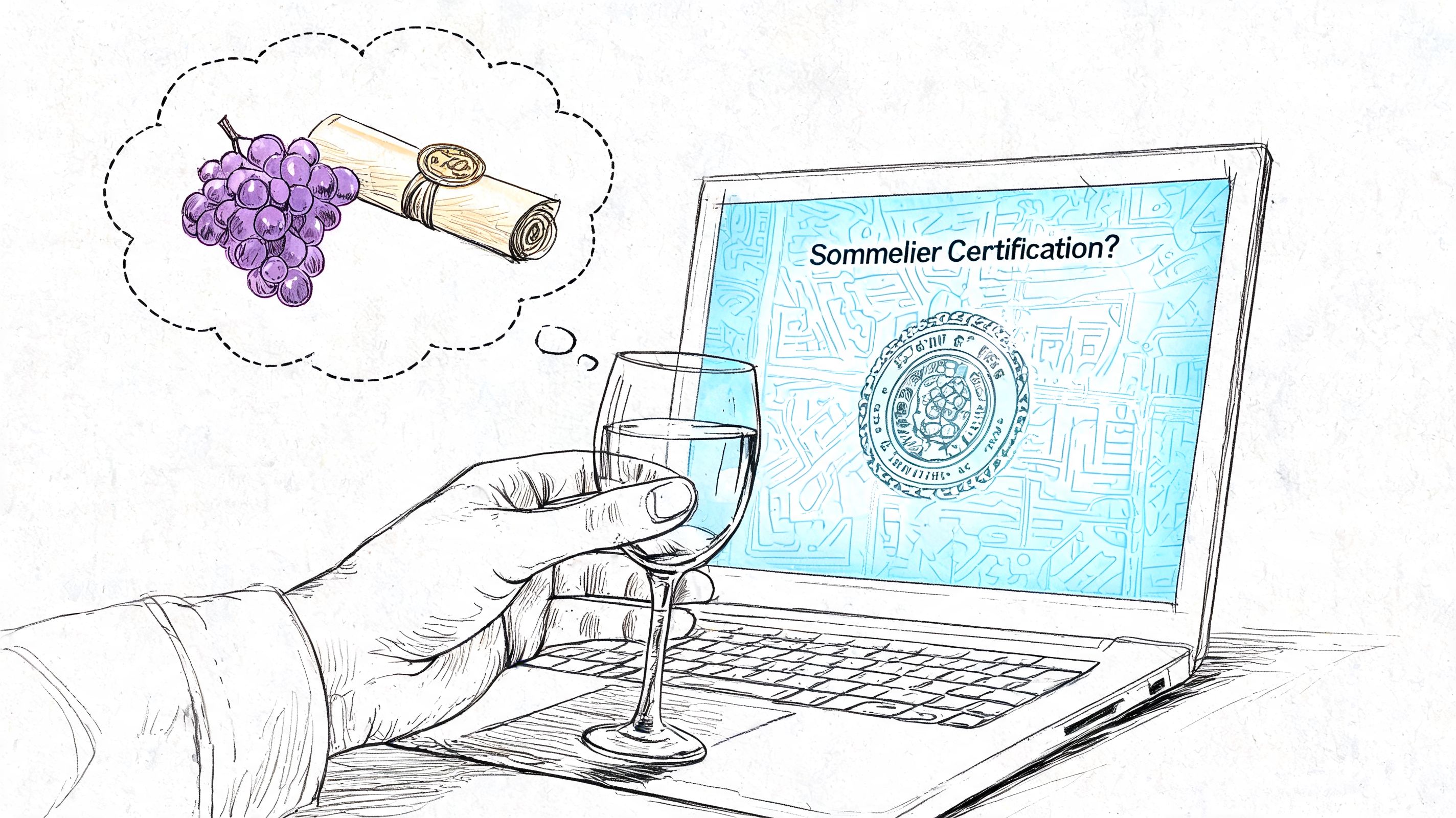
Beginners often treat certification like a badge purchase. Study a little, pass a test, add a line to LinkedIn, and expect doors to open.
Wine education works more like language school. First you memorize vocabulary. Then grammar starts to make sense. After enough repetition, you stop translating in your head and start recognizing patterns on sight. Wine theory develops the same way. Regions, grapes, climate, service standards, pairing logic, and tasting method begin as separate facts. With practice, they connect into a system you can use on the floor, in a shop, or in front of a class.
That is why the first question should not be, “Which program has the most prestige?” The better question is, “What job am I training for?”
Practical rule: Pick your first certification the way you would pick your first kitchen station. Choose the place that teaches strong habits under real working conditions, not the title that sounds most glamorous.
Those paths overlap, but they reward different strengths. A restaurant-focused student may need more emphasis on service mechanics and table-side communication. A retail buyer may benefit more from broad regional knowledge and commercial context. Someone headed toward teaching needs clear theory, tasting discipline, and the patience to explain the same concept five different ways.
This is also where hidden costs start to matter. Tuition is only one line on the bill. Tasting samples, glassware, maps, exam fees, travel for some assessments, and the study hours you carve out of your week all count. Students who do best online usually build systems to stay consistent. Techniques borrowed from gamification in e-learning programs can help turn repetitive drills, like flashcards, tasting grids, and map work, into a routine you keep.
A good certification can sharpen your palate and strengthen your credibility. The right one also fits the work you want five years from now.
You finish a late shift, open your laptop at the kitchen table, and line up three glasses beside a region map and a stack of flashcards. That is online sommelier study in real life. It feels less like casual video learning and more like building a second job around training your senses.
The format surprises new students. A good online program does not just send you recordings and hope for the best. It gives you a system for learning wine in the same way a conservatory gives a musician scales, exercises, and rehearsals. The screen delivers instruction. Your kitchen, dining room, or back office becomes the practice room.
Most online sommelier programs are built from four working parts.
Theory
You study grapes, regions, climate, viticulture, winemaking, storage, service, and food pairing. This part works like learning the map before driving the route. Without theory, tasting notes stay vague and hard to trust.
Structured tasting
You taste with a formal method, not just personal preference. The goal is to build repeatable judgment. Instead of stopping at “I like this,” you learn to describe acidity, tannin, body, fruit profile, alcohol, and possible origin with discipline.
Testing
Some programs focus on quizzes and written exams. Others add practical elements, especially if the path is closer to restaurant service. That difference matters if your career goal is hospitality rather than retail or education.
Pacing and accountability
Online study gives you flexibility, but it still needs structure. Deadlines, cohort meetings, tasting assignments, and recurring drills keep students from drifting. Even simple systems borrowed from gamified e-learning routines that improve practice consistency can help with repetitive work like map recall and tasting grids.
Students often assume online certification is lighter than in-person training. Usually, it is just different.
Expect timed exams, identity checks, strict technology requirements, and clear rules about how and where you test. Schools protect the value of the credential by controlling the exam setting as closely as they can. If a program is serious, the online format changes the location of the pressure, not the pressure itself.
That point matters for career planning. A hospitality worker hoping to move into floor service may need to prepare for practical evaluation later, even if the first level begins online. A retail professional may spend more energy on theory retention and category breadth. Someone aiming for education or staff training needs both strong recall and the ability to explain concepts clearly.
This confuses beginners more than any other part.
Your palate does not develop from watching a video. It develops from repeated comparison with guidance. The instructor gives you the method, the tasting order, and the questions to ask. You still have to buy or source the wines, pour carefully, take notes, and revisit your conclusions.
Piano lessons are a useful comparison. A teacher can correct posture, timing, and interpretation remotely. You still have to touch the keys every day. In wine study, the bottles are the keys, and your repetition builds the skill.
Treat each practice bottle like assigned reading. You are not there just to enjoy it. You are there to observe, test, and remember.
A normal study week often includes a mix of tasks rather than one long cram session:
This is why online learning suits students who can keep promises to themselves. Freedom helps, but only if you use it well. If your goal is a restaurant floor role, retail buying job, or future teaching path, the program works best when your weekly habits match the job you want later.
The biggest mistake I see is students choosing a wine credential for prestige before choosing it for function.
If you want a useful comparison, stop asking which organization is “best.” Ask which one trains you for the kind of work you want to do when the study materials are closed and a real customer is standing in front of you.
CMS trains closer to live performance. It suits people who picture themselves on a restaurant floor, handling service, pairing questions, and blind tasting under pressure. Its online entry point is the Introductory Sommelier Course. Among surveyed participants, 84% said the Introductory certification was their most recent experience, and 13% completed it virtually rather than in person, according to the Court of Master Sommeliers online course page.
WSET is broader and more academic in feel. It tends to work well for retail, wholesale, importing, marketing, and education because it builds systematic product knowledge that travels across many wine jobs.
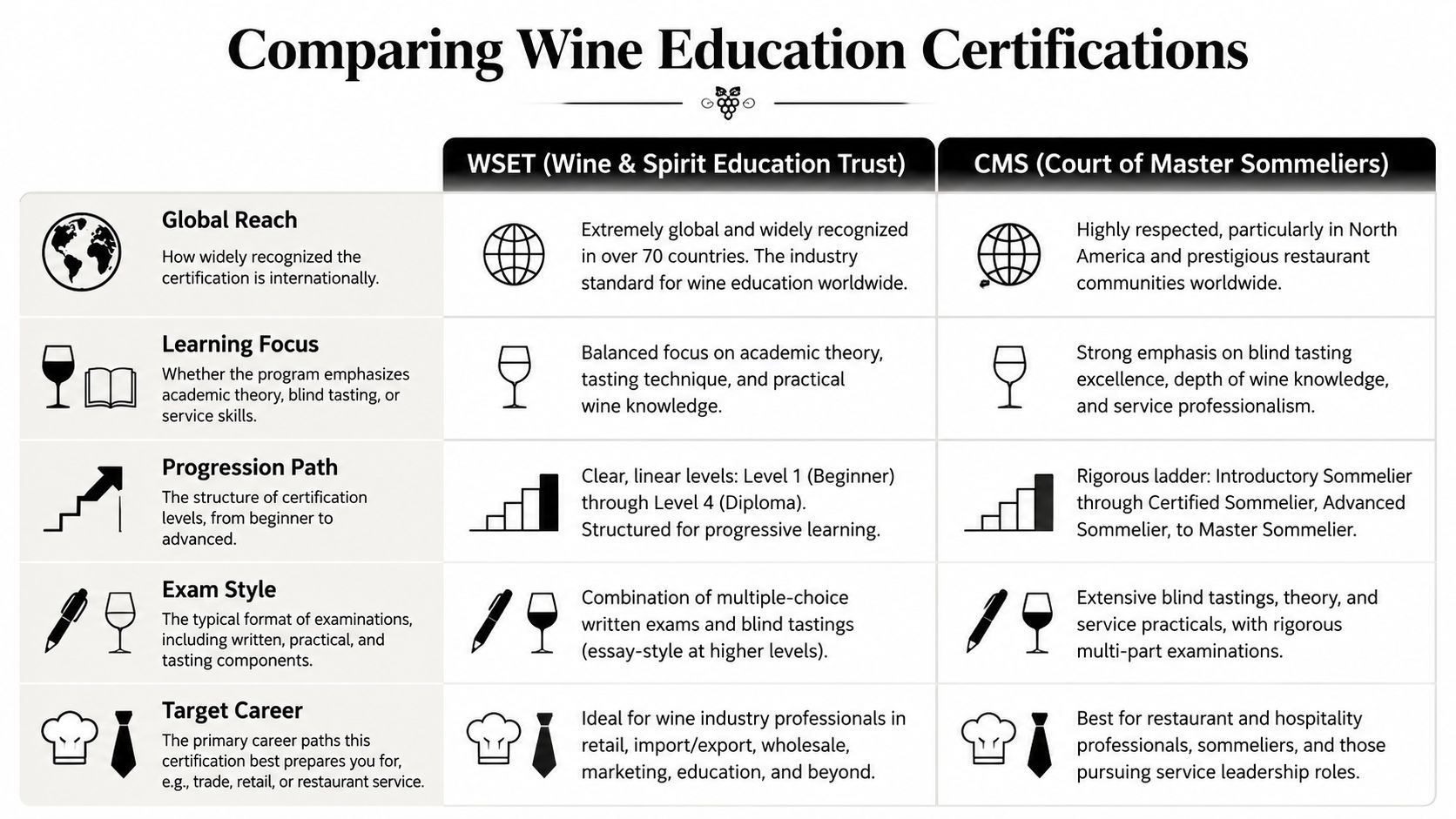
CMS is like training on the line during service. Timing matters. Delivery matters. Composure matters.
WSET is more like culinary school theory plus tasting lab. You study ingredients, technique, origin, and evaluation in a structured way that applies across many workplaces.
Neither approach is superior. They answer different professional questions.
| Organization | Primary Focus | Ideal Career Path | Online Entry Point |
|---|---|---|---|
| Court of Master Sommeliers | Service, tasting method, hospitality standards | Restaurant service, sommelier track, beverage leadership | Online Introductory Sommelier Course |
| Wine & Spirit Education Trust | Structured wine theory and tasting | Retail, distribution, education, broad wine trade roles | Online courses through approved providers |
| International Sommelier Guild | Online wine study with industry-oriented framing | Working professionals seeking flexible access | Fully online Level 1 and Level 2 |
| National Wine School | Self-paced certification study | U.S.-based students wanting flexible progression | Level One online |
For organizations building training pathways, this is also a useful design lesson. A certification should reflect the role it prepares people for. That's the same principle behind how to create a certification program that members can use in practice.
Online learning has real advantages. It also has blind spots. If you're honest about both, you'll make a better choice.
If you already work nights, weekends, or a changing hospitality schedule, online study can be a lifesaver. You can fit theory reading around shifts and build tasting sessions on your own timetable.
It also expands access. People who live far from major wine cities no longer have to wait for a local seminar to start learning formally.
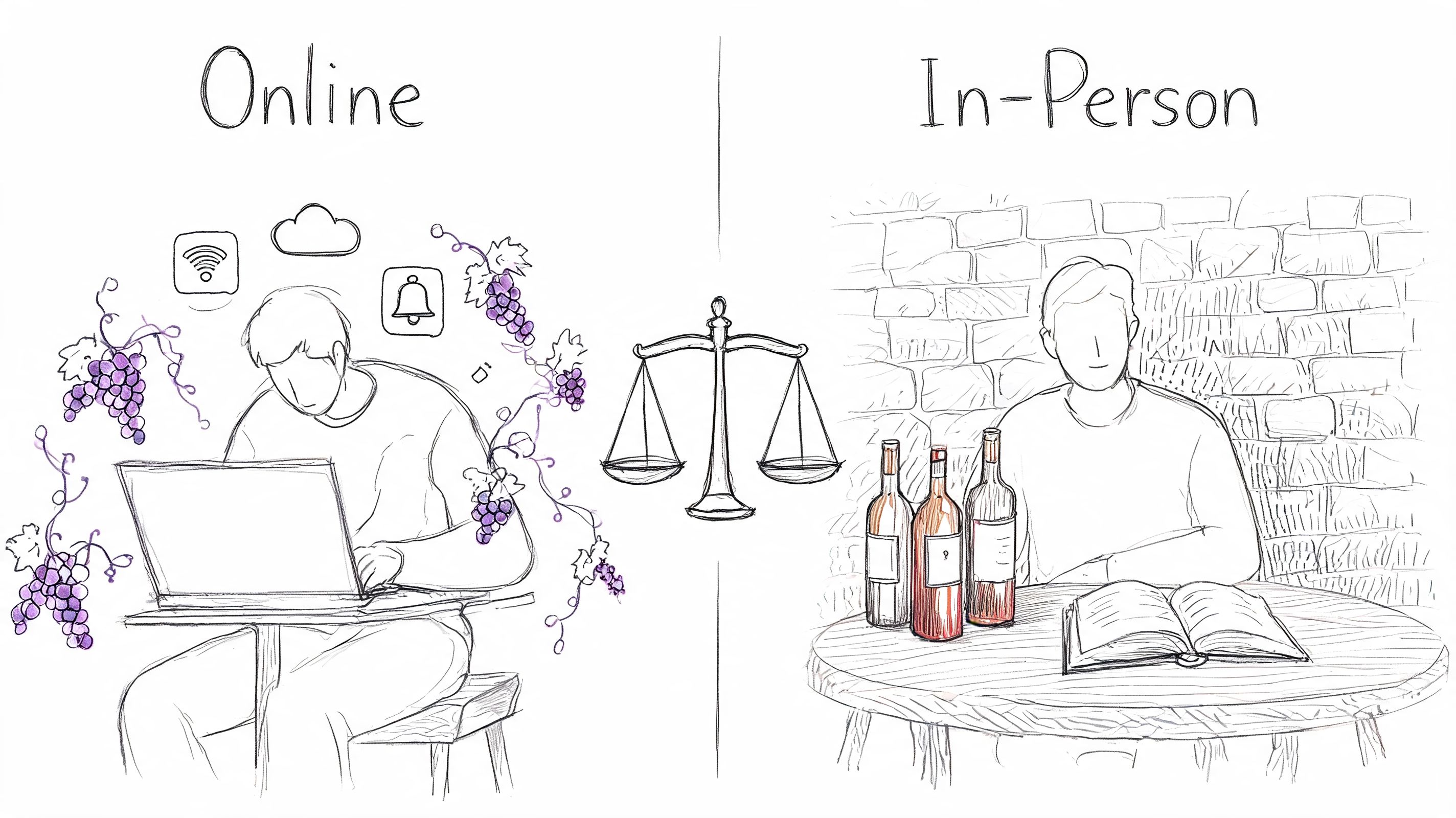
Wine isn't only theory. It's sensory, social, and physical.
You can read about acid, tannin, and body alone. You can even taste alone. But developing calibration is easier with other people. In a room, someone can say, “That isn't oxidation, that's reduction,” and your learning jumps forward. Online, those corrections can come slower unless you build a study group on purpose.
There are also practical barriers many guides gloss over. Online programs can involve time zone scheduling limits for proctored exams, specific webcam and technology requirements, and accessibility challenges for non-native English speakers, as noted on the Court of Master Sommeliers welcome and certification information page.
If your internet is unreliable, your home is noisy, or your work schedule changes every week, the obstacle may not be wine knowledge. It may be exam logistics.
This matters most for hospitality-focused students. Service is bodily knowledge. You learn by moving, speaking, presenting, pouring, opening, and recovering when things go sideways.
Online study can teach sequence and standards. It can't fully replace repetition in front of actual guests. That's why many serious candidates pair remote study with in-person tasting groups, restaurant floor shifts, or peer practice sessions. Structured cohort-based courses can help create that rhythm, even when the official curriculum is remote.
Choose online if these sound like you:
Choose in-person first if you know you need live correction, external structure, and hands-on service coaching from day one.
A student enrolls in an online wine course on Monday because the tuition looks manageable. By Friday, they realize the course fee was only the cover charge. The full bill includes bottles for practice, tasting tools, study materials, and sometimes travel later if their chosen track requires an in-person assessment.
That surprise catches people who choose by program name alone. A better starting point is your career goal.
If you want to work restaurant service, your budget usually needs room for repeated tasting and, in many cases, eventual in-person exam expenses. If you want a retail or sales role, you may be able to build momentum with theory-heavy study and a smaller practice setup at first. If you hope to teach or write, you need both range and repetition, which often means a longer timeline and a broader tasting budget. The right program is not always the cheapest or the most famous. It is the one you can finish and use.
Some schools make entry relatively accessible. The International Sommelier Guild offers fully online Level 1 and 2 courses, and some providers include longer access to materials than others, as noted in Napa Valley Wine Academy's earlier certification comparison.
But tuition is only the first line item. For many students, the primary spending happens in the practice phase.
Common costs include:
Wine study works a lot like learning a language. Paying for the course gets you the lessons. Fluency comes from repetition, correction, and regular exposure.
A short online certificate can fit into a busy season. A serious professional track takes longer because wine knowledge has to become usable under pressure.
Reading about Riesling is one thing. Calling its structure correctly in a blind tasting, then explaining it clearly to a guest or customer, is another. That second skill takes cycles of review. You revisit the same grapes, regions, climate patterns, and tasting markers until they stop feeling like trivia and start feeling like working knowledge.
This is why rushed study often disappoints capable students. They put in hours, but the knowledge does not stick because the schedule allowed for memorizing, not for recall.
Reality check: If your calendar only has room for reading, you are budgeting for theory exposure, not full skill development.
Start in layers.
First, the enrollment layer. What does the program itself include? Recorded lessons, instructor feedback, tasting samples, exam registration, and access length vary more than beginners expect.
Second, the practice layer. How will you taste often enough to make the material real? A hospitality candidate may need frequent benchmark wines and service drills. A retail candidate may get more value from broad regional sampling and producer familiarity. An education-focused student usually needs both breadth and note-taking discipline.
Third, the progression layer. What happens after the first credential? Some students stop after an entry-level certificate because it already serves their job. Others plan to keep climbing, which changes the math. A modest first step can become expensive if the next exam requires travel, more intensive tasting, or months of prep.
Before you enroll, write down four things:
That last point matters more than people think. A server trying to move into fine dining should plan very differently from a shop employee who wants stronger buying knowledge. One needs more service application. The other may need broader commercial wine familiarity and less formal tableside practice.
If your list looks tight, that does not mean you are not serious. It means you need a program that matches your current season of life. Start with a level you can sustain, build tasting habits you can afford, and let the next credential come after the first one has paid you back in skill.
You finish a shift, stay late to taste with the beverage manager, and start wondering whether formal study could change your trajectory. That is the right question. A sommelier certification can change your options, but its value depends on the job you want next.

A credential gives your interest a professional shape. It shows employers that you can study systematically, use wine vocabulary with precision, and follow a standard beyond personal taste. For a hiring manager, that matters because wine knowledge can be hard to measure in a short interview.
The career effect is also different depending on where you work. A restaurant server, a retail buyer, and a wine educator may all study the same grapes and regions, but they use that knowledge in different ways. Certification works like a toolkit. The hammer is useful, but only if you are building the right thing.
If your goal is hospitality service, certification can help you move from order-taking to guided selling. Guests trust recommendations more when you can explain a wine clearly, pair it with confidence, and stay calm under pressure. In that setting, the credential is often less important than the habits behind it: polished service, tasting discipline, and good judgment on the floor.
If your goal is retail or supplier sales, the payoff looks different. Buyers and customers need someone who can compare styles, explain value, and translate regions into plain language. A certificate can strengthen your credibility, but broad commercial awareness often matters just as much. You need to know what moves off shelves, what confuses shoppers, and how to recommend bottles across price points.
If your goal is education, training, or content, structured study helps even more. Teaching wine requires orderly thinking. You are not just naming facts. You are arranging them so someone else can follow the map. If that path interests you, it helps to study how strong educators package expertise into lessons, tastings, and scalable programs through platforms for selling online courses.
A first certification rarely changes a career overnight. It is better to see it as proof of direction than proof of mastery.
Employers still look for the same practical signals:
That distinction matters. A certificate may help you get the interview or earn more responsibility. It does not replace floor experience, sales skill, or the ability to handle a tough service.
A short visual overview helps clarify what that longer path can look like:
The strongest outcome is not the line on your resume. It is the range you build.
You get better at describing wine without jargon. You spot patterns between regions and styles faster. You become more useful to a restaurant team, more credible in a retail setting, and more prepared for leadership conversations about beverage programs, staff training, and guest experience.
That is why career goals matter more than prestige alone. For some students, certification supports a move into fine dining. For others, it strengthens retail authority or creates a path into education. The right program helps you do your current job better and prepares you for the next one with fewer surprises.
When students feel overwhelmed, I ask them to ignore brand names for a moment and answer one question: What job are you trying to become better at?
That usually clears the fog.
If your target is restaurant service, choose a path that respects live hospitality skills. If your target is retail, trade, or education, choose one that builds broad theory and structured tasting language.
A simple checklist helps.
Name your primary goal
Not “work in wine someday.” Be specific. Restaurant floor? Bottle shop leadership? Supplier sales? Teaching?
Match the credential philosophy to the job
CMS usually aligns more naturally with service-driven hospitality goals. WSET often aligns with broader wine trade goals.
Audit the delivery model
Is it self-paced, instructor-led, or mixed? Does that fit your temperament?
Many people enroll too quickly in this situation.
For teams and associations offering education, the same logic applies when evaluating platforms for selling online courses. Delivery quality isn't only about content. It's also about whether learners can persist, participate, and complete.
Use this quick fit guide:
Early in your career, the best program is often the one you will complete well.
Students sometimes shop for advanced identity before they've built beginner habits. That's like buying a Grand Cru cellar before learning how to store an open bottle. Start with a credible first step, taste widely, work where you can apply the knowledge, and let the next level reveal itself.
A student can build serious wine knowledge online. Whether that leads to a credible sommelier profile depends on the job you want.
For restaurant service, online study works like learning the map before you drive the route. It helps you understand regions, grapes, styles, pairings, and tasting method. The floor teaches the rest. You still need to open bottles cleanly, read a table, recover from mistakes, and stay composed during busy service.
If your goal is retail, distribution, or wine education, online study can carry more weight because those roles often depend more on product knowledge, communication, and structured tasting than on tableside service rituals.
They build their own tasting bench, one bottle at a time.
That sounds harder than it is, but it does require planning and a budget. You do not need trophy bottles. You need contrast and repetition. A sharp Sauvignon Blanc beside a fuller Chardonnay teaches more than one expensive bottle tasted alone. A cool-climate Pinot Noir beside a riper version from a warmer region helps your palate learn cause and effect.
A remote tasting routine usually works best with a few simple tools:
Students often underestimate the logistics here. Sourcing wine, splitting bottles, storing leftovers, and tasting regularly can become one of the hidden costs of online study.
Often, yes. Respect depends less on the word "online" and more on three things: the reputation of the credential, how well it fits the role, and whether you can apply what you learned under pressure.
A fine-dining manager may care most about service readiness. A wine shop owner may care more about range, regions, and your ability to explain a bottle to a customer in plain language. An importer or distributor may want broad knowledge, tasting discipline, and signs that you can keep learning fast.
Recognition rules can also vary by certifying body and chapter. As noted earlier, some online entry courses do not count the same way as in-person prerequisites for later exams. Check that before you enroll, especially if you plan to build toward advanced service-centered credentials.
Online study is usually one part of the path, not the whole path.
At the higher levels, wine knowledge behaves like musicianship. Reading the score matters. So does ear training, repetition, coaching, and live performance. In sommelier terms, that means tasting with purpose, getting feedback, working service shifts, and spending time with people who are stronger than you.
Students who progress furthest usually combine study with real-world repetition. They taste classics more than once. They revisit weak spots. They ask for correction.
Pick one credible entry-level program that matches your most likely career direction, then give yourself a serious trial period.
If you are drawn to restaurants, choose a path that keeps service in view. If you are more interested in retail, wholesale, or education, choose a path that builds broad wine fluency first. This career choice is less like buying the "best" bottle and more like stocking the right wine for the table in front of you.
Then test yourself. Study on schedule. Taste with structure. Notice how you feel when the work becomes repetitive and technical, not just romantic. Passion gets people started. Discipline keeps them in the field.
If you run a professional association, training community, or member network that wants to deliver structured education, host cohorts, and keep learners engaged beyond a single course, GroupOS gives you one place to manage memberships, events, content, communication, and community learning experiences under your own brand.