March 1, 2026
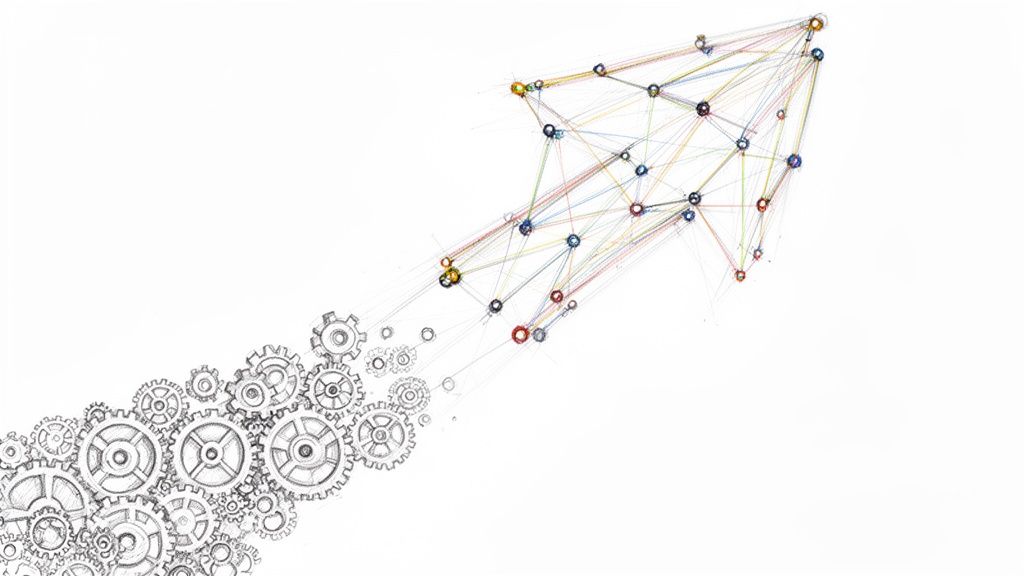
A scalable business model is one where your revenue can multiply without your costs keeping pace. It’s the key to achieving profitable growth—not just getting bigger, but getting better and more efficient as you expand.
Let's break this down with a simple comparison.
Imagine a local bakery that wants to double its sales. To make that happen, the owner needs to buy twice the flour and sugar, hire more bakers, and maybe even rent a second storefront. The costs rise almost directly in line with revenue. This is a classic example of linear growth.
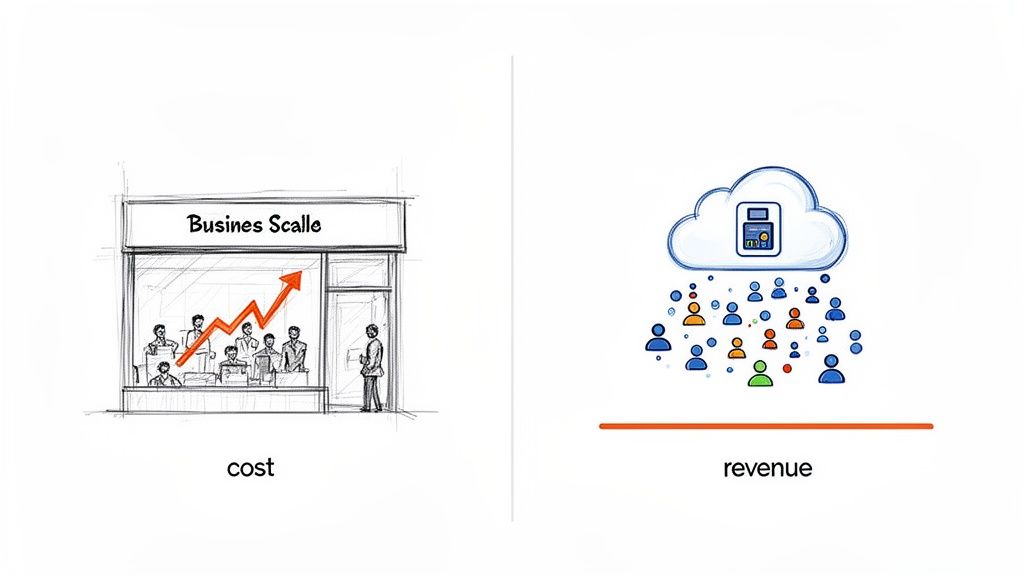
Now, think about a software company. They invest a lot of time and money upfront to create a single, fantastic product. The cost to get that very first customer is steep. But the cost to bring on the 10,000th customer? It's practically zero. Each new user adds to the revenue pile with almost no extra operational cost. That's the magic of a scalable model.
In a non-scalable business, your resources—your time, your team, your money—are always the bottleneck. Every new project or client demands more of them. Scalable models, on the other hand, are designed to break that direct link. They create a system that works smarter as the business grows.
This isn’t just about working harder; it’s about building an engine that can serve thousands (or even millions) without needing a team of thousands to run it. This is usually made possible by a few core characteristics:
Scalability is the difference between building a business that forces you to run faster and faster on a hamster wheel and building one that generates its own momentum. It's about decoupling your revenue from your direct effort.
To see these differences side-by-side, let's look at a quick comparison.
This table breaks down the fundamental differences in how these two types of businesses operate and grow.
As you can see, the path to growth looks entirely different depending on the model you choose.
This isn't just a concept for Silicon Valley startups. It's a strategic imperative for all kinds of organizations, from professional associations to event-driven businesses. A scalable model acts as a powerful buffer against market swings and gives you a serious competitive edge.
When your operations are built to handle growth efficiently, you can reinvest your profits into innovation, marketing, and creating a better member experience. This creates a powerful cycle of success. Instead of getting bogged down by administrative headaches as you grow, you're free to focus on what really matters: delivering incredible value to your community. This structure helps you not only survive but truly thrive.
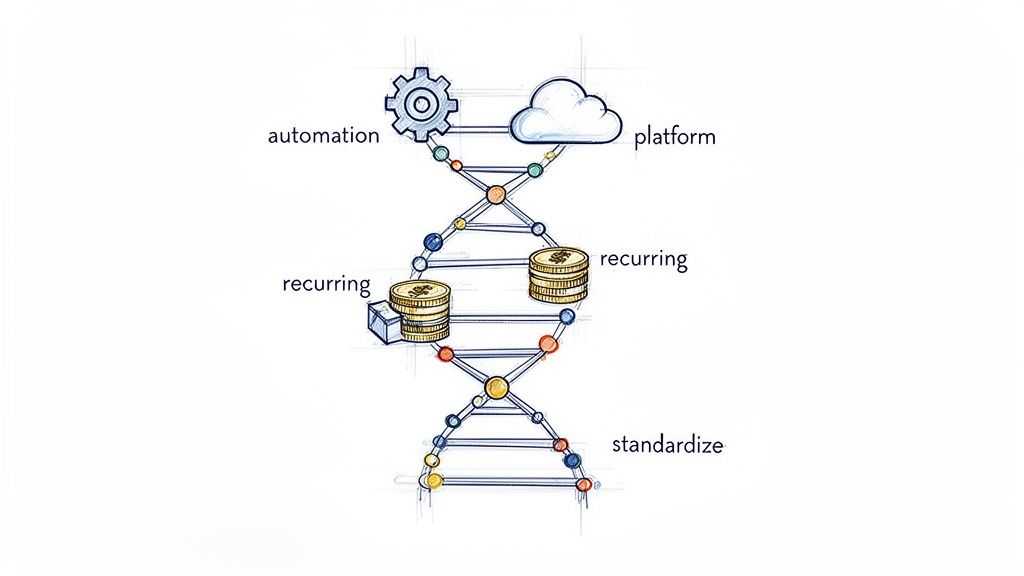
The most successful companies don't just stumble into scale. They're built for it from day one, with specific traits engineered into their very core. These characteristics are the business equivalent of DNA, dictating how an organization will handle growth—whether it will thrive or get crushed by its own success.
Think of it like this: you wouldn't build a skyscraper on a foundation meant for a single-family home. The skyscraper needs a far deeper, more robust foundation to support its height. In the same way, a scalable business needs a strong operational and financial foundation to support massive growth without seeing its costs spiral out of control.
This DNA is a blend of several key components that have to work in harmony. Let's break down what they are.
At the heart of every truly scalable business model is the concept of low marginal cost. Simply put, this is the cost of producing one more unit of your product or serving one more customer. In an ideal scalable model, this cost is nearly zero.
A perfect example is a platform like Spotify. It costs them a fortune to build their streaming technology and negotiate music licenses. But the actual cost to add one more subscriber? It's practically nothing—a tiny blip of data. This is the "build once, sell infinitely" principle in action. The heavy lifting is all upfront, allowing profits to multiply with each new customer because the cost to serve them doesn't grow in lockstep.
A business achieves true scalability when its cost to acquire a new customer is consistently and significantly lower than the revenue that customer will generate over time. Low marginal cost is the engine that makes this possible.
This is a world away from a non-scalable model, like a local bakery. Every new loaf of bread requires a proportional amount of flour, yeast, and labor. Their marginal costs are high, which naturally puts a cap on their growth.
While low marginal costs create the economic potential for scale, automation and standardization are what actually unlock it. These are the systems that let you operate at a massive scale without needing to hire an army of people to keep things running.
Standardization is all about creating repeatable, predictable processes for everything from onboarding to support. Automation is the technology you use to run those processes without a human touching them. When you combine the two, you get what’s called operational leverage.
By systemizing your operations, you eliminate the human bottlenecks that slow you down. It ensures a consistent experience for every customer and frees up your team to focus on high-value work—like improving the product or engaging the community—instead of being buried in repetitive admin tasks. If you want to go deeper on this, our guide to scaling with systems is a great resource.
Finally, nearly all modern scalable businesses are built on a foundation of recurring revenue. Subscription models, whether for software, media, or a professional membership, create a stable and predictable financial runway.
This predictability is a game-changer. It smooths out the chaotic "feast or famine" cycles of project-based work, allowing you to forecast your finances and make strategic investments in growth with confidence. When you combine recurring revenue with low marginal costs and heavy automation, you create a powerful, self-reinforcing engine for growth. That’s the real hallmark of a scalable business.
A business model might look great on paper, but how do you know if it's actually working in the real world? The numbers tell the whole story.
If you don't track the right metrics, you have no way of knowing whether you're building a sustainable growth engine or just growing broke. These key performance indicators (KPIs) are your dashboard—they give you a clear-eyed look at your company's financial health and scalability, moving the conversation from wishful thinking to hard data.
Let's break down the essential metrics every leader needs to have a handle on.
What It Is: Simply put, this is your total cost to land one new customer. You calculate it by adding up all your sales and marketing expenses—everything from ad spend and content creation to sales team salaries—and dividing that by the number of new customers you brought in over a specific period.
Why It Matters: Your CAC is a direct measure of how efficient your growth engine is. A high CAC can bleed your company dry, fast. A low CAC, on the other hand, shows you're bringing in customers without breaking the bank. A truly scalable business is always finding ways to drive its CAC down or at least keep it steady, even as it expands into new territory.
What It Is: This metric projects the total amount of money you can expect to earn from a single customer over the entire time they do business with you. It’s a forecast based on what they typically spend, how often they buy, and how long they stick around.
Why It Matters: LTV tells you what each customer is actually worth. It’s the other side of the coin to CAC. When you have a high LTV, each customer is more valuable, which gives you more breathing room to invest in acquiring them while still turning a profit. Scalable companies are obsessed with increasing LTV by offering fantastic products, delivering great service, and nailing their retention strategies.
This is where the real magic happens. This ratio puts your customer value (LTV) head-to-head with your customer cost (CAC).
A healthy LTV to CAC ratio is the ultimate sign of a sustainable and scalable business model. It proves that your customer acquisition engine is not just running, but generating a real profit.
A solid benchmark for a scalable business is an LTV-to-CAC ratio of 3:1 or higher. This means for every dollar you put into acquiring a customer, you get at least three dollars back over their lifetime. A 1:1 ratio means you're just breaking even, and anything less means you're actively losing money with every new sign-up.
What It Is: Churn rate is the percentage of customers who leave you over a certain period. Its mirror image, retention rate, is the percentage you manage to keep. You can get a deeper dive into this in our guide on calculating your retention ratio.
Why It Matters: High churn is a silent killer, especially for subscription-based businesses. It's like trying to fill a bucket with a hole in it—you can keep pouring new customers in (at a high cost), but you're losing them just as fast. A low churn rate signals that you have a "sticky" product and happy customers, both of which are fundamental for profitable, long-term growth.
At the end of the day, your profit margins—gross, operating, and net—reveal how much of your revenue you actually keep after all the costs are paid. As you scale up, you want to see these margins improve. That’s a clear sign your revenue is growing faster than your costs—the very definition of scalability.
This is directly tied to a powerful economic idea called Returns to Scale (RTS). It measures how your output (like revenue) changes when you increase your inputs (like capital and labor). The best scalable companies are masters of this. A Wharton study of 4.3 million firms found that the top 5% of companies had RTS levels 10 percentage points higher than smaller businesses. This allowed them to generate 7% more output for every increase in input, fueling explosive growth and creating a massive competitive advantage.
For any business with a subscription component, tracking metrics like Monthly Recurring Revenue (MRR) is also non-negotiable for understanding financial health and forecasting future growth with any real confidence.
Knowing the theory behind scalable business models is great, but actually building one is a different beast entirely. Moving from a traditional, hands-on operation to a lean, scalable engine isn't an accident—it’s a conscious and strategic redesign. It's all about rethinking how your organization creates and delivers value, with a laser focus on efficiency and getting more done with less.
This blueprint boils it all down to three foundational pillars: Productization, Platform Effects, and Automation. Getting these right is how any organization, whether it's a professional association or an event-based business, can grow its revenue without getting crushed by rising costs and administrative headaches.
The very first step toward true scalability is to stop selling your time and start selling a product. We call this productization, and it's all about turning custom services into standardized, repeatable offers that can be sold over and over with little to no tweaking.
Picture a consultant who gives one-on-one marketing advice. Their income is directly tied to the hours they can work. To scale up, they need to "productize" their expertise. They could do this by:
This shift is a game-changer. It disconnects your revenue from the finite resource of your team's time and creates a valuable asset you can sell indefinitely.
The most impressive scalable businesses often act more like platforms than simple service providers. A platform creates value by connecting two or more groups of users and making it easy for them to interact or transact. The real magic, though, is the network effect: the platform becomes more valuable to everyone as more people join.
Airbnb is the perfect example of this model in action. Their journey from renting out an air mattress in 2007 to becoming a $66 billion powerhouse by 2023 shows just how potent network effects can be. By 2019, the platform had over 7 million listings and managed 327 million guest arrivals, all without owning a single hotel room.
Airbnb’s scalability comes from its platform model, where hosts and guests connect directly. Automated systems handle everything from listings to payments, which means the marginal cost for each new booking drops dramatically as the network grows.
For a professional association, this could mean creating a member directory that becomes more useful with every new professional who joins. Or a job board that's more valuable as more companies and candidates sign up. As you map out your plan, exploring different actionable small business growth strategies can spark some great ideas.
Automation is the engine that brings scalability to life. It's about using technology to handle all the routine, repetitive tasks that would otherwise eat up your team's time and energy. With the right systems, you can handle massive growth without constantly needing to hire more people.
Automation isn’t about replacing humans. It’s about freeing them up to do uniquely human work—like strategy, creativity, and building relationships. You let technology handle the predictable so your team can handle the exceptional.
This flow chart visualizes the process: efficiently acquiring a customer, keeping them engaged for the long haul, and turning that relationship into profit.
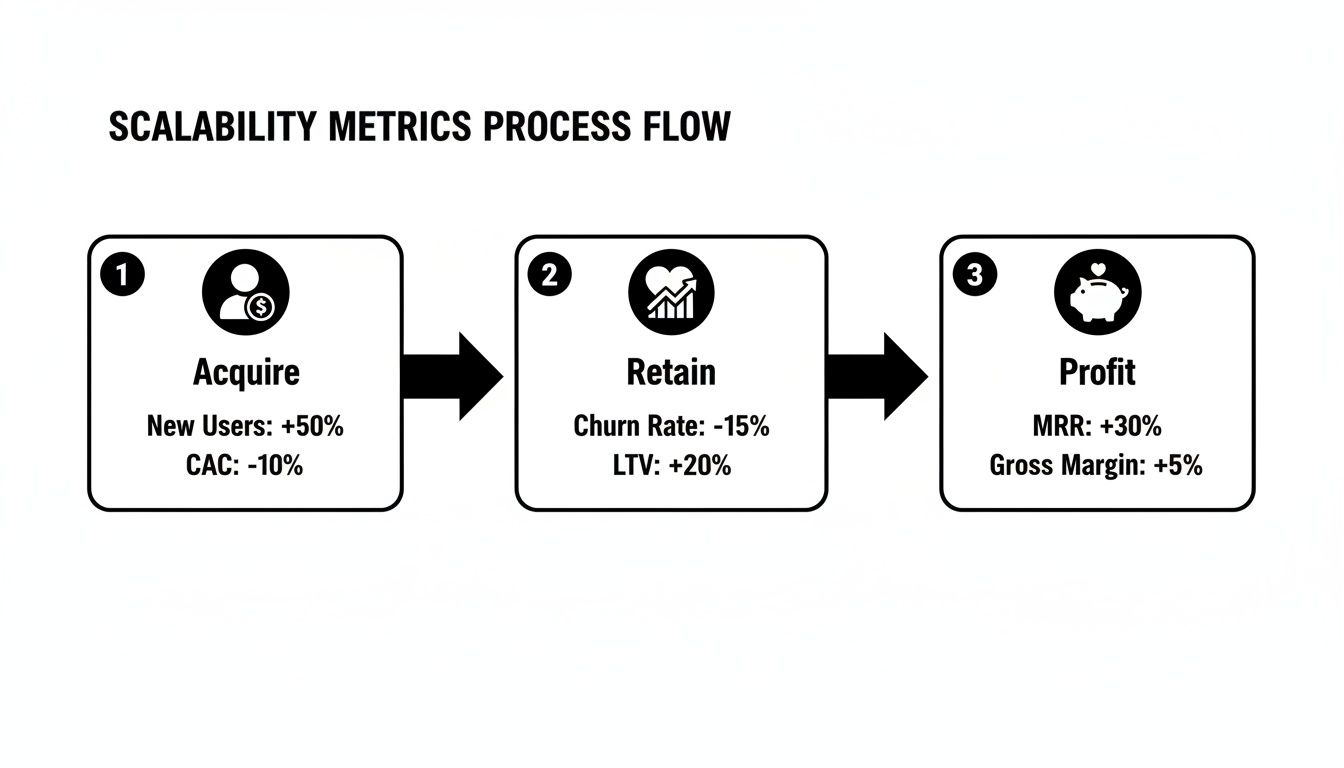
The key takeaway is that real scalability depends on a self-sustaining cycle where efficient acquisition and strong retention directly fuel profitability.
To get started, focus on automating these key areas first:
By combining productization, platform effects, and relentless automation, you create a powerful system where your business can grow exponentially, finally breaking free from the old rules of linear growth.
Knowing the theory behind a scalable business model is one thing. Actually putting it into practice to drive real growth? That's a completely different ballgame. For anyone running a community or organizing events, the biggest hurdle is often finding the right tools to break free from the trap of linear growth—where every new member or attendee just adds more tedious admin work to your plate. This is exactly the point where a dedicated platform stops being a "nice-to-have" and becomes a necessity.
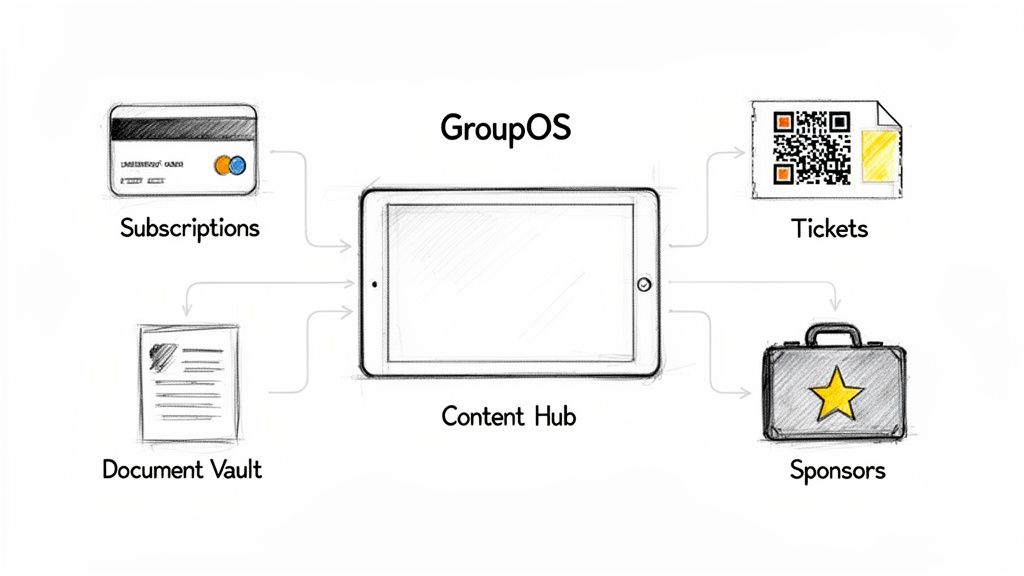
GroupOS was built from the ground up to be the engine for scalable communities. It’s designed to tackle the exact bottlenecks that keep professional associations and event-based businesses from expanding without friction. Instead of juggling a clumsy patchwork of disconnected tools that create errors and manual work, you get an all-in-one solution.
The entire philosophy is simple: let technology handle the repetitive, low-value tasks. This frees up your team to focus on what truly matters—strategy, member engagement, and creating value. Your operations transform from a necessary cost into a powerful asset for growth.
Nothing kills scalability faster than manual management. Chasing down renewals, processing registrations one by one, and answering the same questions over and over are tasks that grow in direct proportion to your member base. GroupOS is built to systematically automate these processes and finally break that chain.
Take the platform’s membership management features. You can set up flexible, automated subscription plans in minutes. The system takes over from there, handling recurring billing, sending renewal reminders, and even managing member access levels without anyone lifting a finger. Not only does this save a staggering number of hours, but it also builds a stable, predictable recurring revenue stream—a true cornerstone of any scalable business.
For events, this looks like ditching clunky registration forms for a truly dynamic ticketing system. With custom forms, tiered pricing, and automated QR code check-ins, you can manage a few thousand attendees just as easily as you can manage a hundred.
This degree of automation means a sudden spike in sign-ups is a reason to celebrate, not a reason to panic about your operations grinding to a halt. It gives you the operational muscle to scale your reach without having to scale your headcount at the same rate.
A brilliant strategy for scaling is to "productize" your value—in other words, package your knowledge and expertise into a format that you can sell over and over again. GroupOS makes this happen with its centralized content hub, which lets you build a secure, on-demand library of valuable resources.
When you create a productized knowledge base, you’re no longer trading time for money. You’re building an asset that serves your members around the clock with minimal ongoing effort. This is the fundamental shift away from a service-based model and toward a truly scalable business model. You can also check out our guide on creating a thriving membership community platform to learn more.
This operational efficiency is critical. Even startups with a fantastic product can fail to scale if their internal systems can't keep up. In fact, research from Harvard highlights that a staggering 78% of such startups falter, often because their backend operations become a bottleneck. GroupOS is the answer for community leaders, providing a unified platform that automates the core functions needed to grow professional networks without hiring an army of administrators.
Knowing the theory behind scalable business models is one thing. Actually putting it all into practice? That’s where the real work—and the real questions—begin. As leaders like you start applying these ideas, a lot of practical uncertainties pop up.
This section tackles the most frequent questions we hear about strategy, implementation, and how to sidestep those costly mistakes. Let's clear up the confusion and get you on the path to building a truly scalable organization.
The best place to start is with a simple process audit. Before you even think about buying new software or overhauling your business plan, you need a painfully honest look at where your team's time is really going. Hunt down the most time-consuming, repetitive, and manual tasks bogging down your daily operations.
These bottlenecks usually hide in plain sight. Think about things like:
Once you have a clear list of these time sinks, your first job is to standardize and automate them. For instance, you might switch from manual invoicing to an automated subscription billing system. Or, you could build out a robust FAQ section or a comprehensive knowledge base to serve as a self-service resource for common questions.
This initial focus on automating low-value tasks is the foundational move toward building a truly scalable business model. It’s not just about saving time; it’s about freeing up your most valuable resource—your team—to focus on strategic growth instead of getting stuck in administrative quicksand.
Absolutely. But it requires a major mental shift: you have to stop selling time and start selling outcomes. A traditional consultancy or service agency is inherently unscalable because your revenue is chained directly to billable hours. With only so many hours in a day, you have a hard cap on your growth potential.
To break through that ceiling, you have to productize your expertise. This means packaging your knowledge and processes into standardized, repeatable formats that you can sell to many clients at once, without your direct involvement in every single delivery.
Here’s what that looks like in the real world:
This approach turns your service from a one-to-one transaction into a one-to-many product. It effectively snaps the link between your revenue and your team's available hours.
The single most common—and destructive—mistake is premature scaling. This is what happens when a company gets ahead of itself and pours money into marketing, hiring, and aggressive expansion before it has locked in two critical things: product-market fit and a profitable way to get new customers.
Trying to outrun fundamental problems only makes them bigger and more expensive. If your product doesn’t truly solve a problem for customers, or if your unit economics are upside down, adding more customers just burns through cash faster and creates operational chaos. A non-scalable model with 1,000 customers is a full-blown logistical nightmare.
Real scalability needs a solid foundation first. You have to be certain that:
Get the model right before you step on the gas. Otherwise, you’re just scaling your problems.
This is a crucial distinction that trips up a lot of leaders. Growth is when your revenue and your costs climb at roughly the same rate. Scalability is when your revenue grows exponentially while your costs only inch up slightly, or even stay flat.
The clearest way to see the difference is by looking at your operating margin. If your revenue doubles, but your operating costs also nearly double to support it, you're just growing. Sure, your business is bigger and your team is working harder, but it isn't fundamentally more efficient.
On the other hand, if your revenue doubles while your costs only increase by 20%, you are scaling. That’s the magic. It proves your business model has leverage and is getting more profitable with every new customer you add.
To see which path you're on, keep a close eye on these two metrics over time:
If those metrics are trending up, congratulations—you're successfully building a scalable business.
Ready to stop growing linearly and start scaling exponentially? GroupOS provides the all-in-one platform to automate memberships, streamline event management, and productize your content. Transform your operations and unlock your organization's true growth potential. Explore GroupOS today and see how you can build a more scalable future.