June 18, 2026

A member posts something that isn't overtly abusive, isn't spam, and doesn't violate any written policy. But the thread turns sour fast. Regulars start subtweeting each other inside your own community. New members go quiet. A moderator asks, “Can we act on this?” and the honest answer is, “I'm not sure.”
That's the moment most groups discover whether they have governance or just optimism.
Good communities rarely fall apart because people are malicious from day one. They erode through gray areas, inconsistent responses, and rules that exist only when conflict becomes inconvenient. Rules in a group matter because they translate values into decisions. They tell members what the group protects, what it expects, and what happens when someone crosses a line that harms trust.
The strongest rule sets don't read like legal disclaimers. They read like a social contract. People can tell the difference between a document written to control them and one written to help the group function. That distinction matters because compliance isn't only produced by surveillance. In a 2025 Nature Human Behaviour study, participants followed an arbitrary costly rule at rates of 55% to 70% even when they were anonymous and acting alone. That finding matters for communities because members often follow norms when they see them as legitimate, not merely because a moderator might be watching.
Psychological safety sits underneath all of this. If members don't know what the group will protect, they won't take interpersonal risks. They won't ask beginner questions, disagree thoughtfully, or report bad behavior early. For a practical parallel outside professional communities, Soul Shoppe's tips for educators and parents are useful because they show how safety is built through clarity, predictability, and respectful boundaries.
A healthy community also produces tangible value. If you need a broader view of what that value can look like, this overview of the benefits of online communities is a helpful companion. But those benefits don't last without governance. Good intent may start a community. It won't scale one.
Most rule failures don't begin with obvious misconduct. They begin with uncertainty.
A founder says the group should stay “professional.” A volunteer moderator interprets that as no profanity. A long-time member interprets it as “I can criticize anyone as long as I sound polished.” A new member interprets silence from the team as approval. By the time staff step in, the damage isn't the single post. It's the confusion about what kind of place this is.
Good rules don't just stop bad behavior. They reduce hesitation when someone needs to act.
Communities that rely on unwritten norms often work for insiders and fail newcomers. Regulars know what gets tolerated. New members don't. That asymmetry creates a hidden class system inside the group, even when nobody intended it.
The practical lesson from rule-following research is not that members will automatically behave. It's that people are far more likely to comply when the rule feels real, fair, and worth following. That has direct implications for rules in a group:
When leaders write vague prohibitions like “be respectful,” they usually mean well. But moderators can't enforce values that haven't been translated into observable behavior. “No personal attacks” is enforceable. “Be respectful” is a principle. You need both, but they're not the same thing.
Rules also answer a deeper question. Who is this community for, and what behavior keeps it usable for them?
That's why the best rulebooks include more than bans. They set expectations for debate, promotion, privacy, reporting concerns, and moderator authority. They help members predict outcomes. Predictability is what turns a room full of strangers into a functioning group.
A rulebook written in isolation usually sounds clean and fails in practice. The language may be polished, but it misses the actual friction points members deal with every week.
PMI recommends a four-step process for team ground rules: align on vision and objectives, document the rules, secure buy-in from all members, and create the rules collaboratively because weak buy-in and top-down rule setting are common failure modes, as described in PMI's guidance on ground rules for high-performing teams.
Before drafting any policy, identify the people who experience the community from different angles. In practice, that usually includes:
If one of those groups is missing, your rules will lean too hard toward convenience for the people in power or permissiveness for the loudest members.
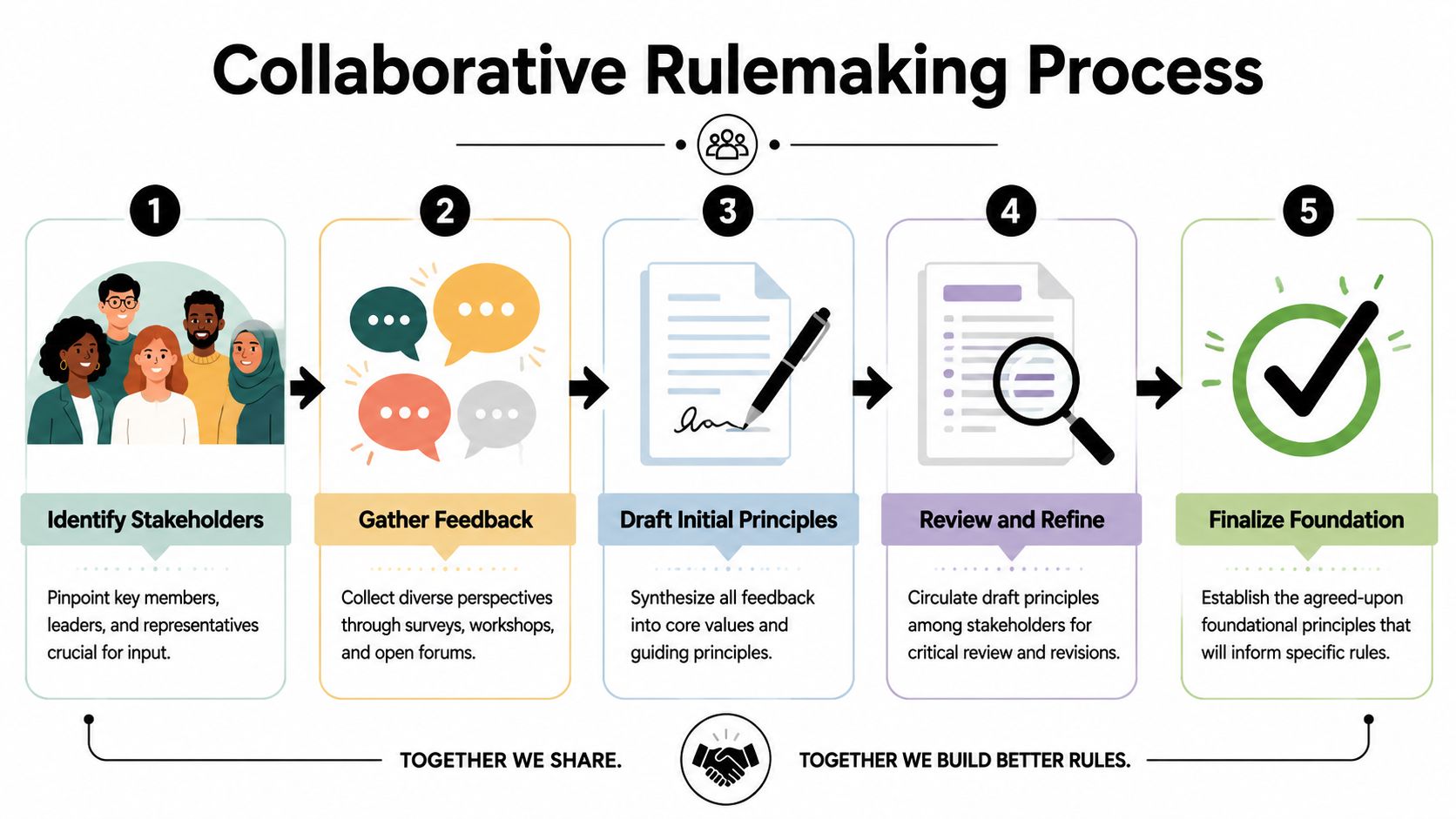
Teams often rush into drafting line items before they've agreed on what the group is trying to protect. Don't start with “No unsolicited DMs” or “No self-promo on weekdays.” Start with foundation principles such as member safety, relevance, fairness, and access.
That shift changes the quality of the conversation. Instead of arguing over isolated edge cases, the group decides what the rules are for. Once those principles are explicit, detailed rules become easier to write and easier to defend.
A practical sequence looks like this:
Open comment threads produce noise. Structured conversations produce decisions.
For larger communities, PMI points to the World Café method, where subgroups rotate across topics in roughly 10-minute rounds and a scribe preserves continuity across tables. That format works well when members have strong opinions but need a process that prevents a few voices from dominating.
Practical rule: Treat the rulemaking meeting itself as a test of the culture you want. If only the most confident people can shape the rules, the rules will reproduce that imbalance.
Buy-in isn't a soft concept. It's operational.
Members are more likely to follow rules they recognize as jointly built. That doesn't mean every rule requires unanimous agreement. It means members should be able to see how the rule emerged, what problem it addresses, and who had a chance to respond.
A useful final step is to publish a short rationale alongside the rules. Not a legal memo. Just enough context so members understand why a rule exists. “This policy exists to keep event discussions useful for attendees” works better than “Promotion limitations apply at moderator discretion.”
Most community rules fail in one of two ways. They're so broad that moderators can't apply them consistently, or they're so detailed that members stop reading after the third paragraph. The job is to write rules that are short, specific, and durable enough to handle edge cases without sounding like a courtroom transcript.
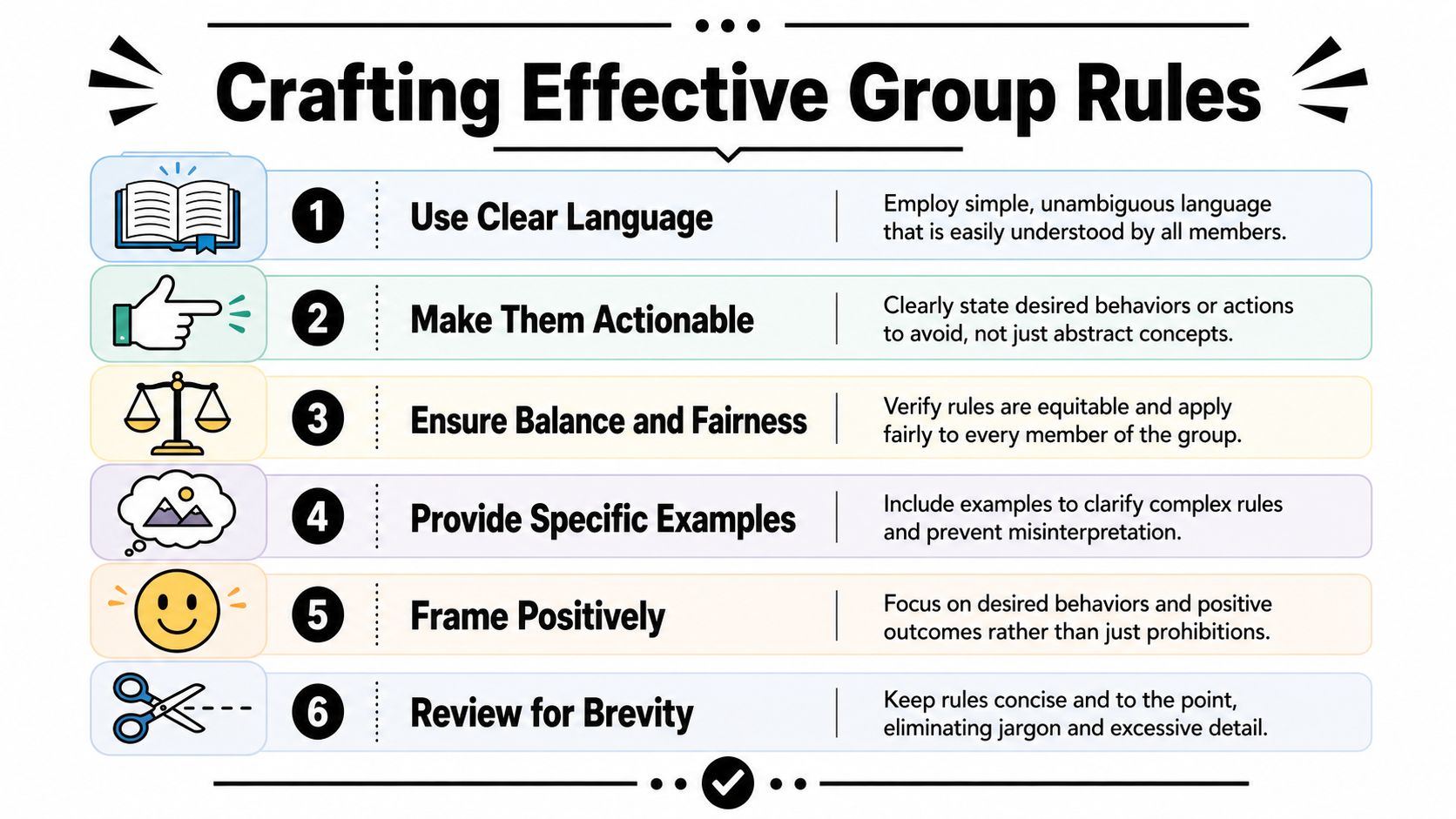
A strong rule describes behavior, not mood. Members need to know what to do, what to avoid, and what moderators will look at when making a call.
Here's a simple test. If two moderators read a rule and would likely reach different conclusions about the same post, the rule needs revision.
Weak wording often sounds like this:
Stronger wording sounds like this:
One practical guideline in public facilitation advice is that ground rules should fit on one page and be simple enough to read in under five minutes, as discussed in this piece on ground rules for group work. That's not a legal requirement. It's a usability standard.
A rulebook no one can scan isn't protecting the community. It's protecting the organization from having to make hard choices in plain language.
This short video offers a useful framing for writing clearer policies and expectations before enforcement starts:
The easiest way to draft rules in a group is to organize them by recurring situations, then write each rule in positive language where possible.
| Rule Category | Positive Framing (Example) | Rationale |
|---|---|---|
| Respectful debate | Address the point you disagree with and keep criticism focused on ideas, evidence, or process. | Preserves disagreement without making discussion personal. |
| Self-promotion | Share your work in approved spaces and explain why it's relevant to this group before posting. | Keeps the community useful without banning member expertise. |
| Direct messages | Ask for consent before sending pitches, recruiting requests, or repeated follow-ups. | Protects members from feeling trapped by participation. |
| Confidentiality | Treat stories, screenshots, and attendee information as private unless permission is clearly given. | Builds trust, especially in member-only spaces and events. |
| Content quality | Post in the most relevant channel and add enough context for others to respond constructively. | Reduces clutter and improves discoverability. |
| Moderator cooperation | If a moderator redirects, edits, or removes content, continue the conversation privately instead of escalating publicly. | Prevents process disputes from taking over the main space. |
For more examples of what this can look like in practice, this collection of community guidelines examples is useful for comparing different styles.
Rules can create safety, but they can also create drag. Some groups write policies for every annoyance and end up teaching members that participation is risky. You don't want a system where people need moderator approval in spirit, even if not in policy.
One practical example from facilitation is the “3-before-me” rule, which aims to prevent a few voices from dominating and create room for broader participation. The broader lesson is that structure should correct predictable group imbalance, not make every interaction feel monitored.
Too few rules produces ambiguity. Too many produces compliance fatigue. The right set makes healthy behavior easier than unhealthy behavior.
When in doubt, ask three questions about every draft rule:
If the answer is no, cut or rewrite it.
A well-written rulebook buried in a footer has the same practical effect as no rulebook at all. Visibility is part of governance.
Members should encounter community rules before their first post, during onboarding, and again at moments where risk increases, such as event check-in, direct messaging, subgroup access, or content submission.
Don't rely on a single “Terms” page. Publish the rules in multiple touchpoints that match member behavior.
That usually means:
Members rarely read policy as literature. They read it when context makes it relevant.

Rule launch should borrow from product testing. Nielsen Norman Group advises testing with small cohorts of 4–5 users to identify issues quickly, using think-aloud methods and task success measures in their guidance on success rate in usability testing. Applied to communities, that means piloting revised rules with a small member group before announcing them platform-wide.
Ask a small set of trusted members to do practical tasks:
What you're looking for is not agreement on every preference. You're looking for friction in comprehension. If members misread a rule in the pilot, moderators will definitely misapply it later under pressure.
New members form opinions fast. If the first week feels chaotic or arbitrary, later clarification won't fully repair that impression.
A solid onboarding flow should include these pieces:
For teams building that sequence, an onboarding plans template can help turn policy into an actual member journey.
Members shouldn't have to guess whether a rule exists, where it lives, or how seriously the team takes it.
Publishing and onboarding are where rulebooks stop being documents and start becoming culture.
Communities don't trust moderators because moderators are nice. They trust moderators because the process is understandable, consistent, and proportionate.
When enforcement feels improvised, every action looks political. One member gets a private warning. Another gets publicly corrected. A third gets ignored because the moderator is tired, conflicted, or unsure. Members notice that pattern quickly. They conclude that outcomes depend on who you are, not what happened.
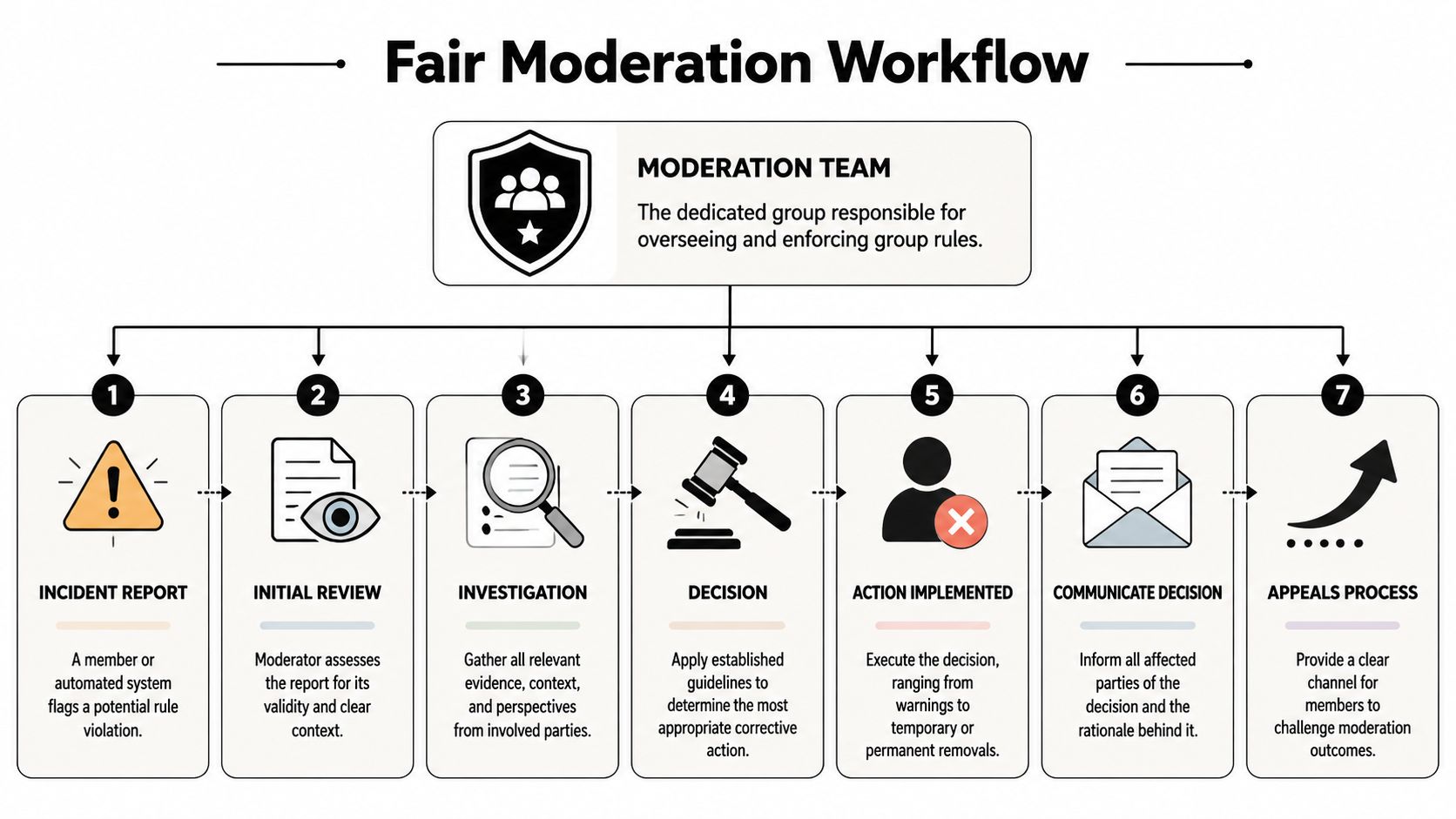
Moderation gets easier when the team isn't inventing responses incident by incident. A written escalation path helps moderators act faster and helps members predict consequences.
A practical ladder often looks like this:
| Situation | Typical response | Why it works |
|---|---|---|
| Minor first-time issue | Gentle public redirect or private reminder | Corrects behavior without unnecessary shame |
| Clear but low-severity violation | Formal private warning tied to the rule | Creates a documented baseline |
| Repeated violation | Temporary restriction, pause, or moderated posting | Protects the group while signaling seriousness |
| Severe misconduct | Immediate removal pending review or permanent ban | Prioritizes member safety and community integrity |
| Disputed case | Secondary review or appeals path | Reduces perceptions of personal bias |
The exact labels matter less than consistency. Members should know that moderation is not random and that serious cases won't be treated like routine etiquette issues.
One of the most common moderation mistakes is deciding too early.
A complaint comes in. A moderator recognizes one of the members involved. The social context is already loaded. If the team jumps straight to discipline without documenting what happened, they invite both real errors and accusations of favoritism.
A cleaner workflow looks like this:
Many teams benefit from a shared internal playbook and a documented list of moderator duties. If you're formalizing that work, this outline of community manager duties can help teams distinguish member support, content guidance, and enforcement responsibilities.
Members don't need an essay when they're moderated. They need clarity.
A strong moderation note usually includes:
Fair enforcement doesn't mean every outcome is soft. It means every outcome is explainable.
Private correction should be the default for lower-severity issues. Public communication is still necessary when the group has already seen the incident and silence would create confusion. In those moments, explain the action without turning moderation into spectacle.
The goal of a workflow is not bureaucracy for its own sake. It's to reduce the emotional burden of frontline decisions.
When moderators know the process, they spend less time second-guessing and less time negotiating basic authority with members. That protects the team and the community at the same time.
A static rulebook usually means one of two things. Either the group never changes, which is rare, or leaders stopped paying attention.
Most public advice explains how to create rules at the start. Far less explains how to revise them once the group grows, conflict patterns change, or new formats like hybrid events introduce new risks. That gap matters. Some guidance recommends periodic review, such as every three months or every 15 sessions in therapy groups, in this discussion of effective ground rules for group therapy. The deeper lesson for communities is that rules should be reviewed on a schedule and also revisited when the group's operating conditions materially change.
Counting violations alone gives a distorted picture. A community with fewer reports is not always healthier. Members may have stopped reporting because they don't trust the process, or moderators may be classifying incidents inconsistently.
Look instead for patterns such as:
There's also a statistical reason to be careful with community data. A methodological review in PMC notes that group membership creates non-independence, which can inflate the Type I error rate if you analyze people as though they were fully independent, and recommends accounting for group effects with approaches such as random effects and transparent reporting of intraclass correlations (ICCs) in clustered data contexts, as explained in this review of clustered data analysis. For community teams, the practical point is simple: don't assume one member action equals one isolated signal. Behavior often clusters by chapter, event cohort, role, or channel.
Not every rule should be renegotiated every time someone complains. Core principles should stay steady. Negotiable operating rules can change.
Use this approach when revising rules in a group:
The healthiest communities treat governance as maintenance, not crisis response. They don't wait for the next blowup to discover their rules are out of date.
If your organization needs a platform that can support memberships, events, content, communication, and the operational side of community governance in one place, take a look at GroupOS. It's built for professional networks and organizations that need structure without adding more tool sprawl.