June 12, 2026
You probably have the same setup most associations start with. Ambassador names in a spreadsheet. Applications in Google Forms. Conversations split across email, Slack, text, and DMs. Event referrals get tracked in one place, member signups in another, and no one can say with confidence which ambassadors are driving results.
That setup works for a pilot. It breaks the moment the program gets real.
Ambassador recruitment only looks simple from the outside. In practice, you're building a distributed volunteer or part-time workforce, asking them to represent your brand, bring in peers, and stay aligned without constant supervision. If you don't design the system up front, you end up managing exceptions all day instead of running a program.
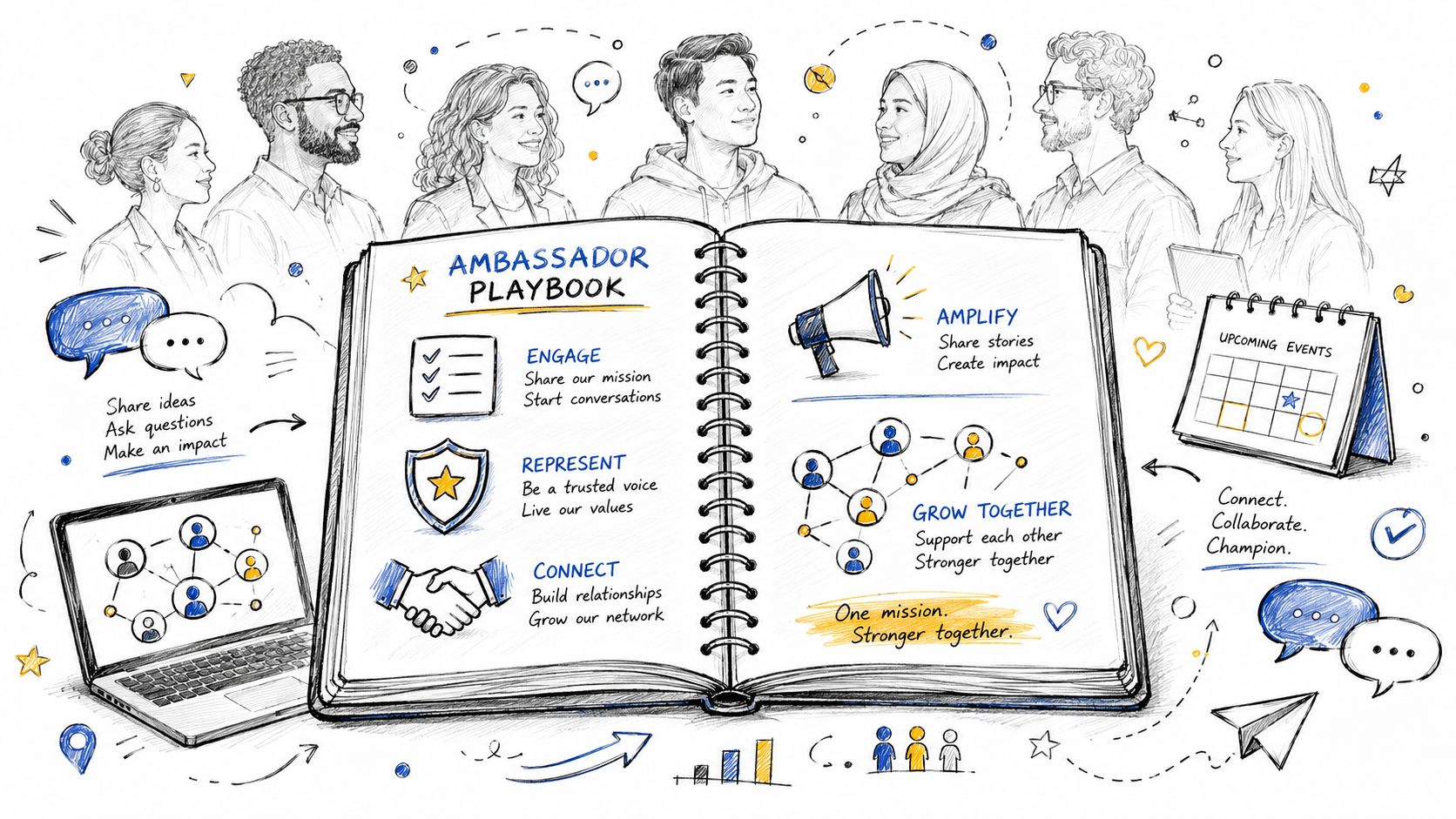
I've seen the strongest programs treat ambassadors less like a side project and more like a channel. They define outcomes first, recruit from trusted circles, vet for reliability, onboard with structure, and measure contribution all the way through to membership, event, and sponsor goals. That's what separates a feel-good initiative from a repeatable growth engine.
Most ambassador programs fail before recruiting starts. The issue isn't enthusiasm. It's vagueness.
An association says it wants ambassadors because it wants more visibility, more engagement, and more community energy. Those are fine ambitions, but they don't tell a candidate what the role is, what success looks like, or what your staff should prioritize. Without that clarity, you recruit appealing people into a fuzzy program and wonder later why the results are inconsistent.
Many modern public-sector and higher-education ambassador programs were built specifically to formalize peer-to-peer representation instead of relying only on top-down outreach. The University of Illinois example reflects that pattern by requiring Statistics Undergraduate Ambassadors to complete core coursework and commit to specific outreach activity, which shows how structured insider advocacy builds trust and scales recruitment more effectively, as described in the Statistics in Schools Ambassador Program materials.
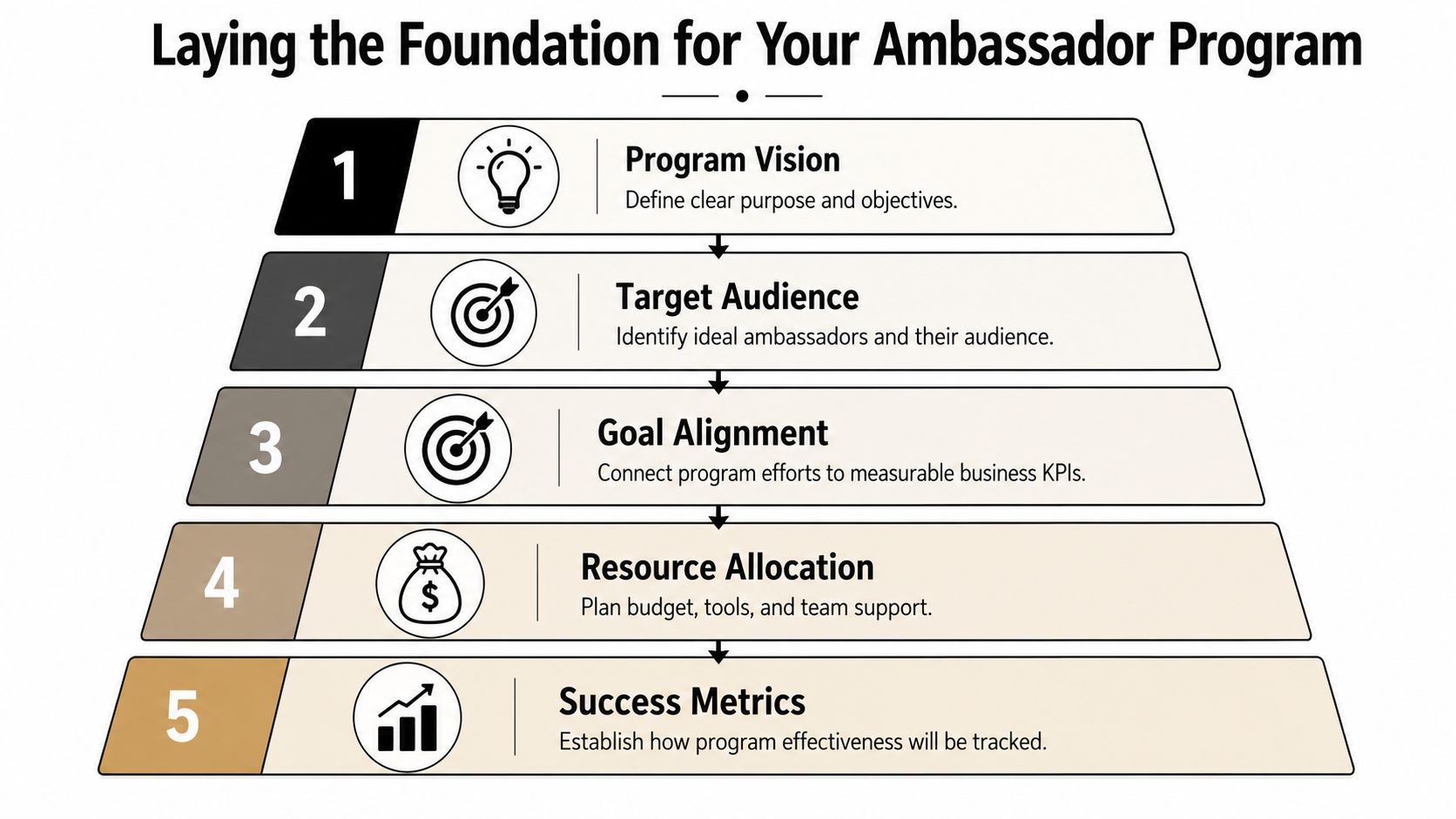
Pick the primary outcome the program owns. For associations, the cleanest options are usually:
Trying to assign all of these at once creates confusion. Give the program a lead objective and a short list of secondary benefits.
Practical rule: If your staff can't finish the sentence "Our ambassador program exists to..." in one line, you're not ready to recruit.
Once the outcome is clear, define the work. Don't ask ambassadors to "spread the word." That phrase produces random activity.
Write the role around actual actions:
| Program goal | Ambassador actions | What staff must provide |
|---|---|---|
| New member signups | Personal referrals, welcome outreach, event invites | Referral links, messaging prompts, tracking |
| Event registrations | Social posting, direct invitations, chapter promotion | Event assets, discount codes, deadlines |
| Community participation | Host discussions, answer questions, introduce members | Content calendar, moderation guidance, escalation path |
| Sponsor visibility | Share featured resources, drive attendees to activations | Approved copy, sponsor rules, campaign dates |
Many teams discover they don't just need ambassadors. They need better internal operations. If your association hasn't clarified who owns events, membership, and communications, fix that first. A useful primer on aligning those responsibilities sits in this guide to association management fundamentals.
Your recruiting page or outreach email should answer six questions clearly:
A strong brief sounds operational, not inspirational. Candidates should know whether they're expected to attend events, create content, welcome members, or help with chapter growth.
Use plain language. "Attend one orientation, represent the association in approved channels, and complete assigned outreach during campaign periods" works better than "be a passionate voice for our mission."
The best ambassadors usually aren't strangers. They're already close to you.
Associations waste time when they start ambassador recruitment on Instagram or LinkedIn before looking at their own member base. Your first pool should be the people who already show up, respond, refer colleagues, volunteer, or keep discussions alive without being asked. Those people need less persuasion and less onboarding because they're already bought in.
There's also a practical labor reality here. Ambassador work often fits people who want flexible assignments rather than standard full-time roles. Zippia reports the average ambassador age is 45, and CareerExplorer reports 78% work part-time, which makes the role especially well suited to engaged members, alumni, and community advocates rather than traditional job seekers, as summarized in ambassador demographics data.
Here's the order I recommend for associations.
Current highly engaged members
Look for people who attend events, answer questions, refer peers, volunteer, or contribute content. These candidates already understand your tone and audience.
Past event attendees
Conference regulars and workshop participants often make strong event ambassadors because they can speak from direct experience.
Committee members and chapter leaders
They're already doing some ambassador work informally. Formalizing it gives them clearer expectations and support.
Alumni and former board participants
These people often have credibility, professional networks, and goodwill toward the organization.
Social followers with real relevance
Don't chase follower counts. Prioritize people whose audience overlaps with your membership goals and who already talk about your field.
If your community platform tracks event attendance, post activity, replies, profile completion, resource downloads, or referrals, use that data to build a target list. Don't ask staff to nominate ambassadors purely from memory. Memory favors familiar names, not always the best candidates.
A good sourcing review includes:
For teams that need a sharper outreach process, ReachInbox's prospecting guide is useful because it frames sourcing as a repeatable workflow, not a one-off recruiting blast.
Most ambassador invitations are too broad. Keep them personal and concrete.
Email template for engaged members
Subject: Invitation to represent [Association Name]
Hi [First Name],
You've consistently contributed to our community through [specific behavior]. We're building a small ambassador group to help with [specific outcome], and your experience stood out.The role would involve [two or three concrete tasks]. We'd provide onboarding, campaign guidance, and a clear point of contact.
If you're open to it, I'd love to send details and see if it's a fit.
Best,
[Name]
DM template for past attendees or social contributors
If you need help identifying who already has affinity with your brand, the thinking behind community-led growth in finding your tribe is useful. The point isn't to recruit the loudest people. It's to recruit the right insiders.
During recruitment, many programs tend to be lenient. A candidate is enthusiastic, seems aligned, and has a nice message history with staff, so they get accepted. Three months later they're inactive, miss deadlines, and need repeated prompting.
The most common operational mistake in ambassador recruitment is selecting for enthusiasm alone. A proven workflow is to define goals, create an application, review each candidate's existing content, conduct brief interviews, and start with a trial period, as outlined in this ambassador program workflow. That sequence screens for alignment and execution before you commit your team's time.

Don't treat ambassador recruitment like a yes or no decision. Treat it like a funnel.
Stage one is the application. Ask for practical information, not essay fluff. You want to know who they reach, how they communicate, why they want the role, what experience they have with your association, and what kind of participation they can realistically sustain.
Stage two is evidence review. Look at posts, videos, comments, talks, volunteer history, chapter participation, or event attendance. If the role involves communication, review communication. If it involves referrals, review network fit and credibility.
Stage three is the interview. Keep it short. You're not hiring an executive. You're testing reliability, judgment, and self-awareness.
Stage four is a trial. Give candidates one contained assignment before confirming a longer-term placement.
I recommend a simple scoring sheet with weighted criteria. Not every candidate needs to be polished, but every candidate should be dependable.
| Criterion | What good looks like | Warning sign |
|---|---|---|
| Brand alignment | Understands your mission and audience | Generic praise with no specifics |
| Communication | Clear, timely, audience-aware | Rambling, inconsistent, off-tone |
| Reliability | Meets deadlines, follows through | Slow replies, vague availability |
| Community standing | Positive history with members | Friction, complaints, or poor judgment |
| Audience relevance | Reaches people you want to engage | Audience doesn't overlap with goals |
| Coachability | Accepts direction and feedback | Wants freedom without structure |
This doesn't need expensive software. A custom form, a shared rubric, and a repeatable review process already put you ahead of most programs.
Don't ask, "Why do you want to be an ambassador?" Everyone has a polished answer.
Ask questions that test behavior:
Good ambassadors don't just love the brand. They can represent it consistently when no one is watching.
Trial periods expose the gap between intent and output. Give candidates a real but limited task. Ask them to welcome new members in a discussion thread, invite peers to an event, post a recap after attending a session, or record a short testimonial using your messaging guidance.
Then evaluate:
Manual systems are problematic when applications live in one place, interviews in another, and content examples buried in email. Staff then start making selection decisions based on convenience. A cleaner workflow preserves standards.
Selection gets you potential. Onboarding turns that into useful output.
Most ambassador programs lose momentum in the first month because people join excited and then hit silence. They don't know where assets live, who approves what, what language is off-limits, or how often they're expected to contribute. When that happens, some freeze and others improvise. Neither helps your brand.
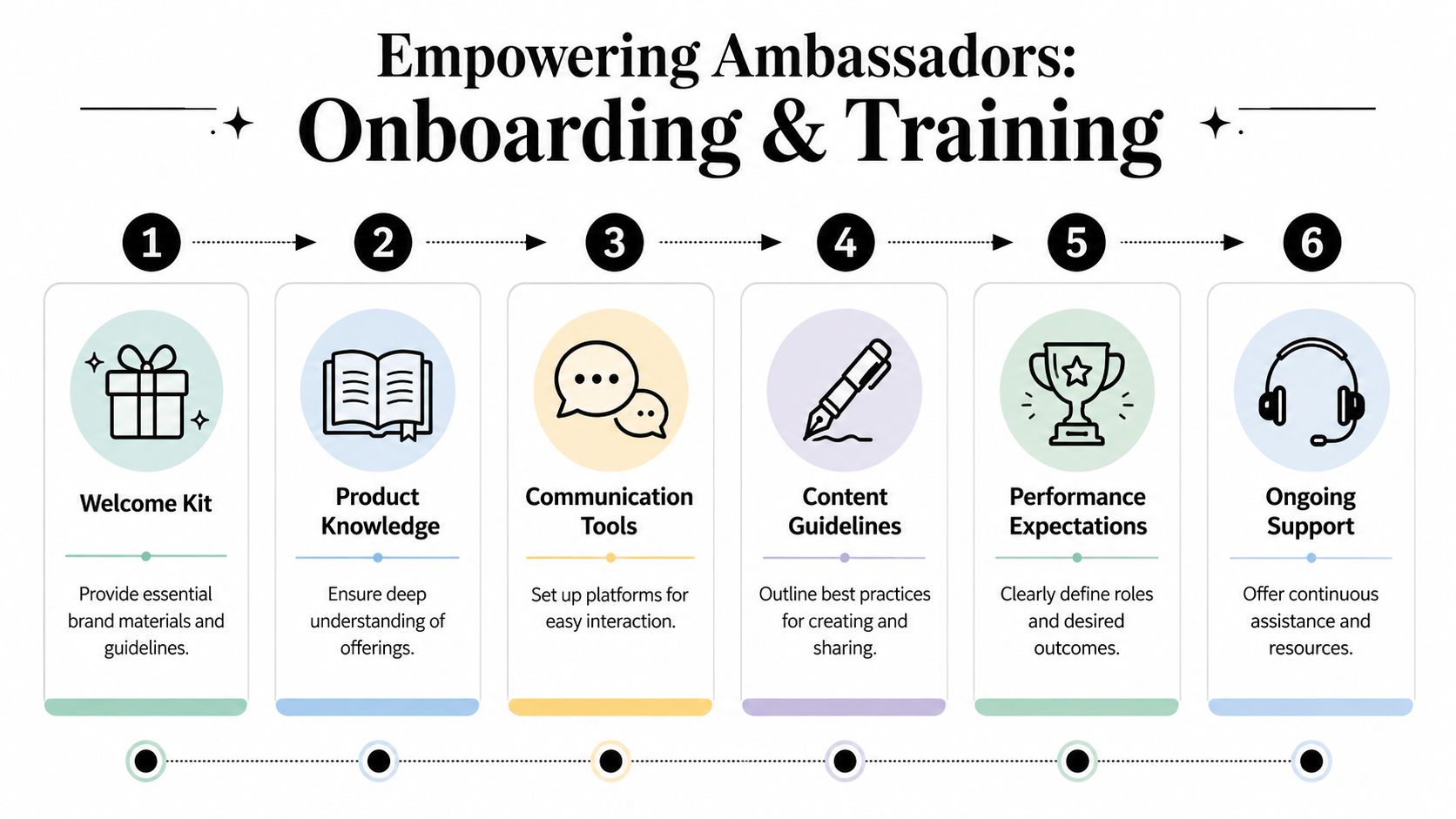
An ambassador welcome kit should remove guesswork. It doesn't need to be flashy. It needs to be complete.
For ideas on physical and branded materials, this roundup of best welcome kit items is a useful reference. But for association programs, the digital materials matter more than the swag.
Include:
Field note: Ambassadors don't need more inspiration. They need fewer points of confusion.
Run live onboarding if you can. Even a short call builds confidence and lets staff calibrate tone early.
A simple agenda:
Welcome and purpose
Explain why the program exists and what success looks like in practical terms.
Audience and positioning
Show who the association is trying to reach and how ambassadors should speak to that group.
Campaign mechanics
Walk through referral links, event promotion, discussion participation, content approvals, and deadlines.
Dos and don'ts
Cover sponsor sensitivity, member privacy, public criticism, and escalation rules.
Questions and scenario practice
Use realistic examples instead of generic policy reading.
This short training video can also help you think about pacing and clarity in onboarding delivery.
Your first month should be structured enough that no ambassador wonders what to do next.
A documented plan helps. If you need a starting framework, this onboarding plan template is a practical reference for sequencing responsibilities and touchpoints.
The main thing is consistency. Ambassadors should be able to find what they need without digging through old emails or asking staff the same question every week.
A lot of associations think retention is about motivation. It isn't. It's about operating rhythm.
Once ambassadors are active, they need regular communication, visible progress, responsive support, and a reason to stay involved. If the program goes quiet between campaigns, people drift. If every message is urgent, they burn out. The strongest programs create a steady cadence and make participation feel manageable.
Practitioner guidance on ambassador programs notes that some teams spend 2 to 3 hours per day maintaining the community after launch, which is a useful benchmark from ReferralCandy's ambassador program guidance. The warning is simple. If recruitment grows faster than your ability to onboard, train, and coach, quality drops.
Associations usually have four incentive options. Each one changes behavior.
| Model | Best for | Strength | Risk |
|---|---|---|---|
| Recognition and status | Professional associations, volunteer-heavy groups | Builds prestige and belonging | Can fade if recognition feels generic |
| Access and perks | Event-led communities | Easy to deliver, strong perceived value | Doesn't always drive consistent effort |
| Stipends or hourly pay | Structured outreach roles | Clear expectations and accountability | Requires budget discipline and admin |
| Referral-based rewards | Membership and event growth | Ties effort to outcomes | Can distort behavior if overused |
The right answer depends on the work.
If ambassadors are expected to represent your association at events, onboard new members, or complete recurring outreach tasks, pure volunteer recognition often isn't enough. If the role is lighter and identity-driven, non-monetary perks may work well. The mistake is mixing high expectations with low support and then calling it community leadership.
Here's the trade-off in plain terms.
Perks work when the role is relational. Free tickets, early access, speaker meet-and-greets, chapter visibility, or exclusive leadership opportunities can deepen loyalty and strengthen community ties.
Pay works when the role is operational. If you need ambassadors to show up on schedule, complete assigned tasks, and represent the organization consistently, compensation creates clarity. It also makes staff more willing to hold standards.
Neither model fixes poor management. A disengaged ambassador with a gift card is still disengaged.
Ambassadors need one dedicated place for updates, questions, wins, and feedback. Don't scatter the program across inbox threads, text chains, and random social messages.
Use a simple communication rhythm:
If ambassadors have to hunt for assets, approvals, and answers, they won't stay consistent.
Retention also improves when ambassadors can see member response. If someone's welcome post sparked a discussion or their event invite helped fill a session, tell them. The loop matters.
For associations trying to improve the member side of that equation, these member engagement strategies are useful because ambassador retention often mirrors member engagement quality. If the broader community feels flat, ambassador energy won't stay high for long.
If you can't connect ambassador activity to outcomes, the program will eventually get cut or deprioritized.
Manual tracking suffers most from data fragmentation. One spreadsheet logs candidates. Another tracks referral codes. Events live in another system. Content engagement sits in social dashboards. Membership data lives elsewhere. Staff can feel the program is helping, but they can't prove how, where, or with whom.
That gap matters because ambassador recruitment isn't only about volume. A medical-center program described ambassadors as a way to educate students and support recruitment of underrepresented participants in Alzheimer's research, but the authors only speculate about whether it improved outreach quality, which highlights a broader evaluation gap noted in this published discussion of ambassador-based recruitment. Associations run into the same problem when they track activity but not whether ambassadors improved who joined, registered, or stayed.
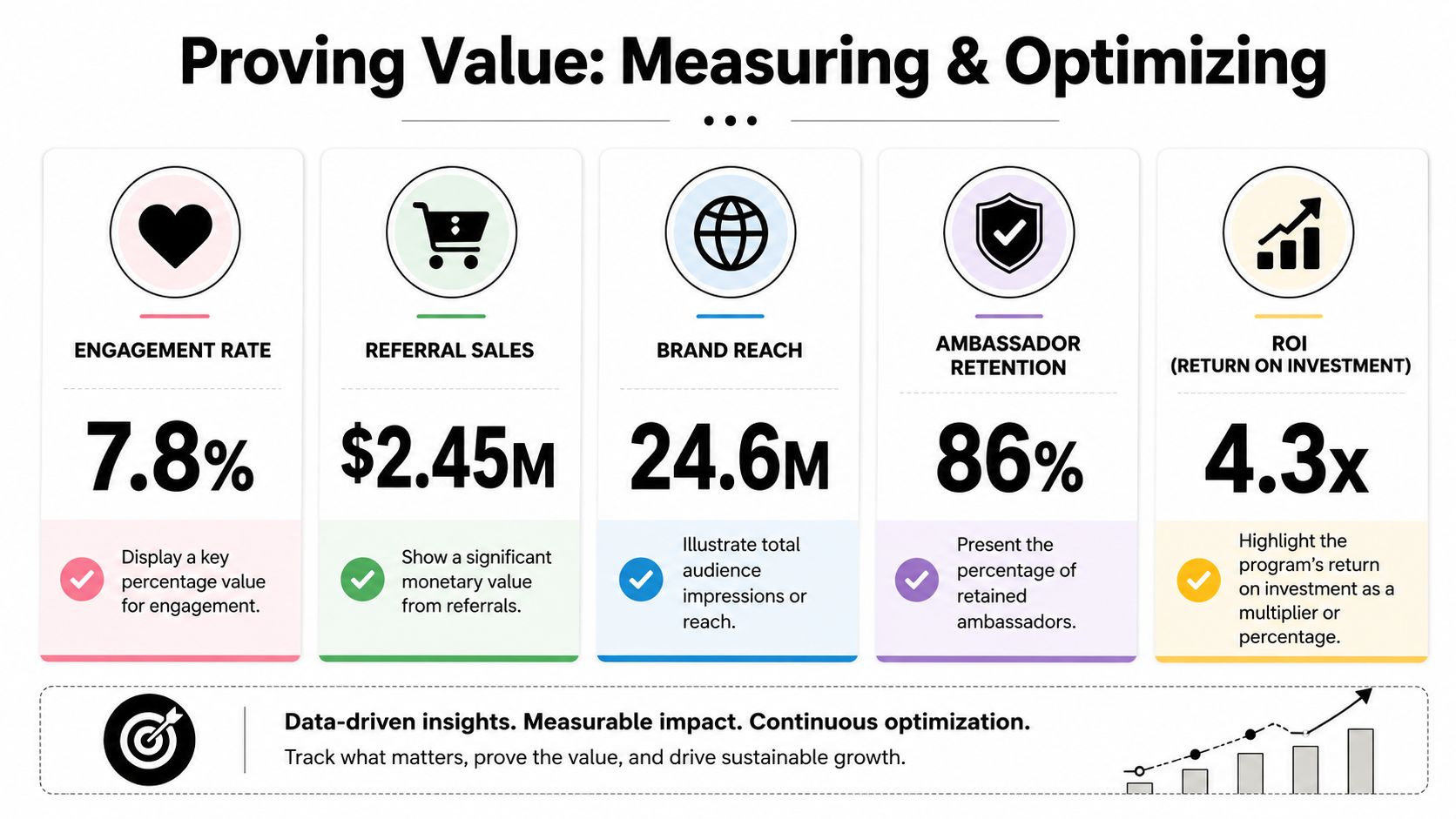
Vanity metrics make ambassador programs look busy. They don't help you improve.
A useful dashboard starts with five outcome categories:
You can still monitor activity metrics such as posts, messages sent, or content submissions. Just don't confuse motion with value.
A monthly performance report should fit on one screen or one page. If leaders need ten minutes to decode it, they won't.
Use a format like this:
| Reporting area | Questions to answer |
|---|---|
| Program output | What did ambassadors do this month |
| Business impact | What memberships, registrations, or engagement can be attributed |
| Quality signals | Did the right kinds of people join or participate |
| Operational issues | Where did onboarding, approvals, or communication slow things down |
| Next actions | What will change next month |
Add qualitative notes where the data is incomplete. That's better than inventing certainty.
The best source of improvement ideas is not your dashboard. It's your friction list.
Log every recurring problem:
Then fix the system, not just the individual.
This is also where lessons from broader people programs help. Some of the strongest employee retention strategies transfer well to ambassador management because retention usually improves when people feel supported, recognized, and connected to a clear purpose.
The long-term play is simple. Stop running ambassador recruitment as a disconnected set of forms, messages, and spreadsheets. Tie sourcing, selection, onboarding, communication, event participation, referrals, and reporting into one operating system so staff can see the full journey. When ambassador activity is connected directly to memberships, registrations, sponsor value, and member engagement, the program becomes easier to manage and much harder to dismiss.
If you're ready to run ambassador recruitment without stitching together spreadsheets, forms, chat apps, and separate event tools, GroupOS gives associations one place to manage community, memberships, events, content, and communication. That makes it easier to recruit ambassadors from your existing network, support them in a branded environment, and connect their activity to outcomes your team can measure.