March 25, 2026

So, what exactly is an online course creator platform?
Think of it as the all-in-one digital toolkit you need to build, sell, and manage your own educational programs. It takes all the scattered pieces—the video hosting, the payment processing, the lesson delivery—and bundles them into one cohesive system under your own brand.
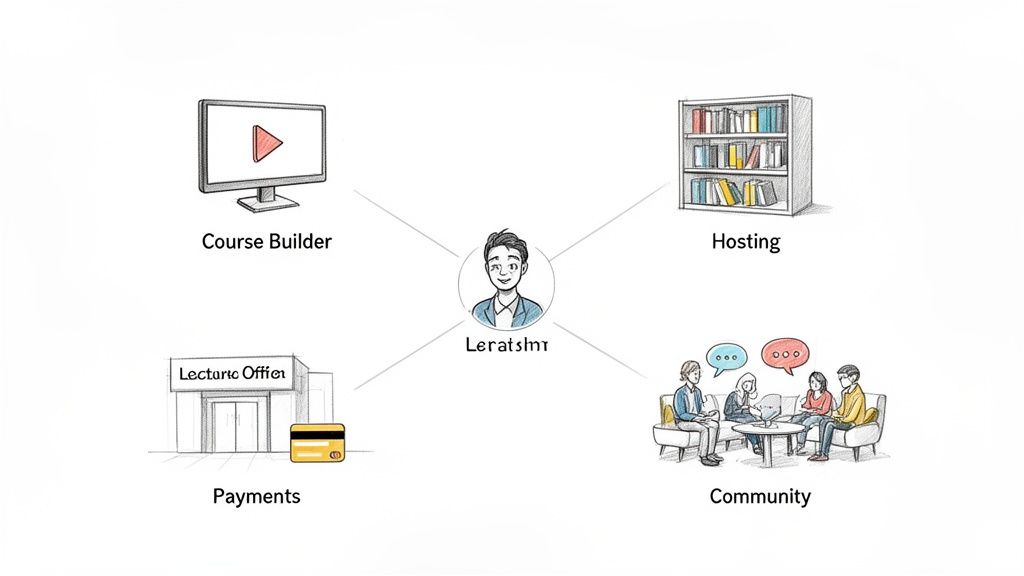
The best way to understand it is to imagine building your own private digital campus. Instead of using a jumble of disconnected tools like Google Docs, Zoom, and a separate payment processor, a course platform provides the entire infrastructure for you.
This "campus" comes with a few essential buildings right out of the box:
The hunger for high-quality, structured learning is undeniable. We're seeing a fundamental shift in how people want to develop new skills, and it’s created a massive opportunity for associations, event organizers, and individual experts.
This isn't just a fleeting trend. The global online course platform market is expected to hit a staggering $665.06 billion by 2025, and you can see more on this market growth at datainsightsmarket.com. That kind of growth tells you one thing: people are actively looking for organized, professional learning experiences they can trust.
An online course creator platform is your direct answer to that demand.
Instead of relying on third-party marketplaces where you compete for attention and give up a significant share of revenue, an owned platform puts you in complete control of your brand, pricing, and student relationships.
When you centralize your content on your own platform, you create a dedicated learning hub. Your members can dive deep into your material without the constant noise and distraction of social media feeds or ads for competing courses. It elevates your expertise from just another piece of content into a premium, well-structured product that delivers real-world value and builds a sustainable business.
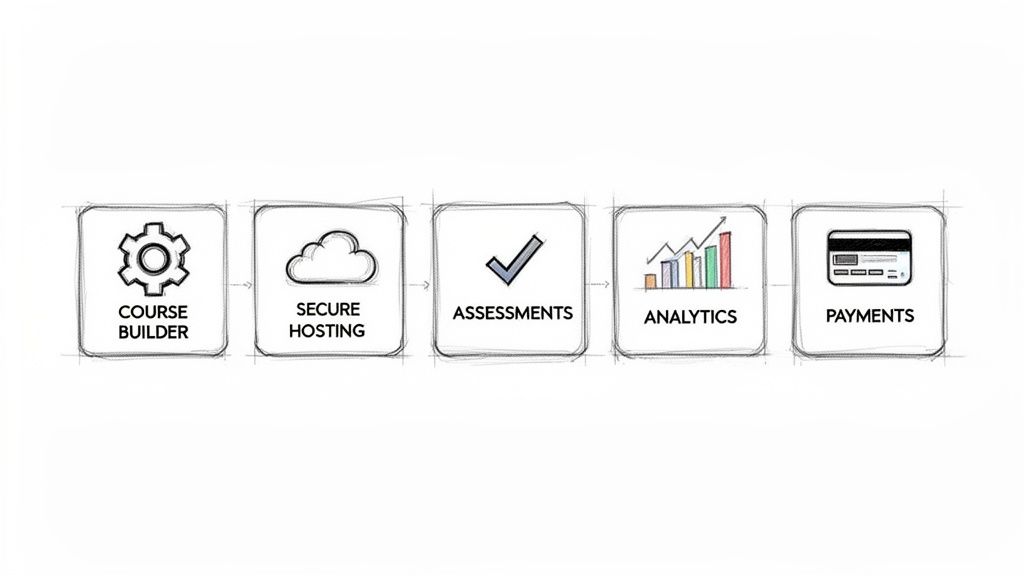
When you're shopping for a course platform, it's easy to get lost in a sea of features. But from my experience, a handful of them are absolute non-negotiables. These are the tools that do the heavy lifting, working together to create a smooth experience for both you and your students.
Think of these as the foundational pillars of your online education business. Get them right, and you've built something that can truly grow.
The heart of any platform is its course builder. This is where you’ll spend most of your time, organizing lessons and uploading your materials. A good one should feel intuitive, letting you drag and drop content, structure modules, and build out your curriculum without wanting to pull your hair out. You shouldn't need a degree in computer science to make it work.
Just as important is secure content hosting. This is what keeps your intellectual property—your videos, worksheets, and guides—safe. It’s the digital lock on your vault, preventing people from downloading and sharing the content you’ve worked so hard to create. Without it, you’re leaving revenue on the table and losing control of your work.
Creating great content is only half the battle; you need to know if it's actually sinking in. This is where assessments and tracking become your best friends, giving you a clear picture of student comprehension and engagement.
Think of your analytics dashboard as a GPS for improving your course. By seeing exactly where students re-watch videos or drop off, you get the insights you need to refine your content and drive up those completion rates.
For example, if you see that 75% of students are bombing a quiz, that's a huge red flag. It tells you the lesson right before it probably isn't clear enough. This is the kind of data that helps you build genuinely effective programs, including more interactive formats like cohort-based courses, which thrive on this kind of feedback loop.
Let’s talk about getting paid. Your platform needs to make the business side of things simple and professional. Seamless payment integrations are a must, letting you take payments through tools like Stripe or PayPal without a fuss. It also needs to support the way you want to sell:
Finally, your course platform shouldn't be an island. It has to play nice with the other tools you use. The ability to connect your platform to your email marketing software, your CRM, or your community platform is what makes everything run smoothly. When a new student enrolls, they should automatically get a welcome email and access to the right community channels—a polished, professional workflow that just works.
For professional associations and event organizers, thinking about an online course creator platform isn't just about delivering content. It’s about building a core piece of your year-round engagement puzzle. When you weave courses directly into your community and events, they stop being standalone products and start driving real, sustainable growth.
This creates a powerful cycle. Instead of member interest fading between annual conferences, you keep the momentum going. You're constantly offering new educational opportunities that deepen those all-important connections.
If you run an association, your world revolves around member retention and proving your value. Integrated courses are your direct line to doing just that. They allow you to build exclusive learning paths that members can't get anywhere else, shifting the membership from a simple annual fee to a key that unlocks continuous professional development.
Think about how you could apply this:
By building a library of high-quality educational content, an association transforms its platform from a simple member directory into a dynamic career development hub, making membership indispensable.
For event organizers, the big challenge is always making the event's impact last longer than a few days. An integrated course platform lets you bottle up all the energy and knowledge from an event and turn it into a permanent asset. It's a win for attendees and opens up new ways to engage sponsors.
Don't let those valuable session recordings just gather digital dust on a server somewhere. Repurpose them with a clear strategy. For more great ideas on this, check out our guide on using video training software to get the most out of your content.
This approach gives you a few powerful new plays:
At the end of the day, bringing courses, community, and events together creates one cohesive experience. Platforms like GroupOS are built specifically for this—to let you manage memberships, host events, and deliver premium courses all under one roof. This unified approach makes your life easier on the admin side and gives your members a polished, professional experience that turns your organization into an essential part of their career.
When you’re ready to pick an online course creator platform, it’s easy to get mesmerized by endless feature lists. But focusing only on the bells and whistles is a trap. The best platform isn’t the one with the most features—it’s the one that actually fits your business goals for the long haul.
Think about it like finding a location for a new shop. You wouldn't just grab the building with the most rooms. You'd scout the neighborhood, check the foot traffic, and figure out if the lease structure lets you turn a profit. The same strategic thinking applies here, and getting it right from the start can make all the difference.
One of the first forks in the road you'll encounter is pricing. How a platform charges for its service has a direct and significant impact on your bottom line, so you need to know exactly what you’re signing up for.
There are generally two models to watch for:
A platform heavy on transaction fees can feel like a hidden tax on your success. As you start selling more, a predictable subscription often becomes the smarter financial choice, giving you the clarity to reinvest in your business.
The platform you pick today has to be able to handle where your business is going tomorrow. True scalability isn’t just about handling more students; it’s about supporting your vision as it expands.
What happens when you want to add a second course? Or what if you decide to launch a paid membership or host live workshops? A platform that can truly scale will accommodate these new ventures without forcing you to pack up and move. This kind of flexibility is what lets you build a dynamic educational brand. For a deeper look at your options, our online course platform comparison breaks down how different solutions handle growth.
The goal is to choose a partner for the long haul. Migrating your entire business—your courses, students, and community—is a massive undertaking that disrupts momentum and creates unnecessary work.
White-labeling might sound like a technical term, but it’s incredibly important. It’s the ability to remove the platform’s logo and branding and make the entire experience your own. This isn't just about looks; it's about building trust and a professional image from the moment a student lands on your page.
This sense of ownership extends directly to your revenue potential. When you're looking at different tools, check out some of the best platforms for selling digital products that put creators in the driver's seat. The earning potential is staggering when you have full control. For example, creators on Kajabi have collectively earned over $6 billion because they own their pricing, brand, and customer relationships. The number of courses sold on that platform alone jumped from 9.1 million in 2021 to 12 million in 2023, proving the demand for premium, creator-owned content is stronger than ever. You can explore more revealing course statistics on whop.com.
All the theory in the world doesn't mean much until you actually get your course into the hands of your members. The good news is that launching a course on an online course creator platform isn’t some massive technical hurdle. It's really just a series of manageable steps that take you from a rough idea to a polished, professional learning experience.
Before you even start building, you need to pick the right tool for the job. This simple framework breaks down the decision-making process into three core stages.
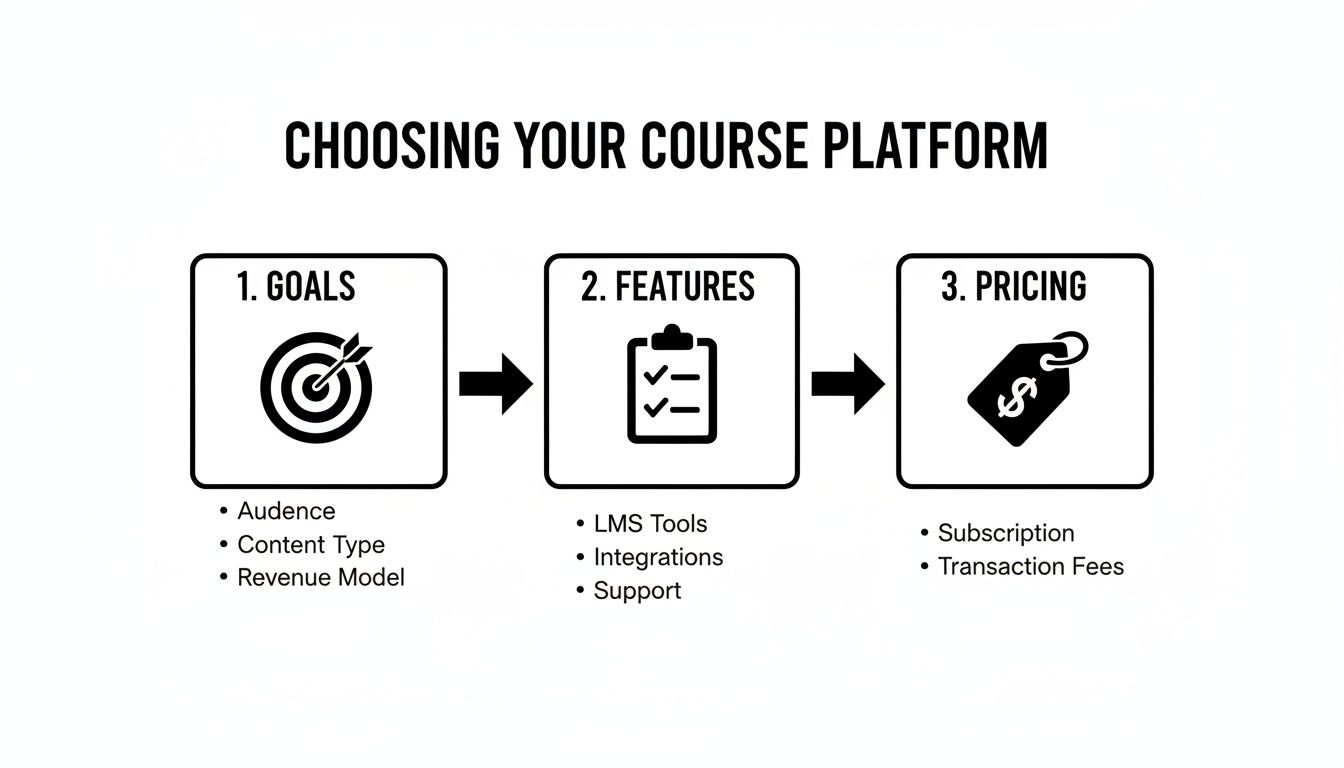
Starting with your goals, then matching them to features, and finally considering price ensures you end up with a platform that truly supports your business—not just one that looks good on paper.
The first real step is to get your content organized. You're likely sitting on a goldmine of existing materials you can repurpose: recorded webinars, PDF workbooks, presentation slides, and blog posts are all fair game. A platform with a good course builder will let you drag, drop, and organize this content into a logical curriculum without any headaches.
Don't feel like you have to build a university-level curriculum right out of the gate. Your first version can be a "minimum viable course" that solves one key problem for your audience.
Your goal isn't perfection on day one. It's about launching something valuable and gathering real-world feedback from your first students. This iterative approach allows you to improve the course based on actual engagement data.
Once you have your core lessons uploaded, you can begin to add more structure. This is where you'll want to master creating a compelling outline of a course, which acts as the roadmap for the entire learning journey.
Now for the powerful part, especially if your platform is integrated with your community. You can create gated content, making certain courses exclusive to different membership tiers. This is a fantastic way to encourage upgrades. For instance, a foundational course might be available to everyone, while an advanced certification is reserved for your premium members.
This is usually as simple as checking a few boxes, instantly creating a new layer of value for your membership. With your course built and your access rules in place, it’s time to launch it to the people who are already warmed up: your existing community.
Here’s a simple launch playbook:
This kind of workflow turns a stressful product launch into an exciting community event. You're not just selling something; you're inviting members to an exclusive experience they helped inspire.
If there's one big takeaway from all this, it's that the tools you use can either create frustrating roadblocks or build incredible momentum. For a long time, the only option was to stitch everything together. You’d have one platform for your courses, another for your community forum, and maybe a third for event tickets.
This setup might work for a while, but it quickly starts to cause problems. Your members get stuck juggling different logins and passwords, and the whole experience feels disjointed. On your end, you're constantly fighting to sync data between systems, trying to figure out who’s doing what and where. It’s a headache for everyone.
This is the exact problem GroupOS was designed to fix. It’s not just another place to upload your course videos; it’s a single, integrated home for your entire professional network.
Think about it: what if you could offer a single, branded space where your members can network with peers, sign up for your annual conference, and enroll in a certification course—all without ever having to leave? That’s the magic of bringing everything under one roof.
This approach delivers some powerful, real-world results:
With GroupOS, you're not just selling another course. You're inviting members into a complete learning environment where the community fuels the courses, and the courses strengthen the community. It’s a powerful cycle for building a brand that's engaging, sustainable, and profitable.
Jumping into the world of online courses naturally brings up a lot of questions. If you're feeling a mix of excitement and uncertainty, you're in the right place. Let's tackle some of the most common concerns we hear from creators.
Honestly, not much at all. Modern platforms are built for creators, not coders. If you've ever uploaded a photo to social media or attached a file to an email, you have the basic skills you need.
Most of these tools feature simple drag-and-drop course builders, so you can structure your lessons without touching a single line of code. The goal of these platforms is to let you focus on what you do best: sharing your expertise.
Absolutely! In fact, that's one of the smartest ways to get your first course off the ground quickly.
A great platform will let you easily upload all sorts of existing materials—think webinar recordings, PowerPoint slides, PDFs, and worksheets. You can assemble your first course in a fraction of the time by simply repurposing the valuable content you already have.
A course platform gives you strategic control over your brand and audience, unlike marketplaces that treat your course as just another product in a vast catalog. Owning your platform means you own the student relationship.
The biggest difference boils down to one word: ownership.
Think of a marketplace like Udemy as a giant digital mall. You’re renting a small kiosk, your course is listed right next to your competitors, and the mall owner takes a significant cut of every sale.
An online course creator platform is like building your own boutique shop. You control the branding, the student experience, and the pricing. Most importantly, you keep all the revenue and build direct relationships with your students.
Ready to bring your community, events, and courses together under one roof? GroupOS is the integrated platform that lets you build a powerful learning hub that's all your own. See how GroupOS works.