May 28, 2026

You're probably dealing with this already. A board member replies to email at 6 a.m. A sponsor only checks messages between client meetings. Speakers for your annual event live in different time zones. Your members say they want to participate more, but they can't make every live call, office-hours session, or committee meeting.
That's where people start asking about the meaning of asynchronous communication. Usually they get a technical definition, a quick list of examples, and then a vague conclusion that “email is async.” That's not enough for someone running a professional community, planning an event, or managing a membership organization.
For communities, asynchronous communication is bigger than email. It's a deliberate choice to build systems where people can contribute without being present at the same moment. When that choice is made well, participation gets easier, discussions get more useful, and operations stop depending on everyone being available right now.
A community manager posts an update about a new member benefit. One member comments during lunch. Another reads it after putting kids to bed. A committee volunteer responds the next morning with a thoughtful suggestion. Nobody had to join a call. Nobody had to stop what they were doing. The conversation still moved forward.
That's the practical meaning of asynchronous communication.
Asynchronous communication means people don't interact at the same time. One person sends a message, update, question, or resource. Another person reads and responds later. The delay isn't a flaw. It's part of the design.
The word didn't start in workplace culture. Historically, asynchronous came from telecommunications and computing, where it referred to transmitting data without synchronizing to a clock. Over time, that idea evolved into a business communication model where messages are sent and answered at different times, which became especially important as distributed work expanded across time zones, as explained in Dropbox's overview of asynchronous communication.
In plain language, the old technical meaning gives us a useful human one. People don't need a shared clock. They need a shared place to communicate.
That's why the meaning of asynchronous communication isn't “using email.” It's building communication around delayed response, documented context, and flexible participation.
Practical rule: If a conversation can still work well when someone replies later, it can probably be designed asynchronously.
Many readers hear “async” and think it means digital communication. That's too broad. A live Zoom call is digital, but it's not asynchronous. A Slack message can be async, but a fast-moving chat thread can act like a live meeting if everyone feels pressure to answer instantly.
The key difference is the expectation.
If the message says, “Reply when you've reviewed this,” that's asynchronous.
If the message says, “Can everyone jump in now?” that's synchronous.
For professional groups, this matters because many activities don't need instant reaction. Member feedback, committee review, event planning notes, sponsor coordination, onboarding questions, and policy discussions often improve when people have time to read, think, and respond carefully. If you want a deeper look at one async format communities often overlook, this guide to forum discussion in online communities is a useful companion.
Creative and distributed teams have been wrestling with this shift for years, which is why Bulby's guide for creative teams is also worth reading. It helps show that async is less about a tool and more about a way of working.
A phone call and a shared document can both solve a problem. They don't solve it the same way.
Synchronous communication happens live. People are present together, whether in person, on a video call, or in a real-time chat exchange. Asynchronous communication happens on each person's schedule. One person contributes now. Another contributes later.
A helpful metaphor comes from telecommunications. In that setting, asynchronous communication transmits data without an external clock signal, often using start and stop bits so the receiver can resynchronize with each byte. In human terms, that becomes communication that doesn't require a shared “clock” or simultaneous attention, as described in Wikipedia's explanation of asynchronous communication.
Here's the visual version first.
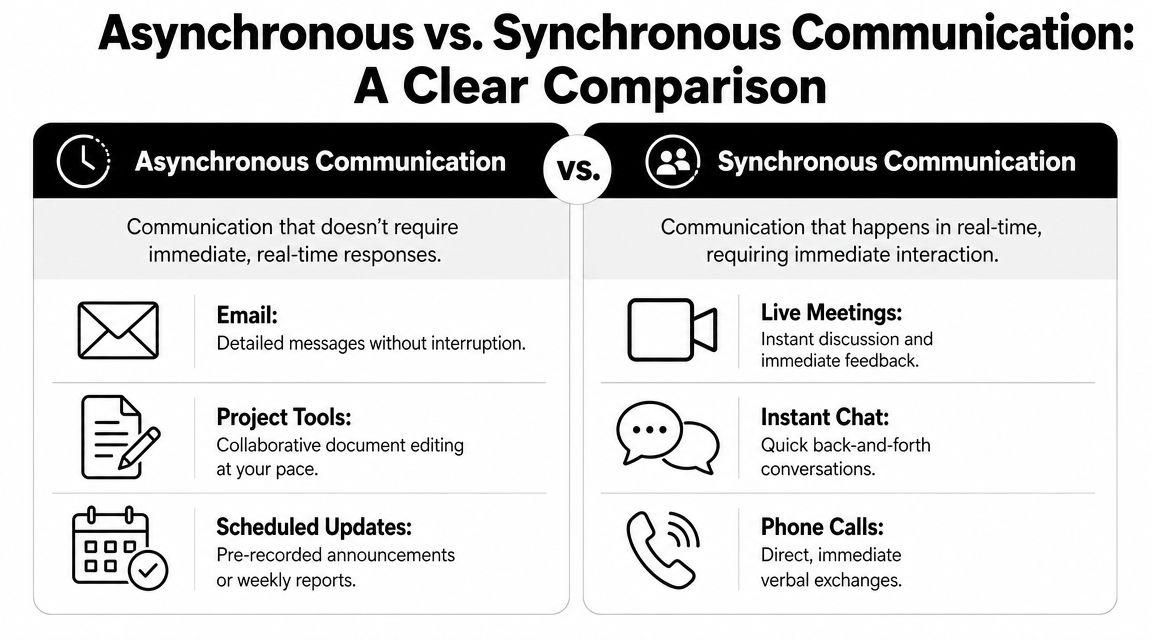
Synchronous communication asks for shared time.
Asynchronous communication asks for shared context.
That one distinction clears up most confusion. Live meetings work when fast clarification matters. Async channels work when people need flexibility, written records, and time to think.
For community leaders comparing tools, this breakdown of Slack for communities can help because chat platforms often blur the line between the two modes.
| Attribute | Synchronous Communication (Live) | Asynchronous Communication (On Your Time) |
|---|---|---|
| Timing | Everyone participates at once | People contribute at different times |
| Response expectation | Immediate or near-immediate | Delayed response is normal |
| Best for | Urgent issues, fast decisions, live discussion | Updates, documentation, review, reflection |
| Examples | Meetings, phone calls, live chat, webinars with Q&A | Email, forums, project boards, recorded updates |
| Impact on focus | Can interrupt deep work | Supports focused work between responses |
| Inclusivity | Favors those available at that moment | Favors people with varied schedules and time zones |
| Documentation | Often needs separate notes | Usually creates a written record by default |
| Risk | Meeting overload, pressure to react fast | Slow replies, drifting threads |
The comparison looks simple on paper, but the choice changes behavior.
A live brainstorming session rewards quick thinkers and strong talkers. An asynchronous discussion thread often gives quieter members more room to contribute. A call can resolve tension quickly. A written update can prevent five follow-up meetings.
Here's a short explainer if you want a second format for the same contrast.
Use synchronous communication when delay creates risk. Use asynchronous communication when interruption creates waste.
Neither mode is “better” in every case. Strong communities use both. The skill is knowing which one fits the job.
Professional communities don't just exchange information. They coordinate volunteers, welcome new members, gather feedback, run committees, support sponsors, and keep conversations alive between events. That makes communication design a structural issue, not a preference.
When a group relies too heavily on live interaction, participation starts to favor the people with the most schedule flexibility. Members in other time zones miss updates. Volunteers skip meetings because of work demands. Event planning turns into a chain of status calls. Good people stop contributing, not because they're disengaged, but because the system asks them to be present at the wrong moment.
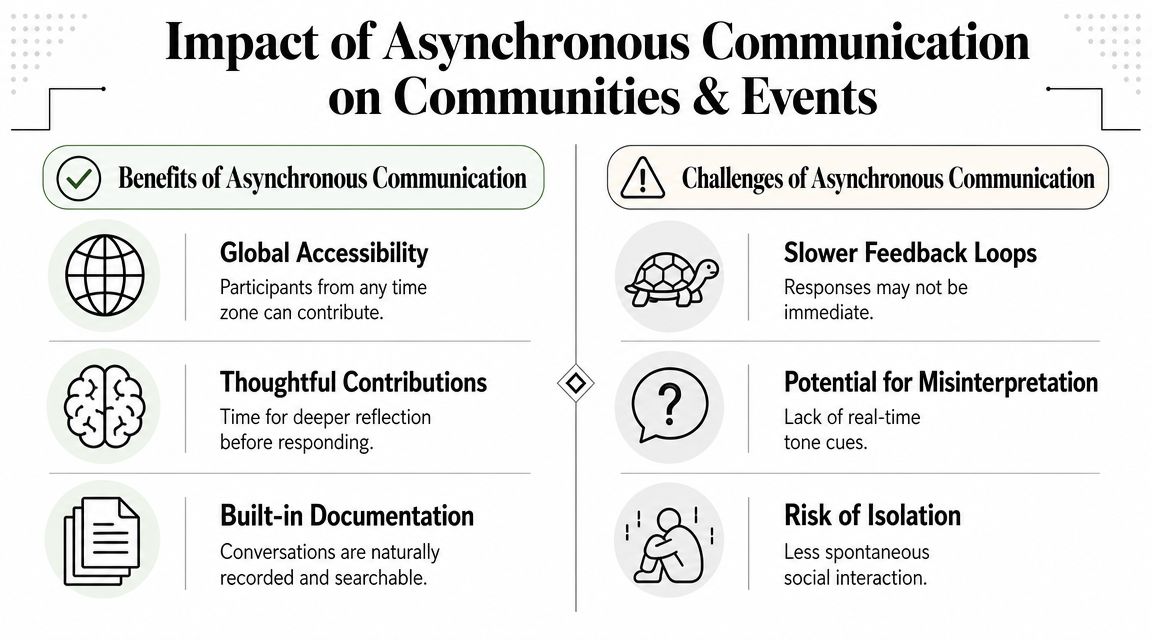
For member engagement, asynchronous communication widens the doorway. A discussion board, recorded update, or structured feedback thread lets members participate when they have time and attention.
That shift often improves the quality of contribution too. Instead of reacting on the spot, people can review context, think through their answer, and write something useful. For committees and working groups, this usually produces clearer reasoning and a better trail of decisions.
For events, async methods also reduce coordination friction. Speaker onboarding, sponsor questions, volunteer instructions, and post-event follow-up all work better when information is stored in one place and revisited later. Organizations that want to strengthen that layer of participation often benefit from studying how to build an online community that sustains conversation.
There's also a direct efficiency argument. In a clinical workflow study, asynchronous communication reduced average task completion time by 20.1 minutes, a 58.8% reduction compared to synchronous methods, and the result was statistically significant at p < 0.01, according to the clinical workflow study on asynchronous communication efficiency. The setting was clinical, not community management, but the principle matters for any organization handling coordination across busy roles.
If fewer tasks depend on real-time back-and-forth, work keeps moving.
That's especially relevant for:
Async communication isn't magic. It can slow down urgent decisions. Tone can get lost in writing. Threads can become messy if nobody summarizes next steps.
The biggest mistake isn't using asynchronous communication. It's using it without clear rules for urgency, ownership, and follow-up.
Communities also need moments of live energy. People build trust through real-time conversation, spontaneous laughter, and fast back-and-forth problem solving. The healthiest model is rarely all-async. It's a thoughtful mix where live interaction is reserved for moments that need it.
Theory makes sense quickly. Practice is what helps people adopt it.

A professional association wants input on a new certification benefit. In the old model, staff schedules a live town hall. Attendance is mixed. A few vocal members dominate the conversation. Staff then spends days reconstructing what people said.
In an asynchronous model, the team posts a structured prompt in a threaded forum. Members can respond over several days. Staff groups the replies by theme, answers follow-up questions in the thread, and leaves the discussion visible for anyone who joins later. The result is cleaner feedback and a record the team can revisit.
A conference planner is working with speakers, sponsors, and vendors spread across several regions. Instead of trying to find one meeting time for everyone, the team uses a shared document for speaker requirements, a task board for deadlines, and recorded walkthroughs for venue or sponsor instructions.
One person updates a task. Another reviews it hours later. A speaker uploads revised materials overnight. The planner wakes up to progress instead of another scheduling problem.
A mentoring initiative pairs senior members with early-career professionals. Live sessions still matter, but not every question needs a scheduled call. Private messaging channels let mentees ask for advice when it comes up. Mentors can answer with context, links, or a short recorded message when they have time.
That changes the relationship. Instead of waiting for the next appointment, the program supports steady learning between touchpoints.
Good asynchronous communication usually looks less dramatic than a big live event. It looks like fewer bottlenecks, clearer records, and more people able to participate without rearranging their day.
Most organizations don't fail because async is a bad fit. They fail because they add a tool without changing expectations. If people still assume every message needs a fast answer, the tool stays digital, but the culture remains interrupt-driven.

At the workflow level, asynchronous communication depends on systems that support non-simultaneous participation, including message storage, later retrieval, and notification of pending messages. It also works best when teams set explicit response-time norms so the intentional reply lag doesn't create confusion, as outlined in Simpplr's glossary entry on asynchronous communication.
That means your first job is to answer questions like these:
Some teams need a formal rollout. Others can begin with one committee, one event workflow, or one member segment. Either way, the basic moves are the same.
Move repeatable updates into written formats.
Weekly progress notes, agenda drafts, onboarding instructions, and FAQs are good places to start.
Create one source of truth.
If the latest answer might live in email, chat, a spreadsheet, or someone's memory, async will feel chaotic.
Write messages that stand on their own.
Include background, decision needed, owner, and due date. Don't force people to decode context from ten previous replies.
Train people to summarize.
Long threads become useful when someone closes the loop with “Here's the decision” or “Here are the next steps.”
Protect live time for what only live time can do.
Use meetings for conflict resolution, sensitive conversations, and fast decisions with real tradeoffs.
Leadership habit: If a question can be answered once in a shared space, don't answer it five times in private.
Adoption becomes easier when leaders model it. That means writing clear updates instead of sending vague pings. It means avoiding “just checking in” messages that create hidden urgency. It means rewarding people for documenting decisions, not only for being visibly responsive.
The meaning of asynchronous communication becomes real when your community no longer depends on immediate reaction to stay coordinated. It depends on clarity, consistency, and accessible information.
You don't need complicated dashboards to tell if async is helping. Start by watching behavior.
Are members contributing to discussion threads without staff chasing them? Are volunteers giving fuller responses instead of one-line reactions? Are common questions getting answered in shared spaces instead of repeating in private inboxes? For community teams building a more formal scorecard, these community engagement metrics offer a useful framework.
Look for a mix of qualitative and operational signals:
For communication channels like newsletters or announcements, it also helps to understand adjacent performance signals. If your async strategy includes email, these key email ROI metrics can help you evaluate whether your outreach is reaching and engaging people effectively.
A “ghost town” forum usually means the prompt was weak, the audience didn't know why it mattered, or leaders failed to reply visibly. Start with narrower questions and respond quickly with synthesis, not just approval.
If threads drag on without resolution, assign an owner to summarize and close the loop.
If people still default to meetings, audit the last few calls. Ask which of them needed live discussion and which could have been a written update, a recorded briefing, or a shared comment thread instead.
Async communication works when people trust the system. They need to know where to speak, when they'll hear back, and how decisions will be documented.
If your organization wants one place to support member communication, event coordination, content delivery, and ongoing engagement, GroupOS gives professional communities a unified way to run those workflows without stitching together disconnected tools. It's built for associations, networks, and event-driven groups that want communication to stay organized before, during, and after every program.