March 26, 2026

Effective marketing for coaches isn't about throwing spaghetti at the wall with random social media posts. It's a thoughtful approach that starts with defining who you are, identifying exactly who you help, and then consistently showing them how you can solve their problems. It’s about building a structured system that attracts and converts clients, using a mix of smart funnels and both organic and paid tactics.
Before you even think about a single social media post or ad campaign, the real work begins. This is the foundational, unsexy stuff that makes or breaks a coaching business. It’s what separates the coaches who struggle to find clients from those who command premium prices and seem to attract them effortlessly.
Without this groundwork, you’re just another voice shouting into a crowded room.
Your first job is to get specific. Calling yourself a "life coach" or a "business coach" is like trying to sell sand at the beach—you'll never stand out. The market is drowning in generalists. Real success comes from being a specialist.
A niche isn't just a fancy label. It’s the sweet spot where your unique skills, your genuine passion, and a real market need all intersect. It’s about solving a specific problem for a specific kind of person.
To start drilling down, ask yourself a few tough questions:
For example, don't just be a "career coach." That’s too broad. Instead, you could be a "career coach for mid-level tech managers navigating their first leadership role." See how that instantly makes you more memorable and relevant to a distinct group? To dig deeper into this process, it's worth learning how to find your tribe.
Once you've picked your niche, you have to get inside the head of the person you're serving. This is where so many coaches fall short, stopping at basic demographics like age or city. A solid foundation goes so much deeper. A great way to get this right is to learn how to create buyer personas that truly reflect your ideal clients.
You need to understand their psychographics—what keeps them up at night, what they're afraid of, what they secretly dream about.
Key Insight: Your marketing should sound like you’ve read a page from your ideal client's diary. You need to articulate their problem even better than they can. When you can do that, they stop asking about your price and start asking how soon they can begin.
Let's go back to our career coach for new tech managers. Your ideal client isn't just "John, 35, in San Francisco." He's "John, who just got promoted, feels completely swamped by his new duties, and is terrified he’s an imposter who’s about to be found out." Every piece of your marketing—every email, every post, every video—should speak directly to that feeling of overwhelm and imposter syndrome.
Your value proposition is your elevator pitch on steroids. It's a sharp, clear statement that answers one question: "Why you?" It’s the magnetic message that connects your expertise directly to your ideal client’s most pressing problem.
A killer value proposition nails three things:
A weak proposition sounds like, "I help people achieve their goals." A powerful one is, "I help new tech managers build the confidence and leadership skills to excel in their roles in 90 days, so they can ditch imposter syndrome and fast-track their next promotion."
When you put in the time on this foundational work, you’re essentially creating a compass for your entire business. It guides every piece of content you create and every conversation you have. It turns marketing for coaches from a game of guesswork into one of strategic, intentional action.
Great content is the lifeblood of your coaching business, but just posting randomly on social media is a recipe for burnout, not consistent clients. What you really need is a system—a client attraction funnel—that intentionally guides someone from a complete stranger to a happy, paying customer.
This isn't about being pushy or "salesy." It’s about being genuinely helpful at every step of their journey. When you have a funnel in place, every piece of content you create has a purpose. Your marketing stops being a series of random acts and starts being a predictable machine that builds trust and brings in qualified leads.
The journey always starts with discovery. This is what marketers call the "top of the funnel" (TOFU), and it’s where people stumble across you for the very first time. The goal here isn't to sell. It's to attract and educate your ideal client with high-value content that speaks directly to their problems.
Think of it like offering a free, bite-sized sample of your expertise. You're showing them what you know and building that initial layer of trust by helping them solve a tiny piece of their bigger puzzle.
Effective TOFU content often looks like this:
The content at this stage should be broad enough to catch the attention of your target audience, but specific enough that they immediately think, "Wow, this person gets it." You're not just another coach; you're the coach who understands their world.
Once you've got their attention, the next logical step is to move the conversation from a public feed to a more personal space: their inbox. This is where a lead magnet is absolutely essential. A lead magnet is simply a valuable resource you offer for free in exchange for their email address.
But this can’t be just any old freebie. A powerful lead magnet solves what I call a "signature problem"—a specific, nagging issue your ideal client is wrestling with right now. It gives them a tangible result and an immediate win, which builds a tremendous amount of trust.
Pro Tip: Your lead magnet should act as a natural prequel to your paid coaching program. It solves one part of the puzzle so well that they can't help but wonder what it would be like to have your help solving the whole thing.
Examples of lead magnets that solve a signature problem include:
A crucial part of this entire system is building an email list. It's the one marketing asset you truly own, giving you a direct line to your most engaged prospects, completely immune to algorithm mood swings.
Now that they're on your email list, you've earned the right to deepen the relationship. Welcome to the "bottom of the funnel" (BOFU), where you gently guide warm leads toward a decision. The content here gets more direct and personal.
This is the time to share client success stories, testimonials, and case studies that showcase the transformation you facilitate. You can directly address common objections or answer frequently asked questions. Finally, you make clear, confident invitations to book a discovery call or apply to work with you. For a deeper look at how to set these systems up, our guide on sales funnels templates provides some great practical frameworks.
This whole process is driven by the foundation you've already built—your Niche, Client, and Message—which informs every stage of the funnel.
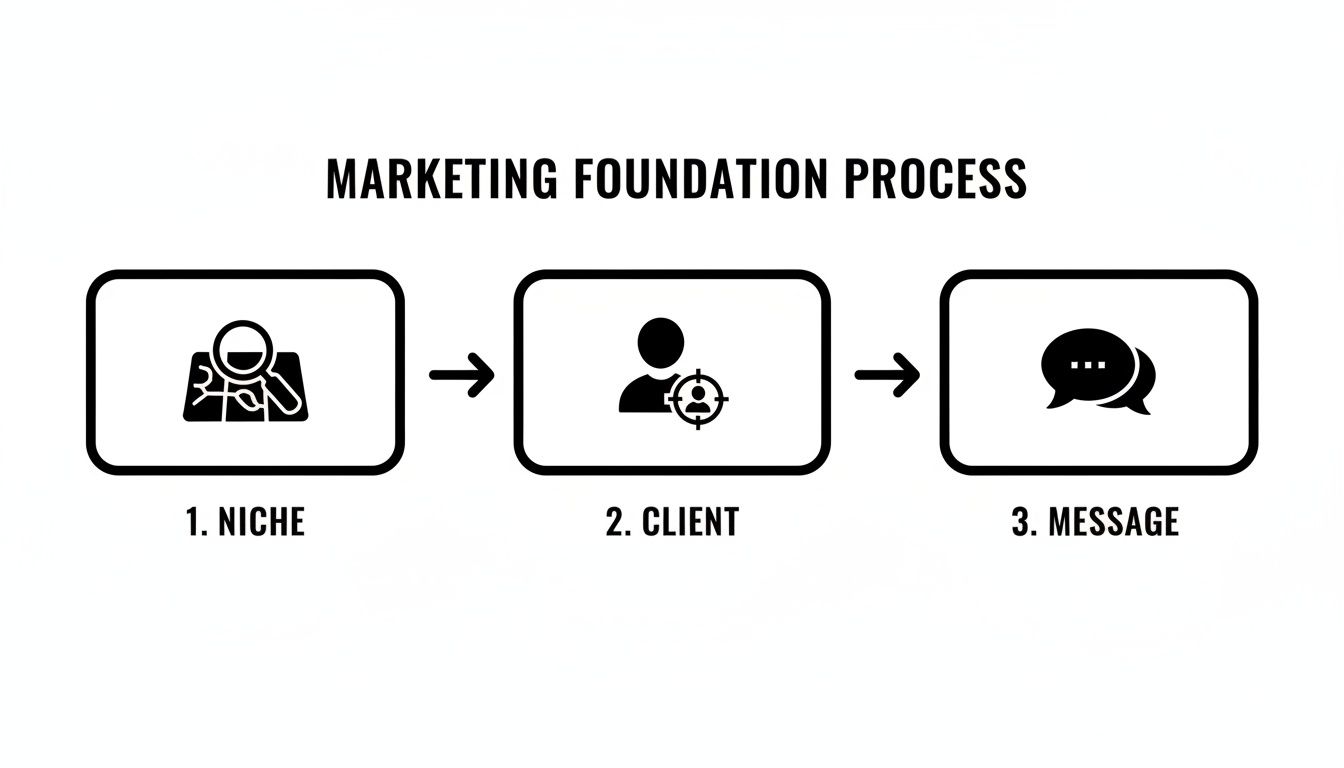
As you can see, a successful funnel isn't just about random tactics. It's the direct result of a well-defined niche, a deep understanding of your ideal client, and a message that truly connects.
What if you could build a marketing engine that works around the clock, building trust and bringing in leads while you're sleeping or, you know, actually coaching? That's what a great community does for your business. It shifts your focus from constantly chasing new clients to cultivating a space where your best advocates are born.
This isn’t about vanity metrics like follower counts. It's about building a real, sustainable ecosystem. When you get it right, your community becomes a reliable source of warm leads for your high-ticket programs, creating a powerful flywheel that just keeps spinning.
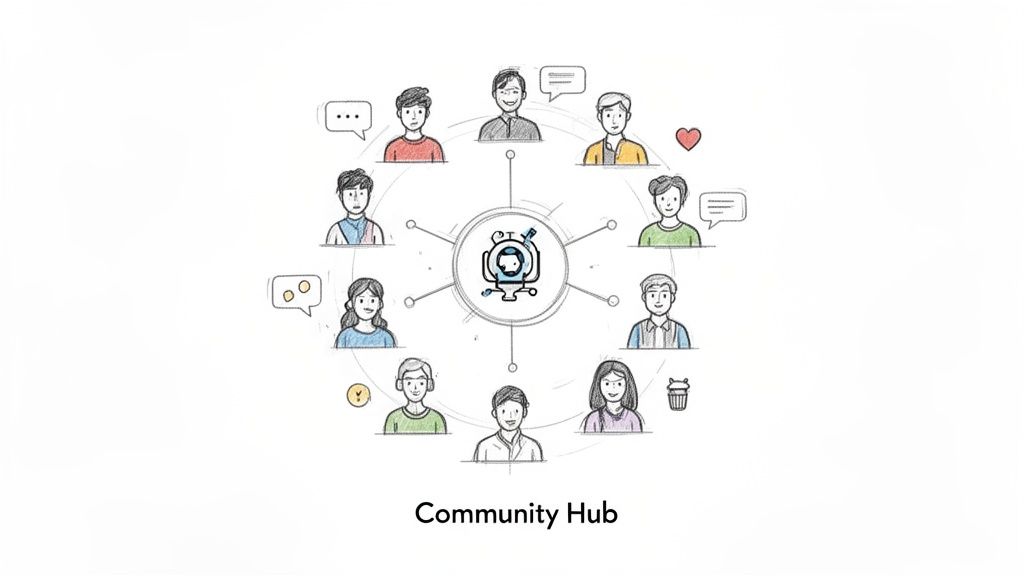
First things first, you need to decide what kind of community actually fits your coaching business. There are two main paths you can take, and both can be incredibly effective parts of your marketing for coaches strategy.
Free Community as a Lead Magnet: This is your top-of-funnel workhorse, often a Facebook group or a free tier on a dedicated platform. Here, you attract potential clients by generously sharing valuable content, answering their burning questions, and demonstrating your expertise. It's the perfect place to build trust on a larger scale.
Paid Membership Community: This model introduces a recurring revenue stream. Members pay a subscription for exclusive content, group coaching sessions, a network of motivated peers, and more direct access to you. It's a fantastic way to serve people who aren't quite ready for 1:1 coaching but still need your guidance.
You don’t have to pick just one. I’ve seen many successful coaches use a free group to nurture leads before inviting the most committed members to a paid community or their signature one-on-one programs.
Let's be blunt: a dead community is worse than having no community at all. Your main job is to be the catalyst for conversation and connection. Just dropping a post and walking away simply won't work.
A community thrives on belonging. Your goal is to make every member feel seen, heard, and valued. When people feel a genuine connection to you and each other, they are far more likely to invest in your paid offerings down the line.
Here are a few practical ways I’ve seen coaches bring their communities to life:
The real magic happens when you move from a monologue (you talking at your members) to a true dialogue where members are talking with you and, more importantly, with each other. A great place to start is by learning the fundamentals of how to create an online community that people are actually excited to join.
As your community grows, trying to manage it all—especially a paid one—can get chaotic fast. Juggling member spreadsheets, different payment tools, and scattered content is a direct path to burnout. This is where a dedicated platform becomes a non-negotiable.
An all-in-one solution like GroupOS can become your mission control. It lets you host your memberships, exclusive events, on-demand courses, and discussions all under your own brand. You can automate payments and deliver content without having to duct-tape a dozen different apps together.
The right tech doesn't just save you a ton of time; it creates a more professional and seamless experience for your members. It's no surprise the coaching platform market is projected to hit $12.01 billion by 2036. This trend shows that integrated tech is becoming the standard for managing client relationships and communities. By adopting a unified platform early, you're setting up your coaching business for growth that you can actually handle.
Alright, you've built your foundation and your community is starting to buzz. Now it's time to pour some fuel on the fire and start actively attracting new clients.
Think of your client acquisition strategy like a well-balanced investment portfolio. You need a mix of long-term, steady growth (organic marketing) and short-term, high-impact plays (paid marketing). Relying on just one makes your business fragile. Combining them is how you build a resilient, scalable coaching practice.
Organic is all about building trust and authority over time. Paid ads, on the other hand, give you immediate, laser-focused reach. When you use them together, something powerful happens—your growth starts to compound.
Organic marketing is definitely a long game, but the payoff is huge. You're essentially creating assets that work for you 24/7, pulling in ideal clients who are already looking for the exact solution you offer. It’s the art of being discovered.
Imagine your perfect client, frustrated and stuck, typing "how to get promoted in tech" or "executive coach for new managers" into Google. SEO is what gets your name to the top of that list. It connects you with high-intent leads at the precise moment they're raising their hand for help.
Your first move? Start writing blog posts that answer the exact questions your ideal clients are asking. Brainstorm the phrases they use and the problems they're trying to solve. When you weave these "keywords" into genuinely helpful, in-depth articles, Google starts to see you as an authority and rewards you with traffic.
Don't fall into the trap of trying to be everywhere at once. That's a one-way ticket to burnout. Instead, pick one or two platforms where your clients actually hang out and go deep.
Every piece of social content should be a breadcrumb leading people back to your website, your newsletter, and your core offers.
Deciding where to invest your time and money can feel overwhelming. This table breaks down some of the most popular channels to help you make a strategic choice based on your goals and resources.
| Channel | Type | Primary Benefit | Investment Level | Best For |
|---|---|---|---|---|
| Blogging/SEO | Organic | High-intent, long-term traffic | High Time, Low Cost | Coaches with niche expertise who enjoy writing and solving specific problems. |
| Organic | Professional networking & B2B leads | Medium Time, Low Cost | Executive, career, and B2B coaches targeting professionals and decision-makers. | |
| Instagram/TikTok | Organic | Brand personality & community building | High Time, Low Cost | Life, wellness, and relationship coaches connecting with a broader consumer audience. |
| Facebook/IG Ads | Paid | Precise audience targeting & speed | Low Time, High Cost | Quickly testing offers, promoting lead magnets, and reaching new audiences based on interests. |
| Google Ads | Paid | Capturing active search demand | Medium Time, High Cost | Getting in front of people actively searching for coaching services with high purchase intent. |
Start by picking one organic and one paid channel from this list. Get really good at them before you even think about adding another. A focused approach will always beat a scattered one.
Paid ads give you speed and predictability. They let you put your message directly in front of a hand-picked audience, right now. Yes, it requires a budget, but stop thinking of it as an "expense."
When you know that every $100 in ad spend reliably brings in a $1,500 client, it's not a cost—it's a growth machine.
The coaching space is booming. The number of professional coaches shot up from around 71,000 in 2019 and is projected to hit over 122,974 by 2026—a 54% spike. This incredible growth, detailed in coaching industry research about its global expansion and what it means for practitioners, means there's massive opportunity. It also means you have to stand out, and paid ads are a fantastic way to do that.
Key Takeaway: The best ads don't just sell coaching. They enter the conversation already happening in your prospect's mind. Your ad copy should feel like you're tapping them on the shoulder to talk about a problem they're desperate to solve.
Managing all of this can get complex, but there are tools to make it easier. Our guide on the best lead generation tools is a great starting point for finding platforms that can help you streamline your campaigns.
The ultimate goal here is to create a marketing system that works for you. Begin with one organic and one paid channel. Master them, track your results obsessively, and only then consider expanding. This balanced, focused approach is the foundation of effective and sustainable marketing for coaches.
So, you’ve got leads coming in. That's fantastic. But the real work—and the real magic—is in turning those interested prospects into happy, paying clients. A clunky, disorganized sales and onboarding process is the fastest way to kill that initial excitement.
Let's walk through how to create a smooth, professional system that not only converts more leads but also kicks off the coaching relationship on the best possible note.
This part of your marketing for coaches playbook is all about mastering the moments after someone shows interest. Nail this, and you'll not only boost conversions but also pave the way for incredible client transformations and a steady stream of future referrals.
For many coaches, the discovery call feels like a high-pressure sales pitch. It can be terrifying. The secret is to completely reframe your mindset. You're not there to sell; you're there to diagnose.
Your only job is to listen with genuine curiosity. Think of it less as a sales call and more like a first coaching session—one where you're helping them find clarity around their problem. Listen more than you talk. By focusing entirely on what they want and what’s holding them back, you can honestly assess if you’re the right person to help.
When you find that perfect fit, asking them to enroll feels like the natural, obvious next step. No hard sell required.
Hearing an objection about price or timing can make your stomach drop. Don't panic. An objection is almost never a hard "no." It's actually a request for more information or reassurance. It often means you haven't quite connected the dots between the value you provide and the high cost of them not solving their problem.
A stellar onboarding experience is your best weapon against buyer's remorse. It immediately validates their decision to invest in themselves—and in you—by delivering immediate value and a clear path forward.
When someone says, "I can't afford it right now," your first response should be empathy. Then, get curious. Try something like, "I completely understand. Can we talk for a minute about what it's costing you to not solve this problem right now?" This simple question reframes your coaching from an expense into a critical investment.
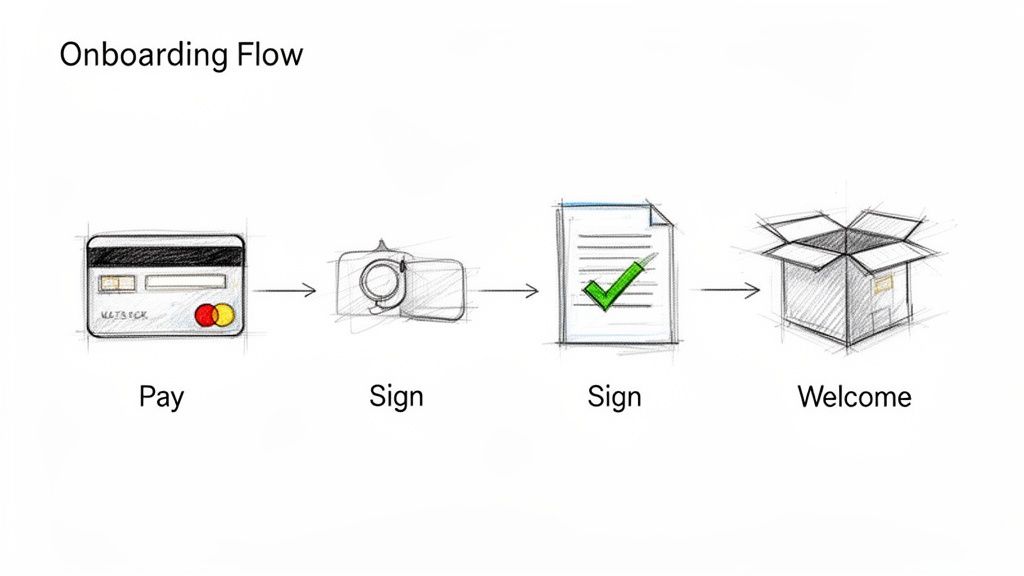
The moment a client says "YES!" is when your systems should take over. The last thing you want is a messy, manual scramble of sending invoices, contracts, and scheduling links through a dozen different emails. This is your first real chance to make your new client feel seen, supported, and cared for.
A well-oiled onboarding workflow automates the crucial next steps:
This is where platforms like GroupOS can be a game-changer. It connects all these moving parts, from taking payment to giving clients a central hub for their resources. This kind of automated, professional sequence proves from day one that they made the right choice in hiring you.
When you're first getting started, the world of marketing can feel overwhelming. It’s easy to get stuck, and I see a lot of talented coaches spinning their wheels because they’re wrestling with the same few questions. Let's clear those up right now.
The coaching space is booming—the industry hit $4.56 billion in revenue in 2022 and is on track to reach a staggering $7.3 billion by 2026. You can read more about the coaching market's growth on Paperbell. That kind of growth creates massive opportunity, but only for those who have a solid marketing plan.
Here are the answers to the questions I hear most often.
Forget trying to find a magic dollar amount. A much better way to think about this is as a percentage of your revenue. As a rule of thumb, plan to reinvest 10-20% of your target monthly income back into marketing.
Of course, when you're just starting out and have zero clients, your budget is mostly your own time—what we call "sweat equity." This means you’re putting in the work on things like:
Once you land your first paying clients, it's time to put real dollars to work. You don’t need to go big. Start with a small, manageable ad spend, maybe $20 a day on a highly targeted Facebook or LinkedIn ad. The goal here is just to test your offer and messaging.
Make sure you track your return. If you spend $100 on ads and land a $1,500 coaching client, that’s not an expense. It's a profitable investment you can double down on.
The best social media platform is simply the one where your ideal clients spend their time. Trying to be everywhere at once is a classic rookie mistake that leads to burnout and weak results.
Your job is to figure out where your people are and then go deep on that one platform.
Do a little homework. Ask people in your target market where they hang out online. Once you know, commit to mastering that channel. One platform done well is infinitely more powerful than five done poorly.
Sure, you can probably land your first client or two without a website, maybe through a personal referral. But if you're serious about building a sustainable business, a website isn't optional. It’s essential.
Think of your website as your digital home base. It's the only corner of the internet you truly own, safe from algorithm updates and shifting social media trends. It's your 24/7 salesperson, working for you while you sleep.
Your website is where you solidify your expertise, share client wins, and most importantly, build your email list. Social media is rented land; your website is the property your entire business is built on.
Every single successful coach started exactly where you are now—with no clients and no social proof. This is the classic "chicken-or-the-egg" dilemma, and there's a straightforward way to solve it.
You need to create your first testimonials intentionally. Put together an offer for a small handful of "founding members" to go through your program for free, or at a very steep discount. Be upfront with them: you're perfecting your methods and, in exchange for the incredible value, you're asking for a detailed testimonial at the end.
This strategy is a win-win-win:
Those first few success stories are the foundation you’ll use to start attracting full-paying clients with confidence and credibility.
Ready to build a thriving community that becomes your best marketing asset? GroupOS provides an all-in-one platform to manage your memberships, events, and content seamlessly. Explore how GroupOS can help you grow your coaching business today.