March 4, 2026
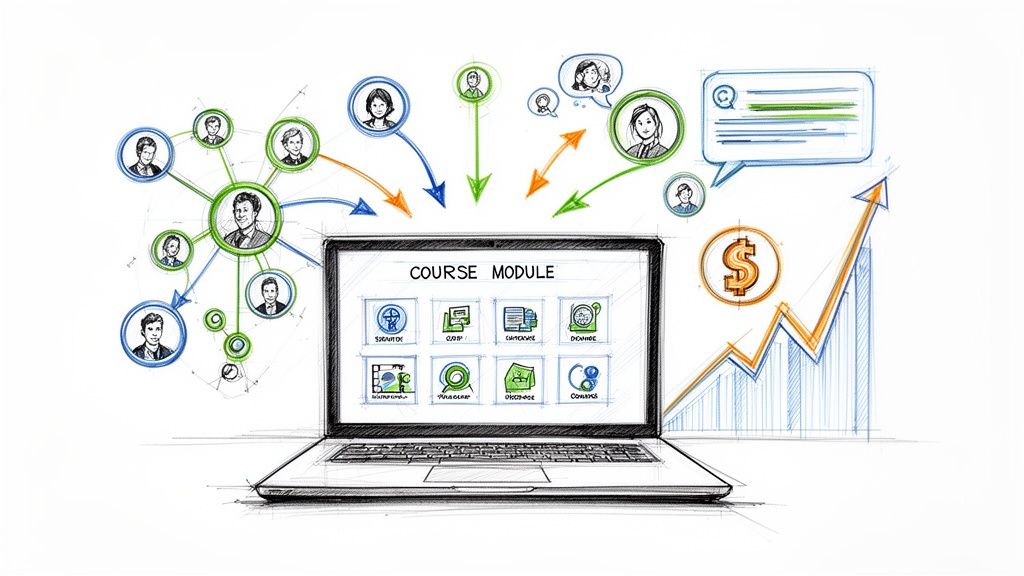
If you think selling online courses is all about creating amazing content, you're missing the most important piece of the puzzle. The real secret isn't just what you teach, but who you teach it to. Your existing professional network—the members, event attendees, and subscribers you already have—is your single greatest asset. It's time to stop relying on unpredictable ad spend and start turning that built-in audience into your primary sales channel.
The online education market is exploding, and your professional organization is sitting on a goldmine. Too many groups treat course sales as a nice little side project, but the real opportunity is to make it a core part of your revenue. The trust and engagement you've already nurtured are far more powerful than any marketing funnel.
This isn't about spamming your members with sales pitches. It’s about a fundamental shift in strategy:
This approach changes the game. Course sales stop being a gamble and become a reliable, scalable part of your business.
The demand for high-quality digital education is off the charts. Just look at the massive open online course (MOOC) market. It ballooned from $30.24 billion in 2025 to $40.68 billion in 2026—that’s a jaw-dropping 34.5% annual growth rate. And it's not slowing down; forecasts predict it will hit $134.07 billion by 2030.
This explosive growth is a clear signal for organizations to sell courses directly within their communities. The business case is solid, too. Companies that invest in real training see 218% higher revenue per employee and 24% higher profit margins. The connection between learning and financial success is undeniable.
The bottom line is simple: You already have the audience. The challenge is learning how to package your organization's expertise into products they actually want to buy.
This guide is a practical playbook built for professional networks and membership organizations like yours. We’ll walk through the entire process, from spotting a great course idea to scaling your sales.
This simple, three-stage process is the foundation for building a successful course business.
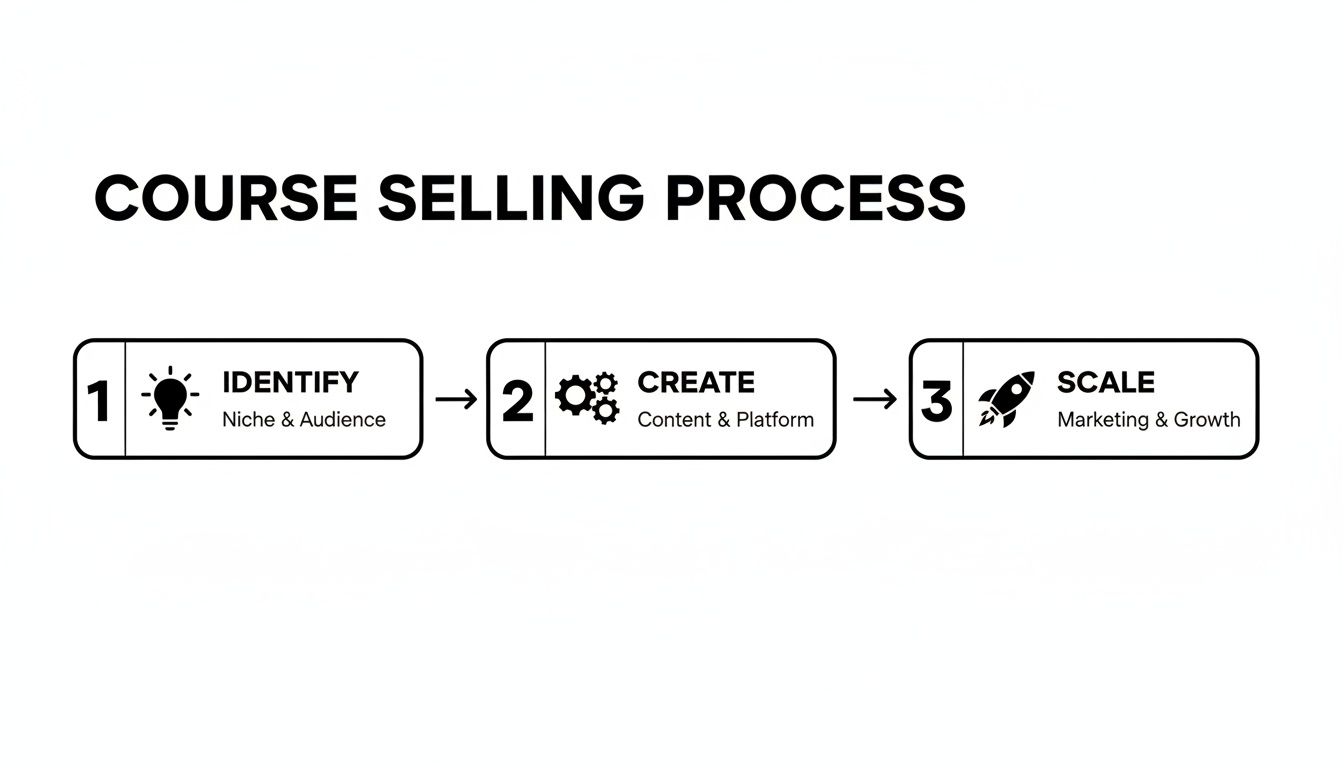
The journey breaks down into identifying what your members need, creating content that delivers real value, and then scaling your efforts for long-term growth. Nailing each of these stages is key, and it all begins with knowing your community inside and out. For more on that, I highly recommend our guide on how to build an online community.
Let’s be honest. A truly successful online course isn't born from a fancy curriculum or slick production values. It starts with an idea your community is desperate to learn about. The real secret to selling courses is to create something that solves a nagging, real-world problem for your members, making the decision to buy a total no-brainer.
This isn’t about guesswork. It’s about data-driven validation. Stop asking, "What course should I create?" and start asking, "What problems can I solve?" Your community is already telling you what they need; you just have to know where to listen.
Your community channels and live events are absolute goldmines for course ideas. The questions, frustrations, and aspirations your members share are the raw materials for your next bestseller.
I've seen organizations find their most profitable course ideas by digging into these key sources:
These qualitative data points are infinitely more valuable than brainstorming in a vacuum. They give you direct proof of what your members will actually pay for.
To get you started, here are some consistently high-performing course topics I’ve seen work wonders for professional organizations, along with the audiences they serve.
Think of this table as a starting point. The real magic happens when you map these general categories to the specific, expressed needs of your own unique community.
Once you've locked in a validated topic, how you structure the course is everything. Remember, your members aren't full-time students. They are busy professionals juggling careers, families, and a dozen other commitments. Your curriculum has to respect their time and deliver value quickly.
Following a solid guide to course instructional design is key to building something that’s both effective and engaging. I’ve found that a great structure blends different learning formats to keep people hooked.
Consider this proven blend:
This mixed-media approach caters to different learning styles and makes the whole experience feel dynamic and supportive, not like a boring lecture series. For more detailed guidance, you can also check out our post on how to create a compelling course outline to really nail down your content structure.
I once worked with a national association for financial planners. Their annual conference keynote on "Retirement Planning for Gig Economy Workers" was a massive hit—the Q&A session even ran over time. Instead of just letting that momentum fade, they got smart.
They repurposed the keynote recording as the first module of a brand-new certification program. From there, they built out five more modules with expert interviews, downloadable financial modeling templates, and a final exam. It sold as a year-round, on-demand certification, turning a single one-hour talk into a major new revenue stream.
By 2026, global online education revenue is projected to hit $221.71 billion, driven by professionals demanding flexible learning. With 46% of learners choosing business courses, professional networks are perfectly positioned to meet this demand. The rise of mobile learning—expected to reach $80 billion by 2027—also means your course platform must be accessible on the go. Discover more insights about these global education trends on Statista.com.
This scenario perfectly illustrates the core principle: your best course ideas are often hiding in plain sight, embedded within the content and conversations you're already having. Your job is to listen, package the solution, and make it easily accessible to the people who need it most.
I’ve seen so many organizations pour their hearts into creating an incredible course, only to have their launch fall flat. They often overlook a critical piece of the puzzle: the offer itself. The way you package and price your course is just as important as the content inside.
You can have the best curriculum in the world, but if the offer isn’t compelling, you're leaving a ton of money on the table. It’s not about just picking a number; it’s about creating a set of irresistible options that speak to different members with different budgets.

The biggest mistake is defaulting to a single, one-time fee. It’s simple, sure, but it’s also restrictive. The most successful education programs think more like retailers, giving people multiple ways to buy.
Think about it. A static, one-time price feels like a "take it or leave it" deal. For a high-value certification, that can be a scary commitment for a potential student. A more flexible approach, on the other hand, invites more people into your learning ecosystem.
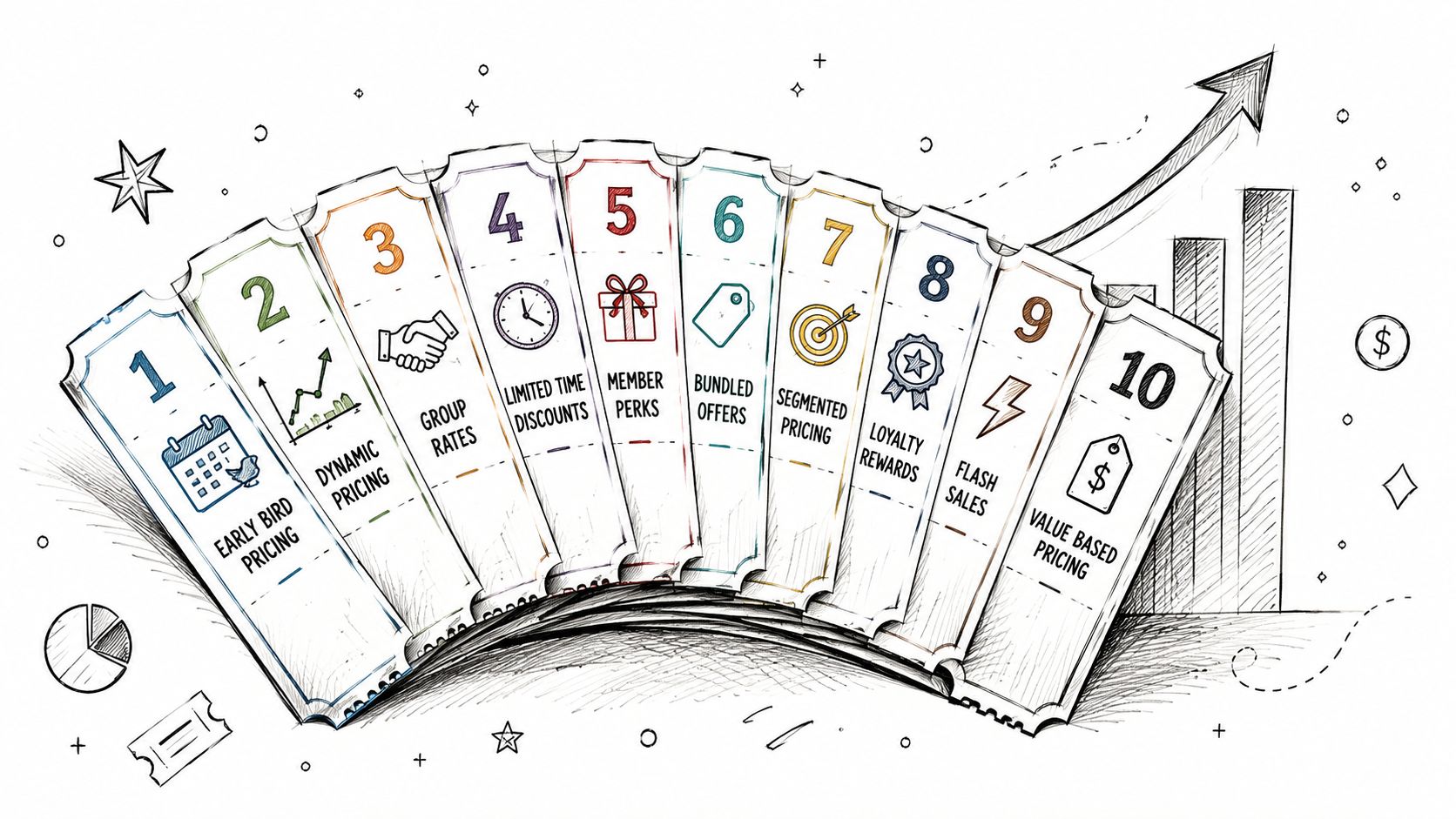
Here are a few models I’ve seen work wonders:
Of course, you’ll need a platform that can handle this kind of pricing flexibility. The goal is to experiment and see what your audience responds to.
So, how do you land on the right price? Don't just look at what your competitors are charging and pick a number in the middle. The most powerful pricing strategy is anchored in value.
Price your course based on the tangible result or transformation it delivers.
Does your certification help members qualify for a $10,000 raise? Does your course teach a skill that lets a consultant charge $50 more per hour? When you frame the price in relation to the outcome, a $1,000 course suddenly feels like a steal.
When you sell a course, you're not selling information—you're selling a transformation. Frame your pricing and marketing around the destination, not the journey.
One of the most effective ways to sell online courses is by weaving them into your live events. Your conference and workshop attendees are your most engaged audience—they are literally a captive audience. This is the perfect time to add value with your educational programs.
Imagine pulling off one of these plays:
These kinds of integrations create a fluid learning path for your members, converting one-time attendees into long-term students. They also make your event tickets far more valuable.
For a deeper dive into building these kinds of offers, our guide on designing subscription pricing strategies has some excellent frameworks you can borrow. Getting this mix of packaging and pricing right is a process of testing and learning, but it’s what separates a nice side project from a major revenue engine for your organization.
You’ve done the hard work of creating, packaging, and pricing your online course. Now, how do you get it in front of the right people? Forget dumping money into ads or getting lost in complicated marketing funnels. Your most powerful sales engine is the audience you’ve already built: your community.
The goal here isn't a hard sell. It's about authentic, value-driven marketing that feels more like a helpful recommendation from a trusted source. You're nurturing the relationship you already have, not trying to build one from scratch.
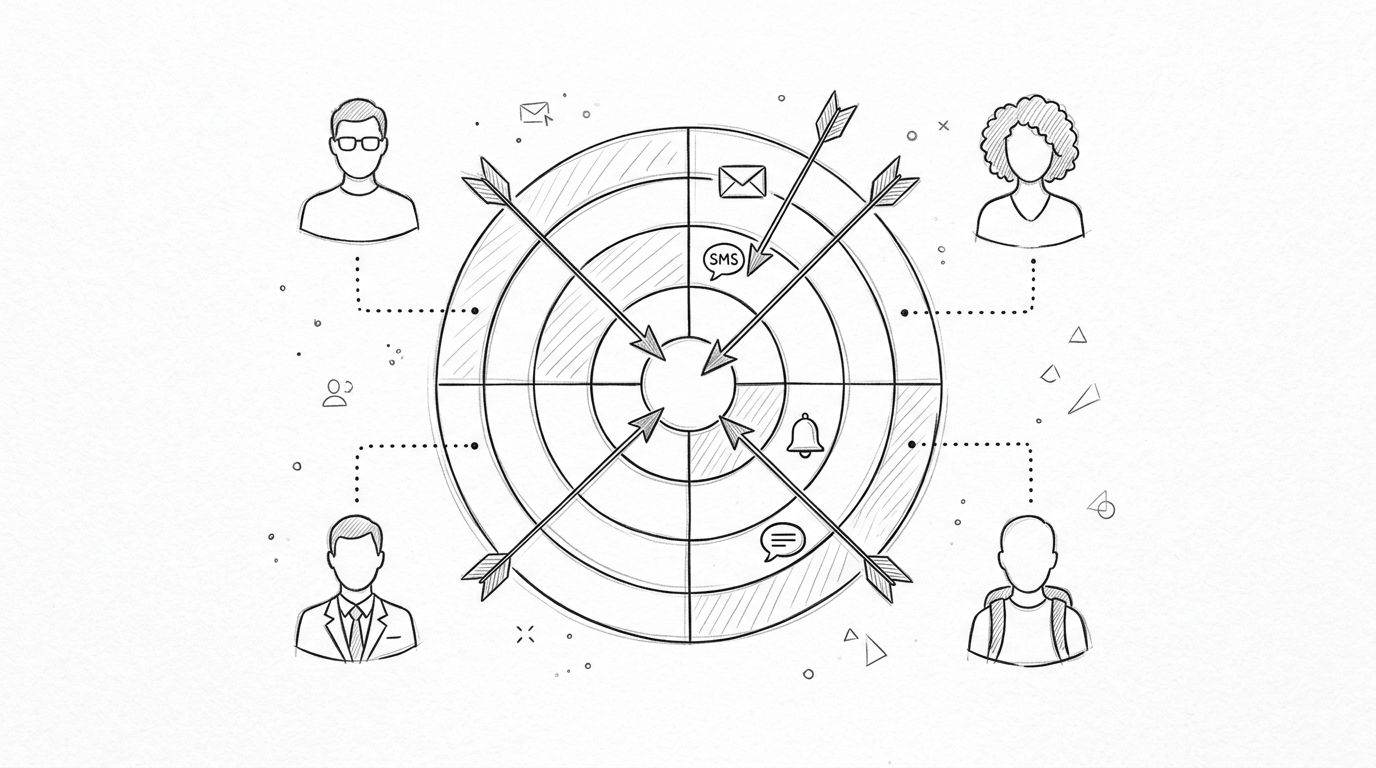
One of the best things about running a community is that you already have direct lines of communication. These are your go-to channels for building excitement and driving sales without spending a dime on external ads. Your best results will come from simply talking to your warm audience.
Start by sketching out a simple promotional plan using the tools you're already familiar with.
By hitting these different channels, you make sure your message finds your members wherever they're most active. It’s a natural way to boost visibility and get people talking.
Your sponsors and exhibitors are more than just logos on a page—they can be fantastic promotional partners. Many are actively looking for ways to give more value back to the community, and co-marketing a relevant course is a perfect fit.
Here’s a simple way to get this going:
This kind of partnership is a true win-win. The sponsor delivers value and gains visibility, and you get your course in front of a brand new, highly relevant audience.
Live events, whether they're in-person or virtual, are buzzing with energy. You have a captive audience of motivated people who are there specifically to learn. This is a golden opportunity to introduce them to your online courses.
Don't let the energy of a live event fizzle out. Use it as a springboard to guide attendees into a deeper, ongoing learning journey with your digital courses.
Picture this real-world scenario. You're running a live, half-day workshop on project management. As you wrap up, attendees are feeling inspired and ready to act. You switch to a final slide with a big QR code on it.
The offer? An exclusive 40% discount on your advanced "Project Management Professional (PMP) Certification Prep" online course, but it’s only good for the next 24 hours. Attendees can scan the code with their phones, land on a checkout page that's already filled out, and enroll on the spot. This simple move closes the gap between the live experience and your digital library, turning engaged attendees into paying students.
This tactic is so effective because it’s timely, exclusive, and incredibly easy. You’re meeting your members at their peak moment of interest.
The market data absolutely supports this integrated strategy. The online education sector is expected to climb from $82.81 billion in 2025 to $101.09 billion in 2026, largely because of this shift toward community-linked, subscription-style learning. Even more telling, corporate eLearning is on track to grow over 250% to $49.87 billion by 2026. This shows the massive opportunity for organizations that learn to sell courses effectively to their own members and event attendees. You can dig into more of this data by exploring the future of the online education market on The Business Research Company.
That first successful course launch feels incredible, doesn't it? But a launch is just a moment. Real, lasting success comes from building a business that can grow even when you’re not personally pulling every lever. This is where you shift from being a course creator to a business owner, and smart systems are what make that shift possible.
The aim is to get out of the weeds of day-to-day operations so you can focus on strategy. This means bringing your tools together and automating all those repetitive tasks that eat up your time. A single, unified platform can become the backbone of your entire operation, handling everything from payments and content access to member communications.
This kind of operational efficiency is a powerful form of business leverage. To really get a handle on growing your courses, it’s worth understanding What Is Leverage In Business and how you can apply those ideas to your educational programs. It's all about achieving more by setting up the right systems from the start.
Picture this: a new member signs up for your signature course at 2 AM. Do you need to be awake to grant them access? Of course not. A smart system should handle that entire process seamlessly while you sleep.
Here’s what your automation setup should be doing for you:
Automating these fundamental tasks can easily free up dozens of hours every single month. That’s time you can pour back into creating new content, engaging with your members, or digging into your business analytics—the high-value work that actually moves the needle.
Instead of guessing what your members want next, you can use data to make confident decisions. A good platform doesn't just host your content; it gives you a window into how your students are actually using it.
Look for these metrics to guide your next move:
Your analytics dashboard isn't just a report card; it's a treasure map. It shows you exactly where your members are finding value and where they're getting stuck, pointing the way to new opportunities.
This data-driven approach takes the guesswork out of content development. You’re no longer creating courses you think your members want; you’re creating courses you know they need because their behavior is telling you so. For a deeper dive into this, our guide on scaling with systems shows exactly how to build these workflows.
As you grow, you’ll hit a fork in the road. Do you keep patching together different tools for your courses, community, and payments, or do you move to a single, integrated platform? While a piecemeal approach might work at first, it almost always leads to data headaches and a clunky user experience.
An all-in-one community platform like GroupOS is built to solve this problem, especially for organizations selling courses.
Here’s a practical look at how the two approaches stack up.
Ultimately, choosing a centralized system is the final piece of the puzzle. It creates a smooth, professional experience for your members while giving you the connected data and automation you need to grow your business smartly and sustainably.
Diving into course sales can feel like a huge undertaking, especially when you're already busy running a professional network. Let’s dig into some of the questions I hear all the time and get you some practical answers so you can start selling your courses with confidence.
Trust me, these concerns are completely normal. The good news is that you can overcome all of them by leaning into the two biggest assets you already have: your expertise and your community.
The first instinct is to peek at what competitors are charging, and you should. It gives you a feel for the market. But don’t stop there. The real key to effective pricing is anchoring it to the value you provide.
Think about the outcome. Does your course help someone land a promotion, master a new skill set, or earn a valuable certification? That’s where the real value lies, and your price should reflect that transformation.
A fantastic way to kick things off is with an "early bird" special. It creates urgency, gets those first crucial sales in the door, and helps you collect testimonials you can use later.
You might also consider setting up a few pricing tiers. For example:
This tiered approach is great because it lets members with different budgets and needs find an option that works for them.
This is a big one, and the answer is almost always less than you think. You absolutely do not need a perfectly polished, 100% complete course to start making money. In fact, one of the smartest things you can do is presell your course.
Here's the game plan:
This strategy is powerful for two reasons. First, it immediately validates your course idea—if people pay for it, you know you're onto something. Second, it gives you cash flow to fund the rest of the course production. You can then release the other modules on a weekly schedule, gathering feedback from your first students as you go.
By preselling, you shift from building in a vacuum to co-creating with your first batch of students. This nearly guarantees a better final product and a more engaged initial cohort.
Your most powerful marketing engine is the community you already have. Forget about pouring money into ads, at least for now. You've already done the hard work of building trust with your network, so start there.
Focus on these no-cost (or very low-cost) marketing moves:
When you market this way, it feels less like a hard sell and more like you’re offering a valuable resource, which is a perfect fit for an established professional community.
Ready to turn your expertise into a thriving revenue stream? GroupOS gives you an all-in-one platform to create, sell, and manage online courses right inside your community. Get started with a free trial today.