November 30, 2025
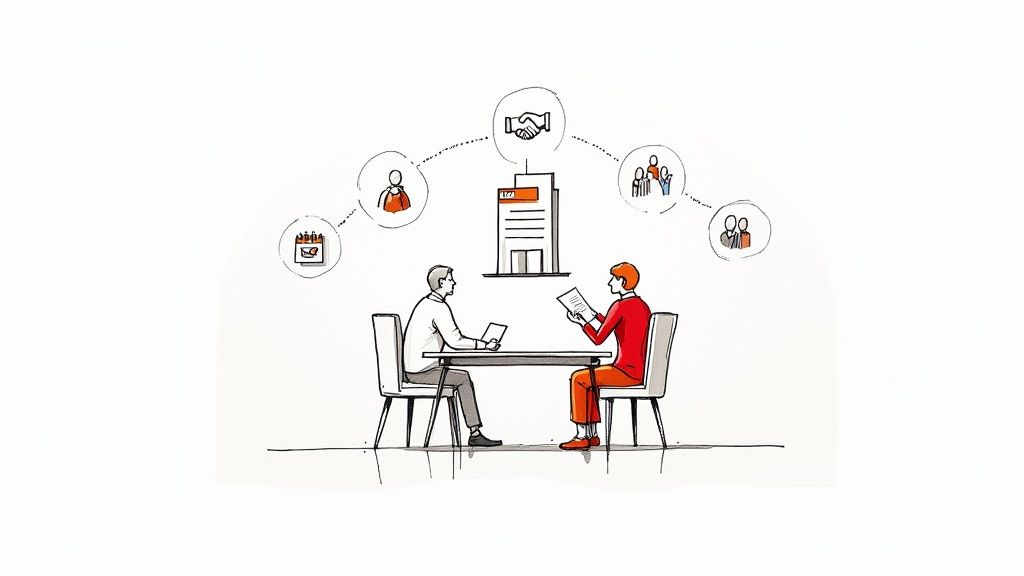
Securing corporate sponsorship isn't about asking for money; it's about presenting an irresistible business opportunity. To do it right, you need to nail three things: precisely defining your audience, crafting a value proposition that screams ROI, and finding companies whose marketing goals are a perfect match for what you offer.
Before you even think about drafting an email or picking up the phone, you’ve got to do your homework. The days of simply slapping a logo on a banner are long gone. Today's sponsors are savvy investors, and they're looking for real, measurable returns.
This first phase is all about getting your house in order. It's where you build the airtight business case that a decision-maker needs to see before they'll even consider cutting a check.
Ultimately, every potential sponsor is asking one simple question: "What's in it for us?" A fuzzy answer just won't fly. You need a confident, data-backed response that shows them a clear path to getting what they want, whether that's generating new leads, boosting their brand, or connecting with the community.
The most powerful asset you bring to the table is your audience. Period. But just saying you have "5,000 members" or "1,000 event attendees" is lazy and ineffective. You have to paint a vivid picture of who these people are.
This means digging deep and creating detailed audience personas. Go way beyond the basics and get into their heads:
This is the kind of detail that makes a sponsor sit up and take notice. For instance, instead of saying you have "tech professionals," you could say, "Our audience includes over 350 senior DevOps engineers from mid-market SaaS companies who are actively evaluating new cloud infrastructure solutions." Now that's a pitch that opens doors. Really getting who you serve is the crucial first step we outline in our guide on how to find corporate sponsorship.
Before you go any further, it's worth taking a moment to see if you're truly prepared.
Use this quick checklist to gut-check whether your organization has its foundational pieces in place. Being honest here can save you a ton of wasted effort down the road.
If you can confidently check these boxes, you're in a great position to start building your value proposition.
Once you have that crystal-clear picture of your audience, you can build a value proposition that speaks directly to a company's goals. This isn't just a laundry list of benefits. It's a short, powerful statement explaining the unique, tangible value of partnering with you.
Think of it less as a one-time transaction and more as the beginning of a long-term partnership. Adopting this mindset is key. To go deeper on this, check out resources like The Donor Engagement Cycle: Building Long Term Support Through Meaningful Relationships, which really breaks down how to foster these kinds of connections.
The money flowing into this space shows just how seriously brands are taking it. Corporate sponsorship spending hit a staggering USD 97.4 billion in 2022 and is on track to reach USD 189.5 billion by 2030. You're not asking for a handout; you're tapping into a massive marketing channel.
Expert Tip: Stop selling sponsorship and start selling solutions. Frame every single benefit—from a speaking slot to a branded coffee station—as a specific tool that helps a company solve a problem or achieve a goal.
This visual flow maps out these crucial first steps, from understanding your audience to defining your value and getting ready to make your case.
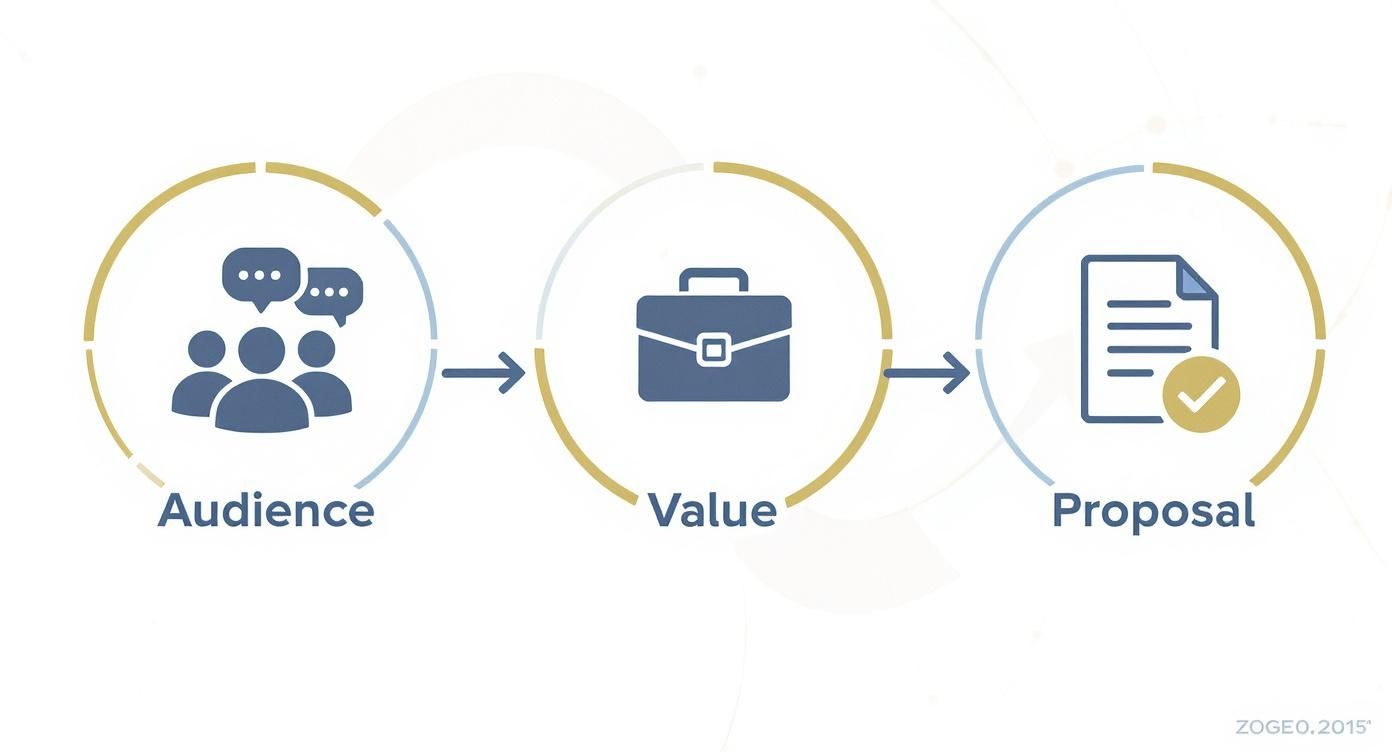
Follow this process, and by the time you build a proposal, it won't be a generic ask. It will be a tailored business case that shows you've done the work and truly understand what both your audience and your potential sponsor need.
Blasting a generic email to a long list of companies is the surest way to get your request sent straight to the trash. I've learned from experience that securing sponsorship is much more like matchmaking than a numbers game. You’re looking for that perfect fit—a company where a partnership is so logical that it feels like a warm introduction, not a cold ask.
To get there, you need to shift your thinking from "who has money?" to "who needs my audience?" The most valuable thing you offer any sponsor is a direct channel to the people they want to reach. So, your search should start and end with companies who share your audience but aren't your direct competitors.
Imagine you're running a national conference for software developers. You wouldn't hit up other conferences for money. Instead, you'd think about cloud hosting providers, software security firms, or project management tools—all businesses that are desperate to get in front of the exact people filling your seats.
Before you even think about writing a pitch, you need a highly curated list of potential partners. It's truly about quality over quantity. A well-researched list of 20 perfectly aligned companies will always outperform a random list of 200.
Here are a few proven ways I've found to uncover those gems:
These tactics help you build a list based on real data and proven interest, making sure your effort is focused where it will count.
Once you have your initial list, the real work begins. Your success hinges on how well you understand each prospect's business. You need to become an expert on them before you ever make contact. This research is what allows you to tailor your pitch so it speaks directly to their current goals and pain points.
A generic proposal screams "I haven't done my homework." A customized one shows you're a serious strategic partner.
My biggest piece of advice: Don't just research what a company does. Research what a company wants to do. Dig into their recent press releases, shareholder reports, and executive interviews. You're looking for their goals for the next year. Aligning your proposal with their future ambitions is an absolute game-changer.
For every company on your list, dig into these areas:
Now it’s time to rank your prospects. I use a simple scoring system to grade each one based on key alignment factors. This helps you focus your energy on the opportunities with the highest chance of success.
Tally up the scores. The companies with the highest totals are your Tier 1 targets—the ones who deserve your most personalized and time-intensive outreach. This methodical approach turns sponsorship outreach from a guessing game into a calculated process.
And don't overlook the growing trend of purpose-driven partnerships. Social impact sponsorships are seeing a 21% year-over-year growth in 2024, because content tied to social causes generates 33% more engagement. You can dig deeper into this and other global sponsorship insights to stay ahead of the curve.
Let's be honest: the days of slapping "Gold, Silver, Bronze" on a PDF and calling it a day are long gone. Today’s corporate decision-makers are smart, and they won't bite on a generic, one-size-fits-all menu. If you want to secure serious sponsorship dollars, you need to design tiers that sell outcomes, not just assets.
This requires a fundamental shift in how you think about your packages. Stop asking, "What can we sell them?" Instead, start with, "What business objective can we help them achieve?" This simple change repositions your offer from a simple ask to a strategic solution—and that’s a conversation sponsors are eager to have.
Every potential sponsor is trying to solve a problem. Your job is to figure out that problem and present a package that offers the perfect solution. Most companies sink money into sponsorships for one of three core reasons.
When you build your sponsorship tiers around these goals, you're immediately speaking their language. The entire conversation shifts from the size of their logo to the quality of the leads you can deliver. Suddenly, your proposal isn't just a list of perks; it's a powerful marketing tool. You can get a much deeper look into building these kinds of modern event sponsorship packages that truly resonate with high-value partners.
This goal-oriented approach transforms your offer from a confusing menu of options into a crystal-clear roadmap for a sponsor's success.
Instead of just listing benefits, try framing them around what a sponsor wants to accomplish. Here’s a simple table to show how this might look in practice. Notice how each tier is built to deliver a specific, measurable outcome.
Building your packages this way makes it incredibly easy for a prospect to find the tier that aligns perfectly with their marketing KPIs for the quarter. It’s a win-win.
To justify your price tag, you have to attach a real-world, quantifiable value to every single item in your packages. Sponsors need to see a clear path to return on investment (ROI), and that journey starts when they understand the tangible worth of what you're offering.
For instance, don't just say "logo on our website." Frame it as: "Logo placement on our event landing page, which saw 15,000 unique visitors last year." An email blast becomes much more attractive when it’s a "dedicated solo email to our highly engaged list of 5,000 industry professionals with a 35% average open rate."
Key Takeaway: Pricing becomes much easier when you stop guessing and start calculating. Assign a market-rate value to digital assets (like email sends and web ads) and a premium for exclusive access to your audience. This data-driven approach gives sponsors the confidence to invest.
This process does more than just validate your pricing; it shows sponsors you’re a serious partner who understands and tracks the metrics that matter.
While digital benefits are a must-have, don’t sleep on the power of unique, on-site activations. These are the memorable experiences that create a genuine buzz, leave a lasting impression on attendees, and deliver incredible value for your sponsors.
Think way beyond the standard 10x10 booth. What exclusive, high-impact experiences can you create?
The market for these creative opportunities is absolutely booming. For some context, the global sports sponsorship market was valued at an incredible USD 60.17 billion in 2024 and is on track to nearly double by 2033. This massive growth shows just how much brands are willing to invest to connect with targeted audiences.
At the end of the day, when you design packages that solve real business problems, price them based on tangible value, and sprinkle in creative benefits, you make it incredibly easy for a sponsor to see the strategic advantage and say yes.
https://www.youtube.com/embed/ufHtdpIXYo0
You've done the hard work of finding the right prospects and building your sponsorship packages. Now for the moment of truth: the outreach. Your pitch email and proposal deck are your first real impression, and you only get one shot. This is where sharp business sense meets the art of persuasion.
A generic, copy-pasted email is a guaranteed one-way ticket to the trash folder. Decision-makers are buried in emails and can spot a template from a mile away. If you want them to even open your message, let alone consider it, personalization is everything.
Look, the goal of your first email isn't to land a $20,000 sponsorship on the spot. It's much simpler: get a reply. That's it.
To do that, your first contact needs to be incredibly short, genuinely personal, and focused entirely on them, not you. A winning outreach email is a masterclass in brevity.
Start with a subject line that’s clear and collaborative, not salesy. Something like "Partnership Idea: [Company Name] & [Your Organization]" feels professional and sparks curiosity.
For the email body, follow this simple flow:
This approach respects their time and instantly positions you as a potential strategic partner, not just another person asking for a handout. We break this down even further with more examples in our post on how to ask for sponsorship.
Once you've landed that meeting, your sponsorship deck does the heavy lifting. Think of it less like a document and more like a visual story that makes the business case for partnering with you. In many ways, it's a lot like learning how to pitch investors and secure funding—both require a compelling, data-driven narrative to succeed.
Keep your deck tight, no more than 10-12 slides. It needs to be scannable, visually compelling, and relentlessly focused on the sponsor's potential return on investment.
Expert Takeaway: Treat your sponsorship deck like a B2B sales tool. It should focus less on your organization's history and more on how you'll drive the sponsor's future success. Every single slide must answer their silent question: "What's in it for me?"
Here’s a proven slide-by-slide structure that works:
Here’s a pro tip: design your deck with the sponsor’s brand in mind. Subtly incorporating their brand colors or referencing their company values shows an incredible level of preparation. It's this attention to detail that turns a standard proposal into an irresistible business case.
Getting that "yes" from a sponsor feels like the finish line, but in reality, it's the starting gun. This is where the real work begins—the part that turns a one-time deal into a recurring, high-value partnership.
Flawless execution and crystal-clear reporting are what separate the amateurs from the pros. Your job now is to make your sponsor's experience so seamless and valuable that renewing next year becomes a no-brainer. Think of them as a partner, not just a checkbook. When you anticipate their needs and over-deliver on every promise, you build the kind of trust that lasts.
Activation is where the promises you made in your sponsorship deck become reality. It’s the moment of truth where sponsors see their investment pay off, whether it’s a packed booth on the event floor or a flood of engagement from a digital campaign.
To pull this off without a hitch, you need a system.
Create a detailed sponsor activation checklist for every single partner. This isn't just for you; it's a shared roadmap. It should clearly outline every deliverable, its deadline, what assets you need from them (like logos and ad copy), and who on your team owns it. This simple document is a lifesaver—it prevents things from getting missed and instantly shows sponsors you’re on top of your game.
It also helps to assign a single point of contact. This person becomes the sponsor's go-to guide, their advocate within your organization. When a sponsor knows exactly who to call with a question or a last-minute request, it builds incredible confidence and goodwill.
Expert Tip: Don't wait until the doors open to start delivering value. Begin activating digital perks—like social media shout-outs, blog features, or newsletter mentions—weeks in advance. This creates a "pre-event buzz" that gives them an immediate return and keeps them excited.
For those using GroupOS, you can give sponsors their own dedicated exhibitor pages. This lets them manage their profile, post updates, and showcase products, effectively activating their own benefits long before day one of the event.
Once the lights go down and the last attendee leaves, your most important task is just beginning: proving you delivered. A thoughtful, data-rich impact report is the single most powerful tool you have for securing a renewal.
This report isn’t just a thank-you note. It’s a compelling, data-backed story of success that your contact can walk directly into their boss's office with to justify next year’s budget. You need to connect your performance directly to their business goals.
Here’s what you absolutely must track and showcase:
This kind of data transforms your report from a recap into a business case. For a deeper look at this, our guide on measuring event ROI goes into more advanced strategies for capturing this data.
Your final report should be professional, visually engaging, and incredibly easy to understand. It’s the final chapter of this year's partnership story—make it a good one.
Structure your report this way for maximum impact:
Getting this report into their hands within two weeks of the event wrap-up is key. It shows you’re professional, organized, and serious about their investment, making the renewal conversation feel like the natural next step.
Even with the best-laid plans, you're going to have questions pop up as you start reaching out to potential sponsors. Let's tackle some of the most frequent ones I hear from organizers, with advice that cuts straight to the point.
Honestly, timing can make or break your entire sponsorship drive. It’s not something you can rush.
For your big annual conference or a major, year-long partnership, you need to be starting the conversation 9-12 months out. Why so early? Because most large companies lock in their marketing and sponsorship budgets for the next year sometime between Q3 and Q4. If you show up after those decisions are made, you're simply too late, no matter how great your offer is.
If you're working on a smaller local event or a one-off program, you have a bit more flexibility. A 4-6 month runway usually works well. That gives you enough time to do your homework on prospects, craft personalized pitches, negotiate the details, and—most importantly—give the sponsor enough time to actually plan how they'll make the most of the opportunity.
I see this one all the time: making the pitch all about you. Your proposal shouldn't be a laundry list of what you need; it should be a strategic solution to one of your sponsor's problems. The entire conversation has to be framed around their business goals, their customers, and what they're trying to achieve with their marketing.
The fastest way to get your email deleted is to send a generic, one-size-fits-all proposal. Prove you’ve done your research on their brand and have crafted a partnership that helps them solve a specific problem or reach a key demographic they care about.
Think of it this way: you’re not asking for a handout. You're offering them a powerful marketing channel. Your proposal needs to reflect that confidence and value.
There’s a fine line between persistent and pushy, and you want to stay on the right side of it. The key is to be polite, patient, and always add value.
My rule of thumb is to wait a solid 7-10 business days after sending the initial proposal before you check in. Your first follow-up should be short and sweet. Sometimes, a little personal touch goes a long way.
For instance, you could try something like, "Just wanted to follow up on the proposal I sent over last week. By the way, I saw your company was just featured in Forbes for its new product launch—congratulations!"
That little note shows you're paying attention and you’re invested in their success, not just their money. If you still don't get a response, a second follow-up a week later is fine. But after two or three attempts, it's time to graciously move on. You never want to burn a bridge; a "no" for this event might just be a "not right now," and handling it professionally could open the door for a "yes" next year.
Keeping track of every conversation, deliverable, and report for multiple sponsors is a huge task. A dedicated platform like GroupOS can be a lifesaver. It gives your sponsors and exhibitors their own pages to manage their profiles, showcase what they do, and see the tangible value you're providing. You can learn more about how it works at https://groupos.com.