March 6, 2026
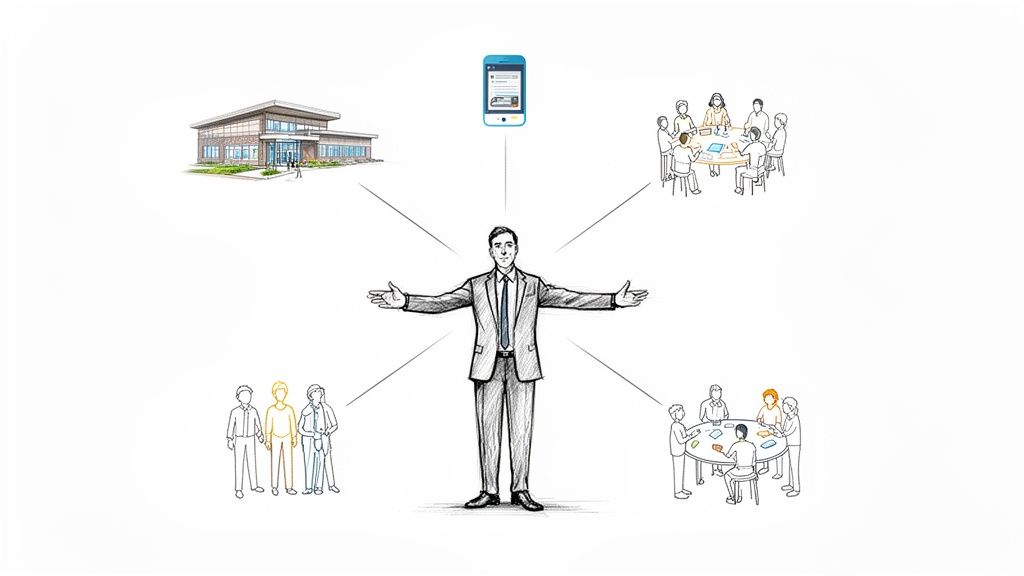
Getting involved in your community often starts with a single, powerful shift in thinking: aligning what you do best with what your community needs most. It's about looking past generic volunteer roles and seeing how your professional skills can solve real problems for non-profits, local groups, or initiatives you care about. This is where you move from just helping out to making a strategic impact.
The most fulfilling community work happens when you’re not just a pair of hands, but a source of genuine expertise. Think about it—your skills in marketing, finance, project management, or tech are incredibly valuable assets that many local organizations are desperate for but can't afford.
Before you start looking, you need to do a quick personal skill inventory. Go beyond your job title and think about what you actually do.
When you find this kind of fit, you sidestep the burnout that comes from feeling underutilized. You’re using the skills you’ve honed for years, which makes the work feel less like a chore and more like a meaningful extension of who you are. Your contribution becomes a sustainable, high-impact partnership.
Finding that sweet spot where your professional skills meet a community need is the key. It ensures your efforts are not only meaningful to you but truly valuable to the organization.
Once you know what you bring to the table, it's time to find the right table to sit at. Start by researching local organizations whose mission gets you excited. Dive into their websites, check out their social media feeds, and if they have one, skim their annual report. You're looking for clues—do they mention challenges in areas where you excel?
I once saw a local youth mentorship program doing amazing work, but their website looked like it was from 1999. As a web developer, I saw an immediate, tangible way I could help. I didn't just send a generic "how can I volunteer?" email. I reached out with a specific idea: "I can help you redesign your site to attract more mentors." That specificity made all the difference.
Your goal here is to build a shortlist of 3-5 organizations where your skills aren't just a nice-to-have, but a must-have. To get started, you can even explore our guide on how to find your tribe and discover groups that match your professional and personal interests.
It’s one thing to be interested in a community group; it’s another to actually jump in and become a part of it. That leap can feel huge, but the secret is to start small and think strategically. You’re not trying to take over the organization on day one. The real goal is to build trust and show you’re a reliable professional ready to contribute.
Honestly, the easiest way to start is just to show up. Find a public meeting, a volunteer orientation, or a community event that looks interesting. But don't walk in completely cold. I always recommend spending at least 30 minutes on the organization's website or social feeds before you go. What are they working on right now? Who are the key players? This little bit of homework transforms you from a random face in the crowd to an informed, potential contributor.
Walking into a room full of people you don't know can be daunting for anyone. A great way to lower that barrier is to connect with a few members or organizers beforehand on a platform like LinkedIn or Meetup. A simple, genuine message can make all the difference. Try something like, “Looking forward to the meeting on Wednesday. The project you’re doing on park revitalization looks fascinating.” This can turn what would be a cold introduction into a warm, friendly conversation starter.
Once you’re there, look for a moment to have a brief but meaningful chat with one of the group leaders. Here’s a key piece of advice: avoid the vague question, "How can I help?" It puts the burden on them to find a task for you. Instead, offer a specific, small contribution based on what you see.
I've found that offering to help with a small, well-defined task is one of the quickest ways to build trust. Say something like, "I noticed you're collecting email sign-ups at the door. I'm happy to manage the clipboard for the next 30 minutes if you need a hand." This shows you're a doer, not just a talker, and it demonstrates immediate value.
This kind of small, initial step is powerful. It builds your confidence and gets you started on the right foot. Even simple small acts of kindness within the group setting can pave the way for deeper involvement later on.
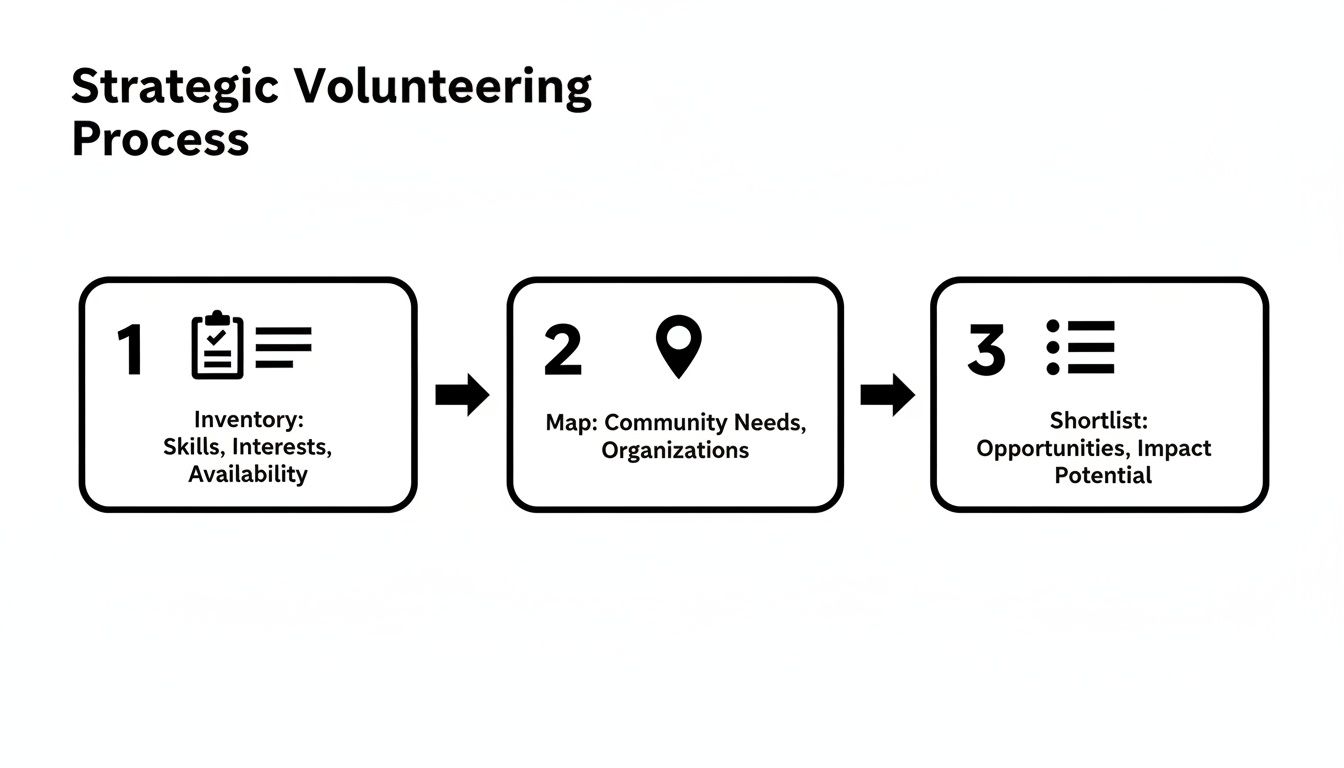
This strategic approach—inventorying your skills, mapping them to local needs, and shortlisting organizations—ensures that your first steps are purposeful. It’s about aligning what you do best with where you can make a real difference.
There are many ways to get involved, and not all of them require a massive time commitment. For busy professionals, finding the right fit for your schedule and goals is crucial. This table breaks down some common pathways to help you decide where to start.
Think about where you are right now. If you're just dipping your toes in, a one-off event might be perfect. If you're ready to share your professional skills, a committee could be a fantastic fit. Use this as a guide to find a path that excites you and works with your life.
Those initial interactions are all about laying a solid foundation for the future. After you attend an event, don't underestimate the power of a quick follow-up email. A short, thoughtful note to a leader you spoke with can make a huge impression and solidify the connection. Be sure to mention a specific point from your conversation to help them remember you.
You'll be surprised how many great ideas and opportunities come from these simple conversations. If you ever feel stuck on what to talk about in these settings, our guide on compelling topics for group discussions has plenty of inspiration.
Remember, figuring out how to get involved in my community is a marathon, not a sprint. Each small action—showing up for a meeting, sending that follow-up email, or handling a minor task—builds on the last. It’s how you establish momentum and become a trusted, valued member of the group.
So, you've started showing up and getting to know people. That's a great first step. But to make a real difference—and to have your contributions truly recognized—you need to move beyond just being present. It’s time to find where your unique professional skills can create the biggest impact.
This is what’s known as skills-based volunteering. Think of it as lending your expertise, not just an extra pair of hands. A marketing director could completely reshape a nonprofit's outreach, or a developer could build a simple tool that saves a community group hours of manual work each week. The value you create this way lasts long after your project is done.

Often, the most impactful way to get involved is to spot a need and suggest a solution yourself. Don’t wait for someone to hand you a task. If you see a gap where your skills could be a game-changer, be the one to step up with a plan.
You don't need to draft a 50-page formal business plan. In fact, please don't. A simple one-page proposal is far more effective. It shows you respect the busy schedules of community leaders and can get straight to the point.
Keep your proposal short and sharp. Just outline these four things:
A simple, clear proposal like this instantly sets you apart. It shows you’re a problem-solver, not just a volunteer. It’s a professional approach that signals you’re ready for real responsibility and leadership.
This single act can change how the organization sees you. You're no longer just a helper; you're a strategic partner invested in their success.
If you’re in a leadership role, your impact doesn't have to stop with you. Why not organize your department for a volunteer day or a fundraiser? This is where your involvement can really start to scale.
The data backs this up. In 2026, companies that encouraged both employee giving and volunteering saw a 16.8% engagement rate, far outpacing the 5.1% for programs that only offered one. And it’s not just for big corporations—smaller companies (under 1,000 employees) actually had the highest volunteer participation at a whopping 63.8%. It just goes to show that a committed culture makes all the difference.
Managing these efforts doesn't have to be a logistical nightmare. Using a platform like GroupOS lets you organize events, track sign-ups, and see your team's collective impact in one dashboard. This is a lifesaver for anyone in a community manager role who's trying to rally people for a cause.
By combining your personal skills, proactive thinking, and your professional network, you become more than just involved—you become essential to your community's growth.

Knowing how to get involved in my community isn't just about showing up anymore. Your in-person efforts need a smart digital strategy to back them up. Gone are the days when a simple newsletter or a town hall meeting was enough. People now expect direct, personal engagement that fits right into their daily lives. A digital presence isn't just a "nice-to-have"; it's a core part of making a real connection.
This isn't just a feeling—the data confirms it. The 2026 State of Community Engagement Report found a huge demand for more transparent and direct ways to participate. People want digital outreach on the channels they already use and crave accessible ways to engage with organizations. The report really drives home the opportunity for groups to team up with community-based organizations to get their message out there without losing that personal touch. You can read the full report to discover more insights and see what this modern engagement landscape looks like.
Let's be honest: passive social media updates just add to the noise. If you want to grab the attention of busy professionals, you have to offer something of genuine value. That means creating focused virtual events that actually solve a problem or share some unique expertise.
For instance, a professional association could host a live "Ask Me Anything" (AMA) with a well-respected industry leader. This gives members a direct line to knowledge they simply can’t find anywhere else. Or imagine a local environmental group running a quick 30-minute webinar on building a water-wise garden, packed with practical tips people can use that same weekend.
What makes these events so effective?
Are you currently trying to manage a Slack channel, a Facebook Group, and an email list all at once? That kind of scattered approach just leads to confusion for your members and makes it nearly impossible for you to track who’s actually engaged. It's time to bring everything together into a unified hub where all your communication, events, and resources can live.
By consolidating your digital tools, you create a seamless experience for your members. Instead of searching across multiple platforms for information, they have a single, reliable source for everything they need. This not only improves their experience but also makes your life as an organizer much easier.
Platforms like GroupOS are designed to replace that digital chaos with one integrated solution. Think of it as the central nervous system for your community, letting you manage memberships, host events, and spark discussions all in one place. If you're weighing your options, our guide to the best tools for community engagement can help you compare what's out there. At the end of the day, a unified system frees you up to focus on what truly matters: building relationships.
Making a real difference in your community is about more than just good intentions. As your involvement grows from a passion project to a serious endeavor, the administrative work piles up fast. This is where modern community platforms come in, handling the backend complexity so you can focus on what matters: the people.
Instead of juggling spreadsheets, email lists, and a half-dozen different apps, these tools bring everything under one roof. Think of it as a central command center for your entire community's activities. For anyone running a professional network or organizing volunteers, this shift is massive. It lets you scale your impact without scaling your stress.
Let's be honest, how much of your time is spent on repetitive tasks? Sending welcome emails, updating member lists, moderating forums, and answering the same questions again and again. This is the kind of work that drains your energy, and it's exactly where automation can become your secret weapon.
Many of these platforms now have AI-powered tools built right in to handle the routine stuff. You can set up an automated welcome sequence for new members, making sure they feel seen and have the info they need from day one. AI can also help with content moderation, freeing you up from policing conversations and allowing you to actually participate in them. The point isn't to replace human connection, but to carve out more time for it.
By strategically automating the busywork, you can redirect your energy from administrative chores to genuine relationship-building. When you're not drowning in logistics, you have the space for the personal outreach that truly makes a community thrive.
In a world of constant scrolling, static content just doesn't cut it anymore. That’s why live virtual events have become such a cornerstone of community engagement. In fact, the 2026 Community Trends Report, which surveyed 1,200 community builders, found that live events like workshops and "Ask Me Anything" (AMA) sessions were the number one strategy for creating real, meaningful connections.
Looking ahead, 70% of community builders plan to use AI-powered chat agents by 2026 to handle routine inquiries, and 19% are already doing it. This highlights a critical point: the best use of technology is to scale human relationships, not to replace them. You can check out more findings from the 2026 Community Trends Report to see how these strategies are taking shape.
If you're running a professional association or a membership-based group, a dedicated platform can completely transform your operations. To really grow your influence and foster lasting bonds, it helps to understand what a customer engagement platform is and how its principles apply to building strong digital communities. These all-in-one solutions offer specialized features that a basic social media group simply can't match.
Imagine having a single tool that handles all of this:
Bringing all these functions together creates a polished, branded home for your community that delivers real, tangible value. You’re no longer just a group; you’re a professional organization. This takes the logistical headache off your plate and lets you get back to the work of growing your community and making a real impact.
Diving into community work is exciting, but it almost always brings up a few nagging questions. If you're a busy professional, you're probably wondering about time, whether you're "qualified" enough, and how to find the right group. These are the same questions I hear all the time, so let's get them answered.
The fear of being overcommitted is the number one thing that holds people back. But here's the reality: community involvement isn't an all-or-nothing game. You can make a real impact with just 2-3 hours per month.
The trick is to start small. Find a commitment you know you can stick with, like joining one monthly meeting for a local group or signing up for a single-day volunteer event. Many organizations now have flexible, project-based roles that are perfect for professionals with packed schedules. Consistency is what truly matters, not the sheer number of hours.
It's far better to be a reliable contributor for two hours a month than to promise twenty and burn out. Find an activity you genuinely enjoy, and you can always scale up your involvement from there.
This is a classic case of imposter syndrome, and trust me, you're not alone. It's easy to think you need years of non-profit experience, but what most organizations desperately need are the exact professional skills you use every day.
Your background in marketing, finance, project management—or even just being incredibly organized—is a massive asset. You bring a professional perspective that can be a game-changer for a small organization.
Think about it this way:
A great way to start is by offering to help with one small, specific task that plays to your strengths. It’s a low-pressure way to build your confidence and show the group what you can do.
Putting your time and energy into a cause is a big deal, so you want to be sure it's a trustworthy one. Finding a legitimate organization is crucial for a positive experience.
A great first step is to check if they are a registered non-profit (like a 501(c)(3) in the U.S.). You can vet organizations on sites like GuideStar or Charity Navigator.
Your local Chamber of Commerce and other professional associations are also goldmines for information, as they often partner with well-regarded local groups. And don't forget the power of showing up—attending a public event is a fantastic way to get a feel for an organization's culture and legitimacy before you commit to anything more.
Ready to manage your community involvement more effectively? GroupOS provides an all-in-one platform to streamline memberships, organize events, and scale your impact. Learn more and start your free trial today.