April 27, 2026

If you're evaluating royal business academy, you're probably asking the wrong first question. The issue isn't only whether it works for some buyers. The real question is whether this kind of low-cost, resell-driven academy creates durable value, trusted outcomes, and a professional learning environment.
That distinction matters a lot for associations, credentialing groups, trade communities, and membership organizations. A model can be attractive, easy to market, and still be the wrong blueprint for any organization that needs brand trust, measurable learning, and long-term member retention. Royal business academy is useful to study for exactly that reason.
Royal business academy gets attention because it combines three things people already want. Low entry cost. Fast-start business ideas. A promise that you can buy once, learn quickly, and start reselling digital products without inventory.
That pitch is powerful because it removes friction. Beginners don't need to build a curriculum from scratch, negotiate supplier contracts, or wait for manufacturing. They buy access, get templates and workflows, and start selling. For solo operators, that's an understandable appeal.
Most online talk about royal business academy gets trapped in a tired debate. Scam or legit. Worth it or overhyped. That frame is too narrow.
A better lens is operational quality. What exactly is the learner buying? What skills are being built? What systems are missing? What evidence exists beyond affiliate-style enthusiasm? And if you're a professional organization, would you ever want your educational community to look like this?
Royal business academy is more interesting as a business model than as a course review.
That shift changes the analysis. You're no longer asking whether a few users can make it work. You're asking whether the structure itself supports trust, skill development, and durable community value.
The strongest marketing around this category leans on resale logic, not institutional learning design. That's fine for a side-hustle experiment. It's weak for any organization that needs accountability, credential integrity, and a branded member experience.
If your world includes chapters, sponsors, events, cohorts, committees, certifications, or member directories, the model starts to look thin very quickly. Even the platform choices often mirror that limitation. If you want context on one common course-community setup, this overview of Skool is a useful baseline for understanding where lightweight education communities work and where they don't.
Royal business academy isn't best understood as a traditional online school. It's closer to a digital franchise kit.
You aren't just buying lessons. You're buying a package that combines training with rights to resell certain digital products. That changes the economics, the buyer motivation, and the way people talk about results.

The core terms matter:
That combination explains why the model spreads fast. The offer isn't just "learn business." It's "learn business and sell the same asset class."
According to a YouTube review describing RBA 2.0, Royale Business Academy 2.0 launched on April 20th as "My Sales Best Friend" and promotes an advanced sales system with 400+ income streams, 65+ niche startup blueprints, and 100% profit margin per resale through PLR-style digital delivery. The same review says the package includes lifetime access and unlimited resales.
Those are big promises. They also explain the appeal.
Here's the plain-English version. A buyer sees one package that appears to offer:
That's why royal business academy attracts beginners who want compression. They don't want to spend months building from zero. They want a shortcut into motion.
People often treat RBA like a course marketplace. That misses the point. The educational content is only part of the offer. Its main appeal is the resale potential.
That creates a very different set of incentives:
| Buyer motivation | Traditional course | Royal business academy style model |
|---|---|---|
| Primary goal | Learn a skill | Learn and resell |
| Value test | Better capability | Faster monetization |
| Marketing focus | Expertise and outcomes | Opportunity and access |
| Trust signal | Instructor authority | Proof of resale potential |
Decision rule: If resale rights are the star of the offer, you're not evaluating a school first. You're evaluating a business system.
That doesn't make it bad. It just means you should judge it by the right criteria.
The curriculum appears broad because breadth is part of the sales logic. Royal business academy isn't narrowing the learner into one trade or one certification path. It's presenting a menu of business paths so more buyers can see themselves in the offer.
That broad menu is attractive to beginners. It can also create confusion for anyone who needs sequence, depth, and skill validation.
The available descriptions position RBA as a modular library built for people who want fast exposure to multiple venture models. The curriculum is framed around startup blueprints, digital selling workflows, and implementation assets rather than a tightly governed educational progression.
That matters because broad catalogs often sell better than disciplined learning paths. Buyers feel they are getting "more." But more modules don't automatically produce better competence.
The technical requirements also reveal something important. A published requirements page for Royale Business Academy says users need minimum 10Mbps upload/download, modern browsers such as Chrome v100+ and Firefox v110+, and devices with HTML5 video support and around 4GB+ RAM for smooth access to 65+ modular courses. That same source claims suboptimal setups can contribute to 20-40% dropout in hands-on modules.
RBA looks best suited to a specific type of buyer:
That is not the same as a serious association learner. A professional member usually needs a clearer path: competencies, milestones, practical support, community accountability, and proof that the curriculum fits career development rather than social media momentum.
A wide library can inspire action. It can also leave learners jumping between models without mastering any of them. That's one reason content strategy matters so much in professional education. If you're thinking about how creators and educators turn expertise into structured offerings, the Klap blog on content monetization is a useful reference because it frames monetization as a system, not just a product upload.
For associations, curriculum design should answer a harder question. What should members be able to do after completing each stage? That's the discipline many resale-first academies lack. A practical place to start is this guide on how to develop training curriculum, especially if your content needs to support chapters, committees, and multi-level memberships.
The reputation problem around royal business academy isn't that criticism exists. Every fast-growing online offer gets criticism. A key problem is that clear, independent outcome data is hard to find.
That should immediately change how you evaluate it.

A lot of visible commentary follows a familiar pattern. Promotional videos emphasize affordability, access, and "done-for-you" momentum. Skeptical videos ask whether the program is overhyped, but even those often stop short of hard evidence because the evidence isn't publicly aggregated.
A YouTube review discussing whether RBA is worth the hype states the key gap plainly: there is no independent dataset showing long-term member retention or revenue generation beyond promotional testimonials, and no aggregated metrics like average earnings or dropout rates.
That's not a minor omission. That's the difference between marketing and evaluation.
Use a stricter filter than "people seem excited."
Ask these questions:
Who benefits from the recommendation
If the reviewer earns from referrals or resale, their opinion may still be sincere, but it isn't neutral.
What outcome is being measured
Excitement, first sale, and sustainable business performance are not the same thing.
Is there cohort-level evidence
One person's screenshot doesn't tell you how the average enrollee performs.
What happens after onboarding
Most programs look strongest at the moment of purchase. Weak programs get exposed later.
If a program sells certainty but doesn't publish outcome tracking, buyers are carrying the risk blind.
That issue becomes even more important in member communities. Associations can't rely on hype cycles. They need to know who completed what, who engaged, who renewed, and where members are dropping off. That's why churn analysis matters in community businesses.
A video can help you see how the public conversation is framed, but it won't solve the evidence problem on its own.
I wouldn't call royal business academy automatically illegitimate. I would call it insufficiently verified.
That's an important distinction. Plenty of buyers may get value from packaged training and resale rights. But if the program can't show independent, durable performance data, then serious organizations should not model themselves after it. They should treat it as a warning about what happens when promotion outruns measurement.
For a solo reseller, fragmentation is annoying. For a professional association, it's damaging.
An organization has to manage member trust, staff workflows, sponsor visibility, events, learning assets, renewals, and reporting in one operating system. A resale-first academy doesn't solve that. It usually creates more disconnected work.
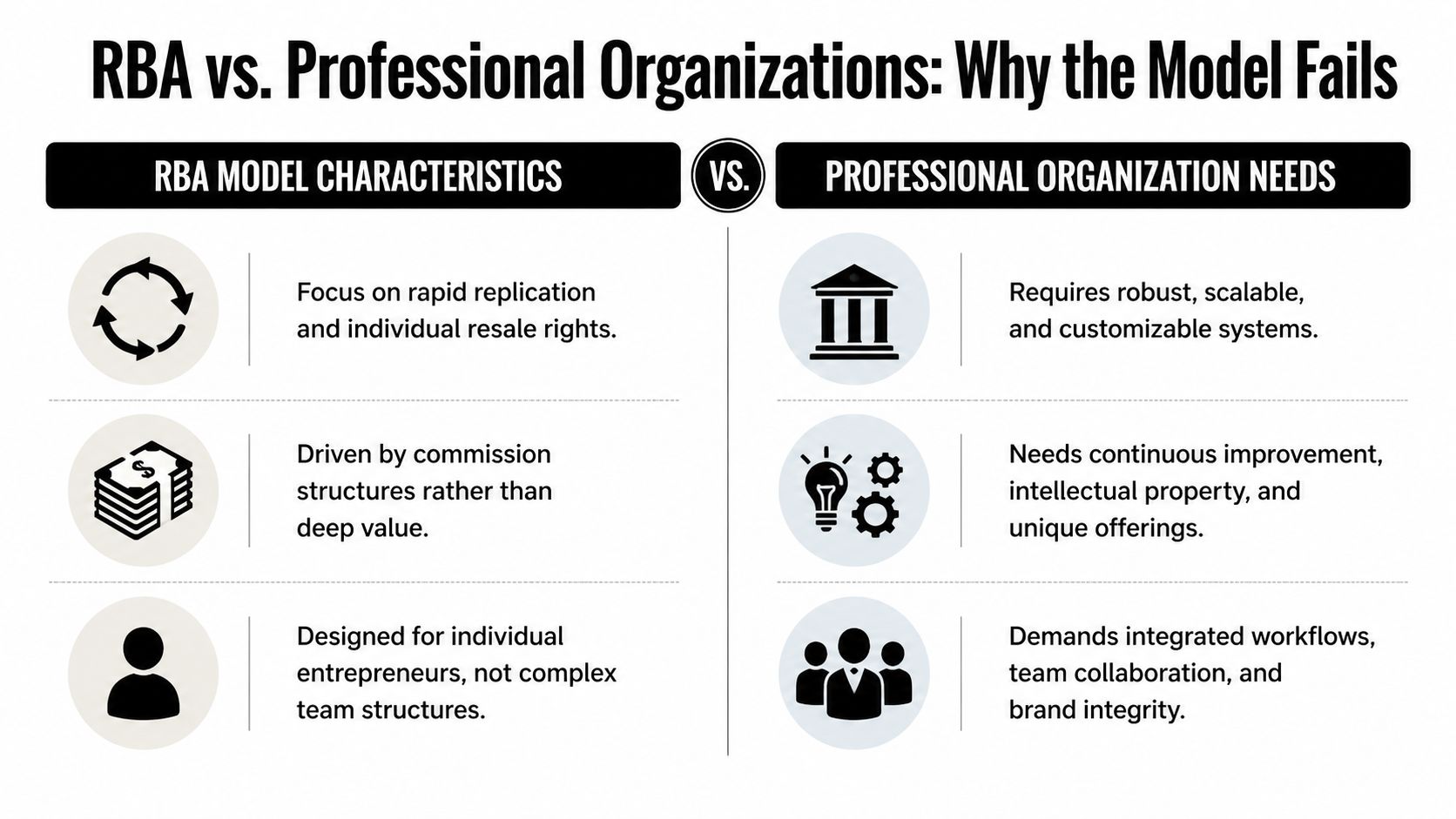
The biggest weakness is integration. Professional groups don't just publish videos and hope members figure it out. They need registration, member records, communications, event logistics, sponsor packages, reporting, and content delivery to work together.
A source discussing RBA-related integration gaps says these models often ignore needs like event ticketing and member tracking, and it cites a claim that 70% of membership businesses fail to scale without integrated analytics. Whether or not you're evaluating that exact figure, the strategic point is solid. Associations cannot scale on disconnected tools.
The contrast is sharp:
| RBA-style model | Professional organization requirement |
|---|---|
| Fast replication | Controlled brand standards |
| Individual resale focus | Institutional learning value |
| Fragmented tools | Unified operations |
| Hype-led promotion | Trust-led member experience |
Associations also have governance responsibilities. Staff need visibility. Boards want reporting. Sponsors want accountable exposure. Members expect a polished journey, not a patchwork of links, logins, and side-channel communication.
Operational rule: If your members need events, courses, discussions, sponsor access, and renewal workflows, your education model can't live in isolated tools.
That is why association leaders should spend more time evaluating association management solutions and less time chasing creator-style shortcut models. The latter may produce bursts of revenue. They won't protect the brand you've spent years building.
Even if you could force-fit a resale-style academy into an organization, you shouldn't. Members join associations for authority, standards, community, and advancement. They don't join to enter a repackaged hustle funnel.
That's the primary failure of the RBA model in this context. It confuses monetization mechanics with member value. Professional organizations need the opposite order. Value first. System second. Revenue after trust.
If royal business academy is a case study in speed, the better model for associations is a case study in coherence. Professional education works when the entire member journey is designed as one system.
That system should answer five questions clearly. What does the member get? How do they progress? Where do they interact? How do staff measure engagement? How does the organization turn learning into retention, events, sponsor value, and renewal?

A serious academy should be built around institutional assets, not resale rights.
That means:
Royal business academy attracts attention because it's simple to explain. Buy access, learn the system, resell the offer. Professional learning communities need a richer structure because their job isn't to create one transaction. It's to create repeated relevance.
Most associations already have the raw ingredients for a much stronger academy. They have experts, event content, chapter leaders, industry frameworks, and sponsor relationships. What they often lack is orchestration.
Use a member journey like this:
Entry experience
New members get guided onboarding, role-specific recommendations, and one clear next step. No content dump.
Core learning hub
Courses, recordings, documents, and resources live in one place with a consistent structure.
Community layer
Members discuss the material in private channels tied to roles, cohorts, or regions.
Event connection
Learning links directly to webinars, annual meetings, workshops, and certification prep.
Measurement loop
Staff review participation patterns, identify disengagement early, and refine programming.
That architecture fixes the central weakness of low-cost hype academies. It ties learning to identity and membership, not just purchase intent.
A lot of academy launches fail before the first lesson goes live because the organization announces too much and validates too little. Build demand the same way you build member confidence. Start with a pilot group. Test the curriculum. Refine the onboarding path. Then launch publicly with real examples of who the academy is for.
If your team is planning that rollout, this guide on how to build pre-launch hype is helpful because it focuses on staged anticipation rather than random promotion blasts.
Many organizations frequently stumble. They buy software features instead of designing service outcomes.
Use a simple mapping approach:
| Need | Better academy response |
|---|---|
| Members miss events | Connect registration, reminders, and on-demand replay access |
| Learners get overwhelmed | Create role-based pathways and sequenced curriculum |
| Sponsors want ROI | Offer branded placements tied to relevant content and audience segments |
| Staff can't see engagement | Use reporting across memberships, events, and content activity |
| Community lives in too many places | Bring discussion into one branded environment |
Good academy strategy doesn't ask, "What can we sell?" It asks, "What member behavior are we trying to produce?"
That one question changes everything. Instead of pushing generic business opportunities, you build around competence, belonging, and progression.
Royal business academy sells momentum. Professional organizations should sell advancement.
That means creating an academy where members can trust the source, understand the pathway, participate in discussion, attend related events, and see how each piece fits their professional identity. The result is more durable than any resale-rights offer because the value compounds inside the community itself.
If you're advising an association, don't copy creator-economy shortcuts. Study them, extract the useful parts, and then build something more disciplined. Keep the speed of digital delivery. Drop the fragmentation. Keep the appeal of practical education. Drop the dependence on hype. Keep the desire for monetization. Tie it to member outcomes, not resale mechanics.
That's the key lesson from royal business academy. Not that packaged digital offers are bad. It's that professional communities need a higher standard.
If you're building a branded academy for members, sponsors, and event attendees, GroupOS gives you a cleaner path than stitching together resale-style tools. It brings courses, memberships, events, communication, and analytics into one system so your organization can deliver education people trust and operations your team can readily manage.