March 7, 2026
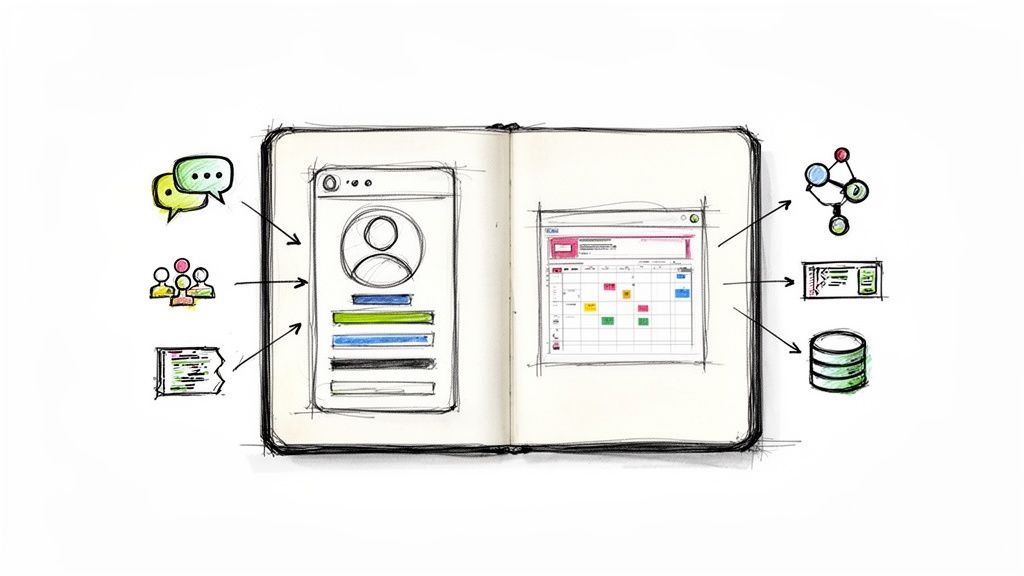
So, you want to build a social network for a professional community. Before you even think about code or wireframes, there's a foundational step that will make or break your entire project: nailing down your strategy.
This isn't just about having a cool idea. It's about doing the detective work to ensure you're building something people actually need and will use. Let's walk through how to do it right.
I've seen too many ambitious social platforms fail because they tried to be the next LinkedIn. They aimed for everyone and ended up resonating with no one. The web is littered with these digital ghost towns.
Your path is different. You succeed by going small. Forget "professionals"—that's too broad. Instead, think about a platform exclusively for pediatric occupational therapists, or a hub for freelance sound engineers, or a community for sustainable architects. The narrower you go, the clearer their problems become.
The goal isn't to build the biggest audience; it's to build the right audience. You win by becoming so essential to their work that they can't imagine their professional lives without you.
A network for architects might need features for sharing large-format blueprints and collaborating on 3D models. A community for chefs, on the other hand, would find those features useless but might crave a tool for sharing recipes with precise measurements and techniques.
When you focus on a specific group, you stop guessing and start solving real, tangible problems. This specificity is your single greatest advantage.
Once you've identified your potential community, you have to get out of your own head and talk to them. This is the most crucial part of the discovery phase. Don't just send out a survey; have real, one-on-one conversations.
Talk to the people who will actually use the site, but also talk to the people who might manage or sponsor it, like association presidents or event organizers. For more on this, check out our guide on how to find your tribe and lay a strong community foundation.
When you interview them, ask questions that get to the heart of their frustrations:
This whole process can be boiled down into a simple, repeatable framework.

Think of it as Identify, Interview, and Prioritize. By following this flow, you ensure that every feature you decide to build is directly tied to a real-world problem you've already validated. This is how you move from a vague idea to a focused plan for a platform people will not only use but will be happy to pay for.
With your core strategy locked in, it’s time to move from big ideas to the actual blueprint of your site. This is where we figure out how people will move through your platform—how they'll click, tap, and interact. The goal here is to make the entire experience feel completely natural and effortless.
A great user experience (UX) isn't magic; it’s the result of meticulous planning. It starts by getting inside the heads of your members by creating detailed user personas. These aren't just generic profiles; they're fictional but realistic representations of your key audience members.
Don't fall into the trap of creating one vague "member" persona. For a professional network, you have to dig deeper. Think about the distinct people who will show up on day one.
Building out these personas forces you to walk in their shoes. It shifts your thinking from abstract requirements to real human needs, which will inform every design decision you make from here on out.
Once you know who you're building for, you can map out their user flows. A user flow is just a simple, step-by-step diagram of how a user accomplishes a task. Start with the most important actions you want people to take.
What does the flow for "joining a private group" actually look like? It probably starts with a search, then a "request to join" button, an admin approval step, and finally a welcome notification. Each of these moments is a touchpoint you have to design. By mapping this out now, you spot friction points and dead ends before a single line of code gets written.
A truly great user flow is invisible. The user just glides from one step to the next without even thinking about it. Your job is to find every single rock in their path and remove it.
This planning phase is also where you'll start to nail down the structure of key pages. You need a clear visual hierarchy, especially for information-dense pages like event registrations or member directories. We also have a detailed guide that gets into the weeds of how to design landing pages that turn passive visitors into active members.
Next, you build wireframes. Think of these as the bare-bones skeleton of your website—simple black-and-white layouts that focus purely on structure and function. This is where you test the placement of buttons, menus, and content without getting bogged down by colors and fonts. From there, you move on to interactive prototypes that let you actually click through the user flows you just mapped out.
Honestly, this is a non-negotiable step. It lets you get your design in front of real users early on, so you can catch usability problems when they’re still cheap and easy to fix.
Throughout this entire process, you need to be thinking with a mobile-first approach. With giants like Facebook holding a staggering 73.06% market share on mobile devices, it’s obvious where people are spending their time. For a platform like GroupOS, which provides custom iOS and Android apps, designing for the small screen first is critical. It ensures that core features like QR code check-ins and member maps are fast, fluid, and work perfectly on the go. This trend is only getting stronger, and ignoring it is a recipe for failure.
A social network is only as good as the connections it creates. Your job is to design a platform that doesn't just let people exist, but actively encourages them to connect, share, and get involved. This means going way beyond a simple profile page and a news feed to build features that genuinely solve problems for your specific professional community.

Think of your core features as the heart and soul of your platform. Each one needs a clear purpose that adds to the overall energy of the community. Without them, you've just built an empty room.
A member profile needs to be much more than a digital business card. It’s the starting point for every single connection made on your site. If you want to build a platform that feels alive, you have to design profiles that spark real interaction, not just passive scrolling.
Go beyond the tired "name, title, company" format. Give your members interesting ways to show off who they are in a professional context.
The end goal is to transform a static page into a dynamic snapshot of a member's professional life. When someone lands on a profile, they should immediately see several clear paths to starting a meaningful discussion.
I've seen so many professional communities struggle with scattered conversations. They're juggling email threads, random WhatsApp groups, and maybe a few Slack channels. Your social network has a massive opportunity here: bring all that communication into one focused, integrated place.
Designing effective group channels isn't about just cloning another chat app. It's about creating a purpose-built space that consolidates conversations and makes other tools feel redundant.
This is non-negotiable for a modern social platform. The explosive growth of apps like WhatsApp, which serves over 2 billion monthly active users, shows just how much people want integrated messaging. This is why platforms like GroupOS are so successful; they build in secure, branded chat channels that replace messy, external tools for everything from board meetings to event exhibitor logistics. With 71% of U.S. adults using Facebook, it's clear that built-in communication keeps users coming back—a lesson supported by various social media statistics.
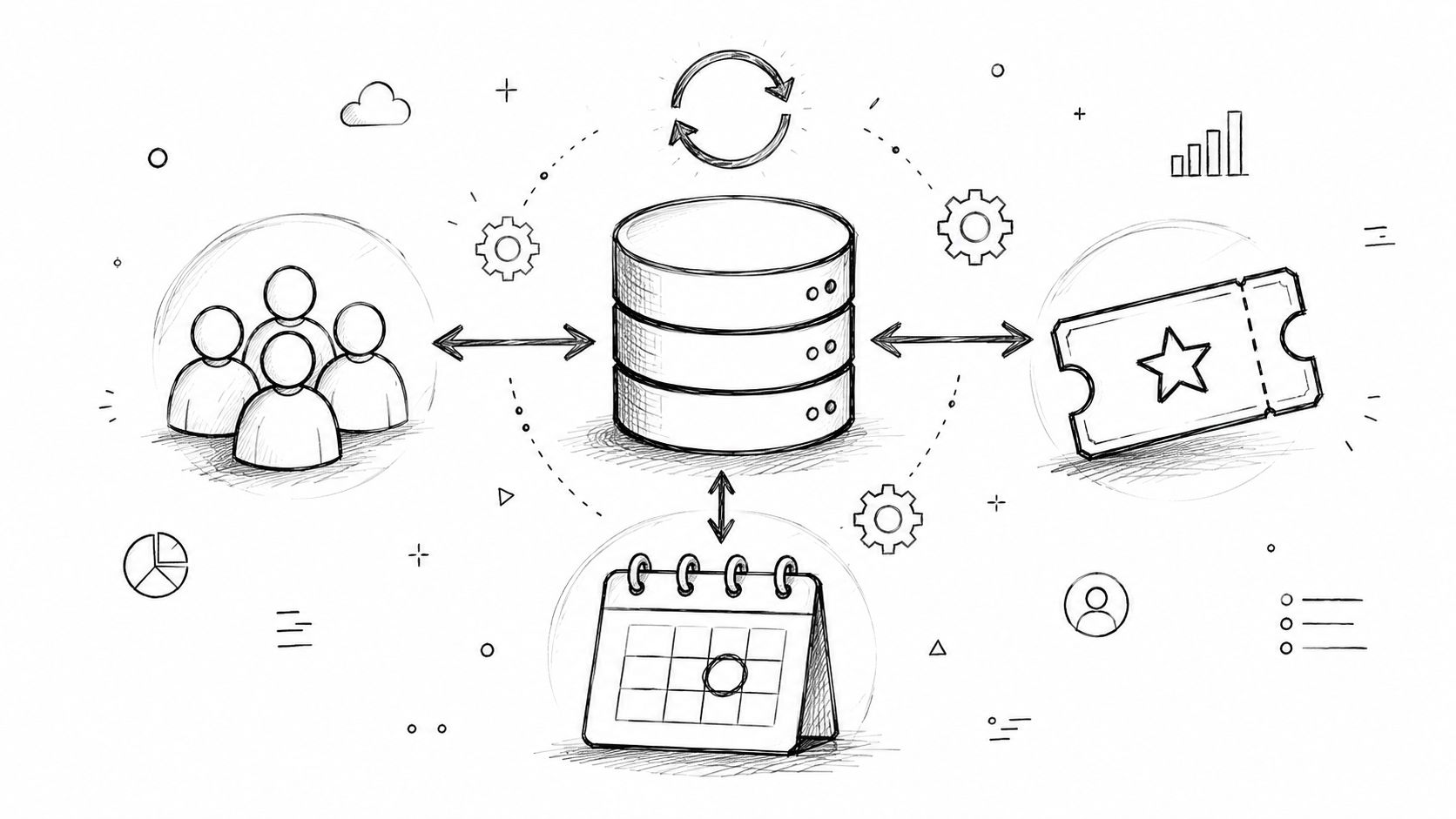
For most professional organizations, events are everything. A clunky, disconnected process for selling tickets, managing registrations, and communicating with attendees is a huge source of frustration. Your platform can become absolutely essential by bringing all of these functions under one roof.
A truly powerful event system should handle it all:
To keep your platform running long-term, you have to deliver real, measurable value to sponsors and exhibitors. Just slapping a logo on the homepage isn't going to cut it anymore. Instead, design dedicated sponsor pages that act as powerful lead-generation tools.
Think of these pages as mini-websites for your partners, living right inside your community. They need to be packed with features that deliver a clear return on investment.
By building these monetization tools directly into the platform, you create a very compelling package for partners and a sustainable revenue stream for your network. For a deeper look at this, check out our other guides on tools for community engagement that can enhance these core features.

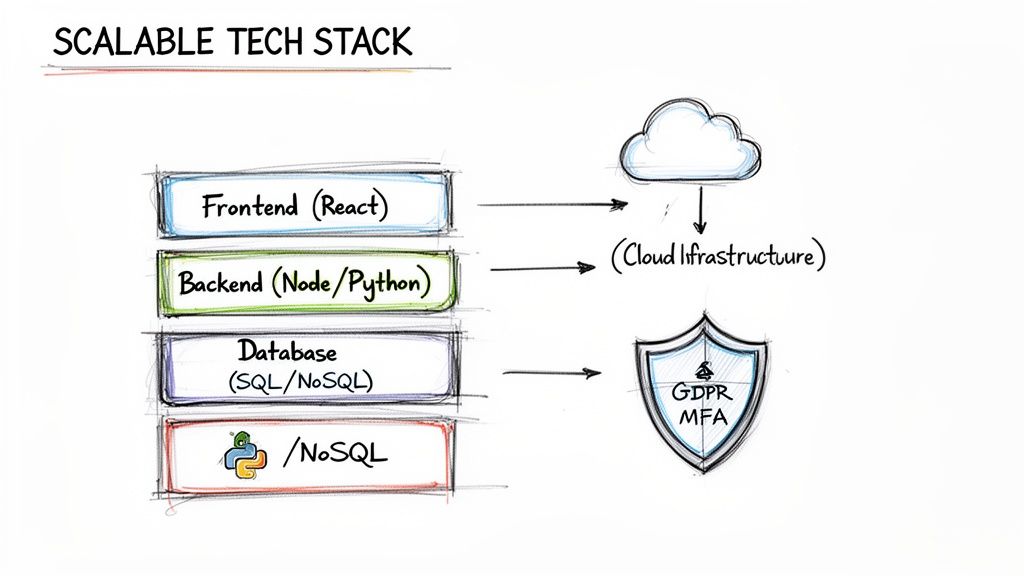
Alright, let's talk about the technical foundation of your entire network. The tech stack you choose is one of the most consequential decisions you'll make. It dictates how fast your site feels, how you'll handle security, and whether you can scale from 100 members to 100,000 without having to rebuild everything from scratch.
This can feel like a huge decision, so I always advise breaking it down into three core components: the front end, the back end, and the database.
For the front end—what your members will actually see and click—the conversation almost always centers on React vs. Vue.js. React is a powerhouse with a massive community, thanks to its origins at Meta. If you're planning a highly complex platform, its vast ecosystem of libraries is a major plus. On the flip side, many dev teams find Vue.js has a gentler learning curve, which means you can often build and iterate faster, especially with a smaller team.
Honestly, you can't go wrong with either. The right choice really hinges on your team's existing skills and how intricate your user interface needs to be.
The back end is where all the magic happens behind the curtain. It’s the server-side code that runs your business logic, processes data, and authenticates users. Two popular workhorses here are Node.js and Python (usually with the Django framework).
I've seen teams lean on Node.js for its sheer speed and efficiency, making it perfect for real-time features like instant messaging or live notifications. Python with Django, however, is incredibly solid and mature, with a clean syntax that many developers love, particularly when heavy data processing is involved.
Then comes the database, the heart of your community where every profile, post, and connection lives. This is where scalability truly gets put to the test.
For a professional community with lots of user-generated content and evolving features, a NoSQL database often provides the flexibility you need to grow without hitting a ceiling.
In a world of constant data breach headlines, security can't be a feature you tack on at the end. For a professional network, trust is your most valuable asset, and a single major leak can evaporate it overnight.
Security isn't just a task on a checklist. It's a mindset. You have to approach every architectural decision by assuming bad actors are already at the gates and build your defenses from the inside out.
Start with ironclad authentication. At this point, multi-factor authentication (MFA) isn't a nice-to-have; it's the bare minimum for any platform handling sensitive user information. For private messaging, end-to-end encryption is non-negotiable. Your members need to know their private conversations are just that—private.
You also have to think about regulations like GDPR from the get-go. This means architecting your data model so that users can easily request, download, or delete their own data. It’s not just about ticking a compliance box; it’s about showing genuine respect for your users. As you plan, it's also smart to look at what's next. Decentralized models like the Bluesky protocol are exploring new ways to give users more control, offering clues for how you can future-proof your own platform.
If navigating these technical decisions feels overwhelming, remember that you don't have to build everything from scratch. For many organizations, leveraging a pre-built solution is a far more practical path. Our guide on using a white-label community platform breaks down how you can launch faster while leaving the heavy lifting of security and scalability to the experts.
You’ve built a technically sound and beautifully designed platform. That’s a massive accomplishment, but the work is far from over. A brilliant launch and a solid growth plan are what will actually turn all that code into a vibrant, self-sustaining community. The old "build it and they will come" mindset is a surefire way to create a digital ghost town.
Your launch shouldn't be a single, big-bang event. Instead, you should approach it as a phased rollout, one that’s carefully designed to gather feedback, squash bugs, and build organic momentum. This process actually starts long before you ever think about opening the doors to the public.
The best launches I've seen always start small and controlled. Begin with an alpha test by bringing in your internal team and a handful of trusted, super-engaged members from your target community. Their one and only job is to try and break things. Seriously. They’ll quickly spot the awkward workflows and confusing buttons that you've become completely blind to after months of development.
From there, you can move on to a beta test. This involves a slightly larger but still exclusive group—maybe the board members of a partner association or the first 100 people who joined your waitlist. This phase is less about hunting for bugs and more about validating the overall user experience and getting honest feedback on your core features.
A phased launch transforms your first users from passive consumers into active co-creators. They become your most valuable source of feedback and your first brand evangelists.
This early feedback loop is your greatest asset. It gives you the chance to make crucial adjustments when the cost and effort to do so are still relatively low.
An empty social network is a turn-off. No one wants to be the first person to show up and start talking in an empty room. Your go-to-market strategy absolutely must include a plan to seed the community so it feels alive and welcoming from the moment the first wave of new members logs in.
One of the most effective tactics here is to partner with a founding organization or a key industry association. By giving them early access, you can get their members to pre-populate the platform with profiles, discussions, and events. This single move instantly creates a sense of activity and gives new users a compelling reason to stick around and explore.
This strategy ensures that on your official launch day, your platform is already buzzing with:
Once your platform is live, your focus has to shift from building to nurturing. Sustainable growth is a mix of smart acquisition tactics and a relentless focus on keeping your members engaged. Your first shot at this is with a strong onboarding process. Don’t just dump new users onto a dashboard; guide them through setting up their profile, joining their first group, and maybe even registering for an event.
Ultimately, integrating key features like event and membership management is what will set you apart. User expectations are constantly changing—platforms like TikTok and Instagram are seeing projected YoY growth of 17% and 13% respectively in 2025, and that raises the bar for everyone. With social media users expected to hit 6 billion by 2028, your platform must deliver clear ROI. This is where tools that connect community to commerce, like GroupOS's subscriptions and analytics, become indispensable. You can find more on these trends in this recent social media report.
Finally, get obsessive about your analytics. Track key metrics like daily active users, post frequency, and event attendance. This data is the voice of your community, telling you what’s working and what isn’t. Use those insights to spark new conversations, host must-attend events, and share content that keeps your professional community coming back for more.
If you're thinking about building your own social network, you’ve probably got a dozen questions swirling around. It's a big undertaking, and getting straight answers on things like budget and strategy is critical before you write a single line of code. Let's dig into a few of the most common questions we hear from people just starting out.
This is a bit like asking, "How much does it cost to build a house?" The answer really depends on what you're building. A bare-bones Minimum Viable Product (MVP) cobbled together from a template might only set you back a few thousand dollars.
But for a truly custom platform with unique features—think integrated event ticketing, deep analytics, and polished mobile apps—the budget can balloon quickly. You could easily be looking at a range from $50,000 to over $250,000.
What drives that cost? A few key things:
This is where an all-in-one platform can be a game-changer. It sidesteps the massive upfront cost and timeline of custom development by giving you pre-built, professional-grade modules you can brand and configure yourself.
When you’re building a network for professionals, members will be sharing sensitive information and having confidential conversations. Security isn't just a nice-to-have feature; it's the bedrock of your entire community. If people don't feel safe, they won't stick around.
Security and data privacy are non-negotiable. Your platform must be built to protect members from day one, ensuring their private information and conversations remain confidential.
At a minimum, you absolutely must have these three things dialed in:
Let's be blunt: you're not going to beat LinkedIn at its own game. Trying to build a general-purpose professional network is a surefire way to get lost in the noise. The secret isn't to go broad; it's to go deep.
Find a specific, underserved professional niche and build the absolute best online home for them. Don't build a network for "all business professionals"—build the indispensable platform for "sustainability consultants" or "esports marketing managers."
Your differentiation comes from offering hyper-relevant features that the big platforms would never bother with. This could be specialized project management tools for a particular industry or accredited course delivery for a specific trade. When you solve a niche problem better than anyone else, you create a powerful moat.
Creating a high-quality, exclusive culture is another massive differentiator. A branded, all-in-one platform feels less like another social media app and more like a private, members-only club. That feeling of exclusivity is incredibly valuable and something people are willing to pay for.
Ready to build a thriving professional community without the headaches of custom development? With GroupOS, you can launch a branded social network complete with event management, member subscriptions, and secure communication channels. See how our all-in-one platform can bring your vision to life by visiting https://groupos.com.