January 17, 2026
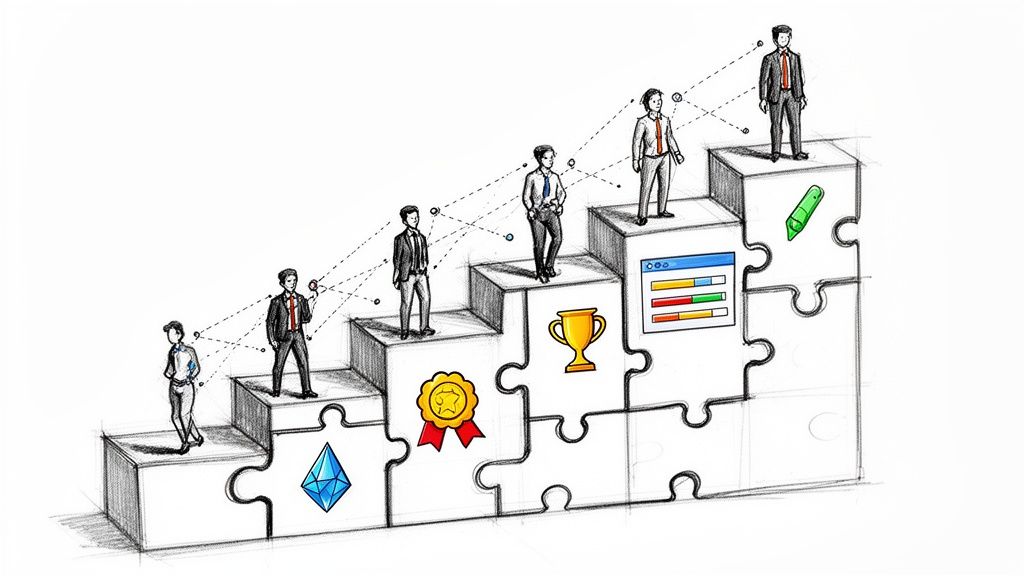
Here's the simple truth: when we talk about gamification in elearning, we're not talking about letting your members play video games during training sessions. It’s much smarter than that. We're talking about strategically weaving game-like elements—points, badges, leaderboards—into your educational content to make it stick.
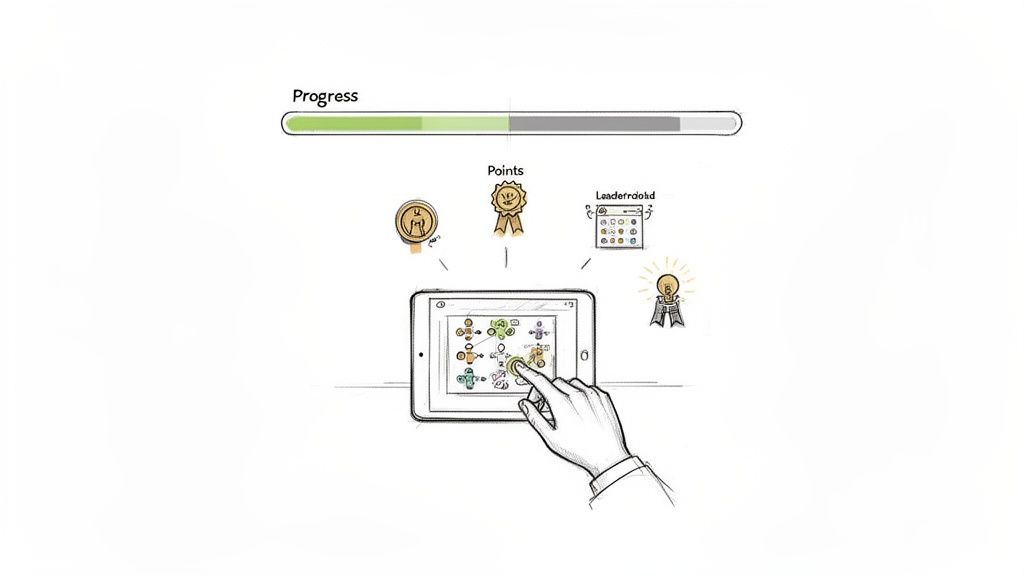
Think about the difference between a standard lecture and an interactive workshop. In a lecture, you're a passive observer, just trying to absorb information. Now, picture that same material redesigned as an escape room. Suddenly, you're actively solving problems and collaborating with others to unlock the next piece of the puzzle. That's the essence of what gamification in elearning does.
This approach works because it taps into our basic human psychology. We are hardwired to crave achievement, recognition, competition, and that satisfying feeling of completion. When a learning module gives you points for a right answer or a shiny badge for mastering a tough section, it delivers an instant hit of positive feedback. That little reward creates a powerful loop that keeps learners hooked and coming back for more.
While points and leaderboards are the most obvious parts of gamification, the real magic happens at a deeper level. It’s about structuring the entire learning journey around a compelling story or a series of meaningful challenges. The goal isn’t to slap on superficial rewards; it's to turn passive learning into an active, motivating adventure.
When done right, the results are pretty staggering.
A landmark study found that a whopping 83% of employees who went through gamified training felt motivated. In stark contrast, only 28% of those who took traditional, non-gamified courses felt the same way. The connection between game mechanics and learner drive is impossible to ignore.
This is a game-changer for professional associations and member organizations. You need your members to stay engaged, complete their certifications, and actually remember what they learned. Gamification gives you the tools to make learning feel less like a chore and more like a rewarding quest. For a deeper dive into structuring your educational content, our guide on how to develop training curriculum is a great place to start.
For adult learners, the why behind the training is just as important as the what. Gamification provides clear, immediate answers.
By building these principles into your courses, you can create educational content that doesn't just inform—it inspires and drives real, long-term engagement within your professional community.
Let's be honest. For any professional network, membership organization, or event organizer, the biggest headaches are usually the same. How do you keep members active? How do you stop them from leaving? And how do you make sure your educational content actually sticks?
Too often, traditional learning feels like a chore—passive, uninspiring, and frankly, a bit boring. The result? Low course completion rates and communities that feel more like ghost towns than bustling hubs. This is exactly where gamification in elearning can completely change the dynamic.
It’s not about adding fluffy games just for the sake of it. It’s about tackling real business problems by tapping into basic human psychology. When a member earns a badge for finishing a certification module or watches their name climb a leaderboard, their brain gets a little hit of dopamine. That’s the chemical that signals pleasure and reward. This creates a positive feedback loop that makes them want to keep learning and participating.
This kind of intrinsic motivation is what turns passive content consumption into an active, rewarding experience—one that keeps your members deeply invested in the community you’ve built.
One of the biggest wins from a well-designed gamified system is its incredible power to boost how much people actually remember. We all know people learn best by doing, not just by watching. Gamification pushes them into the driver's seat.
Instead of just reading a PDF or passively watching a video, members get to apply what they've learned through quizzes, hands-on scenarios, and problem-solving challenges. The instant feedback—like earning points or seeing a progress bar fill up—reinforces the right answers and shows them where they might need a little more practice. This process of active recall literally builds stronger connections in the brain, making it far more likely they'll remember and use the information long after the course is over.
This approach directly translates into more valuable certifications and more effective professional development, turning your educational offerings from a simple member benefit into a cornerstone of their career growth.
For your organization, that means higher completion rates on mandatory training and a more skilled, knowledgeable membership base that sees undeniable value in sticking around.
Beyond just helping individuals learn, gamification is a fantastic tool for sparking a real sense of community and a little friendly competition. Things like leaderboards, team challenges, and social badges get members interacting with each other, not just with your content.
Think about how this could play out:
These social elements transform learning from a solo chore into a shared journey, strengthening the bonds between members and their connection to your organization.
At the end of the day, the real power of gamification in elearning is in the results you can actually measure. The most obvious impact is the dramatic boost to learner engagement and motivation. Just look at the numbers from corporate settings: gamification has been shown to create a 48% engagement uplift, and 95% of workers say it makes them more excited and eager to achieve more. An incredible 89% of employees even feel more productive with gamified training. You can find more of these gamification statistics on Gamizign.com.
This spike in engagement isn't just a "nice-to-have" metric; it directly fuels your organization's most important goals. More people finishing your courses can lead to higher revenue from certification programs. A more active community leads to higher member retention rates because people are far less likely to leave an organization where they feel a real connection.
By building a system that rewards participation and celebrates achievement, you create a self-sustaining cycle of engagement. It’s a clear return on investment that solidifies the value of your community for every single member.
So, you're sold on the 'why' of gamification. Now for the fun part: the 'how'. This is where we get to open up the toolbox and look at the actual game mechanics—the rules, rewards, and feedback loops that make a learning experience compelling instead of a chore.
Think of these mechanics less like a checklist of features and more like ingredients for a recipe. You'll need to combine them in the right way to get the result you want. We can generally group them into three buckets: Progression, Social, and Reward mechanics. Each one taps into a different, very human, motivation.
Progression mechanics are all about answering the learner's subconscious questions: "Where am I going?" and "How far have I come?" They create a sense of forward momentum, which is a massive psychological driver. When people can actually see their progress, they're much more likely to stick with it.
Here are the workhorses of progression:
These tools work together to turn a potentially overwhelming curriculum into a structured, achievable path.
Learning can feel isolating. Social mechanics change that by tapping into our very human need for connection, recognition, and a little friendly competition. For any professional association, this is where the magic happens, turning individual learning into a shared community experience.
This is how a well-designed gamification strategy drives real results, focusing on engagement and retention to deliver a solid return on your investment.
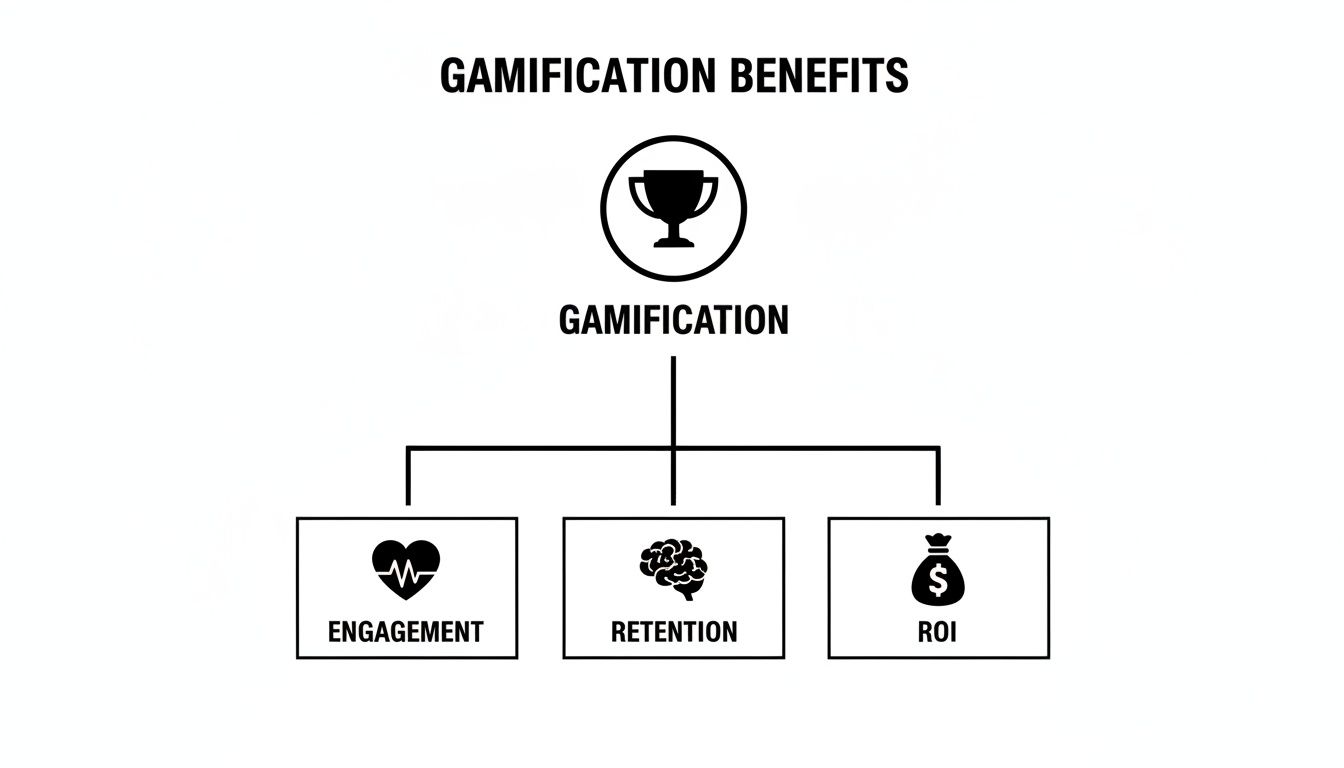
As the diagram shows, gamification isn't just about fun; it's a powerful engine for building member loyalty and achieving tangible goals. Some of the best social mechanics include:
Bringing these social elements into your platform takes some planning. For a deeper dive, check out some of the best tools for community engagement that can work alongside your gamified courses.
Finally, we have rewards. These are the tangible acknowledgments that mark important achievements. While points and levels are rewards in their own right, this category is about the digital (and sometimes physical) trophies that people can show off.
Rewards give learners a lasting symbol of their effort and expertise. They transform an internal sense of accomplishment into an external, shareable credential that holds value both inside and outside your community.
Consider adding these powerful motivators:
The real art of gamification lies in picking the right blend of mechanics to achieve your specific objectives. A leaderboard might be great for driving competitive engagement, but team challenges might be better for fostering a collaborative culture.
This table breaks down some common choices to help you align your tactics with your goals.
Ultimately, the best strategy is to start with a clear goal. Do you want to increase course completion rates? Boost discussion forum activity? Once you know what you're aiming for, you can select the game mechanics that will get you there.
The theory behind game mechanics is great, but seeing gamification in elearning actually work in the real world is what really matters. The true power of this strategy shines when organizations use it to tackle specific problems, turning so-so engagement into real, measurable wins. These aren't just abstract ideas; they're proven blueprints for growth.
Let's walk through a few scenarios where professional networks, event organizers, and companies have used gamification to get some seriously impressive results. These examples show how a smart approach can turn passive learning into an active, motivating experience with a clear return on investment.
A national trade association had a classic problem: their members weren't finishing their main professional certification program. People would sign up, full of ambition, but then life would get in the way. The momentum would fizzle out because the learning journey was long and didn't offer any quick wins along the way.
To fix this, they rolled out a simple but brilliant gamified system.
The results were stunning. Within six months of launching the new system, the association saw a 50% increase in member certification rates. That mix of visible progress and social kudos turned a lonely chore into a community-driven challenge.
If you're an event organizer, proving value to your exhibitors is everything. An annual tech conference was looking for a better way to get attendees to actually visit sponsor booths. Their answer was a gamified event app built to get people moving and talking.
Attendees could score points by completing a "Sponsor Safari." This meant visiting specific exhibitor booths, scanning a QR code, and answering a quick question about what the sponsor offered. The more booths they hit, the more points they racked up.
This simple change turned wandering the exhibitor hall into an engaging treasure hunt. Suddenly, attendees were actively seeking out sponsors to climb the leaderboard, which naturally led to more meaningful conversations and better leads.
The top point-earners were entered into a raffle for big-ticket prizes, like a new laptop or a free pass to next year's conference. This straightforward system delivered a 30% increase in qualified lead generation for exhibitors over the previous year—a direct and powerful ROI. For more practical insights, you can explore other powerful gamification examples in education that demonstrate similar real-world success.
A big company had a whole library of fantastic online training courses that nobody was using. Employees saw the courses as optional, maybe even a little boring, and the company's learning culture was flatlining. To inject some energy back into the program, they introduced team-based gamification.
They grouped departments into teams to compete in a quarterly "Learning League." Here's how it worked:
Switching the focus from individual to team-based learning sparked a new sense of collaboration and accountability. People started encouraging their colleagues to finish modules to help the team get ahead. This friendly rivalry completely revitalized the program, leading to a 40% jump in overall course completions in the very first quarter.
Putting a gamified learning strategy in place is exciting, but sooner or later, every stakeholder is going to ask the million-dollar question: How do we know it’s actually working?
To prove the value of your investment and get people excited for what's next, you need a solid way to measure success and show a real return on investment (ROI).
Just saying it's "fun" won't cut it. The real power of gamification in elearning is its ability to shape member behavior and hit tangible business goals. This means we have to look past the superficial numbers and zero in on Key Performance Indicators (KPIs) that tie directly to what your organization wants to achieve.
The best way to build a strong case is to track metrics in three key areas: engagement, learning, and business impact. Let's break them down.
Engagement is your first and most immediate signal that your gamification strategy is resonating. These numbers tell you if members are actually jumping in and playing along. Without active participation, you can't reach your learning or business goals.
Here are a few essential engagement KPIs to keep an eye on:
Monitoring these gives you a live pulse on the health of your learning community. For more ideas on what to track, check out our guide to essential community engagement metrics.
Once you see people are engaged, the next question is: are they learning more effectively? These metrics are all about proving your gamified system is more than just entertainment—it’s genuinely educational.
Focus on these learning-focused KPIs:
This is where the rubber meets the road—tying your efforts directly to the bottom line. Business metrics demonstrate how gamified learning affects your organization's financial health and strategic goals, proving its value far beyond just the learning platform.
The data speaks for itself. Gamification in eLearning is a proven way to close skills gaps and deliver a clear ROI, especially for associations. In fact, companies that do it well report an incredible 218% higher revenue per employee. The numbers consistently show gamification boosts eLearning retention by 25-60% and can slash training time by up to 60%. You can dig into more of these stats over at iSpring.
Want to calculate your own ROI? Here’s a straightforward formula:
ROI (%) = [(Net Profit from Gamification - Cost of Gamification) / Cost of Gamification] x 100
Your "Net Profit" isn't just one thing. It could be revenue from more course sign-ups, money saved from keeping members around longer, or even a bump in event ticket sales that were promoted in your courses. When you can translate better engagement and learning into dollars and cents, you build an airtight case for the power of gamification.
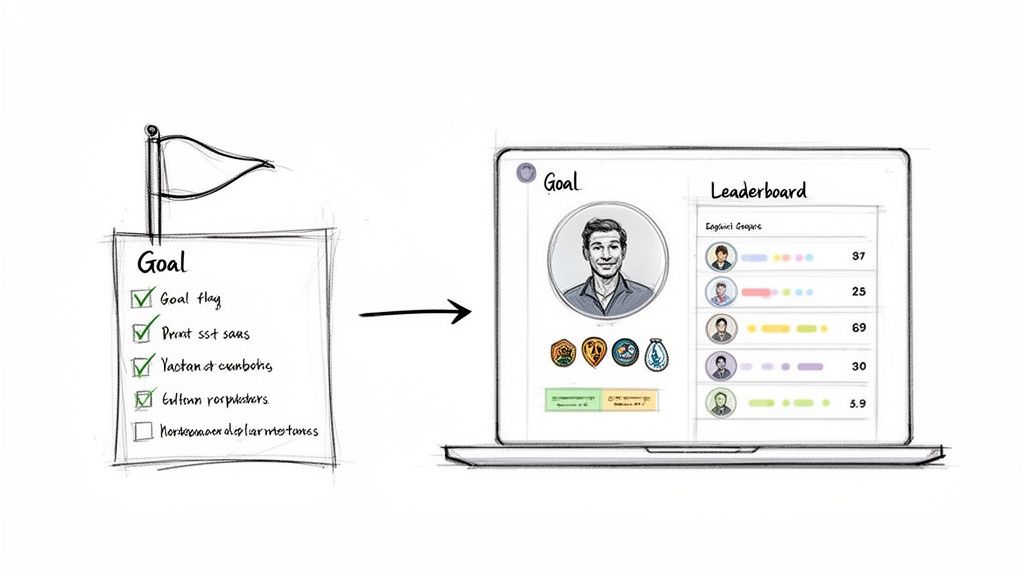
It’s one thing to talk about a strategy, but bringing it to life is where the magic happens. The good news? Implementing gamification in elearning doesn't mean you have to scrap your existing content and start over. It all begins with one simple, powerful step: defining what success actually looks like.
Forget vague goals like "increasing engagement." Get specific. You want something you can actually measure, like "increase new member onboarding completion by 20%" or "boost weekly participation in the community forum by 15%." This specific goal becomes your North Star, guiding every decision you make about game mechanics and rewards.
With a clear objective in hand, you can start building. Most modern community platforms are designed for this, so you can think of it less like coding from scratch and more like snapping together pre-made building blocks.
A great place to start is your content hub—the home for all your courses, documents, and videos. You can immediately assign points for completing a module or award a simple badge for finishing an entire course. Just like that, you've turned passive content consumption into an active, rewarding experience. From there, you can start layering on more sophisticated elements.
Your member profiles are the perfect trophy case for achievements. When members can display their badges and see their point totals, you’re creating a public record of their expertise and commitment. This adds a powerful social element to their accomplishments.
Of course, having the right platform is key to a smooth rollout. Our online course platform comparison can help you find the tools and features that will best support your gamification plans.
Once your goals are set and your tools are in place, it’s the small details that make the experience feel truly compelling. A few practical tips can make a huge difference in how your members respond.
This iterative approach turns your strategy into a living program that grows with your community. And the timing couldn't be better. The eLearning gamification market hit a staggering $1.8 billion in 2023, and with the broader market projected to reach $48.72 billion by 2029, integrating these strategies isn't just a nice-to-have—it's essential for growth. You can discover more about these market trends on emailvendorselection.com.
Lots of organizations get hung up on the idea that gamification in elearning is this massive, expensive undertaking. But here's the thing: you don't need to build a complex gaming empire overnight.
The best strategies actually start small. Try adding a simple point system and a few badges to a single onboarding course. See what clicks with your members, learn from it, and then build from there. When you're ready to get started, picking the right platform is key for making it all work smoothly, so it's worth looking into the best Learning Management Systems (LMS). This phased approach keeps things manageable and budget-friendly.
This is a big one. People worry that adding game-like features will somehow cheapen important professional development material. And honestly, it can—but only when it’s done poorly. Slapping random points onto a course without any real meaning is a recipe for trivialization.
But thoughtful gamification does the exact opposite. It actually elevates serious content by making it stick. The trick is to tie every single game element directly to a learning goal. A badge, for instance, shouldn't just be for showing up; it should represent the genuine mastery of a new skill.
Gamification should serve the content, not overshadow it. When a leaderboard reflects genuine expertise and challenges require critical thinking, the experience deepens learning rather than trivializing it. It adds a layer of motivation that helps members master complex topics.
It's a fair question. What about the members who aren't driven by a competitive streak? A leaderboard might just turn them off completely. This is why a one-size-fits-all strategy is doomed to fail.
The secret is to create different paths to success. While not everyone is a born competitor, almost everyone finds motivation in seeing their own progress or working with a team.
Here's how you can appeal to different personalities:
By offering more than one way to "win," you can build an inclusive program that engages and motivates every type of learner in your community.
Ready to build an engaging learning community that drives real results? GroupOS provides all the tools you need to launch a powerful, gamified eLearning experience. Discover how GroupOS can transform your professional network today.