March 9, 2026
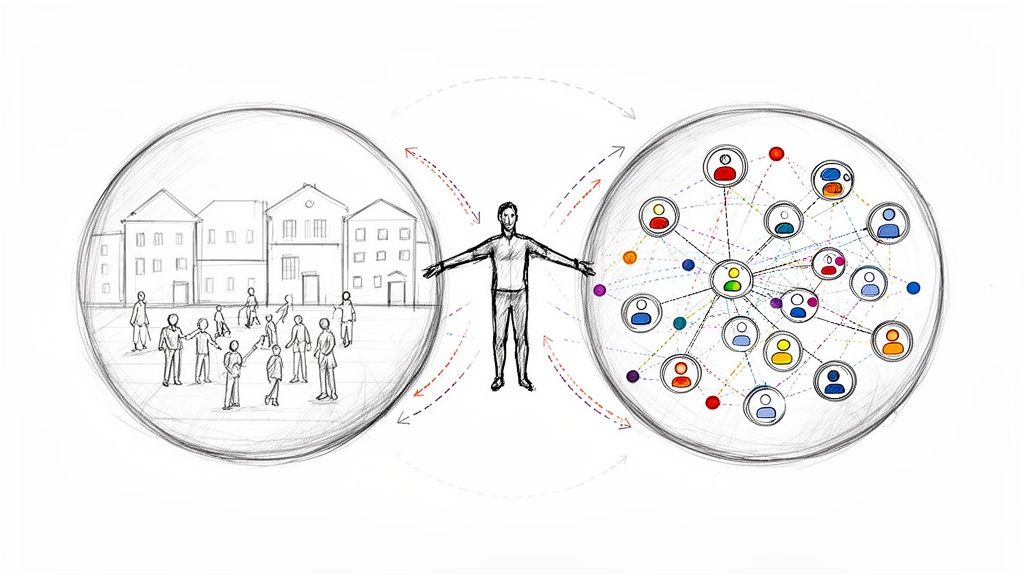
A community social media manager is the crucial link between a brand's public social media presence and its private member community. This person isn't just shouting into the void with one-way messages; they're the host of the party, making sure every conversation is a good one and building real relationships.
For a long time, the social media playbook was pretty straightforward: pump out content, rack up followers, and cross your fingers. Social platforms were treated like giant billboards, where the main goal was simply to be seen by as many people as possible. But the game has changed, especially for professional associations and event organizers.
Smart brands now realize that a small, dedicated group of champions is infinitely more valuable than a huge, silent audience. This is exactly where the community social media manager shines. Their job isn’t just to post updates; it's to build a vibrant space where members feel connected, valued, and heard—not just by the brand, but by each other.
What’s driving this shift? It’s simple: people want genuine connection, not just another piece of content to scroll past. As of 2026, old-school broadcasting has taken a backseat to community-first strategies, with 73% of businesses now focused on using organic social media to spark real conversations. It’s clear that 1,000 fans who actively like, share, and comment are worth far more than 10,000 followers who never engage.
This new reality demands a professional who can juggle two key responsibilities:
The goal is no longer about just getting followers. It’s about creating a 'sticky' environment that people want to be a part of, turning passive observers into active participants and, eventually, your biggest advocates.
When you blend the public-facing work of a social media manager with the deep relationship-building of a community manager, you create a powerful cycle. A community social media manager listens to what members are talking about inside the community and uses those insights to create public content that truly hits the mark.
At the same time, they use public social channels as a magnet, drawing in like-minded people who would be a perfect fit for the community. This integrated strategy is one of the biggest benefits of online communities. It transforms social media from a basic marketing tool into a self-sustaining source of growth, loyalty, and priceless member feedback. You’re no longer just running campaigns; you’re building lasting relationships.
Let's be honest, the lines between posting content and building relationships have gotten pretty blurry. It’s created a lot of confusion. Is a community social media manager just a social media manager with a more impressive title? Or are they a community manager who also happens to post on Instagram?
The answer is neither. It’s a distinct, hybrid role that pulls the best from both worlds.
To really get it, think of your brand’s presence as a bustling town square.
The Social Media Manager is the town crier. They stand on a platform, broadcasting news and stories to everyone in the square and anyone just passing through. Their main goal is reach—making sure the message is heard far and wide.
The Community Manager is the mayor. They’re on the ground, walking through the crowd, talking to residents, organizing local events, and making sure everyone feels heard and valued. Their focus is on the people already in the town.
The community social media manager does both. They are the charismatic leader who gets on stage to draw in a crowd, but they also step down to mingle, introduce people, and make everyone feel like they belong.
The town square analogy is a good start, but the real differences show up in the day-to-day work. What someone focuses on, what their tasks are, and how they measure success all stem from their core objective. Getting a handle on these practical details is key. For more on the social media side of things, these game-changing social media manager tips are a great resource.
This image really drives home how the community-focused role is built on a few core pillars. It's less about just shouting messages and more about being an architect for connection.
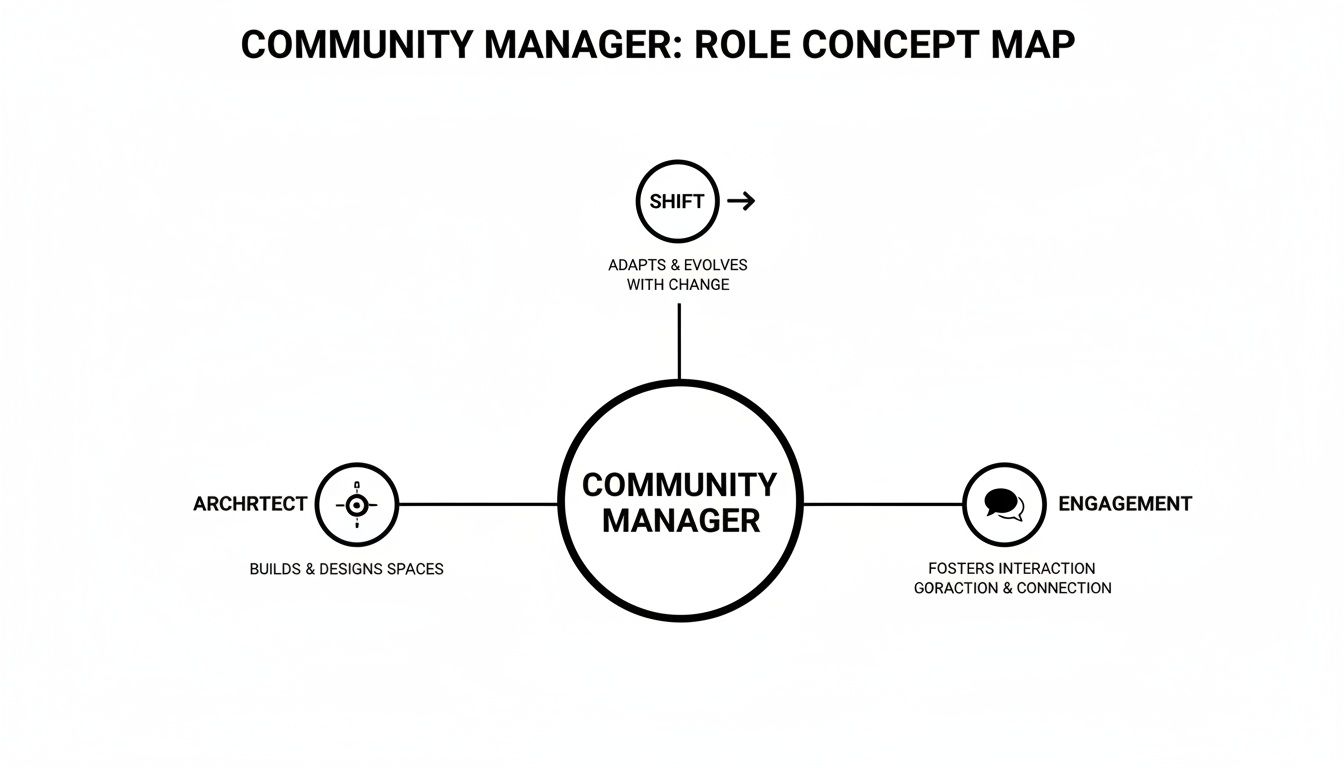
You can see how this professional actively designs the space for interaction. It’s a proactive job, not just a reactive one. They aren't just putting out fires; they're building the fireplace everyone wants to gather around.
To fully appreciate what a community social media manager brings to the table, it helps to see how their duties overlap and expand on the other two roles. Let's put them side-by-side. This comparison makes it clear how this one person can connect audience growth with genuine member loyalty.
As the table shows, this hybrid role solves a common problem. A great social media manager might build a massive following that doesn't stick around. On the other hand, a dedicated community manager can create a tight-knit group but might struggle to bring in new people.
This is where the community social media manager shines. They create a smooth path for someone to go from seeing a post on social media to becoming an active, valued member of the community. It’s an approach that ensures your growth efforts result in a stronger, more engaged group of people. If you want to explore this further, our guide on social media community management offers even more specific strategies.
So, what does this hybrid role actually do all day? It’s far from just scheduling a few posts and calling it a day. A community social media manager is constantly switching hats—part data analyst, part content creator, part conversationalist, and part strategist. Their job is to have a finger on the pulse of the community and use that insight to both attract new members and keep existing ones happy.
Let's walk through what a typical day might look like. While no two are ever the same, there's a certain rhythm to the work, a flow designed to make the biggest impact. Think of it as a cycle of listening, broadcasting, and then listening again to see what landed.
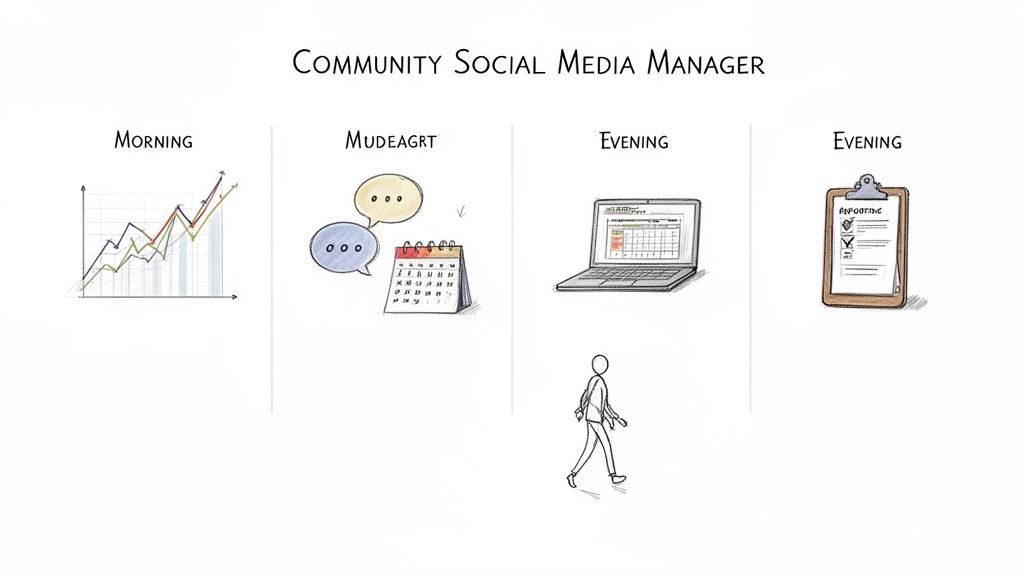
This daily loop is what keeps the community healthy. It ensures the manager isn't just reacting to conversations but is actively shaping them and guiding the community toward its shared goals.
The day almost always starts with a deep dive into listening and analytics. Before you can talk, you have to know what everyone else is talking about. This isn't just a quick scan of notifications; it's about digging into the data to understand the story it's telling.
This morning routine is foundational. It sets the stage for the rest of the day, ensuring that every piece of content created and every conversation started is based on what the community is genuinely interested in.
With a solid read on the community's mood, the middle of the day shifts from listening to creating. This is when the manager starts building the bridge between the public-facing social media channels and the private community space.
This is where you can really see how the industry has changed. The job has evolved because 72% of businesses now measure their social media ROI through engagement (68%), conversions (65%), and revenue (57%), ditching old vanity metrics. This shift explains the rise of micro-communities, where niche influencers can deliver incredible 3.86% engagement rates by speaking to highly targeted professional groups. You can dig deeper into how social media metrics are changing on Sproutsocial.com.
This focus on real connection directly influences their midday tasks:
A platform like GroupOS is a game-changer here. It lets a manager schedule content, analyze member activity, and message members directly—all from one dashboard. This cuts out the tedious process of juggling multiple tools and spreadsheets, freeing them up to focus on strategy and genuine connection.
As the day winds down, the focus shifts to closing the loop and planning for tomorrow. This is all about translating the day's activities into clear, actionable insights for the rest of the company.
The manager will compile a quick report on the day's KPIs, highlighting any interesting trends, high-performing posts, or valuable member feedback that the product or marketing teams need to hear. This feedback loop is what ensures the voice of the community helps shape the business.
Finally, they'll take a look at the content calendar, make any necessary adjustments, and start outlining a plan for the next day. The goal is to finish the day with a clear direction, ready to keep the momentum going.
A great community social media manager wears two hats. They're part creative storyteller, sparking conversations and building relationships, and part data-driven strategist, proving that their work actually moves the needle for the business. It's a role that demands more than just being "good at social media"—it requires a specific blend of technical skill and genuine human connection.
To really understand what makes someone thrive in this role, it helps to split their abilities into two camps: the teachable “hard skills” and the innate “soft skills.” You absolutely need both to build a community that people love and that also delivers results.

Think of it this way: technical skills get the content out the door, but the soft skills are what make people want to stick around and engage with it.
The best in the business have mastered both the technical tools of the trade and the nuanced art of human interaction. One side is about the "what" they do; the other is about the "how" they do it.
Hard Skills (The "What")
Soft Skills (The "How")
Likes and shares feel good, but they don’t tell the whole story. To prove their worth, a community social media manager must focus on Key Performance Indicators (KPIs) that leadership and stakeholders actually care about—the numbers that show a clear return on investment.
Forget vanity metrics. The real measure of success is found in how your community behaves. Are members sticking around? Are they bringing in their peers? Are they happy?
Here are the four core KPIs that truly matter:
Engagement Rate: This is the big one. It measures what percentage of your audience is actually interacting with your content through comments, shares, and meaningful reactions. A high engagement rate is proof that your community isn't just present; it's alive.
Member Retention: This metric shows you how many members stick around over time. If people aren't leaving, it's a powerful sign that they're finding real value in the community you've built.
Conversion Rate from Social: This directly links social media activity to business growth. It tracks how many people discover you on a public social channel (like Instagram or LinkedIn) and then take the next step to become an active community member or a paying customer.
Community Sentiment: This goes beyond the numbers to measure the overall vibe of your community. By using social listening tools or just paying close attention, you can gauge whether the mood is positive, negative, or neutral. This qualitative data is priceless for understanding member satisfaction.
By tracking these metrics, a community social media manager stops being a "cost center" and becomes a strategic driver of growth. For a deeper look into what to measure, check out our complete guide to community engagement metrics.
Finding the right person to build and nurture your community is one of the most critical hires you'll make. This isn't just about managing a social media account; you're looking for the voice of your brand, the architect of your digital town square, and a direct line to your most passionate members. Hiring a true community champion demands a thoughtful process that goes way beyond a standard marketing hire.
To attract the best talent, your hiring strategy needs to be as intentional as the role itself. This starts with a job description that speaks their language and an interview process designed to spot that unique mix of empathy, strategy, and creative flair. When you’re ready to start your search, applying some proven recruitment process best practices will make a world of difference.
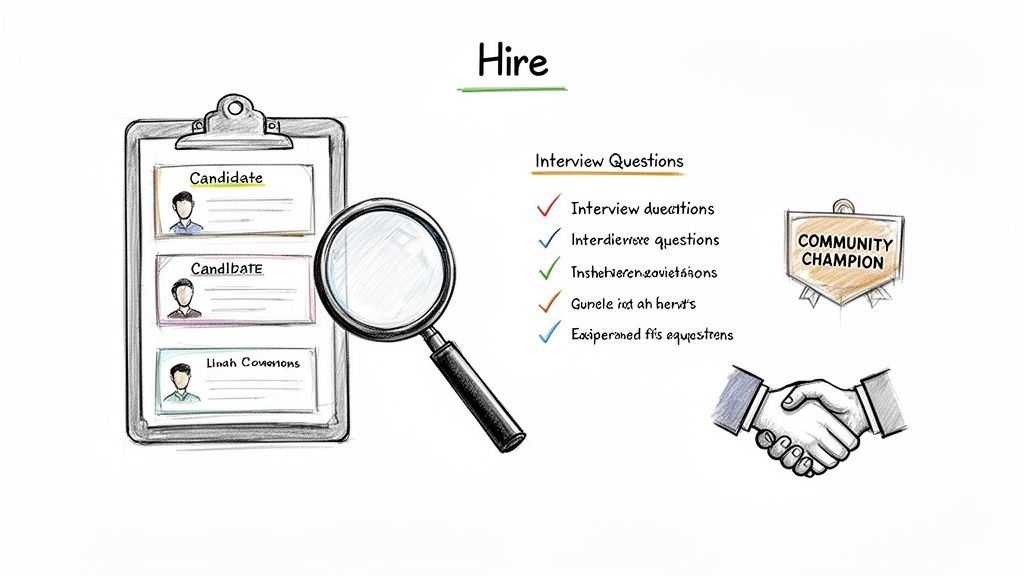
Remember, you’re not just looking for someone who can post on a schedule. You’re hunting for a leader who can spark genuine connection and drive real business results.
A generic job post is a magnet for generic candidates. If you want a real community builder, your description has to reflect the hybrid nature of the job. It needs to strike a balance between creative work and analytical thinking, putting just as much weight on relationship-building as it does on content creation.
Here’s a simple template you can make your own:
Job Title: Community Social Media Manager
About Us: [Quickly describe your company and its mission. What makes your community a place someone would be excited to lead?]
The Role: We’re looking for a passionate and strategic Community Social Media Manager to become the heart of our digital presence. You'll be in charge of growing our audience on social media while also nurturing a vibrant, engaged community of members. This unique role is a perfect blend of creative content, data-driven insights, and authentic human connection.
From there, you can get into the specifics. For a deeper dive, check out our full guide on writing an online community manager job description.
Key Responsibilities:
Finally, outline the qualifications you need. Be sure to list both hard skills (like data analysis) and the crucial soft skills (like empathy and patience).
Once candidates start rolling in, you need to ask questions that show you how they think, not just what’s on their resume. Move beyond the classic "tell me about your experience" and throw some real-world scenarios at them.
Asking these kinds of questions will quickly separate the people who just talk a good game about "community" from the ones who actually know how to build one.
Think of a community social media manager role not as a destination, but as a launchpad. It’s one of the best places to start a career because it throws you right into the heart of strategy, creativity, and analytics—skills that every single growth-focused company is desperate for.
Once you’ve spent time in the trenches building engagement and proving you can move the needle, you’re in a fantastic position to move up. The experience you gain is a direct ticket to senior roles where you get to shape the company’s entire approach to its audience.
Your career can branch out in a few exciting directions. Most often, you’ll see a clear path toward overseeing bigger teams and tackling more ambitious strategic projects.
This career path isn’t going anywhere. As more businesses realize that chasing new customers is a fool's errand compared to building real loyalty, the person who genuinely understands how to build and nurture those relationships becomes the most important person in the room.
The community management field is changing fast, and if you want a long-term career, you need to keep an eye on what’s next. The biggest trend? Even when budgets get tight, companies are doubling down on community-led growth.
For example, CMOs plan to dedicate 16% of their marketing budgets to social media in 2026, and that’s expected to jump to 19% by 2029. That investment makes perfect sense when you consider the number of people on social media is projected to hit a staggering 5.66 billion in 2026. You can dig into more of these numbers in these social media trends and statistics on Agorapulse.com.
This wave of investment points to two massive shifts on the horizon:
At the end of the day, the community social media manager role is only becoming more strategic and more critical to a company’s bottom line. As long as businesses value their customers, the people who know how to build a thriving community around them will always have a seat at the table.
Even after getting the big picture, some practical questions always pop up. Whether you're an organization looking to hire or a pro considering this career path, let's tackle the most common ones head-on.
Let's talk numbers. Since this is a hybrid role that blends two distinct skill sets, the pay reflects that. For 2026, you can expect the average salary for a community social media manager to land somewhere between $75,000 and $110,000 USD a year.
Of course, this can shift based on your city, industry, and experience level. The real opportunity for growth comes from proving your value. If you can draw a straight line from your work to better member retention, community growth, and getting people to move from social media into your private community, you'll have all the leverage you need to negotiate a higher salary.
The short answer is yes, but with a huge asterisk. It’s absolutely possible, especially for small or mid-sized organizations, but it all hinges on having the right technology. Trying to manage both social media and a community without a unified platform is a recipe for burnout.
Without an integrated toolset, your manager will spend all day hopping between different platforms and spreadsheets, drowning in admin tasks. The right tech automates the grunt work and frees them up to focus on what actually matters: strategy and building real relationships.
Think of it as giving a chef a fully equipped kitchen instead of just a single hot plate. The right tools make it possible for one person to create something amazing without getting overwhelmed.
While the goal is always to build relationships, how you do it changes completely depending on the audience. A great community social media manager knows how to read the room and tailor their approach.
For a B2B professional association, the entire conversation is about career advancement, sharing deep industry knowledge, and fostering professional connections. LinkedIn is usually the main stage, and the tone is more polished and packed with value.
For a B2C brand, it's a totally different ballgame. The focus might be on user-generated content, tapping into lifestyle trends, or providing quick, friendly customer support. Here, you'll likely live on more visual platforms like Instagram or TikTok, with a voice that’s personal and fun.
Ready to give your community champion the tools they need to succeed? GroupOS is the all-in-one platform designed to manage members, events, and content seamlessly. It frees your manager to stop juggling tasks and start focusing on what they do best—building your community. Learn more about streamlining your community operations.