December 20, 2025

A community manager is the bridge between a brand and its audience, acting as a strategist, moderator, and advocate all at once.
At its core, a community manager's job is to build, grow, and look after a company's community. Think of them as both the architect and the host of a party. They design the space, set the vibe, and make sure everyone feels safe, heard, and connected—both to the brand and to each other.
The role is a mix of being proactive with a long-term strategy and being reactive to the daily needs of the members. It's about making sure the community doesn't just run smoothly, but that it actually helps the business hit its bigger goals.
This isn't a niche role anymore; it's a central piece of modern marketing and customer relations. The U.S. Bureau of Labor Statistics actually projects that jobs for social and community service managers will grow by 6% between 2024 and 2034. That's faster than the average for all jobs, which shows just how much businesses are starting to value community. You can read the full occupational outlook from the BLS for more details.
To really get a handle on what a community manager does day-to-day, let’s break down their main responsibilities.
A huge part of this role is protecting the brand's image online. For anyone serious about this, here's a comprehensive guide to using a reputation monitoring service that can be incredibly useful.
The table below gives you a quick snapshot of the primary functions a community manager juggles.
All these responsibilities fall under the umbrella of community management. It's all about building real, authentic relationships with people at scale.
If you want to dive even deeper, we have a complete guide that asks and answers the question: what is community management.
If you think of a community manager's job as just a long to-do list, you're missing the forest for the trees. Great community management is far more than just checking off tasks; it’s a strategic role that lays the foundation for real business growth. It's the difference between having a simple group of users and cultivating a vibrant, self-powering ecosystem.
I like to think of a community manager as an architect. They don't just throw furniture into a room. They design a space with a clear purpose. Every room, hallway, and window is thoughtfully placed to encourage people to connect, collaborate, and feel comfortable. In the same way, every single thing a community manager does is a deliberate act of building an environment where members feel like they truly belong and are excited to contribute.
These responsibilities aren't just siloed tasks—they're all connected. Let's break down the core pillars that turn a passive audience into your company's most powerful asset.
Engagement is the pulse of any community. It's the lively discussions, the constant back-and-forth between members, and the shared excitement that makes the space feel alive and buzzing. The community manager's job is to be the spark, kicking off conversations that are not only interesting but also genuinely relevant to what members need.
This goes way beyond posting a generic question of the day. Real, strategic engagement is about creating rituals—things members can actually look forward to, like a weekly "Share Your Wins" thread or a monthly Q&A with an expert. It's also about spotting your most active members and shining a spotlight on them, helping to turn them from quiet observers into passionate advocates for your brand. A big part of this is putting effective community engagement best practices into action to keep the group active and healthy.
When people feel like they’re being seen and heard, their loyalty skyrockets. They become your most authentic marketing team, organically sharing great experiences and even defending your brand online. That kind of advocacy is pure gold, and it comes directly from consistent, thoughtful engagement.
Engagement isn't just about getting people to reply to your posts. It's about creating a space where members feel so comfortable they start conversations on their own. The real win is a community that thrives even when the manager isn't actively stirring the pot.
The diagram below really shows how these essential functions—engagement, moderation, and content—all work together to build a successful community.
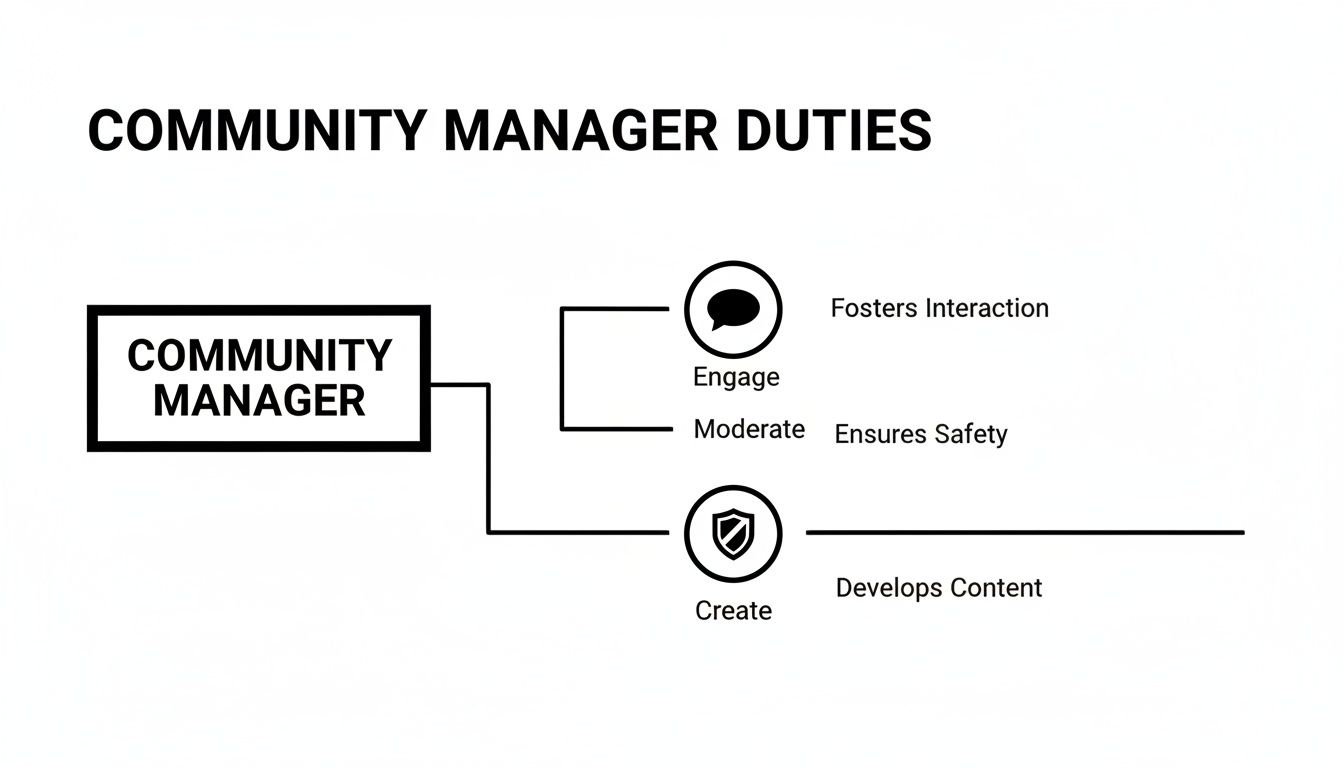
It’s a balancing act. You're constantly nurturing interaction, keeping everyone safe, and delivering value through great content, all at the same time.
If engagement is the community's heartbeat, then moderation is its immune system. The main goal here is to build and protect psychological safety—that shared feeling that this is a safe place to take risks, ask tough questions, and just be yourself. Without that safety net, your members will never open up.
Good moderation is proactive, not just reactive. It all starts with having clear, easy-to-find community guidelines that set the tone from day one. A community manager's job is to enforce those rules fairly and consistently, which shows everyone that their well-being is the number one priority.
This pillar has a massive impact on retention. A well-moderated space becomes a refuge from the chaos and toxicity you see elsewhere online. Members stick around because they trust the environment you've built, which means less churn and a much healthier, more stable community. To learn more about building this kind of space, check out our guide on creating a community engagement strategy.
Content is the fuel that keeps the community engine running. It’s what gives people a reason to come back day after day. A community manager is responsible for creating, curating, and facilitating content that aligns with the community's purpose and what members are actually interested in.
This can look like a few different things:
Planning your content strategically ensures there's always something valuable and fresh, so the community never feels stale. This is where a platform like GroupOS comes in handy. It gives you a central place to share documents, host on-demand videos, and organize course materials, making sure all your valuable content is easy to find. This transforms your community from a simple forum into a resource your members can't live without.
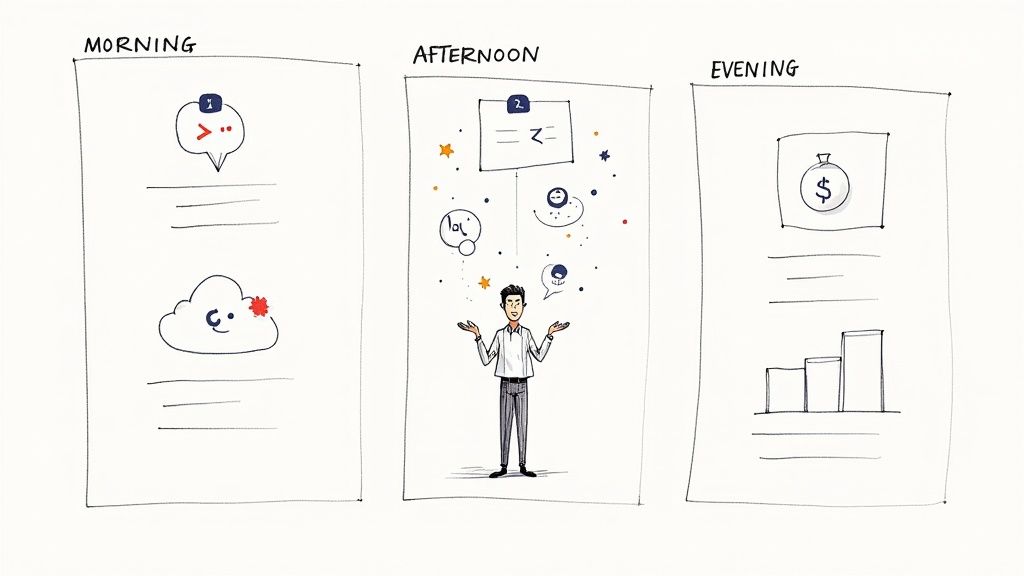
It’s one thing to understand the high-level strategy behind community management, but what does the job actually feel like day-to-day? If you're picturing someone just posting on social media, you're only seeing a tiny corner of the picture. The reality is a fast-paced blend of careful planning and completely unpredictable human moments. No two days are ever the same.
A community manager’s schedule ebbs and flows with the energy of its members. You’re part proactive architect, part responsive firefighter, and you have to be ready to switch hats in an instant. Let's pull back the curtain on what a typical day, week, and month really involves.
Most mornings start with a pulse check. Before I even think about my to-do list, I spend the first hour or so sweeping through all our community channels—Slack, Discord, forums, you name it. This is the reactive part of the job: hunting for urgent member issues, spotting a brewing conflict, or just putting out little fires before they can spread.
Once the coast is clear, I can switch gears to proactive engagement. This is where the magic happens.
This daily dance requires ruthless prioritization. You constantly have to weigh what needs your attention right now versus what can wait, all while keeping the bigger strategic goals moving forward.
When you zoom out to a weekly view, things start to feel a bit more structured. Daily engagement never stops, of course, but a set of recurring tasks gives the week a predictable rhythm that ensures we're consistently delivering value.
For example, I might dedicate Monday mornings to planning the week’s content calendar and scheduling posts. Wednesday could be our dedicated event day, where we host a live "Ask Me Anything" (AMA) session or an expert-led workshop. Then, Friday is often my analysis day—pulling engagement reports, summarizing member feedback, and translating it all into actionable insights for the rest of the team.
A community manager’s week is like conducting an orchestra. Each day has its own instrument to feature—content, events, analytics—but the goal is to make them all work together in harmony to create a cohesive and engaging experience for the members.
This kind of structure is what keeps the role from becoming purely reactive. It carves out the necessary time for strategic projects, like launching a new member onboarding sequence or testing a new engagement campaign, to actually get done.
Looking at the month as a whole, the community manager’s duties shift from tactical, in-the-weeds work to high-level strategic oversight. This is where the big-picture thinking comes into play. The start of the month is all about setting clear goals, like aiming to increase our active member rate by 5% or encouraging more user-generated content.
Mid-month, I'm often collaborating with other departments. I'll sync with the marketing team on an upcoming campaign or with the product team about a new feature launch to make sure the community’s voice is represented across the entire company.
The end of the month is for reflection and reporting. This is when I analyze our performance against the goals we set, compile a report for stakeholders, and use what we learned to inform the strategy for the next month. It’s an intense cycle. In fact, recent data shows that 65% of community professionals feel overworked precisely because of this constant juggling act. You can discover more insights on community manager workload to see just how demanding the role can be.
This cycle of planning, executing, and analyzing is the engine that proves a community’s value and secures the resources needed to keep it thriving.

Being an effective community manager is a delicate balance. It's part art, part science—a unique mix of people skills and technical know-how. You can't just be a "people person" or a tech wizard; you have to be both.
Think of it like being a skilled diplomat. You need the finesse to navigate tricky conversations and build genuine relationships. But you also need the practical ability to look at data, understand what it's telling you, and use the right tools to get the job done efficiently. Both sides of that coin are absolutely critical.
At the very core of community management is the ability to connect with people. These aren't just "nice-to-have" traits; they're the foundation of any thriving community. They’re what make a space feel safe, welcoming, and real.
The most powerful skill a community manager can possess is empathy. When members feel genuinely understood and cared for, they transform from passive consumers into active co-creators of the community’s culture.
These are the skills that turn a group of strangers into a genuine community.
If soft skills are the heart of a community, then hard skills are the brains. These are the measurable, technical abilities that allow you to execute your strategy, analyze what's working (and what isn't), and show the real impact of your work.
It's where creativity meets analytics, letting you create great experiences and then prove how effective they are.
Having the skills is one thing, but having the right tools to amplify them is another. A modern community tech stack helps automate the boring stuff, gather useful data, and scale your efforts so you can grow without burning out. For a deeper dive, check out our complete guide on the top tools for community engagement.
The right platform lets you focus less on manual tasks and more on what really matters: connecting with your members. Here’s a quick look at how different platforms stack up for some core community manager duties.
Choosing your home base is a major strategic decision. A platform's features can either supercharge your efforts or create frustrating roadblocks. This table breaks down how a few popular options handle key tasks.
As you can see, a platform like GroupOS is built to bring all these functions under one roof. It gives you a single, powerful system for managing everything from events and content to member data, saving you from having to juggle a dozen different tools.

How do you prove your community is more than just a “nice-to-have” feature? The answer is looking past the vanity metrics. Sure, a huge member count looks impressive on a slide, but it says nothing about whether your community is healthy or actually helping the business.
A huge part of a community manager's job is to connect the dots between all that member activity and a compelling story backed by data. It’s about showing leadership that the community isn't a cost center—it’s an engine for retention, a source of new leads, and a goldmine of product feedback. This means shifting your focus from "how many" to "how engaged."
Engagement is the pulse of your community. Tracking it the right way is how you check its vitals. Instead of getting hung up on the total number of members, zoom in on the percentage of them who are actually showing up and participating. That gives you a much clearer picture of how vibrant your space really is.
Here are the essential engagement numbers to keep an eye on:
These figures help you tell a much richer story about what's really happening inside your community. For a more detailed breakdown, our guide on community engagement metrics offers even more KPIs to track.
Beyond the day-to-day chatter, you have to connect community activity to real business results. This is how you prove ROI and get the budget you need for your programs. Tying engagement to the bottom line is what separates a good community manager from a great one.
To get there, you need to track metrics that show both the internal health of the community and its external impact on the company's goals.
A healthy community doesn't just talk; it acts. It lowers support costs by encouraging members to help each other, makes products better with raw feedback, and builds the kind of loyalty that keeps customers around for the long haul.
Here’s how you start measuring that impact:
Platforms with analytics dashboards built right in, like GroupOS, make tracking all of this much less of a headache. The right tool gives you a clear, at-a-glance view of member activity and content engagement without you having to dig for it.
When you present this kind of data to leadership, you completely change the conversation. You’re no longer just managing chats and posts; you’re a strategic partner contributing directly to customer success, product innovation, and the company's financial health.
Being a community manager isn't just a job; it's the first step onto a seriously dynamic and strategic career ladder. The skills you pick up here—handling everything from member engagement and moderation to staring at data until it makes sense—are the very same ones that build senior leaders who steer a company’s entire relationship with its customers.
This isn't just a vague, "work hard and you'll get there" kind of path, either. The industry is putting real structure behind it. A 2024 global survey from The Community Roundtable found distinct roles like Community Specialists, Managers, Strategists, and even Executives, all with their own salary bands. This is a huge deal. It means companies finally get how valuable this work is and are building official pathways for growth.
As you climb that ladder, what you do day-to-day changes quite a bit. You'll move from being hands-on in the trenches to steering the ship from the bridge.
Most people start their journey as a Community Specialist or Moderator. Think of this as the front lines. Your world is purely tactical: you’re jumping into conversations, gently reminding people of the rules, and posting the content that someone else planned out. You’re learning the heartbeat of the community, one interaction at a time.
When you step up to become a Community Manager, your perspective gets wider. You're not just executing anymore; you're starting to build small-scale strategies of your own. You’ll plan a virtual event, create original content, and start pulling together reports on what’s working and what’s not. You’re still deep in the daily flow, but now you’re asking why you’re doing things and how they tie back to the bigger business goals.
The next big jump is to a role like Community Strategist or Head of Community. At this point, your day-to-day work looks completely different. You’ll find yourself spending far less time in the weeds of individual threads and a lot more time looking at the big picture.
The real change when you move into a senior role is shifting from managing a community to leading the community function. Your focus zooms out from member-level chats to department-level strategy, owning a budget, and proving the community's value to the C-suite.
Your new to-do list includes things like:
At the very top, you have the Chief Community Officer (CCO). This executive-level position shows just how critical community has become. The CCO has a seat at the table, ensuring that the community isn't just a silo but a core part of the entire business strategy, influencing major company decisions.
As community management solidifies its place as a crucial business function, a lot of the same practical questions pop up. It's easy to grasp the job description, but the day-to-day reality is a different beast. Let's break down some of the most common things people ask.
Ah, the classic tightrope walk for any community manager. The trick is to stop thinking of moderation as the enemy of engagement. Instead, see it as the very thing that makes real engagement possible.
Think of your community guidelines as the rules of a friendly pickup basketball game. When everyone knows the rules and plays fair, the game is way more fun and people are more likely to jump in. Clear guidelines and a positive tone set from day one actually reduce the amount of reactive, heavy-handed moderation you have to do. This frees you up to be the host of the party, not just the bouncer.
Beyond the daily grind, two challenges consistently surface: burnout and proving your worth. This job is incredibly demanding and often feels like you need to be "on" 24/7, which is a fast track to exhaustion if you don't set firm boundaries.
At the same time, tying your community's health to cold, hard business numbers is a constant struggle. You have to move past simple metrics like member count and show how your work actually improves customer retention, lowers support costs, or sparks new product ideas. That requires getting smart with data and telling a compelling story with it.
Good news: you absolutely can. The secret isn't a specific degree; it's proving you have the skills by creating your own experience.
The best way to show you can manage a community is to just start managing one. Initiative and a genuine passion for connecting people often speak louder than a perfect resume.
Here are a few ways to get your foot in the door:
Ready to make your community management duties easier and focus on what really moves the needle? GroupOS is an all-in-one platform built to handle your events, content, and member engagement without the headache. Start your free trial and see how it works.