December 14, 2025
Securing sponsors for your event is less about asking for a handout and more about proposing a powerful business partnership. You have to show a potential partner exactly how your audience aligns with their target market and what tangible value you can deliver. It’s a shift in mindset—from "can you give us money?" to "here's how we can help you achieve your goals."
Before you even dream of drafting a pitch deck or sending that first outreach email, you need to lay some serious groundwork. This isn't just about listing what your event is; it's about defining what your event does for a sponsor. You have to take off your event organizer hat for a moment and look at your event through the critical lens of a marketing director with a budget to protect.
This foundational work is more important than ever because the sponsorship game is incredibly competitive. While a whopping 88.4% of event marketers count on sponsorships as a major revenue stream, nearly a quarter of them (24.6%) say that actually securing those sponsors is their biggest headache. That gap shows a real disconnect between needing sponsors and knowing how to land them.
So, what makes your event a must-sponsor opportunity? The answer is never just "we have 500 attendees." A truly compelling value proposition goes much deeper, connecting the very soul of your event to a sponsor's business objectives. This is the core story you'll be telling, and every single part of your sponsorship strategy will hang on it.
To really sharpen your value proposition, ask yourself these questions:
This simple flowchart breaks down the essential process for creating a solid sponsorship foundation.
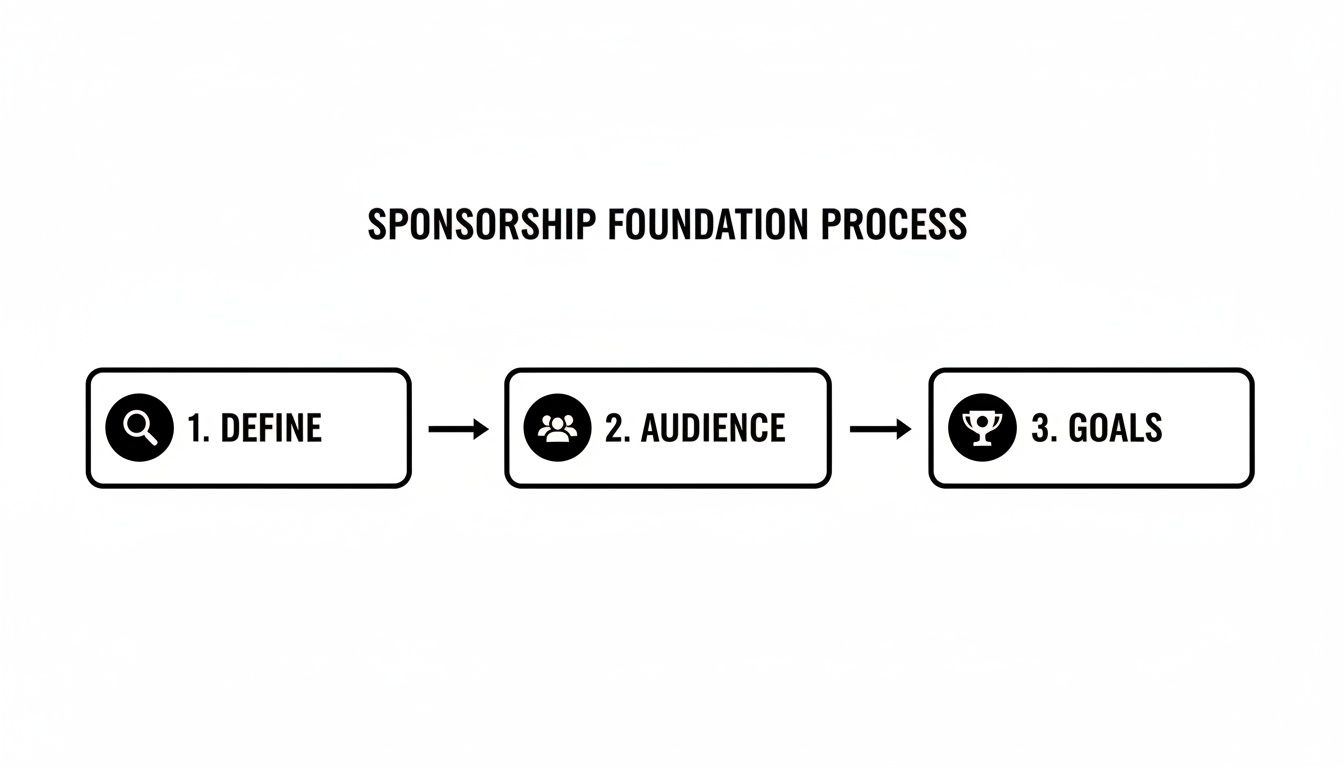
As you can see, defining your value, getting crystal clear on your audience, and setting specific goals are the sequential pillars that hold up any successful sponsorship outreach campaign.
Let's be clear: sponsors aren't paying for access to your event; they're paying for access to your audience. A vague description like "professionals aged 25-45" just won't cut it anymore. You need to paint a vivid picture of your attendees—a detailed persona that a brand will immediately recognize as their perfect customer.
You have to dig past the basic demographics and get into the psychographics. You should know their:
Pro Tip: Your pitch becomes infinitely more powerful when you can confidently say, "Our attendees are your future customers, and we have the data to prove it." That's what gets your proposal moved to the top of the pile.
For anyone looking to get better at understanding brand strategy and event marketing, the Branditok blog is a great resource full of articles and expert insights.
Finally, you can't get what you want if you don't know what you're asking for. Are you looking for straight cash to cover the venue, or would an in-kind sponsor providing a key service be just as valuable? Defining your goals upfront helps you zero in on the right companies and build sponsorship packages that actually make sense.
Get specific with your targets. For instance:
Having these precise goals shows potential partners that you're organized, strategic, and professional. It's the final piece of the foundation you need before you can start building sponsorship proposals that are too good to refuse.
Once you’ve nailed down your event’s value and audience, it’s time to package all that goodness into a sponsorship proposal that gets read, not deleted. Think of this document as your single most important sales tool. A generic, one-size-fits-all brochure is a dead end, but a thoughtful, data-driven proposal that tells a story? That starts a conversation.
The real key is to flip the script entirely. Stop thinking about what you need from a sponsor and start obsessing over what you can deliver for them. Your proposal must answer their unspoken question: “What’s in it for me?”
Every proposal that actually works is built on a foundation of clarity, relevance, and value. It needs to be scannable for the busy executive but detailed enough to justify a serious investment. I like to think of it as a pitch deck that anticipates a sponsor's questions before they even think to ask them.
So, what goes inside? Make sure you’ve covered these bases:
Here’s a hard truth: sponsors are marketers, and marketers live and die by return on investment (ROI). Your proposal has to translate your event’s cool features into tangible business benefits. A logo on a banner isn't a benefit; it's a feature. The benefit is the brand exposure to 1,500 qualified industry professionals.
The most effective proposals don't sell sponsorship; they sell outcomes. Frame every benefit in terms of what a sponsor will gain—brand awareness, lead generation, market penetration, or community engagement.
Instead of just listing what sponsors get, show them what those deliverables achieve. This simple reframing can completely change how they see your offer.
Sponsorship Feature vs. Business Benefit
This approach shows you’ve done your homework and that you genuinely understand their marketing objectives. You’re not just asking for a check; you’re presenting a strategic opportunity. To see how these elements come together, check out this complete sample sponsorship proposal that puts these principles into action.
While tiered packages give you a solid structure, the real magic happens when you offer unique, high-value activations that go beyond the standard menu. This demonstrates creativity and a genuine interest in building a true partnership, not just selling a package.
Try weaving a few unique activation ideas into your proposal, like these:
By presenting a well-researched, value-focused proposal, you elevate the conversation from a simple transaction to a strategic partnership. You prove you're committed to helping them win, making it that much harder for them to say no.

If you're still blasting out generic sponsorship proposals, you're doing it wrong. That's the fastest way to get your email deleted or, worse, flagged as spam. Landing high-value event sponsorships in today's market requires a much more surgical approach. Think of it as part art, part science—the days of "spray and pray" are long gone.
The stakes are higher than ever. The global sponsorship market is projected to skyrocket from $97.4 billion in 2022 to an incredible $189.5 billion by 2030. With that much money on the table, brands are getting smarter. In fact, 74% of them are tightening their portfolios in 2024, cutting smaller deals to double down on bigger, more impactful partnerships that show a clear return.
Before you even think about writing an email, you have to know who you’re writing to. You need to build a detailed profile of your "dream sponsor," much like you'd create a buyer persona for a product. This isn't about casting a wide net; it's about spearfishing.
A great place to start is with your own audience. What brands do your attendees already love and use? Whose software is essential to their workday? The answers point you directly toward companies that already have a vested interest in reaching your crowd.
Drill down and get specific with your profile:
With your ideal sponsor profile locked in, it’s time to hunt for prospects. This is where you put on your detective hat and dig in, using a combination of smart tools and good old-fashioned research.
A well-researched list of 20 perfect-fit companies will always outperform a generic list of 200. Quality over quantity is the golden rule of sponsorship prospecting.
One of the smartest shortcuts is to look at who sponsored similar events last year. Those companies have already bought into the value of event marketing and, more importantly, have a line item in their budget for it.
From there, expand your search with these powerhouse tools:
Okay, you've found the perfect company. Now, you need to find the right person. Sending your amazing proposal to a generic "info@" address is like throwing it in a black hole. You need a name.
You're typically looking for titles like:
When you finally write that first email, personalization is everything. Mention a recent product launch you loved, a clever ad campaign they ran, or a company milestone you saw in the news. This immediately shows you've done your homework.
Keep the initial email short and sweet. Your only goal is to start a conversation. You can get more great tips on how to find sponsors for events in our other guide. Always end with a clear, low-friction call to action, like asking for a quick 15-minute chat. This is how you turn a cold lead into a warm partnership.
Getting that verbal "yes" from a sponsor feels fantastic, but don't pop the champagne just yet. This is where the real work of building a partnership begins. The negotiation phase isn't about trying to wring every last cent out of them; it's about collaboratively building an agreement where everyone feels they got a great deal. That’s how you turn a one-time sponsor into a long-term partner.
You're shifting gears now from a sales pitch to a working session. They’re already sold on the idea of partnering with you. Your job is to nail down the specifics so there are no surprises for anyone down the road.
Every negotiation has its own rhythm, but you can count on a few topics coming up almost every time. Being ready for these makes you look professional and keeps the conversation moving.
For instance, a sponsor might ask for exclusivity. Being the "Official Beverage Partner" is a huge competitive advantage for them, so you need to price that privilege accordingly. Think of it as a premium add-on.
Other things you'll almost certainly discuss:
The most powerful tool in your negotiation toolkit is your ability to connect every line item back to its value. When a sponsor truly understands the why behind a price, they're much more likely to sign off on it.
It's going to happen. A potential sponsor will almost always question the price. Don't get defensive—it's just their due diligence. This is your moment to shine, not to start slashing prices.
Resist the urge to immediately offer a discount, which can cheapen the perceived value of your event. Instead, circle back to their goals. Remind them why they were interested in the first place. If they wanted leads, talk about the proven purchasing power of your audience and the direct access you're offering. This is where the data you gathered early on becomes your best friend.
If the budget is a genuine, unmovable obstacle, get creative. Can you swap out a higher-cost benefit for something else they'd find just as valuable?
This kind of flexibility proves you're a partner who's invested in making it work, not just a salesperson trying to hit a number.
Once you’ve shaken hands (or clicked "end meeting" on Zoom) with a verbal agreement, it's time to make it official. A formal sponsorship agreement is non-negotiable. It protects you, it protects your sponsor, and it turns all those great conversations into concrete, legally-binding commitments.
Your contract doesn't need to be a hundred pages of dense legalese, but it absolutely must be clear. Think of it as the playbook for your partnership. At a minimum, make sure it covers:
Moving smoothly from that verbal "yes" to a signed contract is the final, crucial step. It solidifies your partnership and clears the way for you to focus on what really matters: delivering an incredible event experience.
Getting the sponsorship contract signed isn't the finish line—it's the starting pistol. Now the real work begins. The difference between a one-time sponsor and a long-term partner often comes down to how well you bring their investment to life.
Your job is to move beyond just sticking a logo on a banner. It's about creating memorable, valuable experiences that deliver a phenomenal return. When you over-deliver and generate a genuine 'wow' factor, you're not just closing out a contract; you're starting the conversation for next year's renewal.

Sponsors today expect far more than just passive visibility. They're looking for meaningful engagement, and it's up to you to build the bridge between their brand and your attendees. Think about how you can weave them into the very fabric of the event.
The best activation ideas feel less like advertising and more like a valuable part of the event itself. When you solve a problem for your attendees on behalf of a sponsor, everyone wins.
Modern event platforms are goldmines for delivering tangible results that you can actually show your sponsors. This is where you can offer digital perks that provide hard data and keep their brand visible long after the event ends.
For instance, with a platform like GroupOS, you can give sponsors their own dedicated profiles right inside the event community. These profiles become their digital HQ where they can post product demos, share downloadable guides, and chat directly with attendees who show interest.
You can also sell digital real estate like rotating banner ads in the event app or branded push notifications to announce a giveaway at their booth. These aren't just vanity metrics; they provide concrete numbers like clicks and impressions that prove the investment is paying off. To really get into the weeds of mixing physical and digital experiences, check out our deep dive on event and experiential marketing.
Sponsorship activation has evolved far beyond the physical event floor. A smart strategy blends both on-site and digital tactics to maximize a sponsor's reach and impact. Here’s a quick comparison of how you can provide value in both worlds.
By offering a mix of these options, you cater to diverse sponsor goals, whether they're focused on filling their sales pipeline or establishing themselves as an industry authority.
One of the most overlooked parts of delivering sponsor value is just plain old great customer service. The chaos of event day is no excuse for leaving your partners feeling ignored or unsupported.
Make sure you assign a single, dedicated point of contact for each of your top-tier sponsors. This person is their lifeline—their go-to for everything from booth setup logistics to making sure their presentation tech is working flawlessly.
About a week out from the event, schedule a quick kickoff call with each sponsor. Use this time to walk through their activation plan one last time, confirm logistics, and answer any nagging questions. It’s a simple gesture, but it shows you're organized, you're on top of things, and you're truly invested in their success. That little bit of extra care is what turns a good partnership into a great one.
So, the last attendee has headed home and the banners are coming down. If you think your work with sponsors is done, think again. This is actually your single best chance to turn a one-off sponsorship into a lucrative, long-term partnership.
The secret? Proving your value with cold, hard data. You have to show sponsors exactly what their investment got them.
These days, sponsors are all about the numbers. They have to justify every dollar in their marketing budget, and a simple "it was a great event!" just isn't going to fly. If you want to get your event sponsored year after year, you have to nail the post-event report. This is where you translate all that event-day buzz into tangible business outcomes.
It's tempting to lead with big, flashy numbers like total attendance or the number of social media impressions. And while those numbers have their place, they don't paint the full picture for a sponsor. These are what we call vanity metrics—they look impressive on a slide, but they often fail to connect directly to what a sponsor really cares about: their bottom line.
To build an undeniable case for renewal, you have to zero in on the key performance indicators (KPIs) that truly matter to their business goals.
Your post-event report isn't just a fancy thank-you card. It's your most powerful sales tool for next year. It provides the proof that changes the conversation from "should we do this again?" to "how can we go even bigger next year?"
This is where your event tech really shines. A modern platform like GroupOS is specifically designed to capture the granular data points your sponsors are desperate for. You can stop guessing and start showing them exactly how attendees engaged with their brand.
With the right platform, you can pull reports that show:
This kind of data is a game-changer. Instead of just talking about general "exposure," you can confidently tell a sponsor that 500 attendees viewed their profile and 75 of them downloaded their product guide. That’s a measurable impact they can take right to their boss.
For a deeper dive into this, check out our complete guide on measuring event ROI.
Your final report needs to look sharp, professional, and be incredibly easy to understand at a glance.
Kick it off with a personalized thank you and a high-level executive summary of the event's overall success. From there, create a dedicated section for each sponsor that highlights their specific results.
Use charts and graphs to make the data pop. Don't just write "you received 2,000 impressions"—show them a chart that illustrates the daily reach of their sponsored content. To really drive it home, sprinkle in a few attendee testimonials that specifically mention the sponsor or how much they enjoyed a sponsored activation.
By delivering a comprehensive, data-rich report, you officially close the loop on their investment and set the stage for an easy renewal conversation. You've shown that you're more than just an event organizer; you're a strategic partner dedicated to their success. That makes saying "yes" to next year a no-brainer.
Diving into the world of event sponsorships can feel like navigating a maze, especially if you're trying to lock down your first big partner or just level up your game. Let's tackle some of the most common questions I hear from event organizers about getting an event sponsored.
Ah, the dreaded cold outreach. It can feel daunting, but a smart approach can cut through the noise. First things first, forget generic "info@" email addresses. Do a little digging on LinkedIn to find the actual person in charge of partnerships or marketing.
Your first email needs to be short, personal, and all about them. Mention a campaign they just launched or point out a company value that resonates with your event's mission. This instantly shows you've done your homework. The goal of this first touchpoint isn't to land the deal; it's just to open the door for a conversation.
Pro Tip: Keep the ask small and easy. End your email with something simple, like suggesting a quick 15-minute chat to see if there's a potential fit. Make it a no-brainer for them to say "yes."
Easy. Sending a generic, one-size-fits-all proposal. Brands are inundated with sponsorship requests, and they can sniff out a copy-and-paste job from a mile away. It immediately tells them you haven't put any real thought into what they actually need.
Your pitch has to feel like it was crafted just for them. Never lead with your own needs, like "We need to raise $20,000." Instead, lead with the value you can deliver for their brand. Think about the results you can offer, whether it's direct access to their ideal customer or a really creative activation they can't get anywhere else. Personalization isn't just a nice-to-have; it's everything.
There’s no magic formula, but your pricing should always be grounded in real value, not just guesswork. Start by tallying up all your event costs to figure out your break-even point. That's your floor. From there, do some market research to see what similar events in your niche and area are charging.
Then, you can build out tiered packages—think Gold, Silver, Bronze, or something more creative like Presenting Partner, Supporting Partner, etc.—with clearly different benefits at each level. The value you assign to each tier should be based on concrete deliverables:
Be ready to stand behind your numbers. When you can show a potential sponsor the data on reach, impressions, and lead generation opportunities, your package stops looking like a donation and starts looking like a smart business investment.
Ready to deliver undeniable value and prove your sponsor's ROI with hard data? GroupOS gives you the tools to do just that. With dedicated sponsor profiles, powerful lead capture, and detailed analytics, you can show sponsors exactly what they're getting. Explore everything GroupOS can do to help you manage your event and community from a single, seamless platform.