March 23, 2026
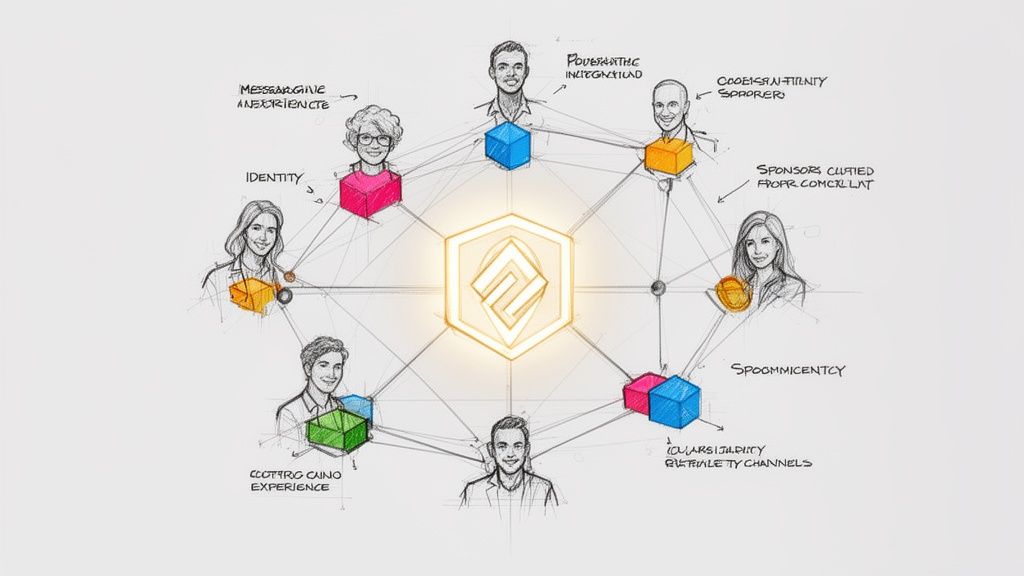
When we talk about branding a community, we're not just talking about picking a logo and a color palette. We're talking about something much deeper: intentionally crafting the identity, the feel, and the shared purpose of a group. It’s about building a unique culture that doesn't just attract members but turns them into passionate advocates.
Done right, a well-branded community becomes the product. It's the reason people show up, stick around, and tell their friends.
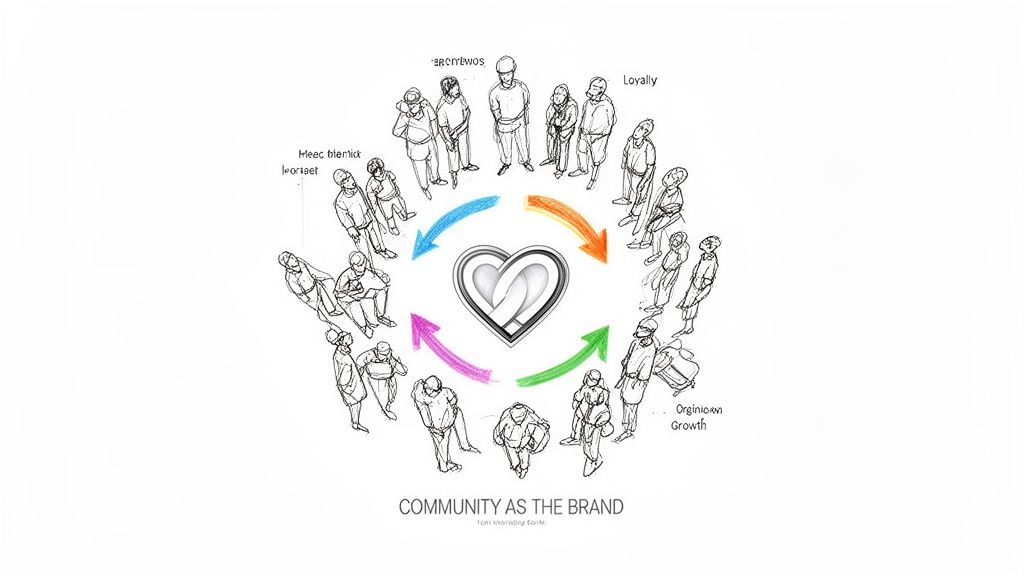
So many organizations fall into the trap of treating their community like just another marketing channel—a captive audience for their next announcement. This completely misses the point. The most powerful professional networks today operate on a simple but profound principle: you don't build a brand for your community; you build the brand through it.
The community is the brand.
Once you make that mental shift, everything changes. The value is no longer just what your organization provides but what the members create together. Their interactions, their shared knowledge, and their collective identity define the brand's worth, fostering a kind of loyalty that no top-down marketing campaign can ever achieve.
Think about a local chamber of commerce. If its "brand" is just a logo and a static mission statement, members are simply passive customers buying a service. But what if the brand is defined by the members' collaborative spirit—the constant stream of referrals, the seasoned veterans mentoring newcomers, and the unified voice championing local business?
Suddenly, the brand is alive. Members aren't just paying dues; they are co-creating the very value they signed up for.
This shift from a passive audience to an active network of advocates shows up in the numbers:
A brand built on community is a self-sustaining engine. Its power comes from the network effect—every new member who buys into the shared identity adds exponential value, creating a powerful moat your competitors can't cross.
Building your brand around your community isn't just a nice idea; it's a massive competitive advantage. The data backs this up. In the UK, 67% of consumers said they are more likely to support brands that actively foster a community, a stat highlighted in the 2026 Community Trends Report. People are craving connection, not just another transaction.
To pull this off, a unified brand identity, consistently applied across every touchpoint, is the glue that holds it all together. This is where a dedicated platform like GroupOS becomes invaluable, giving you a central hub to ensure your brand's look, feel, and voice are always in sync. By truly understanding the benefits of online communities, you can transform a scattered group of individuals into a powerful, cohesive force that drives your mission forward for years to come.
Before we dive into the "how," let's quickly recap the core pillars we'll be building.
This table provides a high-level look at the essential components we'll break down in this guide. Think of it as your strategic roadmap.
| Pillar | Objective | Key Activities |
|---|---|---|
| Purpose & Audience | Define your "why" and "who" to create a strong foundation | Member interviews, persona creation, purpose statement workshop |
| Identity & Messaging | Craft a compelling voice, tone, and story | Value proposition design, personality mapping, core messaging |
| Visuals & Naming | Develop a distinct and memorable visual and verbal identity | Naming brainstorm, logo design, style guide creation |
| Experience Design | Shape the member journey to reinforce brand values | Onboarding flows, event templates, content strategy |
| Integration Strategy | Ensure brand consistency across all platforms and channels | Channel audit, platform setup (e.g., GroupOS), co-branding guidelines |
| Measurement & Iteration | Track performance and evolve the brand based on data | Sentiment analysis, engagement metrics, member feedback loops |
Each of these pillars is a critical piece of the puzzle. Now, let's get into the step-by-step playbook for bringing them to life.
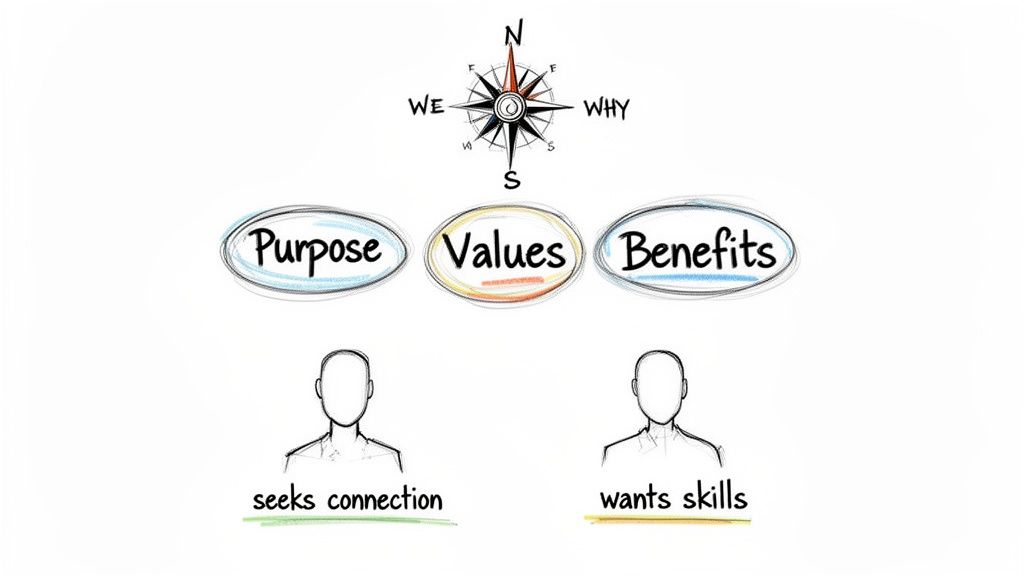
Before you even think about a logo, a color palette, or a clever name, we have to talk about the real starting point of community branding. It all comes down to one powerful question: Why do you exist?
Seriously. A flashy brand without a rock-solid 'why' is like a beautiful house with no foundation. It might look great at first, but it won’t last. This 'why' is your community's core purpose—it's the North Star that guides every single decision you make, from the content you share to the events you plan.
A clear purpose immediately answers the question every potential member is asking themselves: "What’s in it for me, and why should I care?"
This isn’t just some philosophical exercise; it's a strategic must. We're seeing a huge shift where people want to connect with brands that stand for something. In fact, 82% of shoppers globally prefer brands whose values align with their own, and 64% will actively support or avoid a brand based on its social stance. That connection is the entire point of a community, where a shared purpose isn't just a bonus—it's the main product.
Your purpose needs to be captured in a clear, compelling mission statement. Forget the corporate jargon. This is your rallying cry. It should be short enough for a social media bio but powerful enough to get people excited.
A great community mission statement has three core ingredients:
Let’s say you’re building a community for freelance graphic designers. A mission might sound like this: "To empower independent creators (The Who) by providing top-tier resources and collaborative projects (The What) so they can build sustainable, creatively fulfilling careers (The Why)."
Your mission statement isn't just for your website's 'About' page. It’s a tool for decision-making. When a new opportunity pops up, ask: "Does this actually help us achieve our mission?" If not, you have your answer.
Once your 'why' is locked in, you need to get crystal clear on who you're building this for. Demographics like age and location are a starting point, but they don't tell you what really makes people tick. To build a brand that resonates, you need to move from flat data to rich, empathetic member personas.
A member persona is basically a character sketch of your ideal member, built from real data, interviews, and a bit of intuition. It’s about understanding their world.
To build one, start asking better questions:
This process is what makes your brand feel personal instead of generic. You might even discover you need a few different personas to represent the key segments of your audience. If you want to go deeper on this, we've got a whole guide on how to find your tribe and build a thriving community.
With a clear purpose and a deep understanding of your members, you can finally define the core values that will shape your community’s culture. These are the non-negotiables—the principles that guide how everyone interacts.
Are you fiercely collaborative or driven by friendly competition? Is your tone expert and polished, or more experimental and supportive? Pick 3-5 core values that feel genuine. Think things like "Radical Generosity," "Courageous Innovation," or "Unwavering Integrity."
These values all come together in your unique value proposition (UVP). This is your one-sentence promise to every single member, and it’s the ultimate summary of your brand.
It answers the final, critical question: What unique benefit will members get here that they can't find anywhere else? A powerful UVP is the last piece of your brand's foundation, setting the stage for all the design and messaging work to come.
Once you’ve nailed down your community's why, it's time for the fun part: bringing that purpose to life. This is where we move from abstract ideas to the tangible things your members will see, read, and connect with. We're talking about crafting a distinct identity—a look and a voice that feels instantly familiar and welcoming.
Think of it this way: your brand elements are shortcuts to belonging. When a member spots your logo in a sea of emails or reads a post in your signature tone, it should immediately click. That's the feeling we're after.
Your community's name is often its first handshake with a potential member, so it has to count. A great name does more than just sound cool; it should hint at the community's mission, be easy to say and remember, and feel like it truly belongs to the people it serves.
When you're brainstorming, try to push past the most obvious options. Think along these lines:
Once you have a shortlist, do a quick gut check. Say the names out loud. Do they roll off the tongue? And critically, do a quick search to make sure the name and its social handles aren't already taken. Nothing stings more than falling in love with a name you can't have.
Your visual identity is how your members will recognize you at a glance. It's the face of your community, whether it's an icon on a phone screen or a banner at a conference. A truly effective visual system doesn't need to be complicated; it just needs to be consistent.
Think of your logo as your brand's signature. Simplicity is almost always your best friend here. A great logo is distinctive enough to stand out, scalable so it looks just as good on a tiny app icon as it does on a massive banner, and relevant to your community’s personality.
For example, a community for financial advisors might lean towards a clean, geometric logo to signal trust and stability. On the other hand, a community for artists could embrace something more fluid and abstract to reflect creativity.
Colors communicate feelings faster than words ever can. Choosing your brand's color palette isn't about picking your favorites; it’s a strategic choice about the atmosphere you want to create.
Do you want members to feel energized and inspired (think oranges and yellows)? Or calm, focused, and trusting (blues and greens)? A consistent palette is one of the fastest ways to build brand recognition.
The fonts you use say a lot about who you are. A modern, clean sans-serif font like Montserrat can feel fresh and tech-forward, making it a great fit for a software community. In contrast, a classic serif font like Garamond can feel more traditional and prestigious, perfect for an academic or literary group.
The trick is to pick one or two primary fonts and stick with them. Consistency is everything.
Just as crucial as your community's look is its sound. Your brand voice is the personality that comes through in every single interaction—from the welcome email a new member receives to the description of your next big event. Are you the witty, experienced mentor? The super-supportive best friend? The formal, trusted authority?
Defining this requires making deliberate choices. I've found that using a simple spectrum chart is one of the best ways to get this right. It helps you and your team get on the same page by mapping out your personality.
This simple framework can help you turn a vague idea like "we want to be friendly" into a concrete, actionable voice your whole team can use.
| Attribute | Our Voice Is More... | Than... |
|---|---|---|
| Tone | Conversational & Welcoming | Formal & Academic |
| Pacing | Energetic & Quick | Deliberate & Measured |
| Vocabulary | Simple & Accessible | Technical & Jargony |
| Humor | Witty & Clever | Sarcastic & Goofy |
| Perspective | Aspirational & Forward-Looking | Reflective & Historical |
By plotting where you land on each spectrum, you build a clear personality profile. From there, you can define your core messaging pillars—the key themes you'll hit on again and again. For a professional development group, these might be "Skill Mastery," "Career Growth," and "Network Power."
Finally, bundle all these decisions—logo usage, colors, fonts, and voice attributes—into a brand style guide. This isn't about being restrictive; it's about empowering your team. It’s your single source of truth that ensures whether someone is designing a graphic or posting an update in your GroupOS app, the experience always feels like your community.
All that foundational work on your brand’s purpose, identity, and voice? This is where it pays off. Your brand truly comes to life in the day-to-day interactions members have with your community. It’s what they feel when they join, what they see in your newsletter, and what they remember after an event.
This is about moving from abstract ideas to concrete actions. Every single touchpoint is a chance to reinforce your brand's promise and show members they’re in the right place. Let's design an experience that feels intentional, not accidental.
To build a great branded experience, you have to walk in your members' shoes. Think about their entire journey with you, from the moment they first hear your name to the day they become a vocal advocate.
Mapping this out lets you see exactly where you can—and should—be infusing your brand’s personality.
Once you see the full path, you'll spot the gaps and find a ton of opportunities to make every interaction distinctive.
The first 30 days are everything. A clunky or cold onboarding process can instantly kill a new member's enthusiasm. You’re not just checking boxes; you're setting the tone and proving your community is worth their time.
Think about your welcome email series. Is it a dry, system-generated "complete your profile" message? Or is it a warm welcome, written in your brand’s voice and using your visual identity, that guides them toward making their first meaningful connection?
Try framing it around your values. For instance, if collaboration is a core tenet, you might say, "Welcome! The fastest way to tap into the network is by sharing what you're working on. Here’s how to introduce yourself."
Consistency is what builds trust. Your brand needs to be unmistakable in every piece of content you share and every event you host. And no, that doesn't just mean slapping your logo on everything.
It means creating branded templates for your social media posts, presentation decks, and newsletters so everything looks and feels cohesive.
It also means designing your events to reflect your values. If your brand is all about innovation, don't run a boring panel discussion. Host an interactive workshop or a "problem-solving" session that gets people engaged.
Technology plays a huge part here, too. Using a platform like GroupOS lets you create a polished experience from start to finish. Features like sleek QR code check-ins for events eliminate friction and make your community feel modern and professional—a small detail that says a lot about your brand. Thinking through these details is a core part of how you can design a social networking site that feels both exclusive and welcoming.
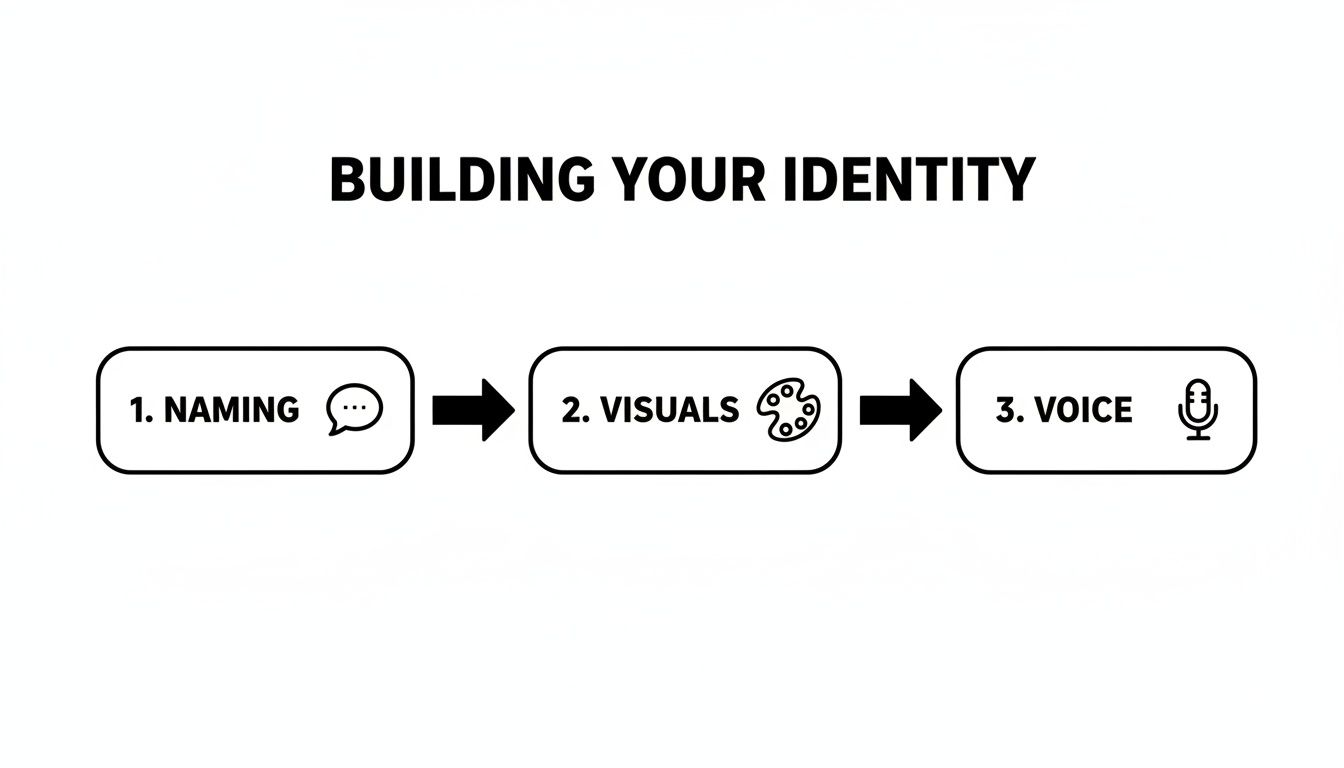
This all stems from the core identity work you did earlier—marrying your name, visuals, and voice into a tangible experience.
Sponsors are essential for many communities, but their presence shouldn't hijack your brand. The key is to find partners who can be integrated authentically, not just slapped on like an advertisement.
Treat sponsors like partners in your mission, not just advertisers. When their brand aligns with your community's values, it feels like a natural fit that adds value for everyone.
Look for ways to weave sponsors into the member experience that feel helpful, not disruptive. For instance, instead of a jarring banner ad, you could feature a sponsor in a dedicated workshop or have them contribute a valuable resource.
Platforms like GroupOS help facilitate this by offering dedicated exhibitor profiles. Here, sponsors can share content, showcase their expertise, and connect directly with members who are genuinely interested. It turns a sponsorship into a valuable resource.
Effective social media community management is also critical for maintaining your brand voice while highlighting partners. By managing these relationships thoughtfully, you protect the member-first feel of your community while delivering real results for your supporters.
A brilliant brand identity is just a concept until it comes to life. If it’s just sitting in a style guide on your computer, it isn’t doing its job. The real work begins when you activate that brand consistently across every single place your members hang out.
This is about creating a cohesive world for your community. Your brand should feel just as authentic in a quick Instagram story as it does in the main forum of your community platform. The goal is to make every touchpoint—from an email newsletter to a live event—feel like a familiar, welcoming part of the same whole.
So, where do you start? The biggest mistake I see is trying to be everywhere at once. That’s a surefire way to spread your team thin and do a mediocre job everywhere. The key is to be everywhere that matters to your members.
Before you launch another social profile, figure out where your people already are.
Think of it as a hub-and-spoke model. Your community platform is the hub, the center of gravity. Social media channels are the spokes, reaching out to engage people and pull them back to the core experience.
A unified platform like this makes sure that no matter how someone discovers you, they land in a space that perfectly captures your brand's look, feel, and mission.
While your core brand voice—your personality—should stay consistent, your tone absolutely needs to adapt. A thoughtful, 2,000-word article that shines on your blog will die a silent death on TikTok. Likewise, the witty, meme-filled tone that crushes it on X (formerly Twitter) might feel jarring in a formal event invitation.
Here’s a quick way to think about it:
This multi-channel approach isn't just a "nice-to-have" anymore; it's essential. Consider that over 200 million brands are active on Instagram alone. Research from We Are Tenet shows that while 74% of people follow brands on social media, their patience is thin. While 77% follow for useful content, a whopping 79% will unfollow if they feel like they’re being spammed with promotions.
The secret to great multi-channel branding isn't just broadcasting your message everywhere. It's about starting genuine conversations in the right places, in the right way.
Here’s the thing: the most powerful brand activation doesn’t come from you. It comes from your members. When they start sharing your brand for you, it's not only authentic—it's the best social proof you could ask for.
Get them involved with a few simple campaigns:
By making it easy and rewarding to participate, you transform your channels from a one-way broadcast into a vibrant, member-driven ecosystem. For a deeper playbook on this, check out our guide on effective social media community management.
Even the most experienced community builders run into tricky questions when it comes to branding. It's natural. These are the conversations that come up time and time again, so let's tackle them head-on with some straight, practical answers.
This is a big one. You've got an established community, but the brand feels stale or misaligned with where you're headed. The number one fear is alienating the very people who built the community with you. So, how do you rebrand without causing an uproar?
You make them part of the process. A rebrand shouldn't be a top-secret project unveiled in a dramatic "big reveal." That's how you lose trust.
When you do it this way, a rebrand stops being a risk and becomes a shared project that actually deepens members' connection to the community.
"What's the ROI on branding?" This question makes a lot of people nervous because branding can feel so subjective. But while you might not be able to draw a direct line from a new color palette to revenue, you can absolutely track metrics that show your brand's health and influence.
A strong community brand doesn't just look good; it actively drives member behavior. The right metrics reveal how deeply your identity is resonating and whether it's translating into a more engaged, loyal, and growing network.
Forget vanity metrics. You need to look at the numbers that reflect true community health:
Tracking these numbers gives you a clear, data-backed picture of whether your branding is just a pretty face or if it's actually doing the heavy lifting to build a thriving community.
Here’s your quick reference for some of the most common community branding questions we hear.
| Question | Short Answer |
|---|---|
| How much should I spend on branding a community? | It depends on your stage. Early on, invest time in workshops with members. Later, you might budget for a professional designer. Align spending with your goals. |
| How do we keep our brand consistent with multiple managers? | Create a simple brand style guide. Even a one-page document covering your logo, colors, and voice acts as a single source of truth for everyone. |
| Is it risky to rebrand an established community? | It can be, but you minimize risk by involving members in the process, communicating transparently, and rolling out changes gradually instead of all at once. |
| How can I measure the ROI of my community brand? | Track metrics that show member behavior: retention rate, engagement levels (discussion, event attendance), user-generated content, and referral rates. |
Hopefully, these quick answers help clear up some of the most pressing concerns as you move forward.
Ready to build a powerful, branded experience for your professional network? With GroupOS, you get an all-in-one platform to manage memberships, host events, and deliver content under your own custom brand. Start your free trial today and see how easy it is to grow your community.