March 28, 2026

Choosing the right platform to sell your online courses can feel overwhelming. If you’re just starting out, a tool like Teachable is a great, simple entry point. For those who need total control over course design, Thinkific offers powerful customization. And if your main goal is marketing, Kajabi packs a serious punch.
But for professional associations and membership-based organizations, the decision is a lot more complex. You need a platform that does more than just host content. You need an all-in-one solution that weaves together courses, memberships, and events, which is where a platform like GroupOS really shines. This guide is designed to help you look past the feature checklists and find a true strategic partner for your organization's growth.

The platform you pick is more than just a tech decision; it's a choice that will shape your revenue streams, member engagement, and overall brand presence. It’s not simply about uploading a few videos and PDFs. The real goal is to build a thriving digital ecosystem that serves your members and hits your business targets. A solid strategy is the first step, and part of that is knowing how to sell online courses effectively before you even pick a tool.
We’re diving deep into a comparison specifically for professional associations, community managers, and businesses that run events. We'll focus on the things that actually matter to you.
For established organizations, the basic course-building features are just table stakes. Your evaluation needs to go deeper. We've found that the most important factors usually boil down to these three areas:
The biggest hurdle we see associations face isn't creating great courses. It's getting those courses to work seamlessly with everything else—events, networking, and day-to-day communication. When your tech is a patchwork of different tools, you end up with confused members and a mountain of administrative work.
It's important to distinguish between a simple course builder and a true all-in-one community platform. A dedicated tool like Teachable is built for one job and does it well, making it perfect for solo creators. But for an organization managing a complete member lifecycle, an integrated platform is almost always the better choice. As you weigh your options, it's worth digging into what defines a great membership site platform, since the core principles are so closely linked to delivering educational content.
To give you a starting point, here is a quick overview of our top picks, highlighting what they do best and who they’re for.
| Platform | Best For | Key Feature |
|---|---|---|
| Teachable | Beginners and solo creators | Simplicity and ease of use |
| Thinkific | Course-centric businesses | Advanced customization and control |
| Kajabi | Entrepreneurs selling multiple digital products | All-in-one marketing and sales tools |
| GroupOS | Associations and event-driven organizations | Unified community, course, and event management |
This table provides a high-level look, but the right choice depends entirely on your specific goals. Are you trying to build a vibrant community, maximize non-dues revenue, or deliver a polished, professionally branded learning experience for your members? The answer will point you to the right system.
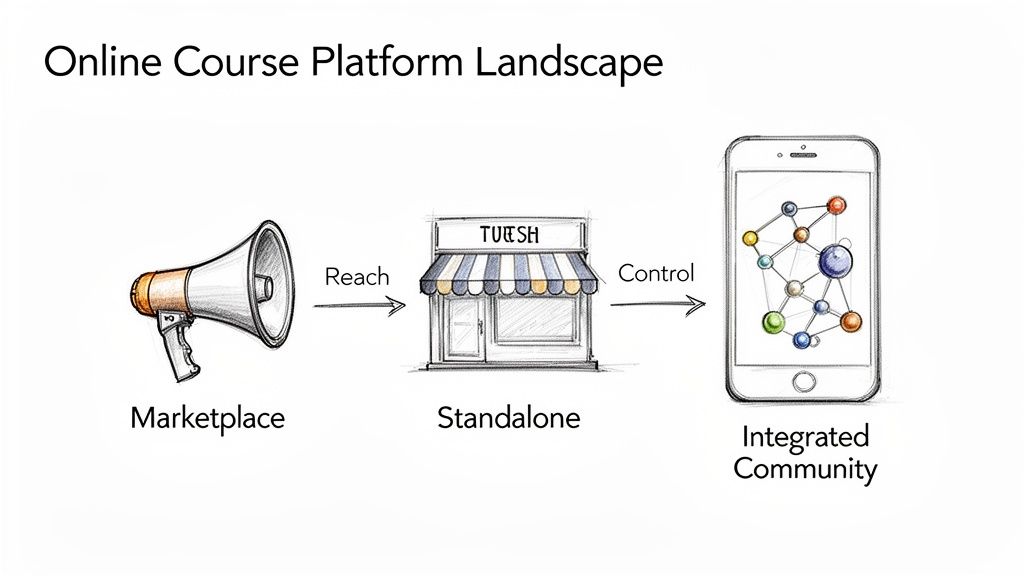
Picking a platform to sell your online courses is a major decision. It’s not just about technology; it’s about strategy. The choice you make will directly impact your revenue, your brand’s reach, and how much control you have over your content and, most importantly, your member relationships.
The market is generally broken down into three types of platforms. Each comes with its own set of trade-offs between reach and control. Getting to grips with these models is the first step in making sure your tech stacks up with your long-term goals for growth and member engagement.
Think of course marketplaces like Udemy or Skillshare as massive digital shopping centers. Your course gets listed on a shelf next to thousands of others, giving you instant access to a huge, built-in audience of people already looking to learn.
This model can be a great launching pad if you're just starting out and don't have an audience of your own. The platform takes care of the marketing and payment processing, which makes publishing your first course pretty straightforward. To give you an idea of the scale, Udemy alone has around 210,000 courses and has reached 67 million learners. That's some serious potential exposure.
But that exposure comes with a price. You give up a lot of control over branding, pricing, and your ability to connect directly with your students. Marketplaces also take a hefty slice of your revenue—often 50% or more. On top of that, course completion rates can be dismally low, sometimes hovering around 12-15%, because of the low-commitment, self-serve nature of the environment. You can find more on these online course creation statistics on autofaceless.ai.
Standalone platforms such as Thinkific and Kajabi flip the script entirely. Instead of listing your course in a crowded market, they give you the tools to build your very own branded online school. This means you get your own website, total control over how your courses look and feel, and you keep all the revenue (minus the standard payment processing fees, of course).
This is the path for organizations and established creators who are serious about building a brand and fostering direct relationships with their members. You own all your student data, which is invaluable for effective marketing and building a loyal community. The flip side? You’re on the hook for all your own marketing and have to drive your own traffic.
Standalone platforms give you autonomy. You're not just a stall in a giant market; you're building your own flagship store. This is a crucial distinction for any organization focused on long-term brand equity and customer lifetime value.
There’s a third model that’s really the next evolution for organizations that need more than just course delivery. Solutions like GroupOS champion this approach by merging courses, memberships, and events into one unified ecosystem. For professional associations and groups that run events, this is a game-changer.
Instead of trying to duct-tape a learning system, a community forum, and an event ticketing tool together, an integrated platform creates a single, seamless home for your members. They can take a course, jump into a discussion, network with their peers, and sign up for an event, all under your brand and on your platform.
This all-in-one approach does wonders for member engagement while dramatically simplifying things on the back end for your team. If your vision is bigger than just being an online course creator platform and you need to manage a complete member experience, an integrated model is almost always the most effective and scalable way forward.
Choosing the right platform to sell your online courses goes way beyond a simple feature checklist. To find the best fit, you really need to understand how each one performs in the real world, especially if you're a professional association, event manager, or membership-based organization.
We’re going to dig into the four platforms that come up most often in these conversations: Teachable, Thinkific, Kajabi, and GroupOS. The goal is to see how they stack up across the five areas that truly matter for your day-to-day operations and long-term growth.
We'll compare them on:
By looking closely at these core functions, you’ll get a much clearer picture of which system actually aligns with how you work.
Before we dive deep, here's a high-level look at how these platforms compare side-by-side. This table provides a quick reference for the features we'll be discussing, especially those critical for professional associations that need more than just a course builder.
| Feature | Teachable | Thinkific | Kajabi | GroupOS |
|---|---|---|---|---|
| Course Delivery | Simple & fast setup | Advanced customization | Integrated with marketing | Community-centric learning |
| Community Management | Basic lesson comments | Basic lesson comments | Simple, separate forum | Native, fully-featured |
| Event Ticketing | Requires 3rd-party tools | Requires 3rd-party tools | Requires 3rd-party tools | Built-in & advanced |
| Monetization Flexibility | Good for course sales | Good for course sales | Best for all-in-one funnels | Best for bundled value |
As you can see, while the first three platforms are strong contenders for selling courses, GroupOS brings a different, more integrated approach to the table, particularly around events and community.
The heart of any learning platform is, of course, its ability to help you build and share your educational content. While they all handle the basics like uploading videos, PDFs, and text, they each have a distinct philosophy on course structure, student engagement, and branding.
Teachable has always been known for its simplicity and speed. Its course builder is incredibly intuitive, with a drag-and-drop interface that lets you get a course online with almost no learning curve. This is perfect for first-timers or small teams who just need to launch something quickly. The trade-off? You sacrifice a lot of customization and design control.
Thinkific, on the other hand, puts that control squarely back in your hands. It offers much more advanced customization, allowing you to create a learning environment that truly feels like an extension of your brand. With more assessment types like assignments and surveys, it gives you better tools to track how well your students are learning. Thinkific is built for organizations that treat their educational content as a polished, professional product.
Thinkific's strength is its robust course-building engine, designed for anyone who needs granular control over the learning experience. In contrast, Teachable is built for speed, helping you launch faster with a simpler, more guided process.
Kajabi positions its course creator as one part of a much larger marketing machine. The course builder itself is perfectly capable, but the platform's real magic lies in connecting that content to sales funnels, email marketing, and landing pages. It’s an excellent fit if you’re selling a whole suite of digital products. However, if you're just focused on creating the best possible course, the tools aren't quite as specialized as what Thinkific offers. For a direct comparison, check out our in-depth analysis in our Kajabi vs. Teachable guide.
GroupOS comes at course delivery from a completely different angle: community first. While it has all the tools you need to build and sell courses, its real power is how it embeds learning directly into a member-focused environment. This is a game-changer for associations where courses are meant to complement an ongoing membership, sparking peer-to-peer discussions right alongside the content.
For most organizations, a course is just one touchpoint in a much larger member journey. The ability to build a genuine community around your content is what keeps people coming back and drives long-term retention.
Here’s where the differences become stark:
If your organization runs webinars, workshops, or annual conferences, you know that event management is a critical function. Unfortunately, with most course platforms, it feels like a clunky afterthought.
Teachable, Thinkific, and Kajabi simply don't have native event ticketing. To sell a ticket to a virtual or in-person event, you’re forced to patch together a solution using third-party tools like Zapier and Eventbrite. This creates a confusing experience for your members and a huge administrative headache for you, with your data scattered across different systems.
GroupOS is the clear winner here, and it’s not even close. It has a powerful, native event management suite built right into the platform. You can:
This integrated approach means your members use a single login to browse courses, register for events, and chat in the community. For any organization where events are a major revenue driver or engagement tool, this unified experience is a massive advantage. It changes the platform from a simple content library into the central hub for everything your organization does.
Let's be clear: there's no single "best" platform for selling online courses. The right choice for a solo entrepreneur would likely frustrate a large professional association, and vice versa. It all comes down to your specific goals, your business model, and who you're serving.
To help you cut through the noise, I’ve broken down my recommendations for four common scenarios. Think of this as moving from a general feature list to a strategic decision that fits your vision. We’ll look at practical use cases to make sure you find a true partner for your work.
Our Recommendation: Teachable
If you're a consultant, expert, or first-time creator, your main goal is to get your knowledge packaged and ready to sell—fast. You can't afford to get stuck in a technical swamp. You need a straight line from idea to income.
That's where Teachable shines. Its interface is arguably the most straightforward on the market. The drag-and-drop course builder is so intuitive that you can have your course structured and ready for content in a matter of hours, not weeks. Built-in payment processing and affiliate tools give you just enough power to get started without creating a steep learning curve. It's the path of least resistance to your first sale.
Our Recommendation: Kajabi
If your business is built around selling a mix of digital products—courses, coaching sessions, ebooks, memberships—then you need more than just a course platform. You need a powerful sales engine. For that, Kajabi is the undisputed leader. It's less of a course tool and more of an all-in-one command center for your entire online business.
Kajabi’s real magic is in its integrated marketing and sales funnels, which they call Pipelines. These are pre-built automation sequences that connect landing pages, email campaigns, and checkout forms into a cohesive customer journey.
While other platforms force you to patch together third-party email providers and page builders, Kajabi has all of this built-in. It’s a closed ecosystem, and that’s its biggest strength. Every piece is designed to work together, which is a massive advantage if you're focused on creating automated, evergreen sales systems.
Our Recommendation: Thinkific
When your courses are the business and you need total control over the student experience, Thinkific gives you the flexibility to build something truly unique. This is the platform for organizations that want to deliver a polished, professionally branded educational product that stands apart from the competition.
Thinkific offers a much more robust toolkit for designing the learning environment itself. You get more fine-grained control over your site's theme, and its assessment options—like assignments and detailed surveys—let you create a richer, more interactive student journey. Its underlying structure is also better suited for complex curricula, making it the go-to for anyone serious about the design and quality of their educational programs.
This decision tree helps visualize where each platform's primary strengths lie, guiding you based on what matters most to you right now.
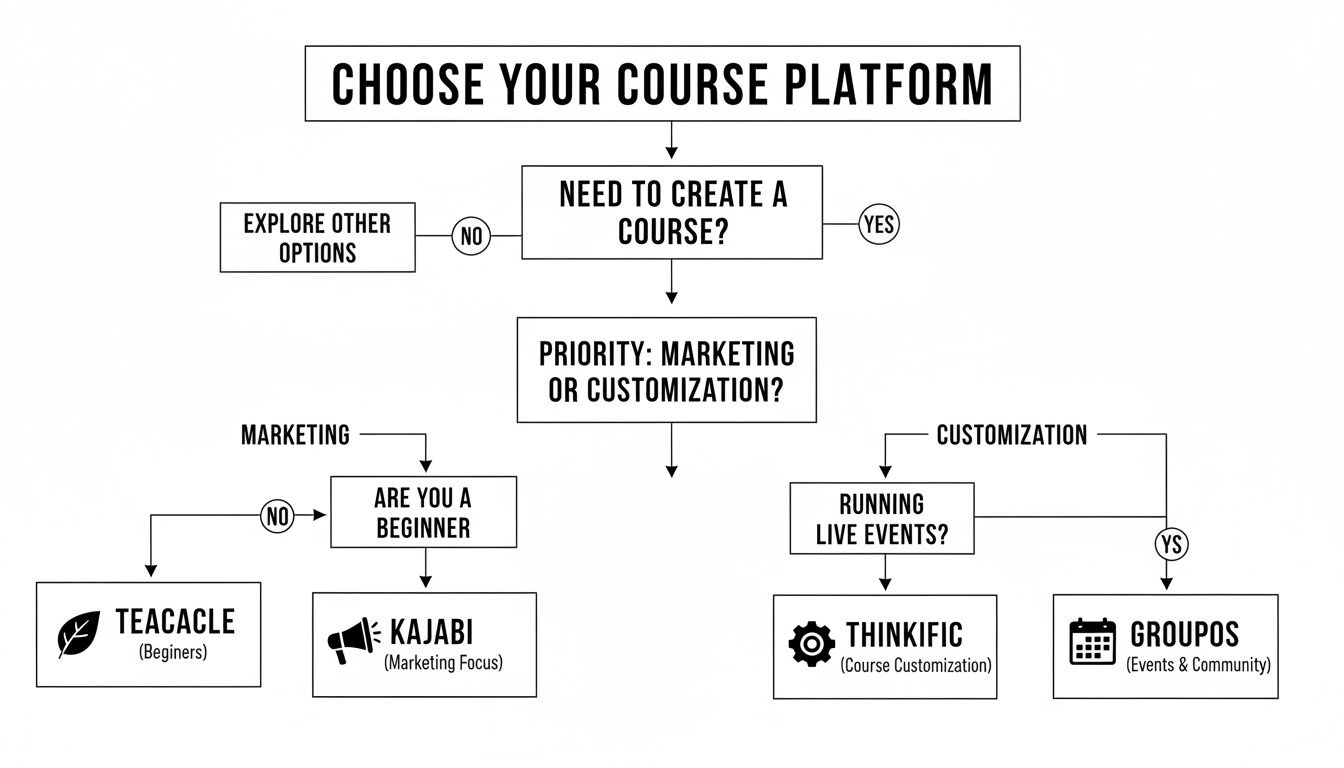
As the flowchart shows, there's a clear fork in the road. Standalone platforms are great at specific jobs, but a truly integrated system like GroupOS is built for a holistic organizational strategy that goes beyond just courses.
Our Recommendation: GroupOS
This is where the conversation shifts entirely. For professional associations, community groups, or any organization where events are a core benefit, your needs are different. You aren't just looking for a place to park course videos; you need a central hub that ties membership, education, and events together.
GroupOS was built from the ground up for this exact purpose. While Teachable, Thinkific, and Kajabi all treat event management as an afterthought that requires clunky add-ons, GroupOS has a powerful, native event management system at its core. This means everything happens in one place.
For any organization managing the entire member lifecycle, this unified approach isn't just a nice-to-have—it's a strategic imperative. It transforms your platform from a simple content library into the true digital home for your community.
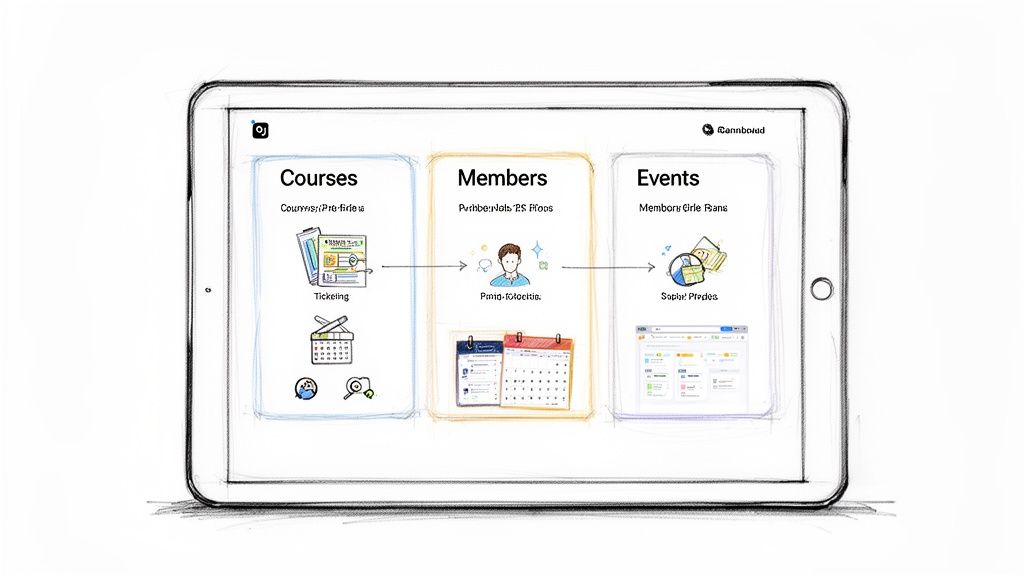
While many of the best platforms for selling online courses are great at delivering content, they simply weren't built for the dynamic world of professional associations and event-focused organizations. These groups do more than just sell courses—they nurture a member's entire journey through engagement, networking, and cornerstone events. Trying to run this on a standard course platform inevitably results in a frustrating, cobbled-together system of disconnected tools.
That’s precisely the gap GroupOS was built to fill. It goes far beyond a typical learning management system by weaving courses, community, and events into one cohesive platform. This isn't just a nice-to-have feature; it’s a fundamental shift that creates a seamless world for your members and radically simplifies life for your administrative team. Instead of juggling different logins for a course portal, a community forum, and an event page, members get a single, central hub for everything.
For any association, member engagement is the ultimate measure of health. A scattered tech stack actively works against you, creating friction points and confusion that drive members away. GroupOS brings everything under one roof, transforming your platform into a true digital headquarters for your community.
This unified design lets you deliver value in ways separate tools just can't match:
The magic of a unified platform is how it turns your digital space from a library of resources into a living, breathing community. When learning, networking, and events all happen in the same place, you'll see engagement and retention climb naturally.
This is where GroupOS really pulls away from the pack. For most course builders, event management is an afterthought, forcing you to use clunky third-party integrations with tools like Eventbrite. This approach splinters your data, complicates your finances, and creates a disjointed registration process for your members.
GroupOS, on the other hand, includes a powerful, native event management suite designed specifically for the needs of associations. You can manage everything from a simple webinar to a complex, multi-day conference without ever leaving the platform.
Key event features include:
Having this native functionality means all your member, course, and event data lives together, giving you a 360-degree view of your community's activity. You can finally see which members are taking which courses, attending which events, and participating in which discussions—all from one dashboard. For a closer look at how this compares to other community-focused tools, our breakdown of Mighty Networks vs GroupOS offers more detail.
This unified model doesn't just make your job easier; it unlocks new ways to package and sell value, boosting non-dues revenue and cementing your organization's status as an indispensable resource in your industry.
Picking the right platform is a big decision. It’s about more than just features and price; it’s about your long-term strategy. To help you navigate the process, we've gathered the most common questions we hear from organizations just like yours.
This is a big one, and it gets to the heart of your business model. Think of a course marketplace like Udemy as a massive digital shopping mall. Your course gets listed right alongside thousands of others, giving you access to their built-in audience.
The trade-off? You lose control. A lot of it. You’re giving up a huge say in your branding, pricing, and, most importantly, your student data. Marketplaces also take a hefty slice of your revenue—often 50% or more. While it might offer some initial exposure, it's incredibly difficult to build a distinct brand or lasting business this way.
A standalone platform, like Thinkific or GroupOS, is completely different. It gives you your own private, branded website. You control the entire member experience, from the look and feel to the pricing and course delivery. For any association or organization serious about building a sustainable community and revenue stream, the standalone model is the only way to go.
They're quickly becoming non-negotiable. While you can technically sell a course without them, integrated community features are what turn a one-time transaction into a long-term, valuable relationship with your members.
Community is what transforms passive learning into an active, engaging experience. Things like discussion forums, direct messaging, and live events create a sense of belonging that has a massive impact on course completion rates and member retention.
For professional associations and membership groups, community isn't just a nice-to-have; it's the entire point. It opens the door for invaluable networking, peer-to-peer support, and natural opportunities to upsell other courses or membership tiers. When you're making your choice, built-in community tools should be a deal-breaker.
Not at all. The best modern course platforms are built specifically for creators and managers, not developers. You absolutely do not need to know how to code to launch a polished, professional-looking course.
These systems are designed with intuitive drag-and-drop course builders, ready-made templates, and clean, straightforward dashboards. The whole point is to let you focus on what you do best—creating great content for your members. While some platforms offer deeper customization for those who do have technical skills, the core functions are accessible to everyone right out of the box.
Yes, and it’s a standard process that leading platforms are well-equipped to handle. They know that organizations grow and needs change, so they've built procedures to make the switch as painless as possible.
Generally, the process looks something like this:
Many providers, including GroupOS, offer dedicated migration support to walk you through each step. They can make sure the transition is seamless for both your team and your members.
Ready to stop juggling disconnected tools and bring your courses, community, and events together? GroupOS offers an all-in-one platform built for organizations like yours. Start a free trial and see how a unified system can transform your member engagement and revenue. Learn more about GroupOS.