March 20, 2026
Trying to run a member-based organization with a patchwork of different tools is like trying to build a house with a random assortment of nuts, bolts, and screws. You might get a structure standing, but it’s going to be wobbly, inefficient, and a constant headache to maintain. That’s the reality for many groups still juggling spreadsheets, email clients, and separate payment apps.
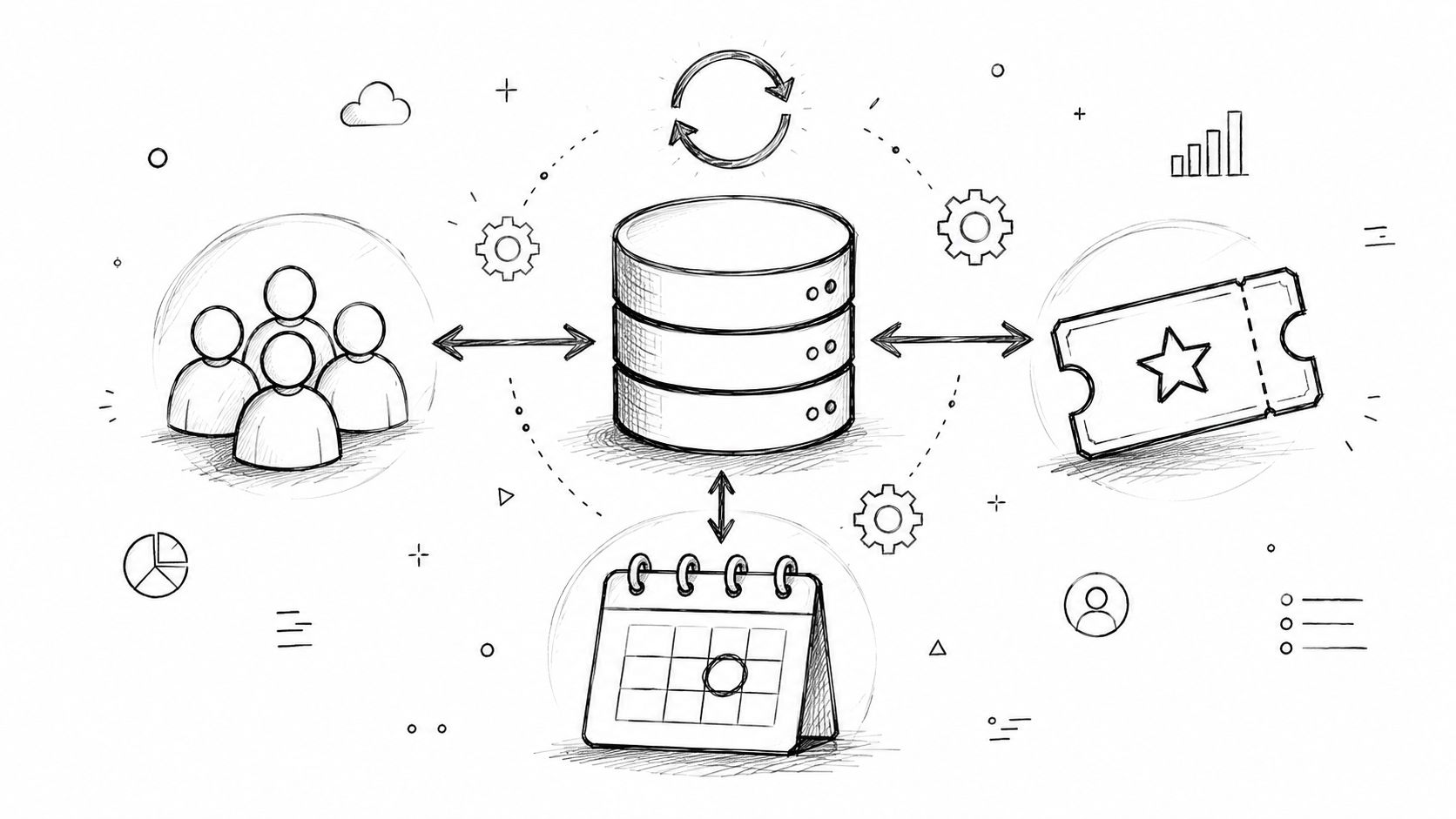
Association management solutions (AMS) are the answer to this chaos. Think of an AMS not as just another piece of software, but as the central nervous system for your entire organization—a single, unified platform where everything and everyone connects.
An AMS is purpose-built for the unique world of associations and professional societies. It’s designed from the ground up to handle complex membership models, event logistics, and member engagement in a way that generic business software just can't match.
Instead of fighting with disconnected systems, you get one source of truth. This shift is fundamental. It frees up your team from tedious administrative work and gives your members a smooth, professional experience. At their core, many of these systems build on the principles of Customer Relationship Management basics, but tailor them specifically for the needs of a community.
The real power of an AMS comes from bringing all your core operations under one roof. When your member database can "talk" to your event registration system, and both can inform your email campaigns, you unlock a whole new level of efficiency and insight.
To make this more concrete, let's look at how an AMS transforms day-to-day tasks.
This table shows a side-by-side look at how tasks are managed with fragmented tools versus a unified association management solution.
| Core Task | Manual Method (Fragmented Tools) | Integrated Solution (AMS) |
|---|---|---|
| Member Renewals | Manually tracking dates in a spreadsheet; sending individual email reminders. | Automated renewal reminders sent based on member data; online payment portal. |
| Event Registration | Using a third-party tool; manually importing attendee data into a separate list. | All-in-one registration, ticketing, and attendee management within the platform. |
| Member Communication | Exporting email lists to a separate marketing tool; no central record of communication. | Integrated messaging, forums, and email campaigns; all activity tracked on member profiles. |
| Financial Tracking | Reconciling payments from different platforms (PayPal, Stripe, bank transfers). | All dues, event fees, and sales are processed and reported in one financial dashboard. |
The difference is clear. One path is filled with manual data entry and a high risk of errors, while the other is automated, connected, and built for growth.
While the name says "association," these platforms are a game-changer for a whole host of member-based groups. From professional societies and trade organizations to clubs and nonprofits, any group struggling to manage its community with scattered tools will feel the benefits almost immediately. If you want to dive deeper, you can learn more about what is association management and see how it applies to different organizations.
Ultimately, an AMS is for leaders who want their teams focused on what really matters: creating value for members and growing the community. It’s about swapping administrative burnout for strategic impact, giving you a solid foundation to build a thriving, engaged organization.
Okay, so you get what association management solutions are in theory. But the real magic happens when you see what they can do. The best way to think about an AMS is as the central operating system for your entire organization. Its power comes from a specific set of features built to handle the tedious work so you can focus on what really matters: your members.
This isn't just a random list of functions. These are the tools that can take an association from a clunky, manual operation to a vibrant, self-sustaining community. Each one is designed to solve a real-world problem, turning administrative headaches into genuine opportunities for connection.
Your members are everything, but let’s be honest—managing their entire journey from prospect to renewal can feel like a full-time job. A solid AMS acts like a digital assistant, automating that whole process.
Instead of hunting through spreadsheets to see who's due for renewal, the system just handles it. It sends out personalized reminders automatically and gives members a simple, secure portal to pay their dues online. That one feature alone is a game-changer. It cuts down on admin time, prevents memberships from accidentally lapsing, and keeps your revenue predictable.
But it goes beyond just renewals. The software creates a living, breathing member directory. People can log in, update their own profiles, and find colleagues based on their location or professional interests. It helps them feel like part of something bigger. For a deeper dive into building that central hub, you can find great advice in guides on membership database software for nonprofits.
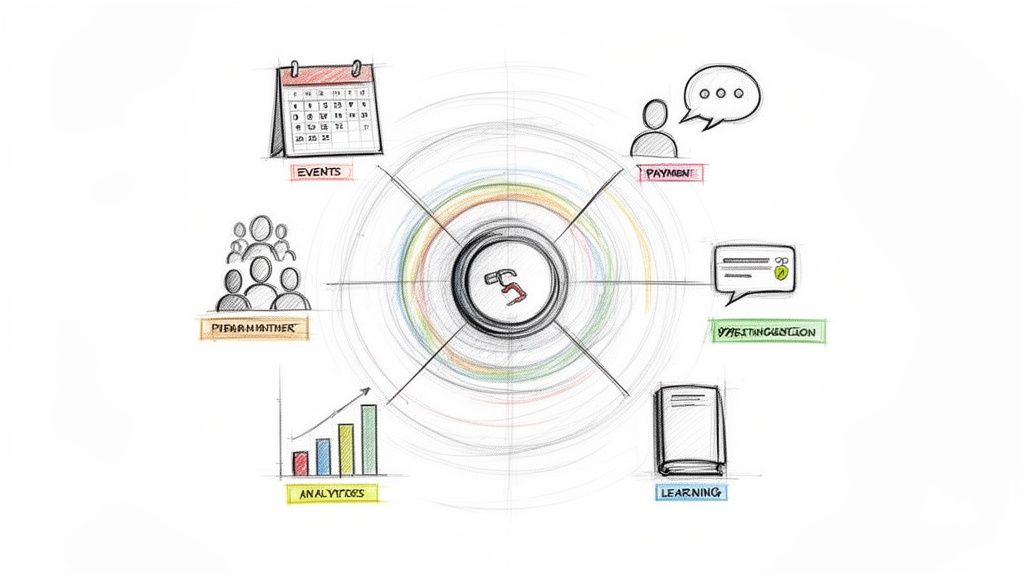
This image shows the shift perfectly—moving from a mess of disconnected tools to one clean, unified solution.
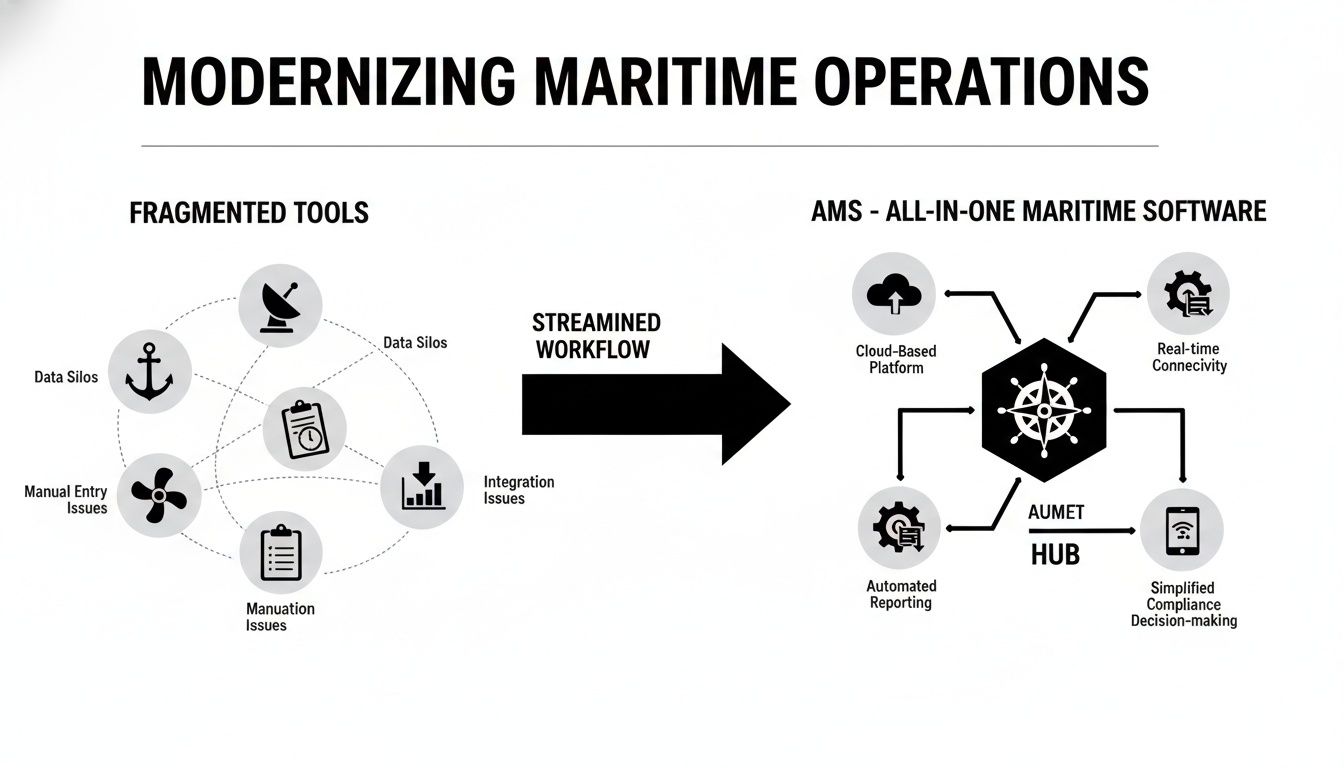
You can see how an AMS organizes the chaos, acting as the central point that connects all of your operational tasks.
Events are the lifeblood of most associations, but the logistics can be an absolute nightmare. A modern AMS comes with event management tools that handle everything from the initial registration page to post-event reporting.
Imagine you’re launching your big annual conference. With an AMS, you can:
For instance, an industry group using GroupOS can run its entire annual trade show right from the platform. They can sell exhibitor booths, manage speaker proposals, and see attendance numbers in real-time. Attendees get a branded mobile app to find their way around, making the whole experience feel seamless.
A great AMS turns event planning from a logistical headache into a strategic way to boost engagement and revenue. It helps you create memorable experiences that your members will keep coming back for.
Your association sits on a goldmine of valuable content—research papers, webinar recordings, training materials, and industry updates. But if that content is buried in email chains or spread across different websites, it loses its impact.
An AMS with a built-in content hub fixes this. It gives you a secure, members-only library where you can organize all your resources so they’re easy to find and access anytime. This doesn't just add value for your members; it opens up new ways to generate revenue through things like paid courses or certification programs.
Having everything in one place protects your intellectual property and cements your association's reputation as the go-to knowledge source in your field. Considering that volunteers often do 20-25% of an association's work, giving them a central resource hub makes their contributions far more effective.
Good communication is what holds a community together. An AMS brings all your scattered communication tools—like a separate email platform, various Slack channels, or disconnected social media groups—under one roof.
This typically includes features like:
When all these conversations happen within your platform, you build a rich history of member engagement. That data is priceless for understanding what your members truly care about, helping you serve them better and ultimately leading to a more active, loyal community.
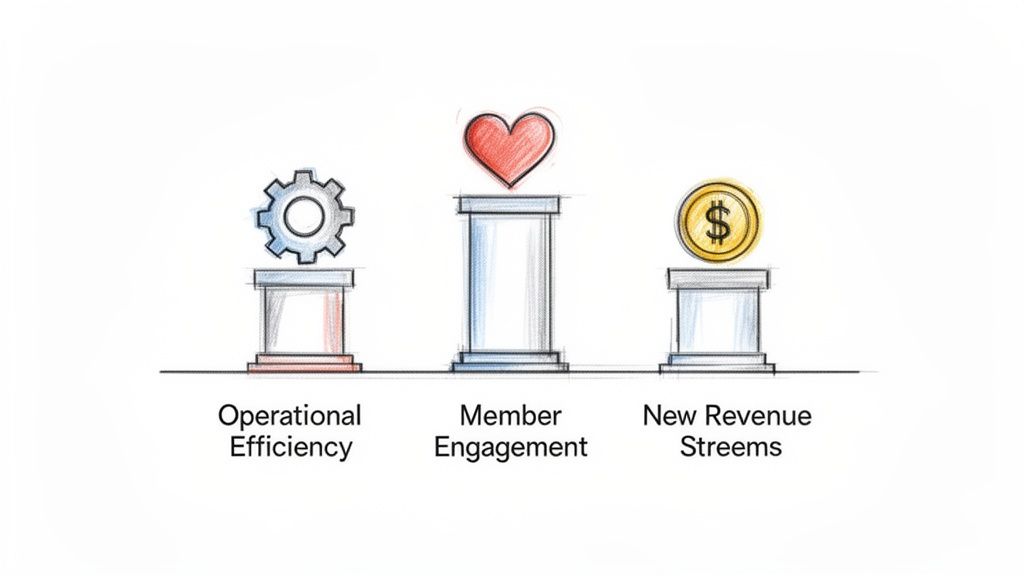
While all the features of association management solutions sound great on paper, their real power is in the concrete results they deliver. Choosing a unified platform isn't just about adding new software—it's a strategic move that directly impacts the health and growth of your association. This investment pays off in three key areas: getting your operations in order, connecting more deeply with members, and opening up new ways to make money.
Think of it as the difference between having a garage full of mismatched hand tools versus a fully integrated, modern workshop. The goal isn't just to own shinier equipment; it's to build better things, faster, and with far less frustration. That’s exactly what a great AMS does for your association.
Right away, the biggest win you’ll see is a massive reduction in administrative grunt work. Those repetitive, manual tasks that eat up your team's day can be automated, freeing them to focus on what really matters—like member outreach and strategic planning.
Just think about the daily grind of running an association with disconnected systems. Staff often get stuck manually processing payments, updating member lists in five different spreadsheets, or sending out renewal reminders one by one. An AMS flips that script.
By automating these core functions, we've seen organizations cut their administrative workload by as much as 50%. This isn't just about saving time; it's about boosting your team's capacity and morale.
When your team is no longer buried in paperwork, they can dedicate their energy to creating better member experiences and driving the organization's mission forward.
Let's be honest: a clunky, scattered tech stack creates a disjointed and frustrating experience for members. A unified AMS, on the other hand, gives them a seamless and professional way to interact with your organization and each other. That has a direct line to member satisfaction and retention.
Personalization suddenly becomes easy when all your data is connected. You can segment your audience and send them content that actually matters based on their membership level, interests, or past event attendance. It’s a simple way to show members you’re paying attention.
The demand for this kind of integrated experience is exploding. North America is currently leading the way, accounting for 36.75% of a global market projected to reach $2,633.6 million by the end of 2025. This growth is fueled by organizations realizing they need better tools to manage and engage their members. You can dig into more data on the association management software market and its impressive growth.
Perhaps the most exciting benefit is how a modern AMS can turn what was once a cost center into a powerful engine for growth. By bringing all your operations under one roof, you unlock new opportunities to generate revenue that go far beyond standard membership dues.
A flexible platform gives you the freedom to experiment with different offerings and business models.
This is how your association management solutions become more than just an operational tool—they become a strategic asset for financial growth. It gives you the power to build a more resilient and diversified revenue model, helping your organization thrive no matter what the economy throws at it.
Picking the right platform from a sea of association management solutions can feel like a monumental task. When you’re staring at dozens of options, it's easy to get lost in feature lists and slick sales pitches. But this decision is a big one—the right system can put your growth on the fast track, while the wrong one can become a daily source of frustration.
Think of it like hiring a new executive director. You wouldn't just glance at their resume and make a call. You’d dig deep, asking tough questions about their experience, their vision for the future, and how they’d adapt to new challenges. You need to bring that exact same critical eye to evaluating software. Let’s walk through a clear framework to help you make a choice you can feel good about.
The very first question you should ask is: will this platform grow with us? A solution that seems perfect for your needs today might feel like a straitjacket in two years. If the pandemic taught us anything, it’s that we can't predict what's around the corner. Your technology has to be agile enough to pivot when you do.
Look for a solution that can handle new demands without requiring a complete, and costly, overhaul. Can you easily add custom data fields for a new member survey? What about creating new membership tiers or bolting on a new tool next year? For example, GroupOS was built specifically to scale, allowing you to add features like exhibitor management or advanced event ticketing as your needs evolve. This ensures your platform is always a perfect fit, not something you're constantly outgrowing.
Choosing an AMS is a long-term commitment. Don't just solve today's problems—invest in a platform that provides a clear path for your association's future success and can adapt to new member needs.
Remember, your new software has two very different sets of users: your administrative team and your members. A system can have all the bells and whistles in the world, but if it’s a pain to use, nobody will. We all expect simple, intuitive digital experiences in our daily lives, and your AMS shouldn't be the exception.
Your staff needs to manage their day-to-day tasks without calling for tech support every five minutes. At the same time, your members should find it effortless to do things like renew their dues, sign up for an event, or access exclusive content. A clunky, confusing interface reflects poorly on your entire brand. When you're evaluating options, insist on a demo where you can click through the platform yourself—both as an admin and from a member’s point of view.
No software lives on an island. Your association management solution has to play nicely with the other tools you depend on, whether that's your accounting software, email platform, or virtual event host. When systems are siloed, you end up with data black holes and massive inefficiencies. Smooth integration isn't a "nice-to-have" anymore; it's a must.
A modern AMS should offer an open API or, even better, have pre-built integrations with the software you already use. This includes things like:
This kind of connectivity is what gives you that coveted 360-degree view of your members, which is absolutely critical for making smart, data-driven decisions. If you want to get a feel for what the market offers, browsing a list of the best membership management software solutions can give you great insight into today’s leading features.
Finally, always remember that you aren't just buying a piece of software; you're starting a long-term relationship. The quality of support, training, and strategic advice you get from a provider is just as important as the technology itself. You need a partner who genuinely understands the association world and is invested in helping you succeed.
When you're talking to potential vendors, really press them on their support model. Is comprehensive training part of the package? What’s the average response time for a help desk ticket? A company like GroupOS, which provides custom setup and has a dedicated support team, essentially becomes an extension of your own team. That kind of partnership is what helps you get the most value out of your investment from day one. To get a better handle on all your options, take a look at our guide on the different types of membership software for associations.
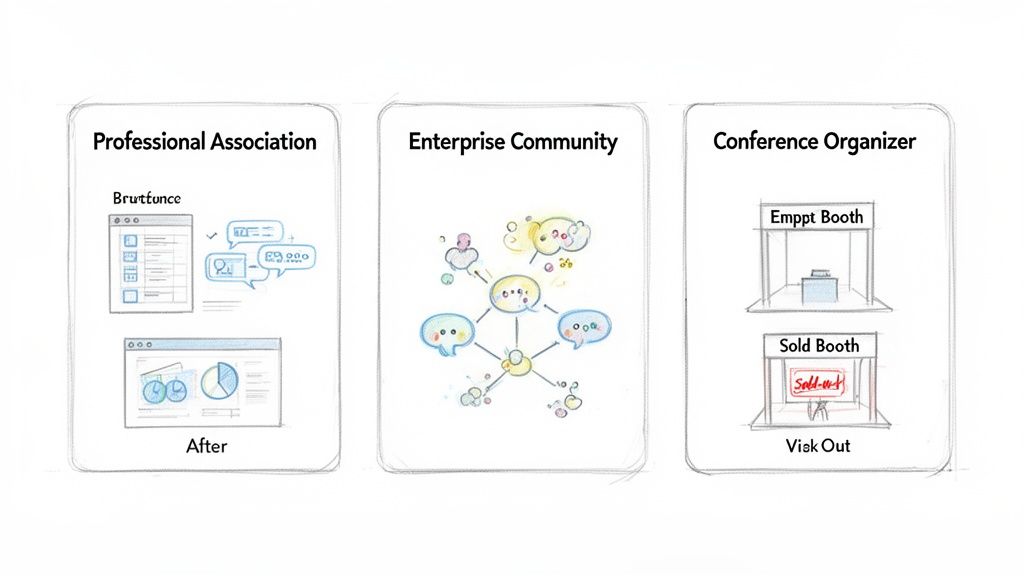
Features on a product page are one thing, but seeing how a tool actually solves real-world problems is where the value truly clicks. Let's step away from the abstract and look at what happens when organizations finally ditch their fragmented systems.
These stories show how different groups, each facing a unique but common challenge, used an integrated platform like GroupOS to get real results. Whether it was boosting event attendance or finally proving sponsor value, the right technology made all the difference.
A national professional association was drowning in spreadsheets. Can you picture it? Membership data lived in one file, event registrations were in another, and their email lists were managed through a totally separate client. This manual, tangled process wasn't just a headache—it was costing them.
The admin team would spend weeks just trying to figure out which members had registered for their annual conference. Their marketing was generic, and the sign-up process was a pain for members. They knew they were leaving engagement—and money—on the table.
Once they moved to GroupOS, all those jobs were pulled into a single dashboard. The change was almost immediate.
The outcome? The association saw a 25% increase in event registrations for their very next conference. It wasn't just a financial win; it was proof that a better member experience leads directly to more participation.
A large tech company had a different puzzle to solve. They had thousands of talented software developers spread across the globe, but collaboration was stuck in silos. People mostly talked to others in their own regional office, using a random mix of chat tools. This disconnect made it tough to share knowledge or feel like part of a unified team.
Their goal was to create a central home where developers could connect, share code, and learn from each other, no matter the time zone. They needed more than a simple forum; they needed a dedicated community platform that felt like a natural part of their company.
Using GroupOS, they built a private, branded community hub just for their developers. The platform gave them the structure they needed to finally connect everyone.
This shift turned their internal community from a scattered collection of individuals into a powerful, collaborative network. It boosted innovation and made their global company culture feel much more connected. It’s a great example of why association management solutions are now being used by corporations to build their internal communities. To learn more, take a look at our guide on event management for associations, which covers how to create these kinds of engaging experiences.
For an annual conference organizer, locking in high-value sponsorships was getting tougher every year. Sponsors wanted more than a logo on a banner; they were asking for hard data on their return on investment (ROI). They needed to see proof that their marketing dollars were actually generating leads. The organizer’s old system simply couldn't track this, putting future funding at risk.
They needed a way to manage the conference and deliver real, measurable value to their partners. By using the exhibitor and sponsor features within GroupOS, they created a whole new value proposition.
Sponsors were given dedicated digital profiles where they could:
This gave sponsors a direct line to the audience and, just as importantly, gave the organizer solid data to report back. They could show sponsors exact numbers on profile views, content downloads, and leads generated. This clear ROI made renewing a no-brainer for sponsors, many of whom invested even more the following year, securing the conference's financial health.
If you're running a member-based organization, you've probably felt the ground shifting. The old playbook of simple email blasts and a static member directory just doesn't cut it anymore. What lies ahead isn't just a minor update—it's a fundamental change in how we build and sustain communities, driven by personalization, on-the-go access, and smart data.
This isn't just a gut feeling; the numbers tell the same story. The entire association management solutions market is projected to swell from USD 2.66 billion in 2026 to an incredible USD 4.35 billion by 2031. That kind of growth happens when an entire industry realizes it needs a new generation of tools to survive and thrive. You can dig into the specifics and see the full association management software market forecast.
So, what’s driving this change? A few powerful trends are already taking shape.
First, artificial intelligence (AI) is finally becoming a practical reality for associations. Soon, AI won't just be a buzzword; it'll be the engine that creates a unique experience for every single member. Imagine your platform automatically suggesting the perfect networking connection, an article they can't miss, or a breakout session based on their actual activity. That’s how you make each member feel seen.
Next, a mobile-first community experience is no longer a "nice-to-have." Your members live on their phones, and they expect their professional communities to be there, too. They want to connect, register for events, and join discussions from anywhere.
The most successful associations will meet their members where they are. This means providing a seamless, branded mobile app that puts the entire community in their pocket.
Finally, we're seeing the lines blur between hybrid events and data analytics. It's not enough to just host a hybrid meeting; you need a platform that can manage the logistics for both virtual and in-person attendees and turn all that engagement data into clear, actionable insights.
This is precisely the future that a platform like GroupOS is designed for. With powerful analytics and custom mobile apps at its core, it’s built to be a strategic partner for growth, not just a database for today. By getting ahead of these trends, your organization won't just be ready for 2026—it will be leading the way.
Thinking about switching to a dedicated association management solution? It's a big step, and it's completely normal to have questions swirling around. We hear a lot of the same concerns from association leaders about cost, the setup process, and whether a new system will even work with their current website.
Let's clear the air and tackle some of the most common questions head-on. Our goal is to give you the straightforward answers you need to feel confident about finding the right fit for your organization.
This is probably the most common worry we encounter, and for good reason. No one wants to get bogged down in a months-long tech project. The good news is that modern platforms have completely changed the game.
While the exact timeline will always depend on the size and complexity of your group, you shouldn't have to wait ages to get up and running. Platforms like GroupOS, for example, are built for a quick launch. With a team dedicated to helping you migrate member data and personalize your setup, many organizations are live in just a few weeks, not months. The key is finding a partner who is invested in a smooth handoff, not one that just sells you software and walks away.
Absolutely. In fact, it must. A good AMS shouldn't be another island of data your team has to manage. It should be the hub that connects everything, especially your website and other tools you rely on, like Slack or your social media accounts.
Think of it this way: your website is your public-facing storefront, and the AMS is the smart, organized back office that powers it. This integration ensures your members have a seamless experience under your brand, without the headache of different logins or clashing designs.
A quality platform is designed to enhance your digital home, not force you to rebuild it from scratch.
Yes, they are now. The days of needing a massive, six-figure budget for an all-in-one system are long gone. The industry has shifted dramatically toward a subscription-as-a-service (SaaS) model.
This pay-as-you-go approach completely removes the barrier of a huge upfront investment. It makes powerful, enterprise-level tools accessible to associations and nonprofits of any size. You can start with a plan that fits your current needs and budget, and then scale up your features as your community grows. It’s a far more flexible and cost-effective way to operate.
Ready to see how an all-in-one platform can transform your organization? GroupOS offers a unified solution to streamline memberships, events, and communication, all under your own brand. Start your free trial today and experience the difference.