June 1, 2026

On a campaign review call, a community team once showed me three promotions for the same event. The emails were polished, the landing page looked fine, and almost none of the copy gave people a reason to act now.
That's the pattern behind a lot of underperforming community marketing. The problem usually isn't effort. It's unresolved tension. You announce a conference, invite members to renew, or launch a new content hub, but the message stays flat. It informs without pushing the reader from mild interest to a clear decision.
A useful way to think about this is speed of resolution. The Anglo-Zanzibar War, often cited as the shortest war in recorded history, lasted from 9:02 a.m. to 9:40 a.m., just 38 minutes. Marketers use that kind of historical example because it captures a truth about persuasion. Problems that are confronted directly move people. Problems left vague sit there.
Community managers deal with the opposite every day. Registration pages that list agenda items but never surface the cost of missing the event. Renewal reminders that mention a due date but ignore the disruption of losing access, visibility, or momentum. Content hubs full of strong material that still feel optional because nobody has framed why scattered resources create friction in the first place.
That's where agitate and solve earns its place. It gives structure to what good operators already know. Name the problem plainly. Make the consequence feel real. Then offer a clean next step.
If your audience is tired of generic promotion, it helps to study how other teams think about addressing content marketing noise before they write a single CTA. The same principle applies inside communities too. People don't join or renew because you published more words. They act because the message reflected their situation with enough precision to feel useful.
For association and network teams, this is especially important when growth depends on fit, not just reach. A healthy community starts with the right people seeing themselves in the problem you describe, which is why the idea of finding your tribe in a more intentional way matters before any campaign goes live.
Practical rule: If your copy can swap in any audience and still make sense, you haven't identified a real problem yet.
Agitate and solve is the plain-English version of Problem-Agitate-Solve, or PAS. It's a long-established marketing structure that was formalized and popularized in the digital marketing era as a three-step pattern: identify the problem, intensify the pain, then present the solution, as described in this PAS framework overview.
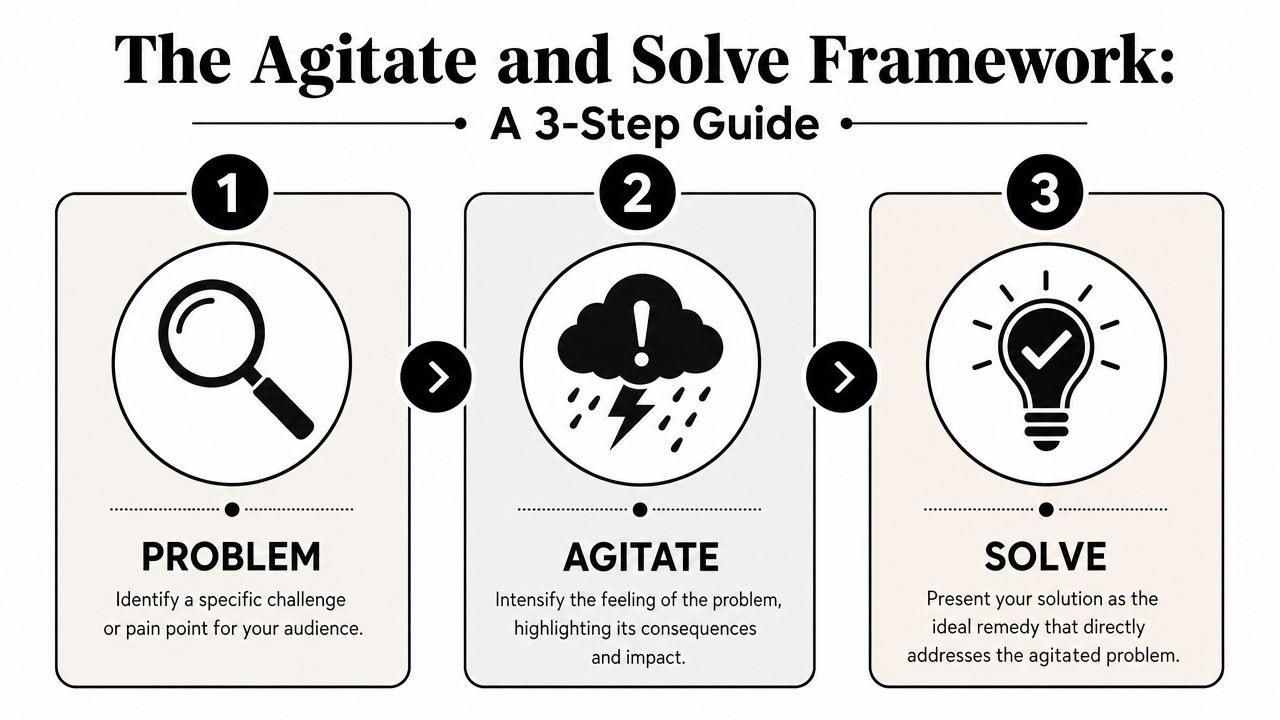
Most weak copy starts too broadly. It says things like “engage with your peers” or “don't miss this opportunity.” That sounds familiar because everyone writes it. It also gives the reader nothing specific to recognize.
A strong problem statement sounds more like this:
The job here is precision, not drama.
This is the part many teams either skip or overdo. If they skip it, the message has no urgency. If they overdo it, the copy starts sounding manipulative.
The best agitation stays close to the actual consequence. For a conference, that might be missed networking, fragmented follow-up, or another quarter of learning from disconnected webinars instead of one focused experience. For a membership renewal, it might be interruption, lost continuity, and the annoyance of rebuilding momentum later.
Consider a doctor's visit. First, the doctor identifies the issue. Then they explain what happens if you ignore it. Only after that does the prescription feel necessary.
Many marketers dump features. That's a mistake. The solve should read like relief, not a brochure.
A good solve answers the exact pain you just described:
| Stage | Weak version | Strong version |
|---|---|---|
| Problem | “Join our event” | “You keep putting off registration until the event feels distant and optional.” |
| Agitate | “Seats are limited” | “When registration stays on your to-do list, you lose the chance to plan, invite colleagues, and commit time on your calendar.” |
| Solve | “Buy tickets now” | “Register now so your spot, schedule, and follow-up plan are handled in one decision.” |
Good PAS copy doesn't invent pain. It sharpens pain your audience already feels but hasn't fully named.
PAS works because it follows a familiar decision path. The writer states a specific problem, intensifies the consequences of leaving it unresolved, and then presents the remedy as the logical next step. That movement from recognition to urgency to action is the core of the framework's effectiveness, as explained in this discussion of PAS as a persuasion model.
Community audiences rarely need more information. They usually need clearer stakes.
A prospect already knows your annual summit exists. A member already knows renewal season is approaching. A lurker in your platform already knows the content hub is there. What they often haven't done is connect inaction to a concrete downside. PAS closes that gap.
That's why “early registration is open” underperforms compared with “if you wait, the event stays abstract and never gets protected on your calendar.” One statement informs. The other creates tension.
Unresolved tasks bother people more than many marketers account for. Community participation is full of half-decisions:
Each one stays mentally open. Agitation works when it highlights the cost of leaving that loop open. You don't need theatrics. You need the reader to see what delay keeps breaking.
For example, a content message might say members want useful discussion, but scattered posts and buried links make it harder to come back consistently. That's a much stronger trigger than “check out our latest resources.” If you're improving your editorial rhythm too, this guide on creating engaging content for communities complements the same psychology from the content side.
The strongest PAS copy feels understood, not pressured. It reflects the reader's situation in language they'd use themselves.
That matters in community marketing because you're not trying to win a one-time impulse purchase. You're trying to build repeated participation. The tone has to carry urgency without sounding like you're cornering the audience.
A reliable test is simple:
The agitation phase should make the audience feel seen before it asks them to act.
More creativity isn't the primary need here. A cleaner drafting process is.
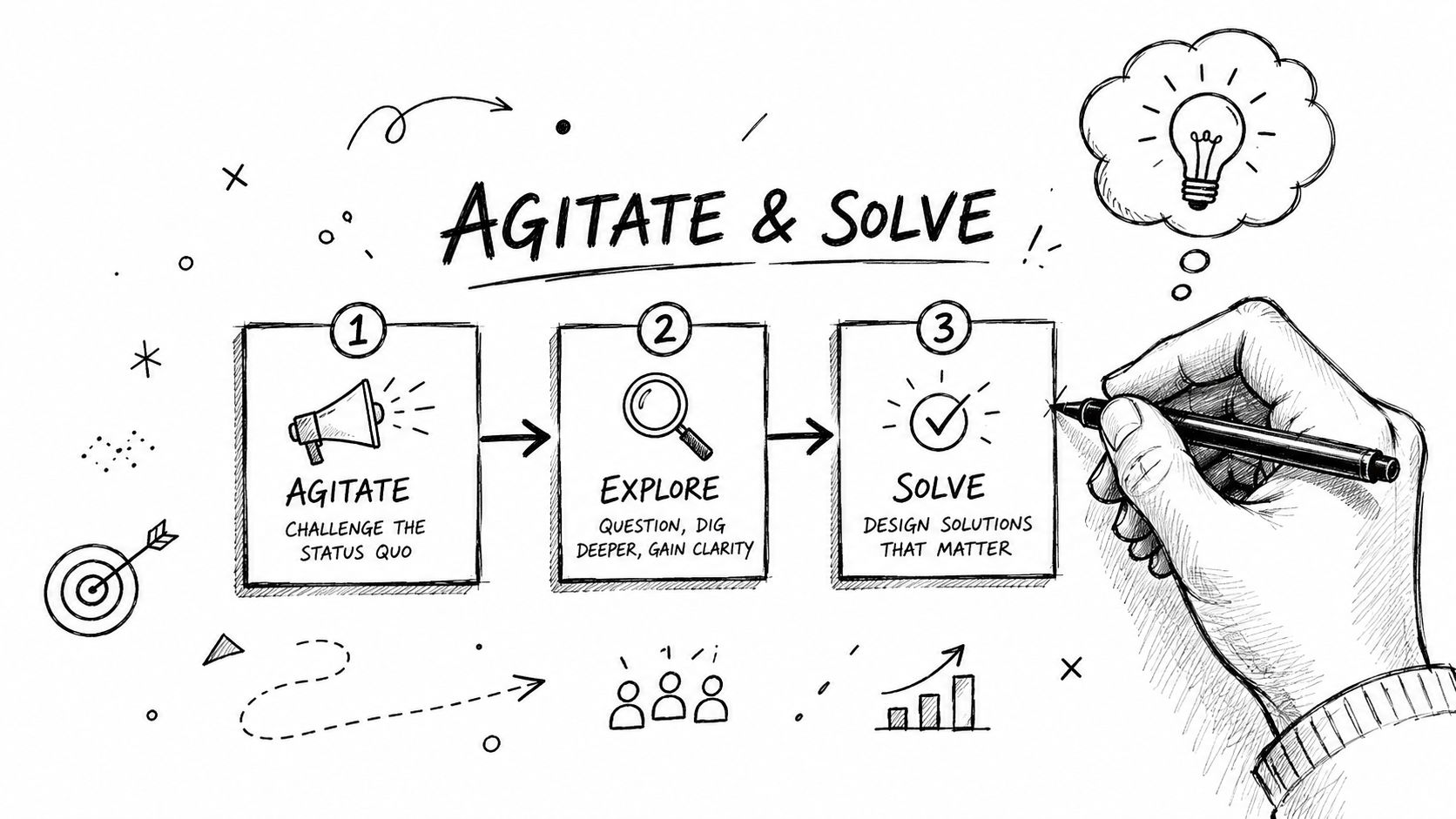
Choose one audience segment and one blockage. Not “members aren't engaged.” That's too broad. Pick the exact friction.
Try prompts like these:
If you answer with a list, keep reducing until one issue stands out.
A lot of community copy fails because it tries to cover every reason someone might care. PAS works better when it narrows the message. One email can address “I haven't made time to register.” Another can address “I'm not sure the event will be worth it.” Don't force both into the same draft.
Expert guidance on PAS recommends brief problem framing followed by focused agitation, not repetitive fear language, because the goal is urgency without reader fatigue. That same guidance also notes that practical implementations often pair the solution with proof elements such as testimonials or other validation to improve credibility, as covered in this PAS copywriting formula reference.
Here's the operational version of that advice:
A bad agitation paragraph sounds inflated. A good one sounds like an experienced manager describing what happens.
Field note: If you can replace your agitation paragraph with “this is inconvenient” and lose nothing, the copy isn't specific enough.
Now give the reader a next step that clearly removes the friction. In doing so, translate your offer into outcome language.
Instead of:
Write:
That shift matters because readers don't buy components. They buy less friction.
A helpful related skill is making the message itself easier to pass along inside the community. This article on how to make a post shareable is useful if your campaign depends on members forwarding, reposting, or echoing your message.
Use this mini-workflow when drafting:
| Draft step | Question to answer |
|---|---|
| Problem | What exact friction does this audience recognize immediately? |
| Agitate | What happens if they keep postponing or ignoring it? |
| Solve | What next action feels like relief, not pressure? |
This walkthrough is a good visual companion if you want to see the framework explained in a more tutorial-style format.
The easiest way to learn agitate and solve is to stop describing it and start using it. Below are working templates for the three jobs community teams handle constantly: event registrations, membership renewals, and platform engagement.
Before the table, one tactical note. If your promotion includes audio, interviews, or guest appearances, your CTA language matters as much there as it does on email and landing pages. This resource on Fame for podcast guesting tips is worth reviewing because spoken calls to action often fail for the same reason written ones do. They ask without first sharpening the need.
| Scenario | Problem | Agitate | Solve (with GroupOS) |
|---|---|---|---|
| Virtual conference promotion | You have interested prospects, but many haven't committed. The event still feels like something they can decide on later. | When people delay registration, they don't block time on the calendar, invite teammates, or choose the sessions that matter most. Interest stays passive, and the event competes with every other deadline that week. | Use copy that ties action to clarity and commitment: “Register now so your place, schedule, and event access are handled in one step.” Then connect that message to GroupOS features such as dynamic ticketing, custom registration forms, VIP upgrades, and QR-based event operations so the sign-up experience feels organized from the first click. |
| Annual membership renewal | Existing members value the community, but renewal notices often sound administrative instead of essential. | Once renewal slips, routine breaks fast. Members lose continuity, stop checking updates, and disengage from the relationships and resources they were using. Rejoining later feels like starting over instead of staying in motion. | Frame renewal as continuity: “Renew now to keep your access, conversations, and member benefits uninterrupted.” Support that promise with GroupOS capabilities like flexible subscription plans, engagement tracking, personalized profiles, and member management in one place. |
| Content hub engagement | Members know resources exist, but they're spread across too many channels and easy to forget. | When content lives in scattered threads, inboxes, and one-off posts, members stop looking for it. Useful material gets buried, discussion fragments, and your best work feels invisible right after you publish it. | Position the hub as one reliable destination: “Log in to find the discussion, documents, and on-demand content in one place.” Tie the copy to GroupOS tools for centralized content delivery, courses, video, private channels, group chats, and branded web and mobile access. |
Use this when people know the event exists but haven't taken action.
You've probably already looked at the agenda and thought, “I should register this week.”
The problem is that events you mean to attend often stay unconfirmed until work fills the gap. Then the sessions you wanted to join, the people you meant to meet, and the follow-up you hoped to get all become another missed opportunity.
Register now so your place is locked in and the event is on your calendar, not just on your list.
This works well when you want urgency without sounding transactional.
Use this for a platform announcement, pinned post, or weekly digest.
The main thing that makes these templates work is alignment. The problem has to match the actual barrier. The agitation has to reflect a genuine consequence. The solve has to remove the exact friction you raised.
PAS is powerful, but it isn't the default answer for every message.
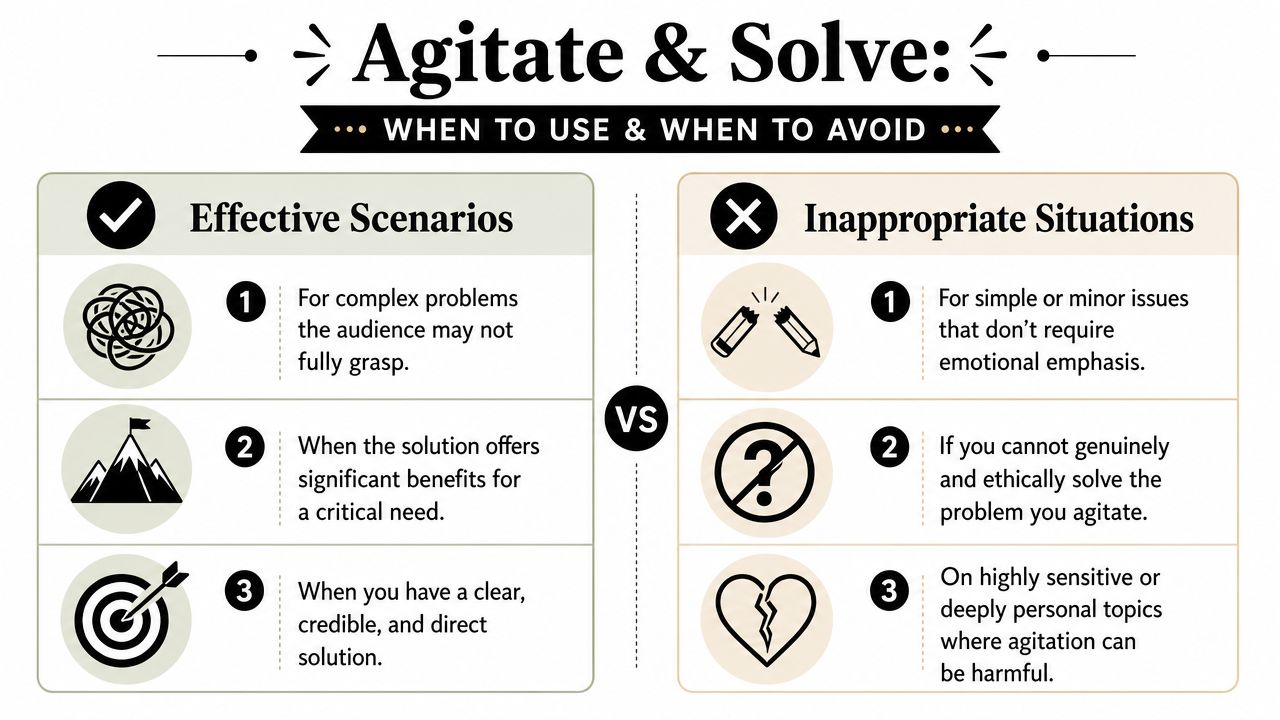
If someone barely knows your organization, heavy agitation can feel abrupt. They haven't earned enough context to exhibit genuine care for the problem yet.
For top-of-funnel brand awareness, AIDA often fits better. You need attention and interest first. If you jump straight into pain, you risk sounding intense before trust exists.
Support content has a different job. A help article should reduce anxiety, not heighten it.
If a member is already trying to reset a password, access an invoice, or find a session recording, they don't need a mini persuasion sequence. They need clean instructions. In that context, clear procedural writing beats agitate and solve every time.
Not every issue deserves emotional emphasis. If the message is “we updated the event badge design” or “we added a new profile field,” PAS is usually too heavy.
A simple Features-Advantages-Benefits structure works better for these updates:
| Use case | Better framework | Why it fits |
|---|---|---|
| New feature announcement | FAB | The reader mainly needs utility and benefit |
| Broad awareness campaign | AIDA | The audience may not feel the pain yet |
| Sensitive member communication | Direct empathy-first copy | Agitation can feel inappropriate |
This is the line too many teams cross. They write strong agitation because it converts attention, but the offer doesn't resolve the issue raised.
That creates two problems. First, the copy underperforms after the click because the landing page doesn't cash the check the headline wrote. Second, trust erodes. In community-led organizations, that damage lasts longer than a bad campaign.
A practical discipline is simple A/B testing. Run PAS against a direct, benefit-led version. Don't assume the more emotionally charged message will win. In mature communities, a calm, specific, credibility-heavy message often performs better than a dramatic one because the relationship is already established.
If the audience already trusts you, clarity can beat intensity.
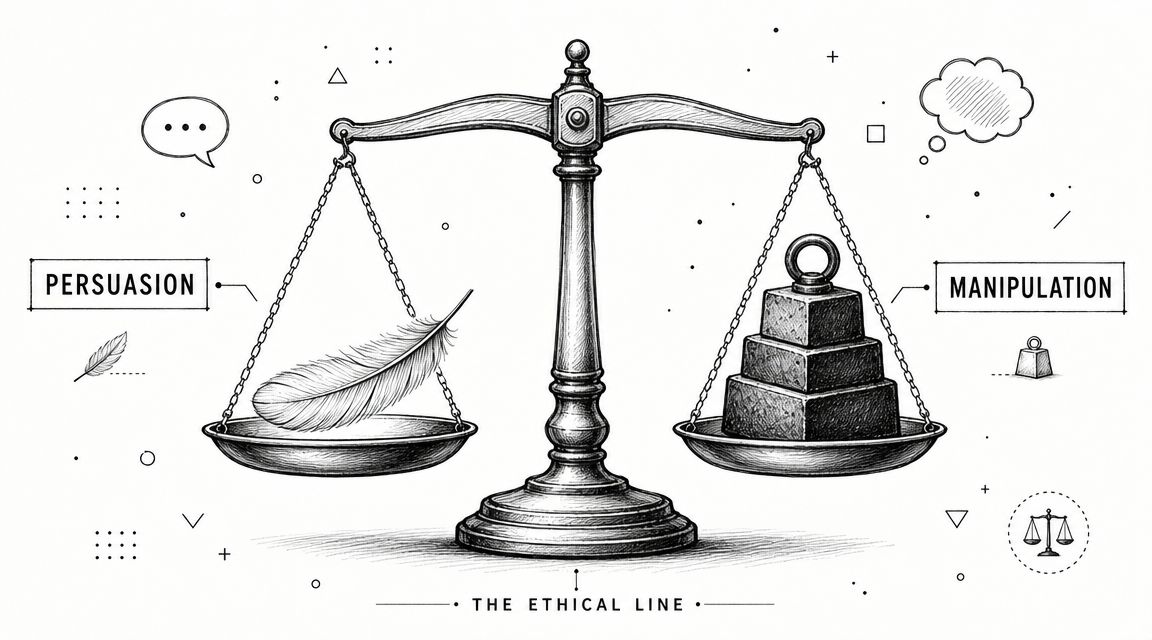
The common excuse for bad PAS copy is that “marketing needs urgency.” That's only half true. Good persuasion needs urgency. Manipulation needs distortion.
If you're writing to a professional association, member network, or event community, you usually know the tensions already. Busy schedules. Fragmented communication. Lapsed participation. Difficulty finding relevant resources. Those are legitimate.
The moment you start exaggerating consequences you can't stand behind, the copy shifts from sharp to corrosive. That includes fake scarcity, inflated downside language, and guilt-based messaging that treats members like targets instead of participants.
A useful benchmark is whether the message still feels fair when read by your most loyal member. If it would make that person roll their eyes, rewrite it.
Ask these questions before the draft goes live:
Your job isn't to make people feel bad enough to click. Your job is to describe a real problem clearly enough that taking action feels sensible.
Used well, agitate and solve is one of the most practical copywriting tools a community manager can learn. Used poorly, it creates short-term clicks and long-term skepticism. The difference is whether your copy helps people make a good decision, or corners them into one.
If you want one place to manage memberships, event registrations, content delivery, and member communication without stitching together separate tools, GroupOS gives community teams a cleaner operational foundation for the campaigns you're writing.