April 6, 2026
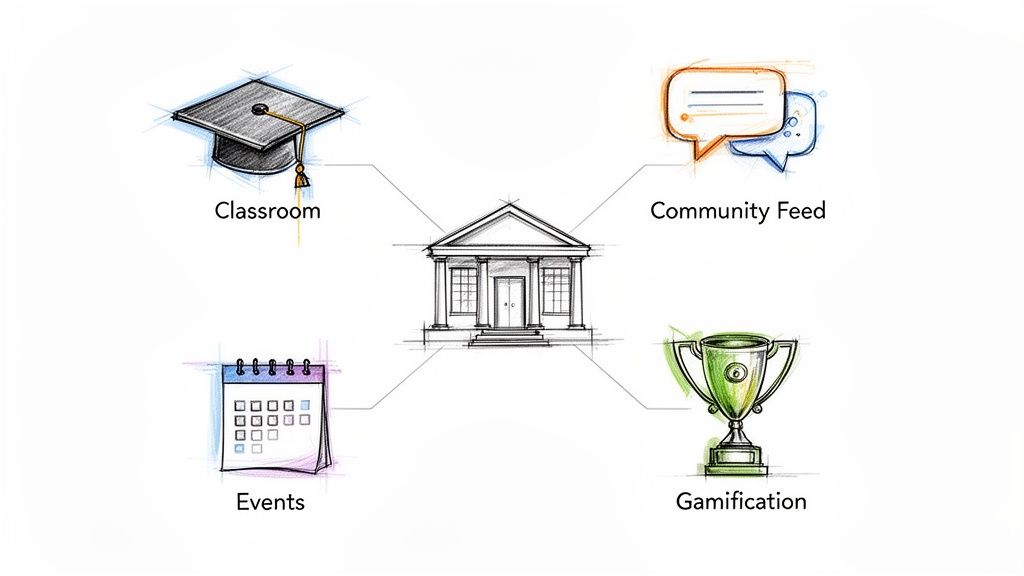
So, what exactly is Skool? The simplest way I can put it is to imagine a dedicated digital clubhouse for your members. It brings your classroom, your social forum, and your event calendar all under one roof.
The whole idea behind Skool, which was developed by entrepreneur Sam Ovens, is to solve a common headache for creators: tool fatigue.
Think about it. You might have a Facebook Group for discussions, a separate course platform like Kajabi for your content, and maybe Google Calendar to manage your events. Skool was built to bundle all that functionality into one streamlined space. It’s designed to create a clean, integrated experience for everyone involved, making it easier for members to learn, connect, and stay engaged.
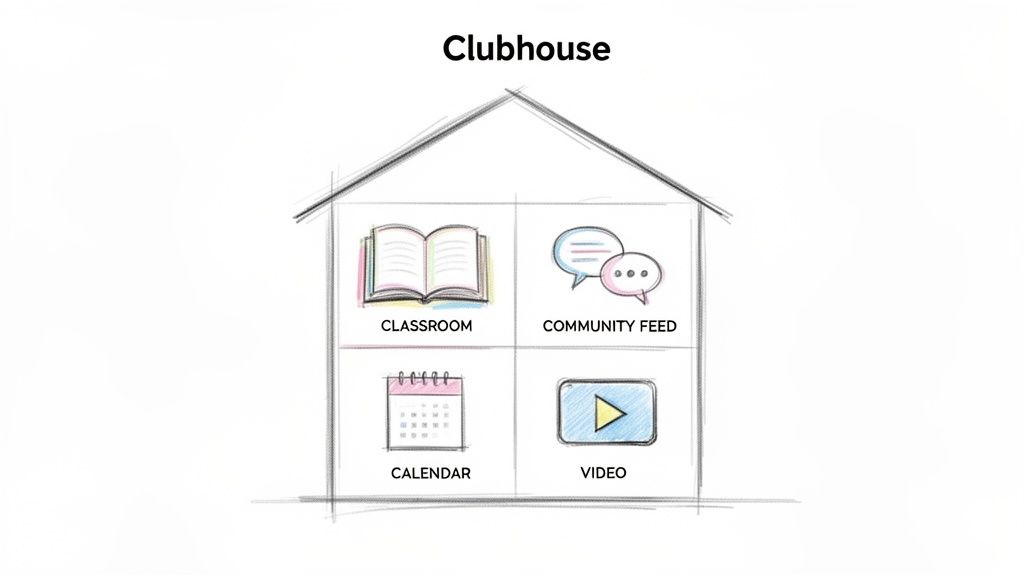
Skool's magic really lies in its simplicity. It intentionally avoids feature bloat, focusing on just four key areas that work together to drive interaction.
To make this clear, let's break down each component.
| Component | Primary Function | Analogy |
|---|---|---|
| Community | The main discussion feed, similar to a private social media wall. | The Living Room |
| Classroom | A structured space for hosting course videos and resources. | The Library |
| Calendar | A simple event scheduler for live calls, Q&As, and workshops. | The Town Square |
| Leaderboards | Gamification that rewards members for activity and contributions. | The Trophy Case |
This simple, four-part structure is designed to put interaction first. The "Community" feed is the default view when a member logs in, immediately showing them what’s new and encouraging them to jump into the conversation.
This approach is a textbook example of a community-based learning model. By placing peer-to-peer discussion at the center of the experience, the platform elevates member engagement from a nice-to-have feature into a core part of the learning process itself.
The core philosophy is clear: when you put the learning content and the community conversation in the same room, people connect more deeply, learn more effectively, and ultimately, stick around longer.
Skool has found its sweet spot with individual creators, coaches, and small businesses who prioritize engagement over complex, enterprise-level features.
It’s a fantastic fit for anyone whose business model revolves around a tight-knit group.
In short, if your main goal is to build a highly active and loyal group without getting bogged down in technical configurations, Skool is a compelling all-in-one solution. It’s less about deep customization and more about fostering real human connection.
So, what really makes Skool tick? The platform’s power doesn't come from a laundry list of features. Instead, its design philosophy is all about simplicity and focus. The entire system is built on four interconnected pillars, designed to work together to create an experience that keeps members coming back.
Think of it as a four-part harmony. Each component has its role, but the magic is in how they blend.
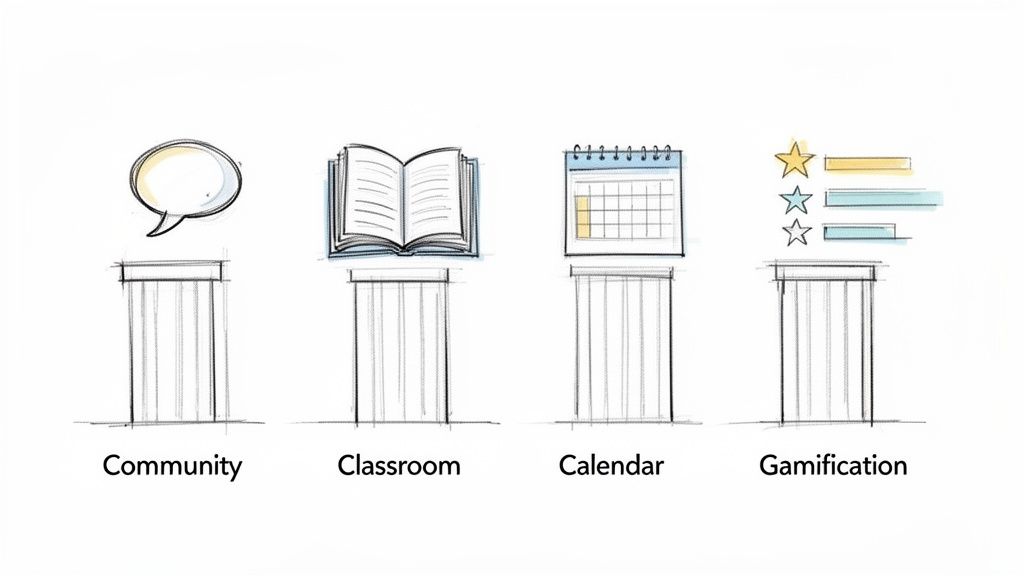
The whole experience is built around these four key areas:
Community: This is your group's home base. It functions like a private, focused social media feed where members can post questions, share wins, and start discussions. When you log in, you land right here, immediately seeing what’s new and important.
Classroom: This is where you house all your learning content. Creators can build out an unlimited number of courses, complete with video lessons, resource files, and transcripts. It's a clean, quiet space built for learning without all the usual digital noise.
Calendar: A simple but essential tool for organizing your group's events. You can schedule everything from live Q&A calls to workshops and virtual meetups. Critically, it automatically displays events in each member's local time zone, so no one ever has to do time zone math again.
Gamification: This is Skool's secret sauce for engagement. It's a clever system of points, levels, and leaderboards that encourages members to participate. We'll get into exactly how that works next.
Skool's gamification isn't just a fun add-on; it’s the engine that drives the whole community forward. It’s a built-in motivation system that rewards people for contributing value.
Here’s the simple genius of it: members earn points whenever another user "likes" their post or comment. The more helpful their contribution, the more points they rack up.
As points accumulate, members "level up" from Level 1 all the way to Level 9. This creates a powerful incentive to get involved.
Admins can lock certain courses in the Classroom, making them accessible only after a member hits a specific level. This brilliant mechanic turns passive learners into active contributors because they have to participate to unlock the next stage of content.
This structure leads to some seriously impressive activity metrics. It's not uncommon for top communities on Skool to see daily active user rates of 15-25%. For context, that’s a number most standalone chat apps or forums can only dream of.
The real power of Skool emerges when these four features start working in concert.
Imagine a member watches a new lesson in the Classroom, then pops over to the Community feed to ask a follow-up question. That question sparks a great discussion, earning them likes and points. Those points push them closer to unlocking the next advanced course.
Meanwhile, the Calendar sends a reminder about an upcoming live Q&A where they can get their question answered directly by an expert. This seamless flow between learning, discussing, and being rewarded is what makes the platform so sticky. It's also a key part of mastering cohort-based courses, where peer interaction is just as vital as the course material.
It’s this cycle that keeps members showing up daily, transforming a static course into a living, breathing community.
Skool is a fantastic tool, but it's not trying to be a one-size-fits-all solution for every organization out there. Its laser-focused design and simplicity are deliberate choices. This platform is built specifically for the individual creator, the coach, and the small business owner who needs an all-in-one community hub that just works.
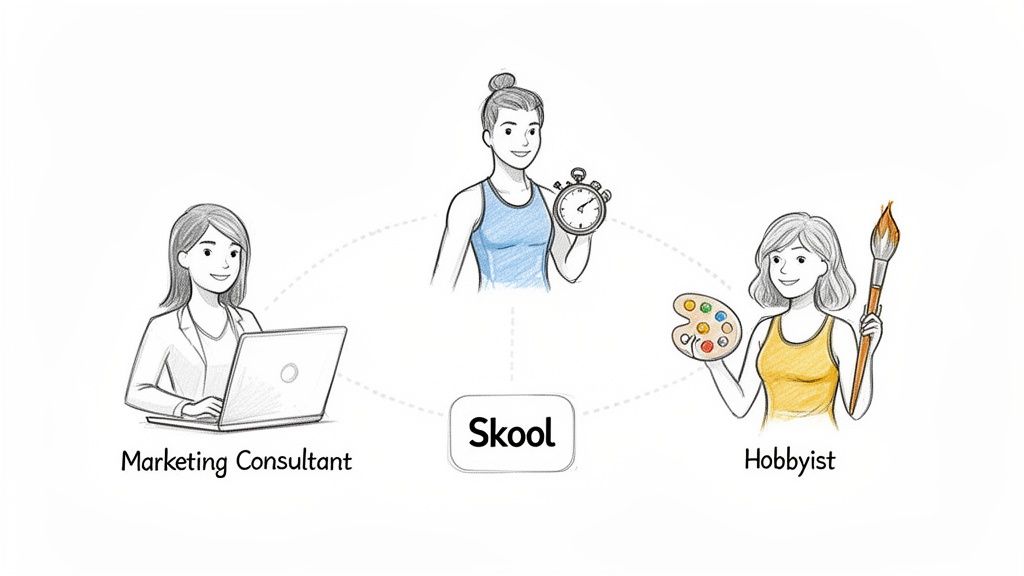
Most people who succeed on Skool are focused on building a really active and tight-knit group. Honestly, understanding the fundamentals of how to build an online community is probably the most important factor. The platform shines when the business model itself revolves around that close-knit interaction—where the community is the main product.
So, who are the people getting the most out of Skool? It's typically solopreneurs or very small teams who want a tool they can set up quickly without a ton of technical headaches.
Online Course Creators: Think of an artist tired of their video tutorials just sitting in a static library. With Skool, they can wrap a community right around their content. Suddenly, it’s not just a one-way info-dump; it’s a collaborative studio where students can post their work, ask for feedback, and learn from one another.
Coaches and Consultants: A marketing consultant, for example, could run a private mastermind group. Members can share their wins, get help troubleshooting ad campaigns, and receive direct feedback in a dedicated space. Likewise, a fitness coach could host a 30-day challenge, using the calendar for live workouts and the community feed for daily motivation and accountability.
Niche Hobbyist Leaders: Leaders of specialized groups—from book clubs to urban gardening enthusiasts—find a perfect home on Skool. It gives them a dedicated, distraction-free space away from the endless noise of social media, where people with a shared passion can genuinely connect.
The real key here is the need for a single, unified space where learning and interaction go hand-in-hand. Skool is for creators who want to build real human connections, not spend their time managing a complicated tech stack.
If you care more about fostering a lively, loyal community than you do about having a million customization options, Skool is probably a great fit. It handles everything in one place, letting you focus on your people. It’s built for engagement first, making it the perfect tool for building your tribe.
Let's be honest: no platform is a perfect fit for everyone. When you’re evaluating a tool like Skool, it’s crucial to understand that its greatest strength is also its biggest potential weakness. The platform is intentionally, almost radically, simple.
For many solo experts and course creators, this simplicity is a breath of fresh air. But for a growing association or a professional organization with complex needs, those clean lines can start to feel like a cage.
So, what’s the appeal? Why do so many creators swear by it?
First and foremost, it’s a true all-in-one system. Skool brings your community, your courses, and your events calendar under a single, clean roof. This gets rid of the need to duct-tape multiple tools together, which is a huge relief for creators and provides a much smoother experience for members.
The other standout feature is its built-in gamification. This isn't just a gimmick tacked on as an afterthought; it’s baked into the platform's DNA. The points and leaderboard system genuinely encourages people to participate.
The ability to lock courses until a member reaches a certain level is a genuinely clever way to get people involved. It shifts the culture from passive content consumption to active contribution, because engagement is directly and visibly rewarded.
Finally, the pricing is incredibly straightforward. You pay a flat monthly fee for each community you run. That’s it. You get unlimited members and courses without the anxiety of your bill skyrocketing as your community grows, which makes budgeting simple and predictable.
On the flip side, what works so well for a small-scale creator can become a major bottleneck for a more established organization.
The most significant limitation is the complete lack of white-labeling. Your community will always live on a Skool.com URL and feature Skool’s branding. For any organization that needs to present a fully branded, seamless experience to its members, this is often an immediate deal-breaker.
Beyond that, Skool's ability to connect with other software is minimal. While there are some basic Zapier triggers, it doesn’t offer deep integrations with essential business systems like a CRM or advanced marketing platforms. This makes it tough to maintain a single source of truth for member data or automate sophisticated workflows.
The analytics are also pretty basic. You can see who your top members are and get a general sense of activity, but it stops there. It lacks the granular data that professional teams need to track sponsorship ROI, measure detailed engagement metrics, or make data-driven decisions about their community strategy.
To put this all into perspective, it helps to see a direct comparison of what Skool offers versus what a larger organization or association typically requires from a community platform.
| Feature Area | Skool's Offering | Typical Enterprise Need |
|---|---|---|
| Branding | Skool branding is always present. | Fully white-labeled web and mobile apps. |
| Integrations | Basic (Zapier for simple triggers). | Deep, two-way sync with CRMs, AMS, etc. |
| Analytics | Simple leaderboards and activity counts. | Granular member data and sponsorship ROI. |
| Content | Unified feed for all members. | Segmented content for different member tiers. |
As the table makes clear, Skool wasn't built to compete on enterprise-grade features. Platforms like GroupOS are designed from the ground up to handle the branding, integration, and data complexity that larger organizations demand.
Ultimately, this brings us back to the core dilemma: Skool’s simplicity is either its greatest asset or its biggest roadblock, depending entirely on who you are and what you’re trying to build.
To really get what Skool is, it helps to see it next to the heavy-duty platforms built for a completely different job.
Think of Skool as a beautifully designed, high-end workshop. It's the perfect setup for a master craftsman—a coach, an influencer, or a course creator—to bring in their apprentices and build a tight-knit group. Everything you need is right there in the box, it’s simple to put together, and it’s laser-focused on that one goal.
But what if you’re not just running a single workshop? What if you're building an entire corporate campus or the headquarters for a professional association? That’s when the conversation changes entirely. You don’t need a single, standardized building; you need a solution that can handle different departments, complex event logistics, deep branding, and plug into your entire operational ecosystem.
This is precisely where enterprise platforms like GroupOS come into play. They’re designed to solve a different class of problems, not for the solo creator, but for the established organization. While Skool shines with its one-size-fits-all community model, enterprise solutions are built from the ground up for customization and scale.
For instance, a professional association has needs that go way beyond a single community feed. They have to be able to:
Skool was never built to do these things. Its greatest strength is its universal simplicity, but that simplicity is a direct trade-off for the advanced controls and deep customization that larger organizations absolutely depend on. You can see a full breakdown of how different platforms stack up by exploring the best online community platforms for various needs.
The gap widens even more when you look at analytics and monetization. Skool gives you leaderboards and basic activity stats, which are great for a quick pulse check on engagement. An enterprise platform, however, delivers a robust analytics suite that tracks member behavior, event attendance, and content performance, giving you the hard data needed to make strategic decisions.
This level of insight is what proves value to stakeholders and attracts sponsors.
For conference organizers, moving to centralized platforms is a major trend. Skool's footprint across 49 live sites in markets like the US and Europe demonstrates its global reach, which can offer exhibitors basic lead generation. This is a simplified take on the powerful banner ads and news feeds in platforms like GroupOS, where quarterly growth audits show top performers hitting 15-20% YoY increases. To learn more about tracking community metrics, check out Skool analytics and what to track inside your community on chriskoehl.com.
At the end of the day, Skool is a fantastic tool for its intended audience. But for professional associations, large-scale event producers, and corporations, moving from a simple tool to a scalable, professional solution is a natural and necessary step for growth. It’s the difference between running a single classroom and operating a fully-equipped, custom-built university campus.
Alright, let's get right to it. After weighing all the features, the big question remains: Is Skool actually the right platform for you? The honest answer is… it depends entirely on what you’re trying to build.
Skool absolutely shines if you're a creator, coach, or small business owner. Its entire purpose is to create a deeply engaging experience where community and courses live side-by-side, without any fuss. The platform is designed from the ground up to eliminate technical headaches and friction, letting you focus purely on your members and your content.
Think of it this way: Skool is like a powerful, perfectly organized workshop for a single, focused group. It’s built to make genuine connection and learning feel effortless in a clean, simple space.
But here’s the other side of the coin. If you’re running a professional association, organizing large-scale events, or need a platform that’s a true extension of your brand, you’ll likely feel constrained by Skool. For larger organizations, the lack of custom branding, detailed analytics, and critical software integrations can quickly become a ceiling on your growth.
This is where the path splits. The choice often boils down to the complexity of your needs—a simple, all-in-one community versus a more sophisticated organizational hub.
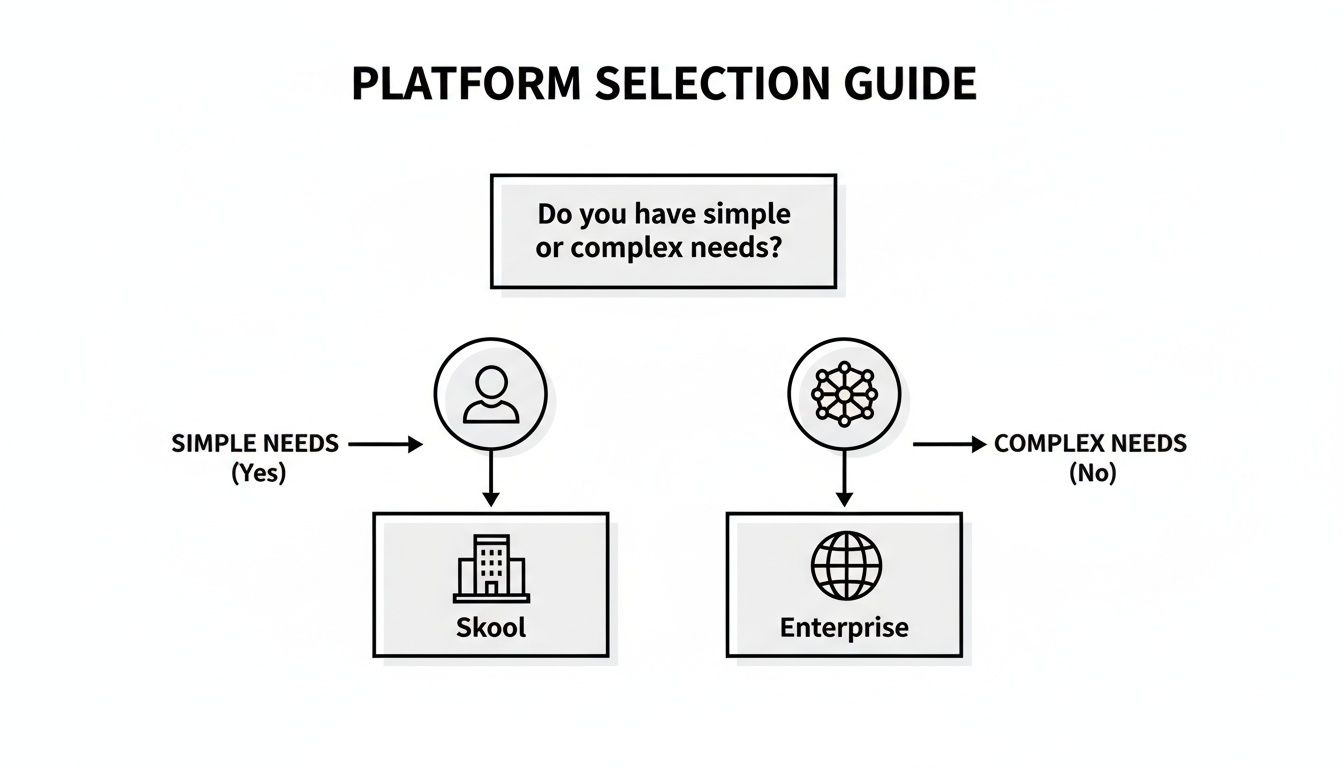
As your operations become more complex, the argument for a more robust, enterprise-level platform gets much stronger. If you find yourself on that path, take a look at our guide on the best membership website builders to explore alternatives that give you far more control, customization, and power.
Alright, let's get into the nitty-gritty. When people start digging into Skool, a few practical questions almost always come up. Here’s a straightforward breakdown of what you need to know.
Skool keeps its pricing refreshingly simple. It’s a flat-rate subscription model. You pay one monthly fee for a single community group, and that’s it.
This single fee unlocks everything: you get unlimited members, courses, and admins right out of the box. There are no surprise charges or complicated tiers that scale with your member count, which makes financial planning a breeze. Just remember, if you want to launch a second, separate community, that will require its own subscription.
The short answer is no. Skool doesn't offer white-labeling. Every community lives on the Skool.com domain and uses the platform's standard look and feel. You can absolutely customize your group’s name, banner image, and description, but you can't point a custom domain to it or overhaul the branding to match your own.
This is a critical point of difference. If your organization requires a completely branded experience, whether on the web or a dedicated mobile app, Skool’s built-in branding will be a major roadblock.
The gamification system is all about encouraging participation through points and levels. Members earn points whenever someone "likes" one of their posts or comments. As they accumulate points, they level up, moving through the ranks of the community.
Here’s where it gets interesting for you as an admin. You can set specific courses to "unlock" only when a member hits a certain level. This gives people a tangible incentive to contribute valuable content and interact with others, because their active participation is directly rewarded with access to exclusive material. A public leaderboard also keeps track of the top contributors, adding a fun, competitive element.
If your goals go beyond simple community engagement—think professional associations or large-scale event series—you'll need more advanced tools. GroupOS is an enterprise-grade platform designed for advanced event ticketing, deep member analytics, and crucial CRM integrations, all within your own branded ecosystem. See how GroupOS can help you professionalize and scale your organization.