May 22, 2026

The root word cand comes from the Latin candere and means to shine, to glow, or to be white. If you think of a candle, you're already close to the heart of the word family: something giving off light.
You've probably seen words like incandescent, candid, or candor and felt that odd language itch. They look related, but they don't seem to live in the same neighborhood. One belongs to lightbulbs, another to honesty, another to personality. The connection feels hidden until you know the root.
That's what makes etymology fun. A word root isn't just a definition to memorize. It's a trail of meaning. With cand, that trail starts in brightness and then spreads outward into ideas like whiteness, purity, openness, and plain speaking.
Once you see that pattern, these words stop looking random. They start behaving like relatives.
When students ask me what does the root word cand mean, they're usually expecting a short answer. They want the clean version they can use on a quiz. That answer is simple: cand means shine.
But the useful answer is a little richer. This root carries the sense of brightness, glow, and whiteness. Those ideas help explain why candle is an obvious member of the family, while candid is a more surprising one.
The confusion usually comes from expecting roots to stay concrete. If a root means “shine,” people expect every related word to involve lamps, flames, or visible light. Language doesn't work that neatly. Meanings branch.
A bright object lights a room. A candid person seems to “light up” the truth. In older patterns of thought, what is white or clear often becomes a metaphor for what is pure, open, or sincere.
Practical rule: When a root seems to connect unlike words, look for the older core image rather than the modern surface meaning.
That's also why studying word families works better than memorizing isolated definitions. If you're building lessons or notes, the same logic that helps you organize vocabulary can help you organize teaching more broadly, especially if you like a structured approach to creating a powerful course outline.
Think of cand as a lantern. It throws light in more than one direction.
That single image of shining is the key that reveals the whole family.
The story of cand begins deep in language history. According to Etymonline's entry on kand-, the root traces back to the Proto-Indo-European forms ***kand- / *kend-**, meaning “to shine.” From there, it fed into the Latin verb candere, which also means “to shine.”
That ancient continuity matters. It tells us this isn't a modern coincidence. English didn't randomly collect a handful of lookalike words. These terms descend from an old, stable idea tied to brightness and illumination.
To keep that history visually simple, it helps to see the family as a chain rather than a list.
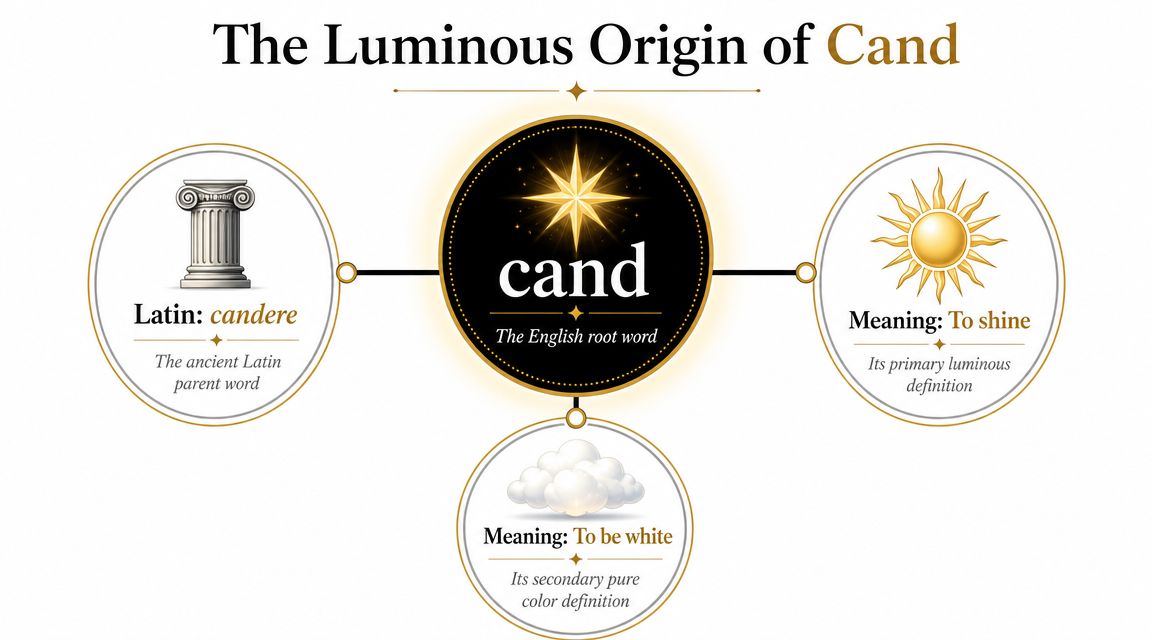
Picture a tree trunk. At the base is the older Indo-European idea: shine. Up the trunk comes Latin candere. Later, English grows branches from that trunk.
Etymonline also notes that words such as candela and candelabrum descend from this same shining root, which confirms that the family stayed closely tied to light for a long stretch of its history.
If you enjoy seeing how these older layers of language connect across time, you might like to learn historical linguistics on Maeve, which gives helpful background on how scholars trace word families across earlier languages.
Latin candere carries more texture than a bare gloss. It gives us the ideas of something shining, glowing, and even appearing white. That combination is important. It explains why later descendants can move from actual brightness into ideas of purity and frankness.
A short visual explanation can help lock that in:
The root behind cand began with light, then carried that light forward into Latin and eventually into English vocabulary.
So when you meet a cand word, you're not looking at a loose syllable. You're looking at an old inherited image: something that shines.
Once you know the core image, the most interesting part begins. The root cand doesn't stay in one lane. It splits into two major pathways, much like a tree trunk dividing into two strong branches.
One branch stays literal. It keeps the root close to flame, heat, and visible brightness. The other becomes figurative. It turns brightness into a metaphor for purity, sincerity, and openness.
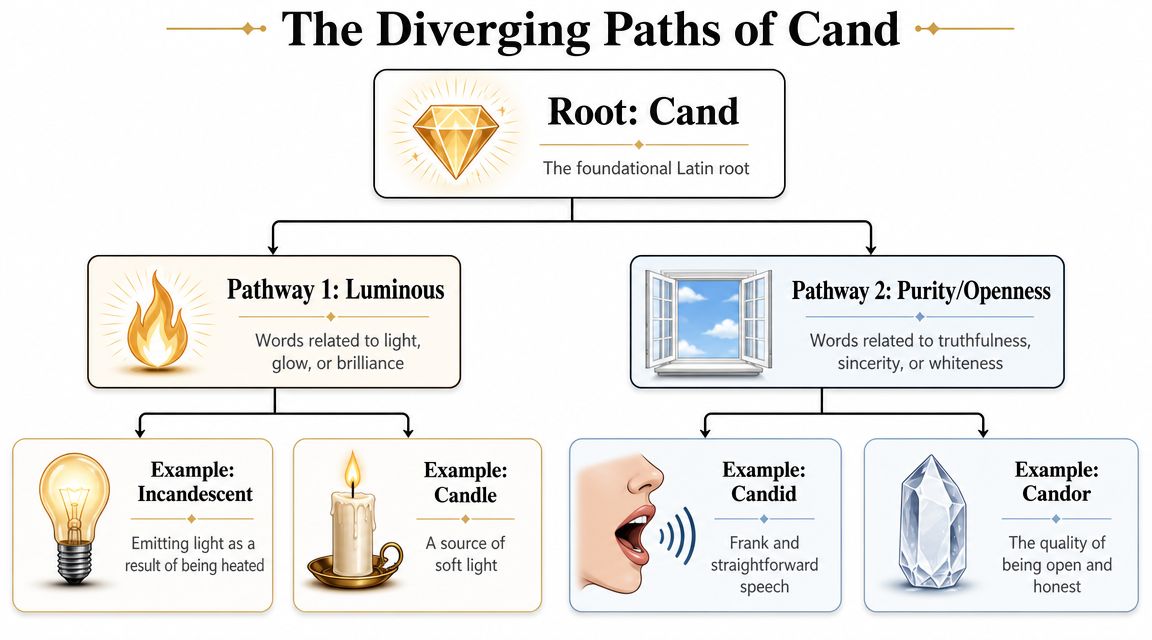
Some words keep the older physical sense almost intact.
A candle gives light.
Something incandescent emits light because of heat.
Something candescent is glowing or heated.
These words are easy to recognize because they stay close to the original sensory picture. You can almost see the root at work.
The second branch is where many readers hesitate. How does “shine” become “honest”?
Modern educational references help explain that bridge. Membean defines cand as “be of brilliant whiteness, shine, be hot” and connects it to candor as honesty in speech in its root guide for cand. That movement makes sense if you follow the metaphor: what is bright, white, and clear becomes associated with what is open and sincere.
Think about two kinds of illumination:
That's the same mental habit working in two settings. Physical light becomes moral or social clarity.
Words often travel by metaphor. A root starts in the body and the senses, then moves into thought, character, and judgment.
This is why cand is such a satisfying root to study. It isn't just a label for “light words.” It shows how language keeps old images alive while applying them in new places.
Here's the simplest way to remember the split:
That last point is the unifier. Whether a word refers to a flame or a frank statement, the root still carries the image of something made visible.
Now it helps to slow down and look at individual words. Not every member of the family wears its history on the surface, but each one still carries some trace of the original idea.
A useful summary from the Studocu explanation of cand- is that the root from Latin candere shows a pattern in which physical brightness, as in incandescent, maps onto abstract meanings such as candid. That's exactly the pattern you can test word by word.
Candle is the easiest starting point. A candle shines. No metaphor needed.
Incandescent means giving off light from heat. Even if you only know incandescent lightbulbs, the root still points back to glowing brightness.
Candid means frank, open, direct. The semantic leap becomes easier once you connect “white” and “clear” with “nothing hidden.”
Candor is the noun form of that quality. If someone speaks with candor, they speak openly.
Candidate often surprises people because its modern meaning seems political or professional rather than luminous. But it belongs to a related historical line through whiteness. The word connects to the idea of being dressed in white, which made one's public role visible and marked.
That's a good reminder that roots don't always survive in obvious ways. Sometimes the original image fades, but the historical thread is still there.
If a modern definition feels far from the root, ask what older image linked them before the meanings drifted apart.
Here's a compact way to compare the family:
| Word | Connection to "Shine/White" | Example Sentence |
|---|---|---|
| Candle | A direct source of light | We lit a candle during the storm. |
| Incandescent | Glowing with light from heat | The wire became incandescent as it heated up. |
| Candescent | In a glowing or heated state | The metal looked candescent in the furnace. |
| Candid | Figuratively clear, open, sincere | She gave a candid answer about the project. |
| Candor | The quality of open honesty | His candor made the discussion easier. |
| Candidate | Historically linked with whiteness and public visibility | The candidate addressed the audience calmly. |
When you spot a cand word, try this quick sequence:
That habit works better than trying to memorize each word as a separate fact. It also helps when you're collecting examples for lessons, study sheets, or writing projects. If you build vocabulary materials online, some teachers also browse content creation websites for educational resources to present word families in more visual ways.
Memory improves when you attach a root to a strong image. For cand, the best image is simple: a candle shining in the dark. If the candle shines, then cand means shine. That's the anchor.

Don't try to remember five definitions first. Remember one picture first.
That sequence gives you a mental path from the familiar to the abstract.
Some learners wonder whether candy belongs to the same family because it starts with the same letters. It doesn't help to assume that similar spelling means shared ancestry. In etymology, appearance alone can be misleading.
That's why root study works best when you connect form, history, and meaning, not just sound.
Say the root to yourself with its image: cand, candle, shine.
If pronunciation slows you down, practice the words in short phrases instead of in isolation. Say: “an incandescent bulb,” “a candid reply,” “with candor.” The phrase gives the word a natural rhythm.
For extra practice, interactive drills can help more than passive reading. Students who like game-based repetition may enjoy gamified English vocabulary exercises, especially when they want to reinforce roots through quick review.
And if you're turning what you learn into lessons, handouts, or posts, it's worth thinking about how to create engaging content so vocabulary study feels alive rather than mechanical.
You read the word candid in an article, then later notice incandescent on a lightbulb box. On the surface, they seem unrelated. Once you know cand carries the idea of shining, they start to feel like relatives.
It means to shine, to glow, or to be white. That single image traveled in two directions. One path stayed close to literal light, as in candle and incandescent. The other moved into the moral and social world, where what is bright and clear becomes what is honest and open, as in candid and candor.
That is the core value of this root. It teaches you to follow a word's story, not just memorize a definition. A bright surface becomes a clear statement. Light becomes truth.
Once you start noticing roots, unfamiliar words stop feeling random. Reading becomes a bit like meeting members of the same family. The faces are different, but the resemblance is there if you know where to look.
With cand, the old image still does quiet work:
That habit matters beyond vocabulary study. It trains you to explain ideas clearly, trace connections, and choose words with more precision. If you want to build that skill in public-facing writing, it also helps to learn how to become a content creator who explains complex topics clearly.
The next time you meet candid, candor, or incandescent, you can do more than recognize them. You can see the semantic journey inside them. The old idea of shining is still there, lighting up both the physical world and the language of honesty.
If your organization needs a better way to deliver educational content, manage events, and build a branded member community, GroupOS offers an all-in-one platform for courses, communication, memberships, and engagement.