January 31, 2026
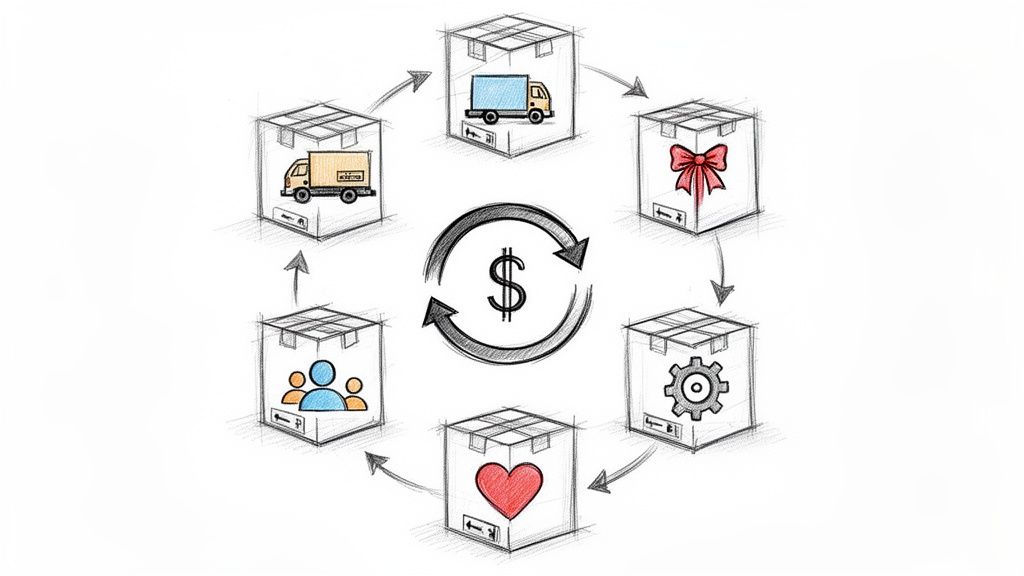
At its heart, the subscription box business model is all about recurring revenue. Instead of relying on one-off sales, you're delivering a hand-picked collection of physical products to customers on a set schedule, creating a steady, predictable income stream.
This isn't just about selling things; it's about building long-term relationships.
Imagine creating an exclusive club where members get a box of curated surprises delivered right to their door every month, quarter, or year. That's the essence of a subscription box. You're not just chasing one-time sales—you're building a loyal community and a predictable revenue engine. This model completely shifts the focus from simple transactions to fostering genuine, lasting connections with your customers.
For consumers, the appeal is a powerful mix of convenience, discovery, and a touch of personalization. People love the thrill of receiving what feels like a hand-picked gift, saving them the hassle of hunting for new products themselves. For the business owner, the upside is just as attractive, mainly because it offers financial stability and a much deeper understanding of your customers.
A successful subscription box doesn't happen by accident. It's built on a few key pillars that deliver consistent value to both the customer and the business.
The magic of this model is its ability to transform a simple product delivery into an ongoing experience. It’s not just about what's inside the box; it’s about the anticipation, the unboxing, and the feeling of being part of a community.
While you'll find endless variations out there, almost every subscription box fits into one of three main categories. Each one meets a different customer need and calls for its own unique strategy. Figuring out where your idea fits is one of the first crucial steps.
To see how top brands put these into practice, you can explore various subscription business model examples and see them in action.
Profitability in the subscription box world isn't just about curating amazing products; it’s about really getting to grips with the numbers that make or break your business. To build something that lasts, you have to look past simple sales figures and start managing the key metrics that signal the health of your entire operation. These numbers are your dashboard—they tell you if you're speeding up, stalling out, or heading for trouble.
Think of it like a regular health check-up for your business. Monthly Recurring Revenue (MRR) is your pulse. It’s the predictable, reliable income you can count on every single month from your subscribers, and it’s the superpower of the subscription model. This stability lets you forecast your cash flow and invest in growth with a lot more confidence. When your MRR is climbing, you know your subscriber base is healthy and growing.
Another vital sign is your Customer Acquisition Cost (CAC). This number tells you exactly how much it costs—in ad spend, influencer fees, or content creation—to get one new person to sign up. Knowing your CAC is the first, non-negotiable step to making sure your growth is actually profitable.
Once you know what you're paying to bring a customer in the door, the next big question is: what are they worth to you over time? This is where Customer Lifetime Value (LTV) comes in. It’s a forecast of the total revenue you can realistically expect from a single subscriber before they eventually churn.
The real magic happens when you put these two numbers together. The LTV-to-CAC ratio is the ultimate gut-check for your business’s long-term health. You’re aiming for a ratio of 3:1 or higher. In plain English, that means for every dollar you spend to get a customer, you make at least three dollars back over the course of their subscription. If your ratio is dipping below that, it’s a red flag that you might be overspending on marketing or not keeping customers around long enough to be profitable.
A strong LTV-to-CAC ratio isn't just a nice-to-have; it's proof that your marketing is efficient, your product delivers real value, and your entire business model is built to last.
The financial power of the subscription model is hard to ignore. The global market hit an incredible $37.5 billion in 2024 and is on track to reach a staggering $116.2 billion by 2033. This explosive growth is driven by the predictable revenue that founders and investors love, especially when average gross margins can hover around a healthy 60%.
The chart below breaks down the main types of subscription boxes driving all this revenue.
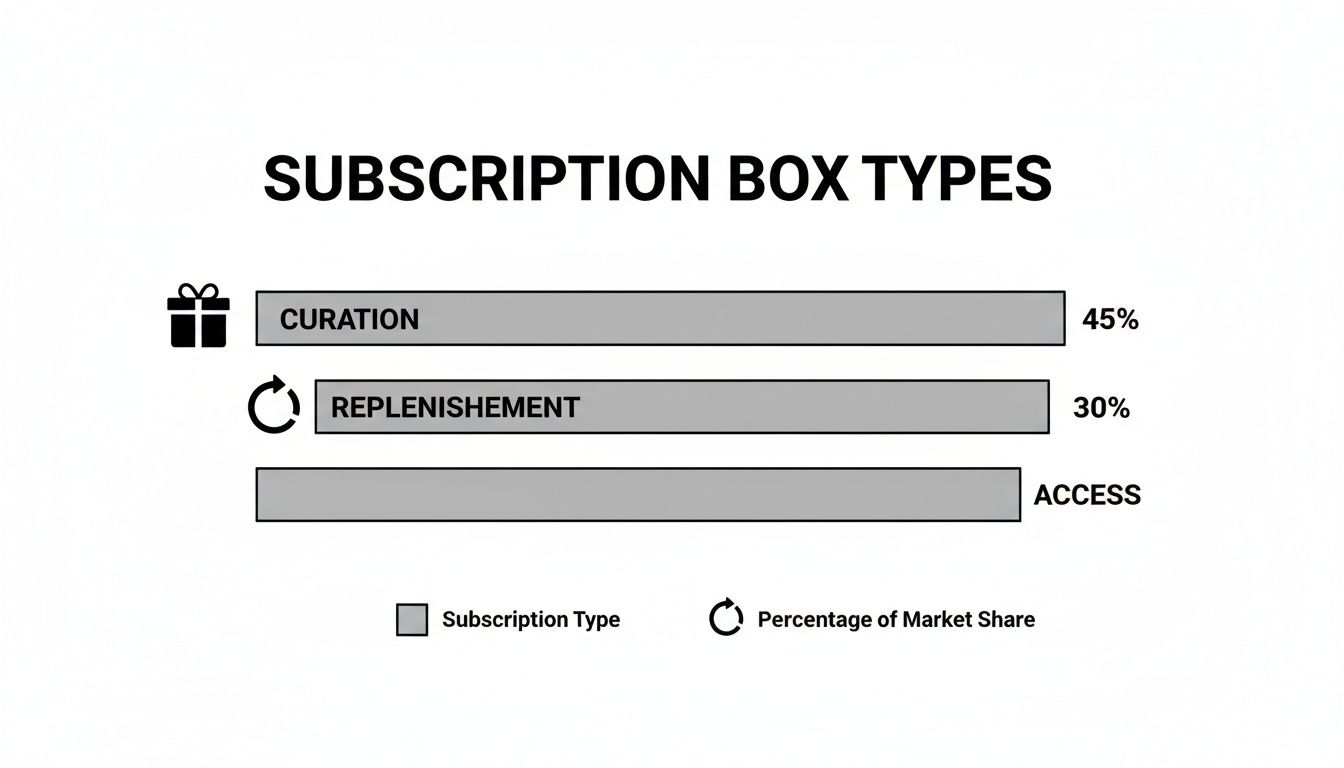
As you can see, different models appeal to different customer needs, and each one demands its own unique financial strategy to succeed.
Pricing your box is a delicate balancing act. You need a price point that attracts customers but also comfortably covers all your costs—from the products inside to the box they arrive in, plus marketing and shipping. Just slapping a single flat fee on your service might be leaving money on the table. It’s often much smarter to build in some flexibility.
For a deeper dive, our guide on subscription pricing strategies breaks this down even further.
Here are a few proven approaches to think about:
To keep your business on track, you need to monitor a handful of critical KPIs. These numbers tell the story of your financial health and operational efficiency.
The table below outlines the most important metrics, what they mean, and what a healthy benchmark looks like in the industry.
Watching these KPIs closely will help you spot problems before they escalate and identify opportunities to grow your business sustainably.
The magic of a great unboxing experience doesn't just happen. It's the final step in a surprisingly complex operational dance that starts with finding the right products and ends with a perfectly packed box on your customer’s doorstep. This backstage process is the engine of your business, and mastering it is what turns a side hustle into a scalable subscription box business model.
Think of your operations as two distinct but connected pieces: product sourcing (what you put in the box) and order fulfillment (how you get it there). You have to nail both to keep costs in check, make your subscribers happy, and build a brand with staying power. Let's dig into how to build this foundation.
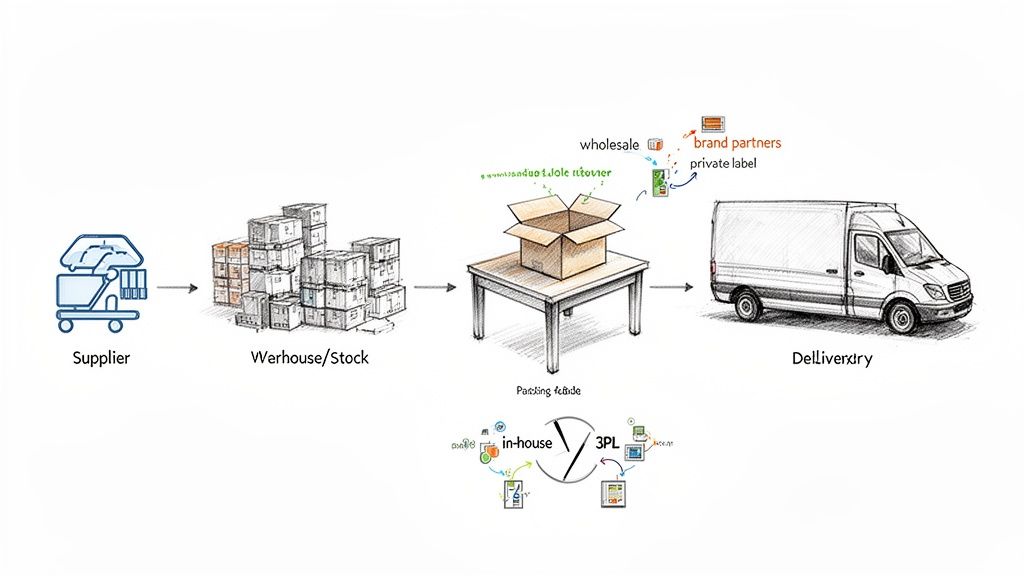
Your sourcing strategy is everything. It shapes your brand, dictates your profit margins, and determines how easily you can grow. It’s the first big domino to fall in your supply chain, and there's no single "right" way to do it. The best approach really depends on your niche, your budget, and what you’re trying to build.
Here are the main ways founders get products for their boxes:
Your sourcing method is a strategic choice. Buying wholesale is about speed and variety, brand partnerships are about exclusivity and discovery, and private labeling is about building a unique brand from the ground up.
Once you’ve got your products, the next hurdle is getting them packed up and out the door. This is fulfillment, and it’s where a lot of new entrepreneurs get bogged down. The big question you have to answer is whether you’ll do it all yourself or hand it off to a pro.
In-House Fulfillment
Let’s be honest, almost everyone starts by packing boxes in their living room. It's a rite of passage! Handling fulfillment yourself gives you 100% control over that unboxing moment, from the branded tissue paper to the little handwritten note. It's also the cheapest way to start when your order volume is low, and you get to personally inspect every single item.
But that scrappy approach has a ceiling. Once you get past a couple hundred subscribers, you’ll find yourself drowning in cardboard and tape. Every hour you spend packing is an hour you’re not spending on marketing or finding the next great product.
Outsourcing to a 3PL
A third-party logistics (3PL) company is basically a fulfillment specialist for e-commerce brands. They handle the warehousing, picking, packing, and shipping for you. You send them your inventory and your custom boxes, and they take care of the rest.
Here’s why growing businesses make the switch:
Moving from your garage to a 3PL is a huge step. It’s the moment your business proves it’s ready for serious growth. The key is knowing which path is right for you right now to build a subscription box that's both profitable and sustainable.
Getting that first sign-up is a rush, but the real magic of a successful subscription box business model happens when you keep those customers excited to see your box on their doorstep month after month. The secret isn't just about finding new people; it's about creating an experience that makes them want to stick around.
Think of it as a cycle: smart marketing brings people in, and a fantastic experience keeps them. When you get retention right, it actually makes your marketing easier and cheaper.
First things first, you have to get your box in front of the right people. Simply launching a website and hoping for the best is a recipe for disappointment. You need to actively go where your ideal customers are already hanging out.
The most successful brands don't just throw money at one channel. They build a marketing engine that combines a few key strategies to create steady, predictable growth.
Here are a few tactics that consistently work:
Getting new subscribers is the fuel for your business, but that fuel burns up fast if they cancel after one or two months. That's where the other half of the equation comes in—and it's where the real, long-term money is made.
The moment someone subscribes, the clock starts. Your mission is to deliver an experience they can't imagine leaving. It’s about more than just the products you put in the box; it's about making each person feel like they're part of something special. If too many people are canceling (what we call "churn"), it can sink your business.
The single biggest key to retention right now? Personalization.
In 2024, personalized boxes pulled in a staggering $11.6 billion in revenue worldwide. The leader of the pack was the curation model—where items are hand-picked for each subscriber—which accounted for $8.7 billion of that. People don't want a one-size-fits-all box; they want one that feels like it was made just for them.
Of course, even with the best curation, things can go wrong. A shipping delay, a broken item—it happens. This is where top-notch e-commerce customer service becomes your superpower. A fast, friendly, and helpful response can turn a potential cancellation into a rave review.
To build an experience that keeps subscribers hooked, focus on these tactics:
When you nail your retention strategy, you're not just preventing cancellations. You're dramatically increasing how much each customer is worth to your business over time. Want to dig deeper? Check out our complete guide to building an effective customer retention program.
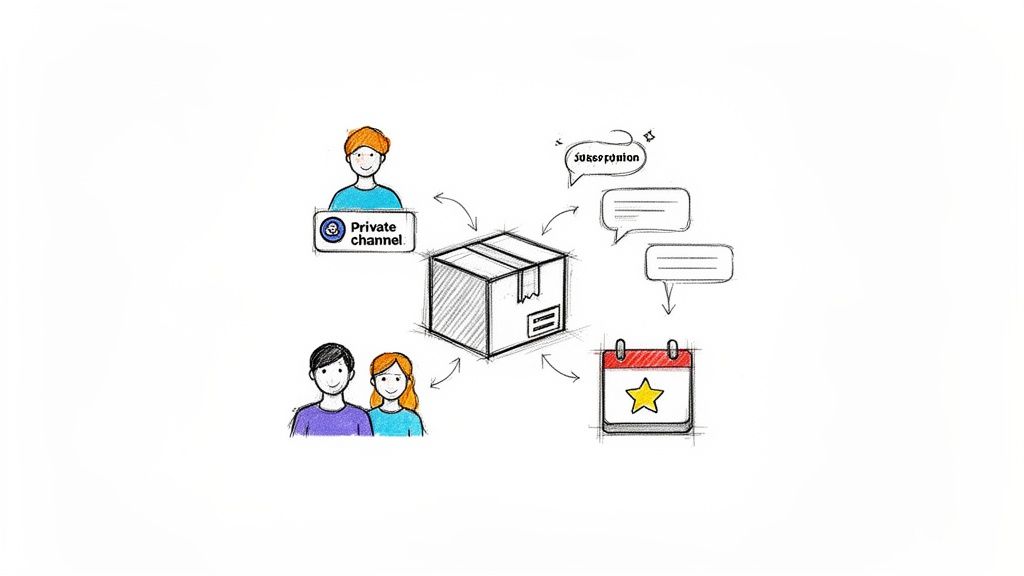
Think of your subscription box as more than just a monthly delivery. It's a ticket to an exclusive club. The brands that truly knock it out of the park know the secret isn't just what's inside the box—it’s the sense of belonging that comes with it. When you turn a simple subscriber list into a living, breathing community, you build your best defense against cancellations.
This simple shift in thinking—from "customer" to "member"—is a game-changer for any subscription box business model. It creates a kind of loyalty that competitors can't touch, no matter how great their products are.
A purely transactional relationship is over the second your customer opens their box. But a community-based one? That's just getting started. When you give subscribers a dedicated space to connect with each other, you give them a reason to stick around long after the unboxing thrill has faded.
This is where all-in-one membership platforms really shine. Instead of duct-taping different tools together, a solution like GroupOS brings subscription management and community features under one roof. That means you can handle recurring payments and nurture member connections all in the same place.
Building a community is the ultimate retention strategy. It makes your subscription "sticky" by giving members something to lose if they cancel—not just products, but relationships and a sense of identity.
Your goal should be to build a central hub where your subscribers feel like genuine insiders. This space needs to offer value that goes way beyond the physical products, making their membership a must-have part of their hobby or lifestyle.
Picture it as a digital clubhouse for your biggest fans. It becomes a place for shared experiences, which naturally tightens the bond between your members and your brand.
Here are a few ideas to bring that community to life:
Putting time and effort into community isn't just a "nice-to-have"—it drives real business results. An engaged community becomes a powerful marketing engine and a goldmine of feedback that helps you make your box even better.
For instance, when members start sharing tips and creative ways to use your products, they’re adding value for everyone else. This kind of user-generated content deepens engagement and gives you priceless insights into what your customers actually want. For a deeper look, check out our guide on how to build an online community that people love.
At the end of the day, a strong community, supported by the right tools, will:
Let's be real—running a subscription box isn't all unboxing videos and happy customers. Even the biggest names in the game run into a few predictable, and sometimes brutal, challenges. Knowing what these are before you launch gives you a huge head start in building a business that can actually last.
The most common killer of subscription boxes? Subscription fatigue. It’s that feeling your customers get when the initial buzz fades, and your monthly delivery starts feeling less like a treat and more like just another bill. When the novelty wears off, cancellations are right around the corner.
Getting ahead of these problems is about more than just having cool products. It’s about running a tight ship and building a brand that people genuinely connect with.
Your best defense against all of this is a powerful brand identity. A box that's just a random collection of stuff is disposable. But a box that stands for a lifestyle, a community, or a shared passion? That gives people a reason to stick around long after they've used the products.
Beyond the day-to-day operations, you absolutely have to build your business on a solid legal foundation. The whole recurring payment model is watched closely, and there are specific consumer protection rules you just can't ignore. Getting this wrong can lead to hefty fines and legal headaches you don't want.
First up, your auto-renewal policies have to be completely transparent. Customers must understand exactly what they're signing up for, how much they'll be charged, and on what schedule. Burying this stuff in the fine print is a surefire way to get hit with angry emails and costly chargebacks.
And it goes without saying, but protecting customer data is non-negotiable. You're handling sensitive information—names, addresses, credit card numbers. Your website and payment processor must be secure and compliant with data privacy laws like GDPR or CCPA, depending on your customers' locations. Being upfront and diligent about these legal details isn't just about avoiding trouble; it’s about building a trustworthy brand that people feel safe doing business with.
Jumping into any new business brings up a lot of questions. Let's tackle some of the most common ones that come up when people are thinking about launching a subscription box.
The honest answer? It really depends. You could get a scrappy start for a few thousand dollars, or you could go all-in with an initial investment of $25,000 or more.
The biggest ticket items right out of the gate will be your first batch of product inventory, designing and printing custom boxes, setting up your website and subscription software, and of course, your first marketing push to get those crucial first subscribers.
To keep things lean, a lot of founders begin by buying from wholesalers and packing every single box by hand in their living room. A bigger launch, on the other hand, might mean creating your own branded products and partnering with a fulfillment center from day one, which naturally requires a lot more cash upfront.
Year after year, the big players are in food, beauty, and wellness. It makes sense—these are products people use up and need to replenish, and the demand is always there.
But the real magic often happens in the niches. Think about it: a box for specialty coffee lovers, a monthly kit for crafters, or curated goodies for dog owners. These focused ideas can be wildly successful because they tap into a passionate, built-in audience. You'll face less competition and build a loyal following of people who truly value what you're curating for them. The trick is finding a niche you can genuinely serve better than anyone else.
Most new businesses start by doing it all themselves. This means you have total control over that amazing unboxing experience and you keep your overhead low. You'll be the one ordering products, storing them (hello, garage-turned-warehouse!), packing boxes, and printing shipping labels.
As you grow, though, this process will start to eat up all your time.
When your subscriber count gets too big to handle in-house, the next move is partnering with a third-party logistics (3PL) company. They take over all the storage, packing, and shipping, which frees you up to work on the business—not just in it.
In the subscription world, a healthy monthly churn rate—that's the percentage of people who cancel—hovers somewhere between 5% and 10%. If you can keep your churn rate consistently under 5%, you're crushing it. That’s a clear sign your customers love what you're sending them.
However, if your churn starts creeping above 10% for a few months in a row, consider that a major warning sign. It’s telling you something is off—maybe the value isn't there, the price is too high, or the overall experience is lacking. Keeping a close eye on churn and actively trying to reduce it is absolutely vital for building a business that lasts.
Ready to build a loyal community around your subscription box? GroupOS provides the all-in-one platform to manage subscriptions, engage members with exclusive content and events, and analyze your growth—all in one place. Launch and scale your community with GroupOS.