April 23, 2026

41% of brands employ a dedicated community manager in 2026, according to community marketing statistics. That single figure changes how leadership should think about the role. A social media community manager isn't just the person answering comments after someone else publishes content. In a professional association, that person sits much closer to retention, member experience, event attendance, sponsor visibility, and the quality of your brand's day-to-day relationship with members.
Most organizations still build this function backwards. They start with channels. LinkedIn, Facebook, Instagram, maybe a private group somewhere else. Then they ask one person to keep everything active. That produces activity, but not necessarily a community. Professional organizations need a tighter model: social channels attract attention, a community function turns attention into belonging, and an owned hub turns belonging into measurable business value.
That difference matters most for associations, institutes, chambers, alumni groups, and event-driven communities. Your audience isn't following you for entertainment alone. They're looking for peers, answers, status, introductions, continuing value, and reasons to renew. That's where a strategic community management function earns its keep.
41% of brands employ a dedicated community manager in 2026. As noted earlier, that number signals a structural shift, not a passing staffing trend. Leadership teams should treat community management as an operating function tied to retention, participation, and member experience.
For a professional association, effective community management holds greater significance than it does for many consumer brands. Consumer marketers can often cover weak community habits with paid distribution and a steady stream of creative. Associations rarely have that margin for error. If members do not feel seen, informed, and connected, renewals drop, event attendance becomes harder to sustain, and the value of membership starts to look thin between major programs.
The role has also changed in scope.
A strategic community manager does not just keep social channels active. They read signal across channels, identify recurring member needs, spot friction before it turns into churn, and connect those findings to the teams that own membership, events, education, and sponsorship. That is the difference between social activity and community infrastructure.
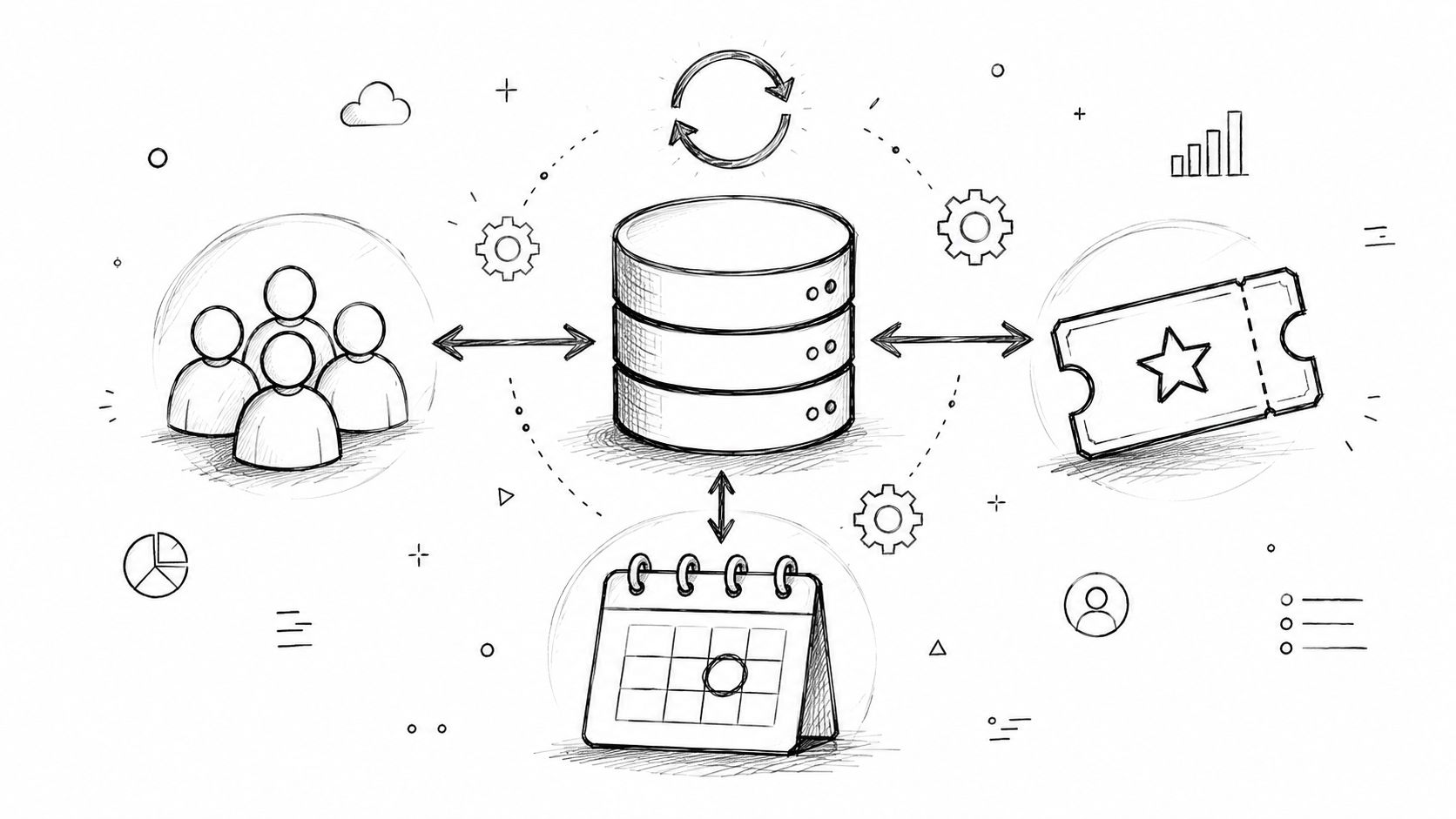
In practice, social platforms should not be the final destination for member relationships. They are useful for discovery, conversation starters, and event visibility. The durable value comes from moving the right people into an owned environment where discussions, introductions, resources, and participation history can compound over time. For many associations, that means using social media to attract attention and a centralized platform such as GroupOS to turn that attention into ongoing member engagement leadership can measure.
I have seen this trade-off play out repeatedly. Teams that judge the role by post volume and follower growth stay busy but struggle to explain business impact. Teams that judge it by renewal influence, event conversion, volunteer participation, and discussion quality build a function that leadership keeps funding.
That is why the role usually belongs closer to membership and program strategy than a narrow social media reporting line suggests. A useful reference on the role is this guide to a social media community manager for membership organizations, especially if your current model is split across disconnected channels and teams.
For organizations building from scratch, the job is not to make every platform equally active. The job is to create a system. Social brings members in. Community management keeps them involved. Your owned hub keeps the relationship from resetting after every post or event. If your team needs a practical outside perspective on the foundation, this primer on how to build online community is a useful complement to the association-specific approach here.
A professional association doesn't need a generic social media operator. It needs someone who can manage relationships at scale without flattening them into canned engagement. The work usually falls into four pillars.
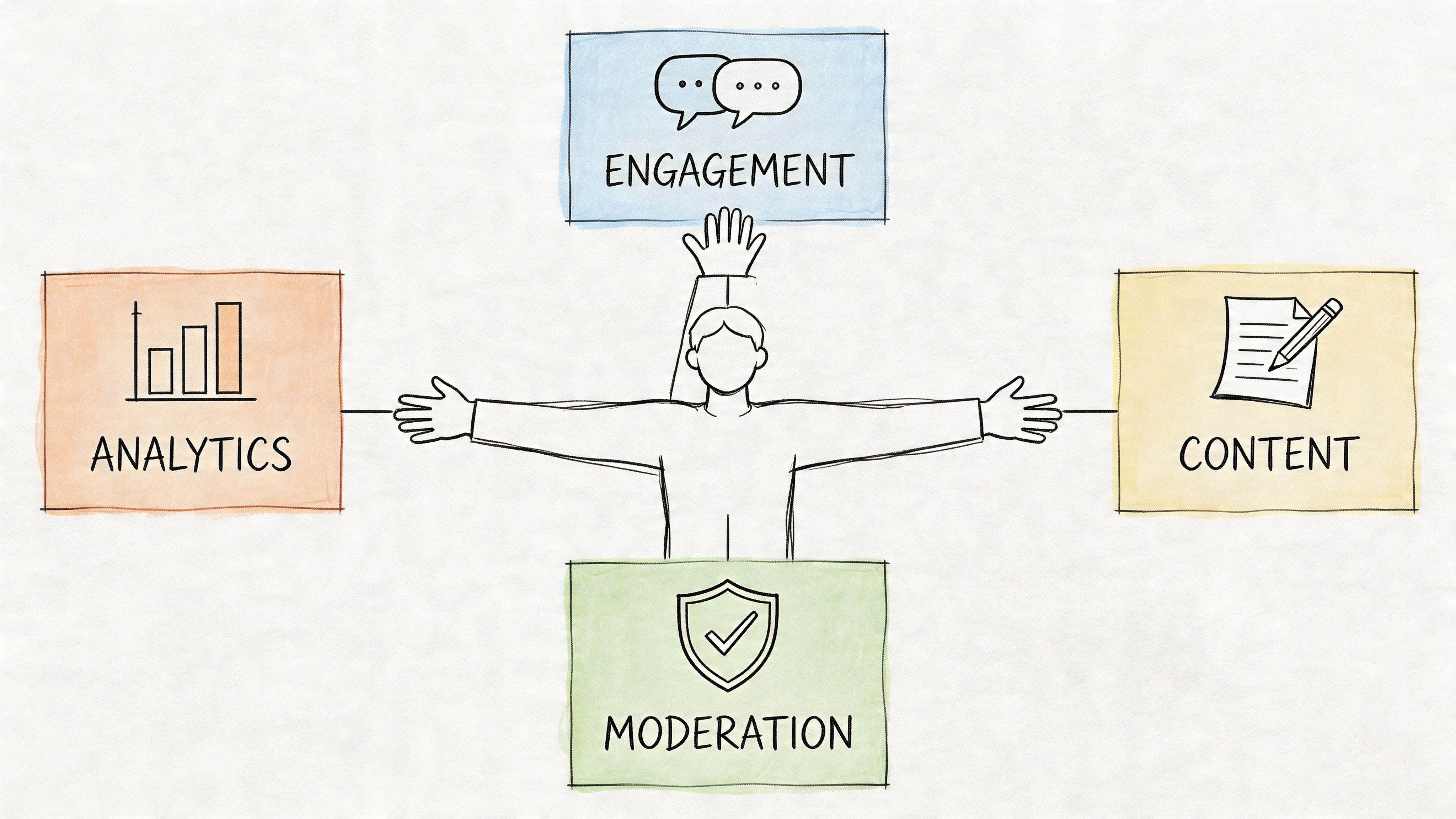
This is the part leaders usually underestimate. Engagement isn't replying "Thanks for sharing!" under posts. It's designing repeated reasons for members to participate.
In an association, that can mean:
A good practical primer on how to build online community is useful here because the fundamentals still matter. The difference is that associations need stronger professional context, clearer member pathways, and tighter coordination with internal teams.
Content in community management isn't just publishing. It's programming. The strongest social media community manager for an association thinks like a host, editor, and producer.
That means planning content around member value:
Video can help leadership understand how broad the role really is:
The key trade-off is this: a packed posting calendar can still produce a quiet community. Programming wins when members see a reason to add something of their own.
Professional communities need boundaries. A manager has to protect trust without policing every exchange into stiffness.
That includes:
In an association, moderation often touches status and politics. One poorly handled thread can alienate a committee, sponsor, chapter leader, or longtime member. That's why moderation guidelines need to exist before the problem arrives.
Practical rule: If leadership only notices moderation when something explodes, the system is already too reactive.
The role stops looking "soft" when a community manager reports what members are doing, what they're asking for, where they're getting stuck, and which activities move them toward renewal or event participation.
Leadership should expect reporting that answers questions like:
A professional community builder isn't there to make channels look busy. They're there to make your organization feel active, useful, and responsive.
The first mistake is writing a job description for three roles and calling it one hire. If you ask one person to lead strategy, create every asset, cover evenings, moderate every channel, run events, and own reporting, you'll either get burnout or mediocrity. Usually both.
Hire for judgment first. Tools can be learned. Calendar mechanics can be taught. Judgment under pressure is harder to train.
A strong job description for a professional organization should clearly define the purpose of the role. The purpose isn't "manage social." It's to build member participation, protect community quality, support event engagement, and report insights that improve retention and programming.
Core responsibilities should include:
If you need a reference point for scope and language, this online community manager job description is a useful benchmark.
Don't overindex on polished personal branding. Community management in associations often rewards calm operators more than flashy creators.
Look for evidence of:
If you want to broaden the hiring pool, especially for remote support across time zones, marketplaces that help teams Hire LATAM talent can be practical when you need strong communication coverage and operational support.
A weak interview process rewards charisma. A good one surfaces decision quality. Ask questions that force candidates to explain trade-offs.
Use prompts like these:
The strongest candidates answer with process. They mention audience context, escalation paths, documentation, and the difference between visibility and value.
Hire the person who can explain what they would stop doing, not just what they would add.
A new social media community manager needs more than a login list. They need context, access, and permission to observe before they start changing things.
Focus on orientation and pattern recognition.
Output at this stage should be a short diagnosis, not a grand strategy deck.
Start fixing workflow and launching small wins.
This phase should produce visible improvements in responsiveness and clarity.
Move into system building.
By this point, leadership should expect informed recommendations about staffing coverage, platform gaps, and program priorities. Not miracles. Just a visible move from scattered posting to managed community operations.
A strong community function runs on cadence. Without one, the manager spends the day reacting to notifications and never gets to the work that improves the system.
The most useful operating model is simple: daily work keeps the space responsive, weekly work keeps it intentional, and monthly work keeps it accountable.
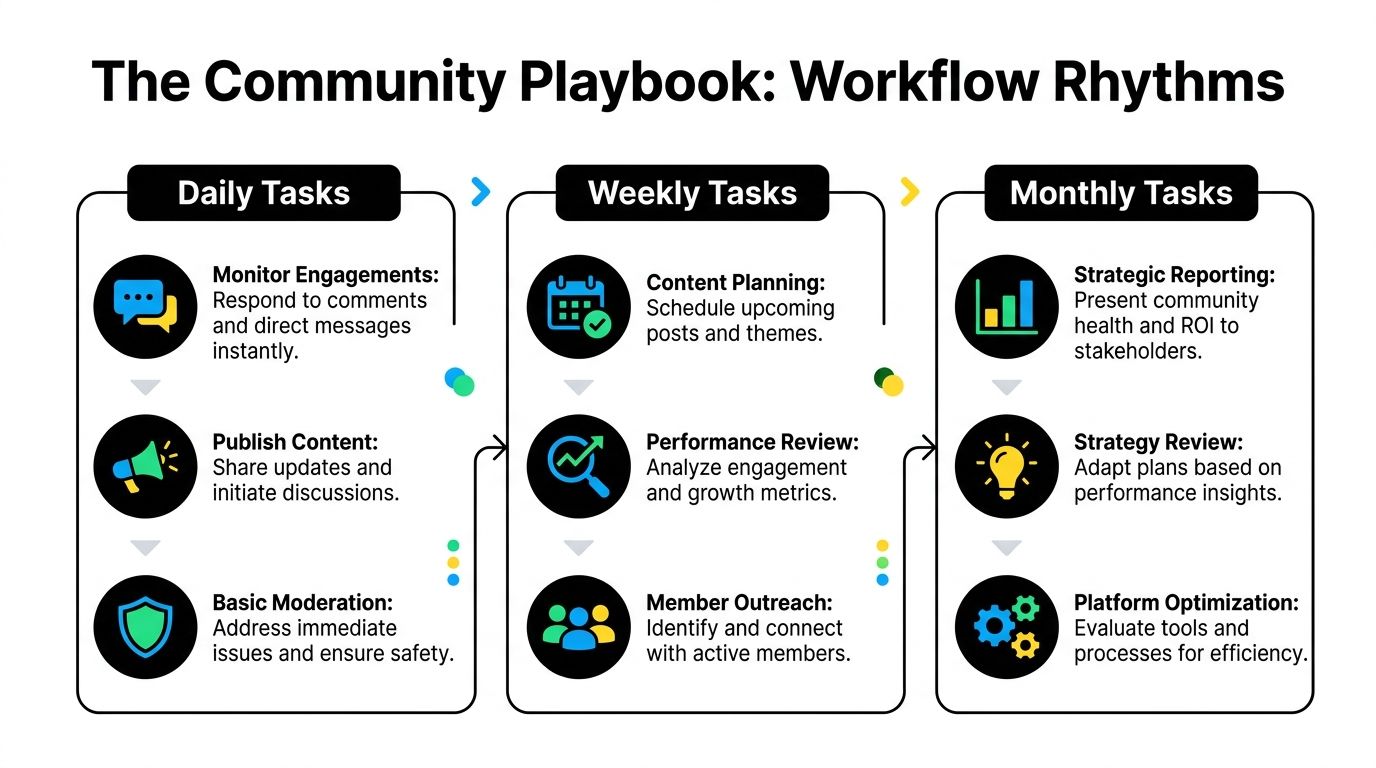
According to social media community management guidance, expert community managers track performance across daily, weekly, and monthly cycles. That guidance includes daily monitoring of response times with a target of under 2 hours for 90% of queries, followed by weekly engagement reviews and monthly content and growth evaluation.
Daily work is frontline work. It protects momentum and prevents small problems from becoming persistent ones.
A practical daily checklist looks like this:
The key trade-off is speed versus quality. Fast replies matter, but canned replies can make a professional community feel cheap. Use templates only when they save time without erasing judgment.
A fast answer isn't always a good answer. In member communities, context matters as much as response time.
Weekly work is where the manager shifts from reaction to pattern recognition.
Use the week to review:
Weekly planning should also include coordination with adjacent teams. If the event team is launching registration, the community manager should know the likely objections and be ready with conversation prompts. If the policy team is publishing a position statement, the community manager should be prepared for member reaction.
A useful content pillar model for associations can stay lean:
Sample content pillars
Member practice: real-world lessons, templates, mistakes, and workflows from peers
Industry change: regulation, technology, market developments, and expert interpretation
Association value: events, member benefits, volunteer opportunities, and education
Recognition: speakers, chapter leaders, award winners, exhibitors, and contributors
Teams often overbuild this part. Four pillars are usually enough if each one ties back to a business goal.
Monthly work is where the function becomes legible to leadership. This is reporting, analysis, and system adjustment.
A monthly review should cover:
The community manager should also bring recommendations, not just observations. Leadership doesn't need a dashboard dump. It needs decisions.
Moderation should be documented before it becomes emotional. Keep the first version simple.
If it's spam, remove it and log the account if needed.
If it's criticism in good faith, respond publicly and helpfully.
If it's a member dispute, acknowledge the issue, redirect to policy, and move to private handling when appropriate.
If it creates legal, safety, or reputational risk, escalate immediately and stop improvising in public.
That last line matters. Community managers need authority, but they also need limits. Not every thread should be solved in the comments.
A social media community manager loses credibility when reporting stays trapped in vanity metrics. Likes and impressions can be useful signals, but they don't tell leadership whether the community is becoming more valuable, more resilient, or more likely to support renewals and events.
The right measurement system focuses on activity quality, retention signals, and contribution patterns.

One of the most useful formulas comes from HubSpot's community management metrics framework: Net Membership Growth = [(Growth rate - churn rate) / churn rate] x 100.
That matters because a loud acquisition story can hide a weak community. The same source notes that ignoring churn is a pitfall in 40% of mismanaged groups, and that hidden churn can erode 20% to 30% of gains annually. Leadership teams should insist on seeing growth and loss together.
A simple example proves the point. If your association adds members to a channel but the same cohort stops participating, your community may look bigger while becoming less useful. Reporting only on new joins rewards the wrong behavior.
For professional organizations, active member ratios are more revealing than follower totals. The key benchmarks come from community manager performance measurement guidance: 57% of community managers track Weekly Active Members to Monthly Active Members, with a 50% WAM/MAM benchmark, and Daily Active Members to MAM at 20%.
Those ratios matter because they show habit. A member who shows up once after a campaign doesn't prove much. A member who returns across multiple weeks is telling you the space is becoming part of their routine.
That same source also points to another useful benchmark. Average posts or comments per member at 2.4 can signal healthy participation. For an association, that's often a better health check than aggregate reaction volume because it shows whether the community is distributed or dependent on a few familiar names.
Referral rate also belongs in the scorecard, especially for membership organizations that grow through reputation. In the KPI framework cited earlier, Referral Rate = (#referrals / total members) x 100, with a 20% benchmark for loyal groups. A healthy community doesn't just hold attention. It gives members a reason to bring in peers.
Sentiment belongs here too, but it needs interpretation. A community can have productive disagreement and still be healthy. What leadership needs is not "positive only." It needs evidence that members can question, challenge, and discuss without the space becoming corrosive. If your team wants a stronger read on conversation quality, sentiment analysis for social media is useful when paired with qualitative review, not treated as a substitute for it.
Report what members are doing repeatedly, not just what they reacted to once.
The last step is translation. A board or executive team doesn't fund community management because comment counts look interesting. They fund it when community activity clearly supports institutional goals.
Map metrics to outcomes like this:
| Community signal | What it can indicate for leadership |
|---|---|
| Higher returning activity | Members are finding ongoing value, which supports retention conversations |
| Fewer repeated support questions in public threads | Better content, onboarding, or self-service materials |
| Strong event discussion before and after registration | Higher relevance, stronger attendee confidence, and better post-event continuity |
| More peer-to-peer answers | Lower dependency on staff for every interaction |
| Healthy referral behavior | Reputation-based growth and stronger member advocacy |
Don't promise perfect attribution where it doesn't exist. Do show patterns leadership can act on. That's what turns community reporting into strategy.
Most organizations still operate on rented land. They build reach on social platforms they don't control, then act surprised when visibility drops or data fragments across tools.
That model is getting harder to defend. As noted in a discussion of hybrid community models, integrating dedicated community platforms with social channels can boost retention by 25% to 40% in membership-based groups. The same source notes that 68% of enterprise community managers reported algorithm changes reducing reach by 30% in the last 12 months. For associations, that isn't just a marketing inconvenience. It's an operating risk.
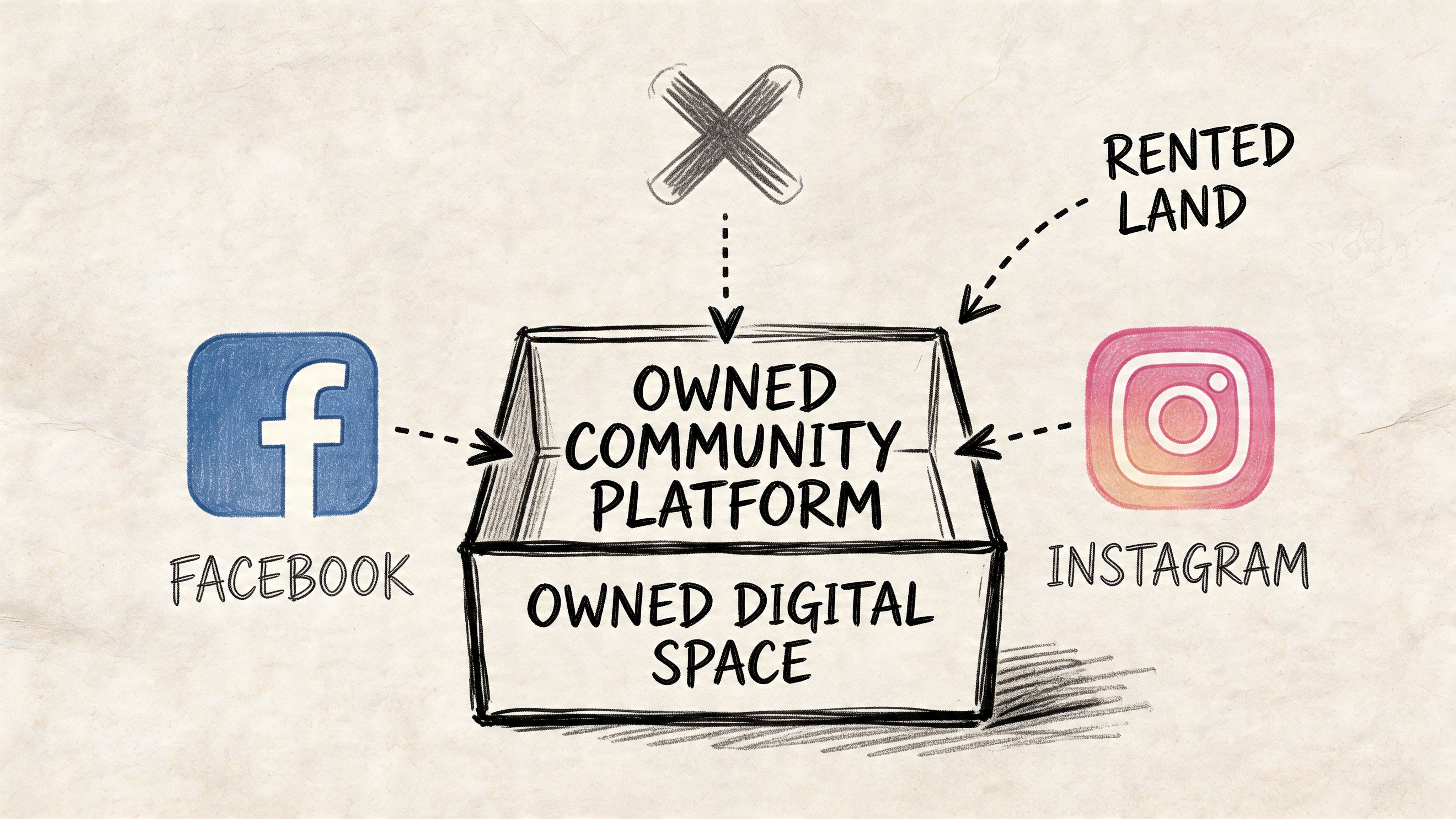
Public platforms still matter. LinkedIn can surface thought leadership. Facebook can support lighter-touch group discussion. Instagram can help with event visibility and brand texture. You don't abandon them.
Use social channels for:
The mistake is expecting public channels to function as the full community system. They weren't built for that. You don't own the environment, the data is limited, and important interactions are easy to lose.
A central community platform solves a different problem. It gives the organization one place to manage member identity, private interaction, event workflows, and engagement tracking without relying entirely on algorithmic distribution.
For professional organizations, the operational gains are straightforward:
One option is social media community management through a hybrid model where public channels attract interest and a platform such as GroupOS handles memberships, event ticketing, content, private messaging, and community interaction in one branded hub.
| Feature | Social-Only Approach | Hybrid (Social + GroupOS) Approach |
|---|---|---|
| Audience ownership | Platform controls reach and visibility | Organization controls member environment and access |
| Member identity | Fragmented profiles and uneven verification | Unified member profiles tied to your organization |
| Event experience | Promotion happens on social, registration often lives elsewhere | Promotion on social, registration and follow-up in the same ecosystem |
| Discussion quality | Public threads are noisy and hard to sustain | Private, structured spaces support ongoing professional exchange |
| Reporting | Metrics focus heavily on platform-level performance | Engagement can be tied more directly to membership and event activity |
| Sponsor and exhibitor value | Visibility is temporary and platform-dependent | Presence can continue inside a controlled community environment |
Don't force a hard switch. Hybrid works better.
Move in phases:
Social should start the relationship. It shouldn't be the only place the relationship lives.
This approach gives the social media community manager a cleaner job too. Instead of chasing fragmented engagement across disconnected channels, they can guide members from broad awareness into an environment built for actual participation.
A social media manager usually focuses on distribution, campaigns, and content performance. A social media community manager focuses on relationships, participation quality, and member experience after attention arrives.
In many associations, you need both functions even if one person temporarily covers both. The problem starts when leadership expects acquisition thinking to solve retention problems. It won't.
This is a common barrier. A recent discussion of entry-level community work notes that 75% of entry-level job seekers cite a lack of specialized portfolio examples, and suggests using free trials of all-in-one platforms to build case studies. The same source says these tools can reduce manager workload by 35%, which makes them useful training environments as well as portfolio material.
A practical portfolio plan looks like this:
That last part matters. Hiring managers want to see judgment, not just screens.
Don't walk into the room with follower charts. Bring operational evidence and business linkage.
Use a script like this:
Then ask for one decision. More staffing coverage. A better platform setup. Tighter event integration. Clearer moderation policy. Community reporting is most effective when it leads to action.
They hire for visible output instead of community quality. The result is a busy feed, a quiet membership base, and no clear link between social activity and organizational value.
A strong community function doesn't just publish more. It gives members reasons to return, contribute, and stay connected to the organization between events and renewal cycles.
If your organization wants to move from scattered social activity to a structured membership and event community, GroupOS gives you one place to manage members, content, ticketing, messaging, and post-event engagement without relying entirely on public social platforms.