April 5, 2026

Before you ever think about curriculum or role-playing exercises, you have to answer one critical question: What does success actually look like? Kicking off a high-ticket sales training program without clear goals is just wishful thinking. It’s the difference between treating training as a checkbox expense and turning it into a powerful revenue engine.

Let's be honest, vague goals like "sell more" don't cut it. You need a rock-solid vision of what you want to accomplish, defined in real numbers that matter to your organization's bottom line.
For an association or event organizer, this means tying your high ticket sales training directly to a specific business outcome. Are you trying to land bigger event sponsors? Or is the goal to sell more premium memberships? Nailing down these top-level objectives is the only way to build a program that has a real impact.
The best programs I’ve seen all start with the end goal and work backward. If your main objective is to grow event sponsorship revenue, your training needs to be laser-focused on the skills required to close six-figure deals with enterprise clients. That means getting deep into advanced prospecting, building bulletproof value propositions, and navigating those tricky buying committees.
Or maybe you run a membership business. In that case, success might be defined as a higher average lifetime value (LTV) per member. Your training should then be geared toward upselling premium tiers and fostering the kind of long-term relationships that prevent churn. When you start from your primary business goals, every single piece of the training curriculum has a clear purpose.
This isn’t just theory; it’s crucial for proving the program’s worth. Research shows that sales training can generate a staggering 353% ROI, or about $4.53 for every dollar you put in. When you see numbers like that, it's clear that targeted training is a serious revenue generator, not just another line item on a budget.
With your main business goals in hand, it's time to break them down into Key Performance Indicators (KPIs). These are the specific metrics you’ll use to track progress and prove that the training is actually working.
Good KPIs aren't complicated. They just need to be specific, measurable, and have a deadline. Think less "increase sponsorship sales" and more "achieve a 25% increase in the close rate for sponsorship deals over $50,000 within the next two quarters."
A common trap is only tracking lagging indicators like quarterly revenue. To get the full story, you have to watch the leading indicators—the daily and weekly activities that predict future success. This includes things like discovery calls booked, proposals sent, and follow-up meetings scheduled.
I've watched organizations completely change their trajectory by getting this right from day one. One association I worked with set a KPI to increase their average sponsorship package from $25,000 to $40,000. By building their high ticket sales training around value-based selling techniques, they hit that goal in under a year.
Tracking the right metrics helps you see what's really happening in your sales process. You can dig deeper into this by checking out our guide on sales funnel templates.
Here’s a look at some of the most important KPIs to track before, during, and after your training program to measure its true impact.
| KPI Category | Metric to Track | Why It Matters for High-Ticket Sales | Example Goal |
|---|---|---|---|
| Activity Metrics | Number of qualified discovery calls | Measures top-of-funnel activity and prospecting effectiveness. | Increase qualified calls by 20% per rep, per month. |
| Pipeline Metrics | Sales cycle length | Shows how quickly reps can move deals from lead to close. | Reduce average sales cycle for top-tier packages by 15% in six months. |
| Effectiveness Metrics | Close rate on deals > $25k | Directly measures the ability to close high-value opportunities. | Improve close rate on high-ticket deals from 18% to 25%. |
| Outcome Metrics | Average deal size | Indicates if reps are successfully communicating value and upselling. | Increase average sponsorship deal size by 30% year-over-year. |
By defining what success means with clear goals and metrics before you start, you're not just creating a training program. You're building a clear roadmap to real, measurable growth.
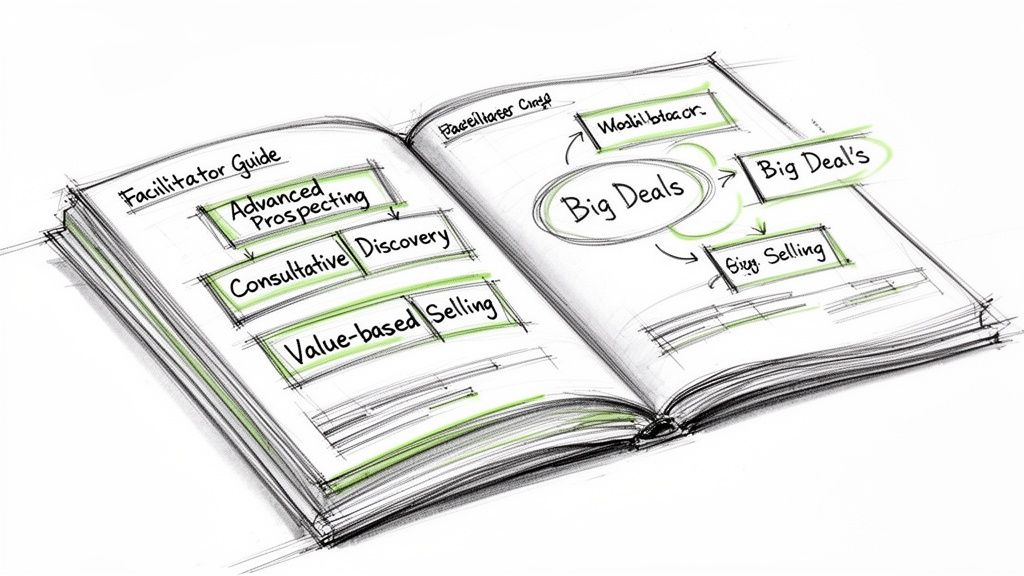
If your KPIs are the destination, a world-class curriculum is the map your team uses to get there. A truly effective high ticket sales training program hinges on its curriculum. This isn't about rehashing generic sales tips; it's about building a structured, repeatable path that directly tackles the unique challenges of closing six-figure deals.
The whole point is to build skills that stick. Every module you create, every workbook you hand out, and every guide you write for your trainers has to be rooted in practical application. This is how you turn abstract sales goals into tangible actions your team can take to consistently win bigger accounts.
To make sure you're building on a solid foundation, it’s smart to ground your program in established key sales training methodologies. This takes the guesswork out of the equation.
Forget the one-size-fits-all training you’ve seen before. High-ticket sales is a different sport, and it demands specialized skills. I've found that the most successful programs are built around three core pillars.
First up is Advanced Prospecting for High-Value Clients. This is so much more than basic lead gen. It’s about teaching your team to pinpoint organizations that actually have the budget and the specific problems your premium solution solves. This module needs to cover account-based strategies, how to map influence within a complex organization, and ways to craft outreach that actually gets a response from C-level executives.
Next, you need to go deep on Consultative Discovery and Deep Needs Analysis. When you're selling a high-ticket item, you aren't just a vendor—you're a problem solver. This part of the training gives reps the tools to ask sharp, insightful questions that uncover fundamental business pains. Sometimes, you’ll uncover problems the prospect didn't even know how to articulate. That's where the magic happens.
Finally, a huge chunk of your curriculum must be dedicated to Value-Based Selling and Price Justification. This is where your team develops the confidence to stand behind a premium price tag. The training has to show them how to construct a bulletproof business case, demonstrate undeniable ROI, and frame the price against the massive value you deliver.
What you teach is important, but how you teach it is just as critical. Nobody learns from dry, theoretical lectures. You need to create engaging, hands-on materials that your team will actually want to use.
Facilitator Guides: These are your trainers' secret weapon. A good guide doesn't just list content points; it includes discussion prompts, timing cues for each activity, and clear instructions for interactive exercises. It empowers anyone on your team to run a killer training session.
Participant Workbooks: Make these more than just a notepad. Your reps' workbooks should be interactive, with fill-in-the-blank exercises, real-world case studies to dissect, and templates for everything from discovery call questions to value proposition statements.
Quick-Reference Job Aids: The learning can't stop when the session ends. One-page cheat sheets on topics like "Handling the 'It's Too Expensive' Objection" or "5 Key Questions for Every Discovery Call" are absolute gold for reinforcing the training when a rep is in the field.
I've seen it a hundred times: companies create beautiful training binders that end up collecting dust on a shelf. The best resources are digital, available on demand, and woven right into your team's daily workflow. That's how learning actually sticks.
If you want to go a level deeper, our guide on how to develop a training curriculum lays out a detailed framework you can easily adapt.
The core principles of closing big deals are universal, but how you apply them is anything but. Your curriculum absolutely must be customized to your team's specific reality and what they're selling.
For instance, a team selling $100,000 event sponsorships needs a curriculum focused on building rapport with VPs of Marketing and proving tangible event ROI. Their role-playing scenarios should simulate tough conversations with CMOs and experienced event marketers.
On the other hand, a team selling $10,000-per-year premium association memberships has a different battle. Their training needs to hammer home the long-term value, the power of community, and the art of upselling current members. Their practice sessions will be all about demonstrating the career and business growth that justifies the premium price.
When you design your curriculum with these core modules, practical materials, and audience-specific scenarios, you’re not just creating training. You're building a machine that equips your team to consistently close the deals that define your business.
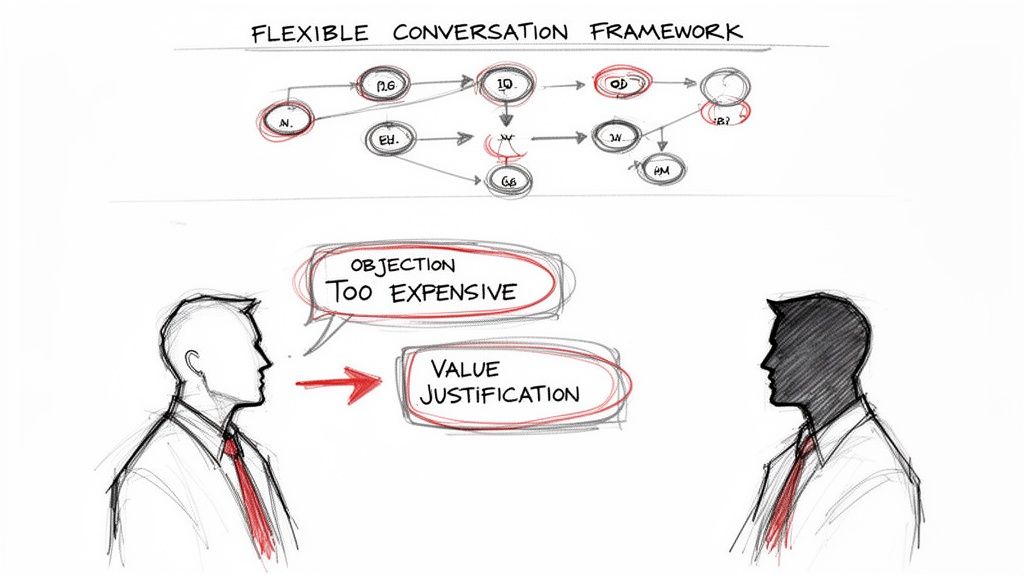
When you're talking about five or six-figure deals, the last thing a prospect wants is a sales rep reading from a script. They're not buying a product; they're investing in a partnership. That's why your high ticket sales training needs to ditch memorization and instead build mastery of a flexible conversation framework.
Think of this less as a script and more as a compass. It gives your team the essential landmarks of a great high-stakes conversation: a solid opening, a clear value proposition, and the skill to ask smart questions that steer the dialogue. The real goal is to build agile reps who can think on their feet and genuinely connect with prospects. We've seen how structured, yet flexible, approaches can dramatically improve outcomes, a principle echoed in methodologies like the one discussed in Dominating Sales with Challenger TM.
The first 30 seconds can make or kill a big deal. Your training must show your team how to cut through the noise, skip the generic pleasantries, and instantly prove they're worth talking to.
A powerful opening gets three things done right away:
Once you have their attention, you can articulate your value. This is not the time for a feature list. It’s a short, punchy statement about the tangible results you deliver. A rookie says, "Our platform has advanced analytics." A pro says, "Our clients use these insights to boost their non-dues revenue by an average of 30%, simply by pinpointing their most engaged members." See the difference?
In high-ticket sales, whoever asks the questions is in the driver's seat. The best salespeople I've known act more like investigative journalists than pitchmen. Your training program has to be laser-focused on developing this skill—the ability to dig beyond surface-level needs and uncover the real, costly business pain.
I train reps to think in three layers of questioning:
The most skilled negotiators don't sell; they lead the prospect to their own conclusion that your solution is the only logical choice. This is the core skill that distinguishes top performers in high-ticket sales.
This type of consultative dialogue and active learning is exactly what makes a modern cohort-based course so effective—it’s about participation and discovery, not just listening.
You will never close a high-ticket deal without hitting objections. The key is to train your team to see them not as stop signs, but as requests for more information. When you have a solid framework for handling them, objections become the moments where you actually build more trust and win the deal.
Let's walk through two of the most common ones.
Common Objection 1: "It's too expensive."
This is almost never about the price tag. It's about a gap between the price and the value they're currently seeing.
Common Objection 2: "I need to run this by my team/board."
This can be a genuine step, but it's often a polite stall. Your job is to make it easy for your contact to become your champion internally.
By equipping your team with these flexible frameworks, you're not just giving them scripts—you're giving them the confidence and skill to navigate any high-stakes conversation with poise and purpose.
All the best sales scripts and frameworks in the world are just theory until they're spoken out loud. The most important part of any high ticket sales training program is when your team moves from just learning the material to actually practicing it. This is where role-playing shines, turning abstract concepts into the kind of muscle memory your team needs to perform under pressure.
Think of it like a flight simulator for salespeople. Effective role-play isn't about reciting lines from a script. It’s about creating realistic, emotionally charged conversations your reps face every day. This is where they learn to handle curveball questions, navigate tricky personalities, and keep their cool when a six-figure deal is on the line. The goal is to make practice harder than the real thing. When they get into a live call, it should feel easy by comparison.
If your practice scenarios are generic, your sales team will sound generic. To build real confidence, your role-play exercises have to mirror the specific challenges your team actually faces. If they sell premium event sponsorships, the scenarios should be built around tough conversations with skeptical CMOs or procurement officers who only want to talk about price.
Your best material is sitting right in your CRM. Dig into deals that were won, lost, or stalled. What were the exact objections that came up? Who were the decision-makers? Use that intel to build detailed personas for your role-play sessions.
When you assign these specific roles and give everyone clear objectives, you move beyond simple practice. You start building genuine strategic thinking.
The real magic of role-playing happens in the feedback loop. But for your reps to be open to criticism, they have to feel safe. This isn’t a performance to be judged; it’s a practice field where it’s okay to make mistakes.
Set one firm rule from day one: feedback is always about the process, not the person. It needs to be specific and actionable. Instead of saying, "You sounded nervous," try something like, "When the prospect brought up the budget, you immediately offered a discount. Next time, let’s try reframing the conversation around the value of reaching our 10,000 attendees first."
The best feedback sessions I’ve ever been a part of are peer-led. When reps learn how to give and receive constructive criticism from their teammates, you foster a culture of constant improvement that lasts long after the training is over.
This structure helps your team get comfortable with being uncomfortable. They can test new approaches, fail without any real-world consequences, and fine-tune their pitch in a low-risk environment.
For role-play to be truly effective, it needs structure. A good session is more than just a 20-minute improv exercise; it has a clear beginning, middle, and end.
Here’s a simple three-part structure that works wonders:
This cycle of practice, feedback, and refinement is what fuels skill development. It's how your team takes the theory of high ticket sales training and turns it into the real-world confidence they need to close your biggest deals.
Let's be honest. The single biggest reason most training fails has nothing to do with the content. It’s the deafening silence that follows the workshop. The "forgetting curve" isn't just a theory; it's a ruthless force in sales. Without a smart follow-up plan, that investment you just made in your team will vanish into thin air.
Even the best high ticket sales training will fade from memory without consistent reinforcement. The numbers are staggering: salespeople typically forget 80-90 percent of what they learned in a single month. But there's good news. According to data on sales training reinforcement, organizations that use post-training coaching see 34% more first-year reps hit their quota. This simple act extends the training's impact by a massive 87%.
The goal is to shift from a "one-and-done" training event to a culture of continuous improvement, weaving learning directly into your team's weekly rhythm.
The first piece of the puzzle is giving your team instant access to all the materials. Learning in 2026 isn't about memorizing a binder full of notes. It's about knowing exactly where to find the right answer, right when it matters most.
Using a platform like GroupOS, you can build a content hub that becomes your team's go-to playbook. This isn't just a file dump; it's a living library of your sales process.
Your content hub should absolutely include:
This turns your training from a past event into a resource they use daily. If you need a hand producing great videos, our guide on training video creation walks you through making content that your team will actually want to watch.
On-demand content gives your team the 'what,' but ongoing coaching provides the critical 'how.' The most powerful reinforcement happens in structured, one-on-one sessions focused on real deals. These are not pipeline inspections; they are dedicated skill-building opportunities.
The goal of coaching is not to inspect but to improve. Focus each session on one or two specific skills your rep is working on, using their current deals as the practice ground. This makes the feedback immediate, relevant, and actionable.
For instance, if a rep is struggling to run a consultative discovery, dedicate your next session to mapping out powerful questions for their upcoming call with a major prospect. Afterward, you can review the call recording together and pinpoint exactly what went well and where they can adjust their approach.
Building confidence through practice follows a simple but powerful flow: define a realistic scenario, practice it, and deliver effective feedback.
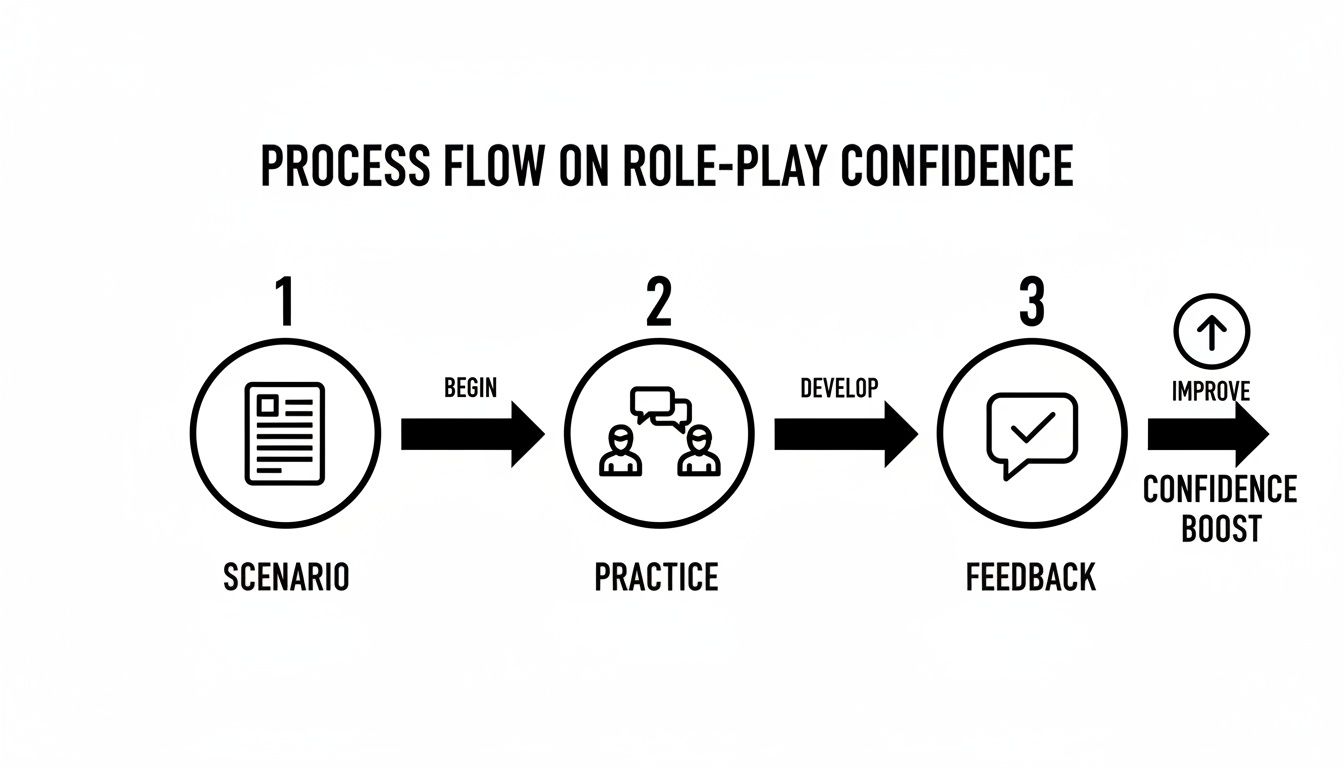
This loop is how you transform theoretical knowledge into a skill they can confidently use under pressure.
Finally, the best reinforcement programs empower the team to coach each other. You need to create a space where reps feel safe sharing their challenges and brainstorming solutions as a group.
When you combine on-demand resources, consistent coaching, and peer support, your high ticket sales training becomes more than just an event. It becomes the engine of a high-performance sales culture.
After helping countless organizations build these programs, I've noticed a few questions pop up time and time again. Leaders are always focused on two things: making sure the training actually gets used and proving it was worth the investment. Let's tackle those head-on.
If your sales team thinks the training is just another corporate initiative disconnected from their quota, they will ignore it. It’s that simple. Adoption hinges on one thing: relevance.
The secret is to build the training around the very real challenges they're wrestling with right now. What deals are they stuck on? What objections are killing their momentum? Involve your top-performing reps in the design process. When the rest of the team sees that the program is packed with strategies from the people who are consistently crushing their numbers, you get instant credibility.
Forget theoretical lectures. Instead, have them role-play a tough negotiation with a skeptical CMO persona. That’s where the real learning happens.
The single biggest lever for getting your team on board is leadership. When managers use the same language and frameworks from the training in their 1-on-1s and deal reviews, it signals, "This isn't optional. This is how we sell now."
Measuring the real impact of high ticket sales training goes way beyond tracking who completed the modules. You're looking for tangible changes in behavior that directly lead to better business outcomes.
First, look for the leading indicators—the small shifts you can see almost immediately. Are your reps asking better discovery questions? Are they confidently reframing price objections instead of immediately offering a discount? You can spot these changes by listening to call recordings or sitting in on coaching sessions.
From there, you can connect those behavioral changes to the hard numbers over the next few quarters. You’ll want to track:
When you combine this hard data with feedback from your reps and managers, you get the full story. This approach transforms measurement from a simple pass/fail grade into a roadmap for continuous improvement.
Ready to build a sales training program that sticks? GroupOS provides the all-in-one platform to create content hubs, run coaching sessions, and track engagement. See how GroupOS can help you build a high-performance sales culture.