June 6, 2026

You're probably looking at Cvent because your event stack has started to sprawl.
Registration lives in one tool. Email reminders come from another. Your onsite team uses a separate check-in app. Finance exports payment data manually. Marketing wants CRM sync. Leadership wants clean reporting across every event. At that point, buying a larger platform sounds rational. The central question isn't whether Cvent can handle complexity. It can. The harder question is whether your organization ultimately benefits from that complexity once implementation, governance, training, and day-to-day administration enter the picture.
That's where most software evaluations go wrong. Buyers compare feature lists and skip the operating model behind the product. With Cvent Event Management Software, that operating model matters as much as the feature set. A global enterprise events team may see structure and control. A membership organization running recurring chapter events may see friction, slower setup, and a lot more system ownership than expected.
A common evaluation starts the same way. An organization outgrows a patchwork of registration, email, check-in, reporting, and venue workflows, then looks for one platform that can impose order across the program. Cvent usually enters that conversation because it has been in the category for decades and is widely used by large event teams.
At a high level, Cvent is event management software designed to centralize planning and execution across the event lifecycle. Depending on the product mix an organization buys, it can cover registration, attendee management, event websites, communications, onsite operations, virtual components, and venue sourcing. For readers comparing the category before judging any single vendor, this overview of what event management software is provides useful context.
The important point is not only that Cvent offers many modules. Enterprise buyers often consider it because those modules are meant to operate inside one administrative system, with shared data, permissions, and reporting structures. That architecture tends to matter more for organizations running portfolios of events across regions or business units than for teams running a small number of simpler programs.
Cvent is best understood as event operations infrastructure.
That distinction affects the buying decision. Infrastructure can reduce fragmentation, standardize workflows, and satisfy procurement requirements. It also introduces setup work, governance decisions, training needs, and ongoing administration that smaller teams sometimes underestimate. The total cost of ownership is rarely just the subscription. It includes the internal labor required to configure the system well, maintain standards across departments, and keep integrations, templates, and user permissions under control.
Cvent benefits from incumbency. Buyers know the brand, consultants and agencies are familiar with it, and large organizations often view established platforms as lower-risk purchases for regulated or multi-stakeholder environments.
That logic is reasonable, but incomplete.
A well-known platform can still be a poor fit if the operating model is heavier than the event program requires. A global enterprise team may see needed control. A mid-market company with a lean events staff may see more system administration than practical. A membership organization may find that event execution is only one part of the requirement, and that member engagement, chapters, committees, and ongoing community interaction sit outside Cvent's center of gravity.
Three questions usually determine whether Cvent fits.
Used in the right setting, Cvent can create order across a complicated event portfolio. Used in the wrong one, it can formalize complexity without creating proportional value.
A common buying scenario looks like this. The events team wants one system for registration, email, check-in, reporting, and CRM sync. Procurement sees lower vendor sprawl. Operations sees standardization. Six months later, the real question is not whether Cvent has those features. It is whether the organization can support the process discipline, template governance, and integration work that make those features pay off.
Cvent's core feature set is broad and tightly connected. Its product materials describe a single platform for event marketing and management, attendee registration, onsite solutions, content and speaker workflows, and reporting across the event lifecycle, as outlined on Cvent's event management software page. The practical advantage is straightforward. Registration data, payment records, communications, agenda selections, and onsite activity can stay tied to the same event record instead of being split across separate tools and exports.
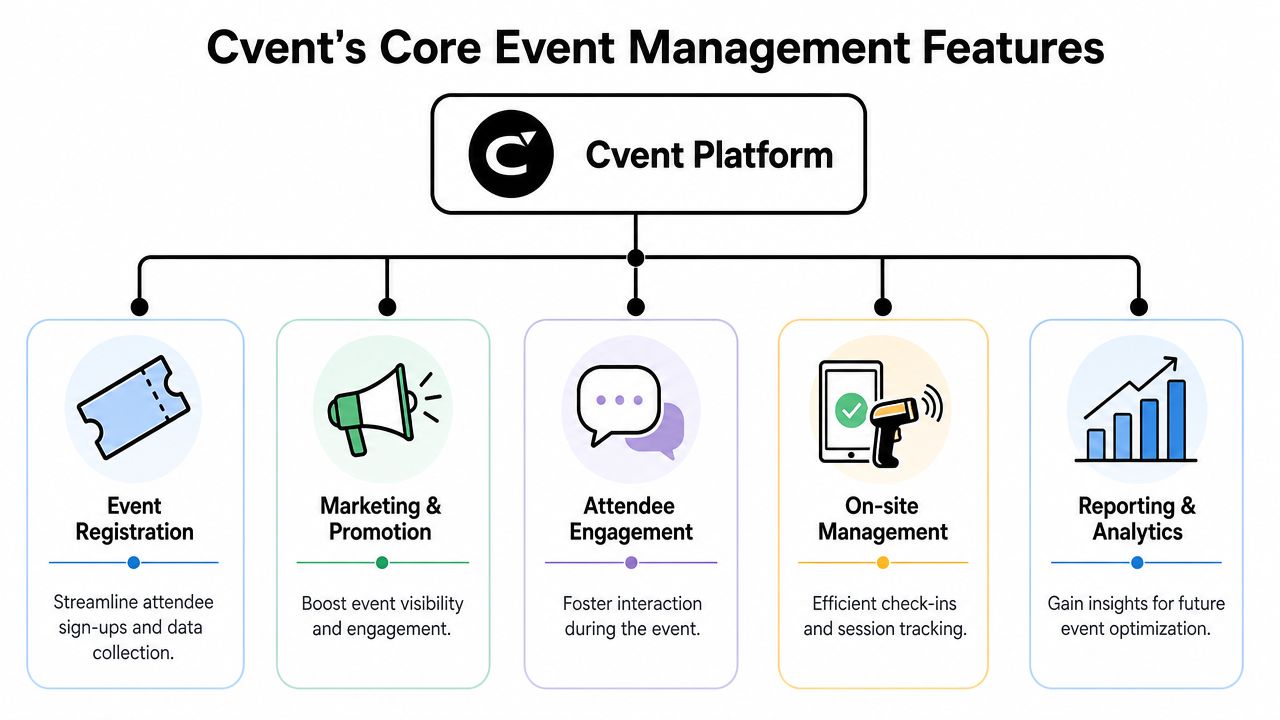
If you want a broader framework for evaluating event management software features, use Cvent as a reference point for what a fully integrated event stack looks like, not just a long checklist.
Cvent is strongest in event setup scenarios with multiple moving parts. That includes branded registration paths, role-based forms, session selection, payment collection, approval flows, invitation segments, and automated communications managed from one administrative layer.
That design reduces a specific kind of operational waste. Teams spend less time reconciling attendee records between the registration system, email platform, finance reports, and session signup spreadsheets.
It also changes who can work independently. Marketing can manage invite and reminder logic inside the event workflow. Program teams can structure agendas and capacities in the same system that attendees use to register. Finance has a cleaner line from registrant to payment record.
The tradeoff is configuration overhead. A simple event can inherit enterprise-level setup logic if the organization standardizes too aggressively. For a global events program, that may be acceptable because consistency matters. For a lean mid-market team running a limited number of events, the administrative burden can outweigh the benefit.
Cvent continues to show its value onsite, where fragmented systems usually break first. Check-in, badge printing, walk-in registration, session scanning, and capacity management all depend on current attendee data.
Cvent's onsite tools benefit from drawing on the same event environment used for registration and communications. Staff are less likely to work from outdated lists or manually patch attendee status across separate systems. That matters most in high-volume or high-stakes events where delays at registration desks create visible problems fast.
The benefit is operational control, not convenience alone.
If an organization runs conferences with complex attendance rules, paid upgrades, or many concurrent sessions, that control can reduce errors. If it runs straightforward member events with modest attendance, the same operational layer may feel heavier than necessary.
Post-event reporting is one of Cvent's more credible strengths because attendance, registration behavior, session activity, and revenue data can live in the same system. That makes cross-event analysis more realistic than it is in a stack built from loosely connected point solutions.
Cvent also offers integrations and APIs that support connections to CRM, marketing automation, and other business systems, according to Cvent's integrations and API resources. For enterprise teams, that matters less as a feature headline than as a governance question. An integration catalog is useful, but it does not remove field mapping decisions, ownership disputes, testing cycles, or the need to maintain data standards across departments.
That is the less advertised part of Cvent's feature story. The platform can centralize event operations, but centralization creates new work. Someone has to manage templates, permissions, naming conventions, duplicate records, integration rules, and reporting definitions.
For enterprise organizations, that overhead often buys control and consistency at scale. For mid-market companies and membership organizations, the calculation is different. If the actual requirement includes year-round community engagement, committees, chapters, member directories, or discussion spaces between events, Cvent's event-centered architecture may leave important workflows outside the core system. In those cases, a more integrated community platform can produce a lower total cost of ownership even if its event feature list is shorter on paper.

A practical way to assess Cvent is to picture a central events team supporting dozens of business units, each with its own deadlines, approval chains, attendee segments, and reporting demands. In that setting, the software's complexity can be justified because the alternative is often a patchwork of spreadsheets, disconnected registration tools, and inconsistent data.
That does not make Cvent the default choice for every organizer.
Cvent fits best where events are high-stakes operational programs rather than occasional campaigns. The strongest candidates are organizations that need standardized workflows across many events, formal controls over registration and onsite execution, and a system that can support multiple internal stakeholders without reinventing the process each time.
Cvent tends to make the most sense for teams with enough scale or risk to justify a heavier operating model:
In these environments, Cvent's administrative overhead often buys something concrete: fewer workarounds, tighter process control, and less dependence on tribal knowledge inside the events team.
The equation changes for mid-market companies, chapter-based associations, and membership organizations with lean staff. These teams often need software that staff, volunteers, or local organizers can use with limited training. They also tend to care less about modeling every event variation and more about reducing setup time across recurring programs.
That matters because Cvent is not only a software purchase. It is also a governance decision. Someone usually needs to own templates, permissions, naming standards, field definitions, approval rules, and training. Large enterprises often absorb that work as the price of control. Smaller teams can end up carrying enterprise-grade process overhead without getting enterprise-scale value in return.
Membership-focused organizations should look especially carefully at this tradeoff. If events are only one part of the member experience, alongside chapters, committees, directories, discussions, renewals, and ongoing engagement, an event-centered platform can leave too much of the operating model outside the core system. In those cases, a community platform with built-in event management may produce a lower total cost of ownership even if it offers fewer configuration options.
Use this table as a buying filter:
| Organization pattern | Likely fit with Cvent |
|---|---|
| Global or multi-region event program with centralized oversight | Strong |
| Annual conference with complex registration logic and onsite operations | Strong |
| Mid-market team running repeatable field events with limited admin capacity | Mixed |
| Membership organization where events support a broader community strategy | Mixed to weak |
| Community-led organization that needs year-round engagement in one system | Weaker |
The non-obvious point is that Cvent is often easiest to justify when internal complexity is already high. If your team is trying to simplify operations, not formalize them, the platform can solve one problem while creating another.
Cvent pricing is usually quote-based, and that's consistent with how the product is sold. A platform built for different event types, operational models, and integration requirements rarely fits a simple public pricing table. Buyers should expect a sales process that starts with use case discovery, not a self-serve checkout.
That pricing structure tells you something important about total cost of ownership. With Cvent, the contract is only one layer. The deeper cost question is how many product areas you'll license, how many internal stakeholders will use them, and how much setup your team can absorb without outside help.
Even without a public rate card, buyers can prepare for the variables that usually matter in enterprise event software evaluations:
The hidden pricing issue isn't just platform cost. It's whether the organization needs additional internal capacity to run the platform well.
That may include a system owner, training time for event staff, documentation for recurring event templates, and governance rules for who can create what. For some teams, that's acceptable because Cvent replaces a patchwork of tools and manual processes. For others, the software quote is only the beginning of the spend.
A productive sales conversation starts with operational honesty. Don't just describe your event calendar. Describe who builds events, who approves them, what systems need data, and how much self-service your teams need.
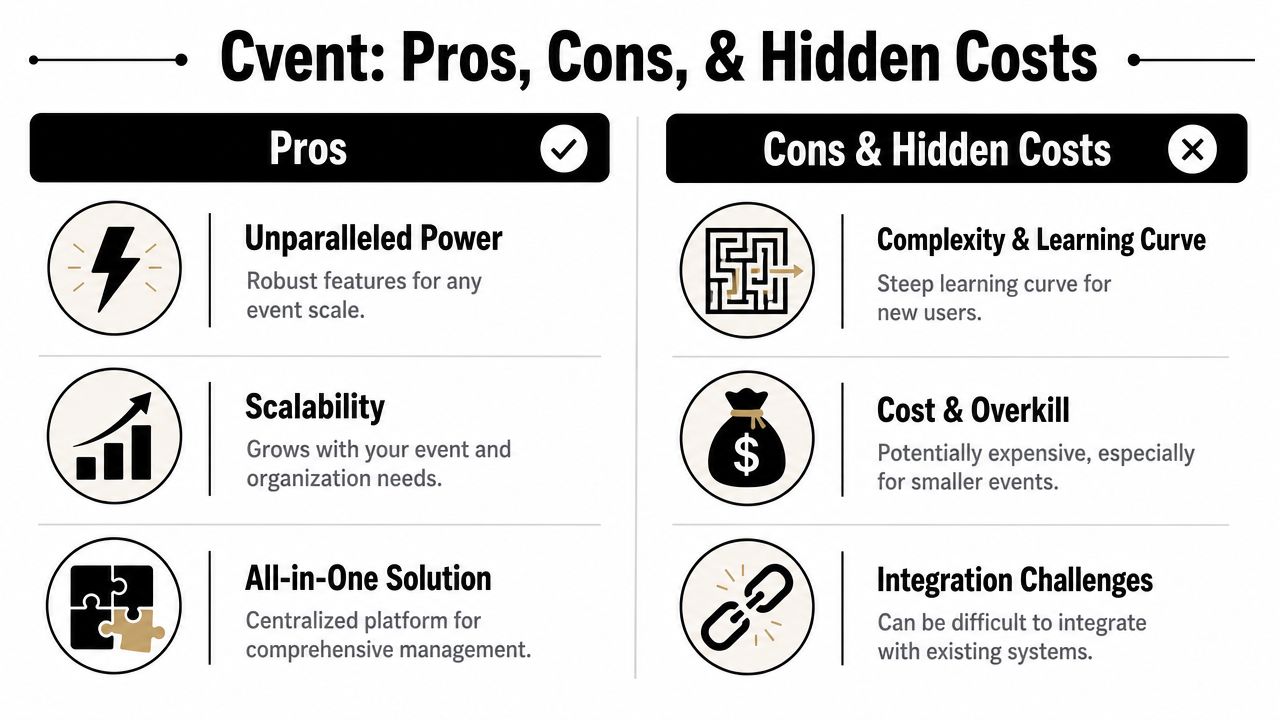
A familiar scenario plays out during software selection. A central events team buys Cvent for standardization, procurement gets the vendor count down, and the first flagship event launches successfully. Six months later, chapter leaders, marketers, and operations staff are all using the same platform in different ways. The question shifts from feature fit to operating cost.
That is the right way to evaluate Cvent. Its value is not defined only by what the platform can do. It depends on how much process discipline, admin ownership, and internal training your organization can sustain without slowing event delivery.
Cvent has clear strengths, especially in environments where event operations need structure and control across many stakeholders. The platform is well suited to organizations that need registration logic, agenda management, onsite execution, sponsor coordination, and reporting in one system. For enterprise teams with recurring complexity, centralization can reduce tool sprawl and create more consistent execution.
Cvent tends to perform best when the event program already looks like an internal operation, not an occasional marketing project.
Those advantages are meaningful. They are also easier to capture when the buyer has a dedicated operations function, not just an event planner who also handles email, web updates, and reporting.
The biggest cost driver is usually not the subscription. It is the operating model required to use the platform well.
Start with implementation overhead. A system with this much range forces decisions about data fields, naming conventions, permissions, registration templates, approval rules, and reporting definitions. Those choices affect every future event. If they are rushed or left to different teams to interpret on their own, consistency breaks down quickly.
Training is the next issue. Cvent can support detailed event programs, but that depth asks more from the people building and maintaining events. New users need onboarding. Experienced users need governance. Volunteer-led teams or chapters with high staff turnover often struggle here because platform knowledge does not stay in one place long enough to compound.
Governance becomes the longer-term challenge. Central teams want standard templates, clean reporting, and brand control. Local teams want speed, flexibility, and fewer approval steps. Cvent can support centralized governance, but governance itself takes work. Someone has to define the rules, document them, enforce them, and update them when the event portfolio changes.
Software does not become simpler because setup gets marketed as faster. The operational work still exists. It just moves onto your team unless ownership is explicit.
That pattern appears in adjacent categories too. This analysis of webinar costs for professional firms makes the same point from a different angle. License fees are easy to price. Staff coordination, production processes, and workaround time are what push total cost upward.
Here's the video overview if you want a product-side perspective before talking to sales:
Cvent is often strongest for enterprise event teams and somewhat harder to justify for mid-market organizations that run repeatable programs with lean staff. If your main requirement is launching events quickly with limited admin overhead, breadth can become a tax. You are paying for flexibility and control, then investing extra time to configure and govern it.
That tradeoff matters even more for associations, membership organizations, and community-led programs. In those models, events are rarely a standalone workflow. They connect to member records, ongoing communication, content access, committees, sponsor relationships, and year-round engagement. A platform built around the event itself may solve registration well while leaving the broader relationship system fragmented.
For that reason, some buyers should compare Cvent against platforms that treat events as one part of a larger engagement stack. This broader view of event management software for organizations running recurring programs is useful if your team is weighing event infrastructure against member or community management needs.
The main risk is not that Cvent fails. The main risk is overbuying. An organization licenses enterprise event infrastructure, uses a limited portion of it, and still absorbs the full burden of administration, training, and governance. For global teams, that can be acceptable. For smaller, decentralized, or membership-focused organizations, it can be a sign to look for a more integrated platform with a lighter operating footprint.
The cleanest way to compare alternatives is by job to be done.
If you run a high-complexity conference with many audience types, formal registration paths, and a need for deep event controls, Cvent has a clear advantage. Cvent's data model supports segmented registration logic for personas such as attendees, staff, speakers, and exhibitors, allowing different rules and pricing paths without rebuilding separate event sites, as shown in this Cvent product demonstration. That's serious event infrastructure.
But not every organization needs event infrastructure first.

Some buyers should look beyond classic enterprise event suites:
These organizations often need a platform that treats events as one function inside a broader relationship system.
An interesting aspect of the market emerges: Cvent is optimized for managing events as operational units. Membership-focused organizations often need something different: a system that combines registrations, member data, communication, content, and sponsor visibility in one place.
For readers evaluating that category, this overview of event management software options gives useful context on how these platforms differ.
One option in that broader category is GroupOS, which combines membership operations, ticketing, content delivery, and communication in one branded environment. That design fits organizations where the event isn't the product by itself. The member relationship is.
| Criteria | Cvent | GroupOS |
|---|---|---|
| Primary operating model | Event-first platform | Community and membership platform with events |
| Best fit | Complex conferences, enterprise event programs | Associations, networks, and member communities |
| Registration flexibility | Strong for segmented attendee personas and layered paths | Built for ticketing and custom forms within broader member workflows |
| Onsite event operations | Strong check-in and badge-focused workflow | Supports event operations but centers broader community engagement |
| Year-round engagement | Typically requires adjacent systems | Built to combine content, communication, and member interaction |
| Admin model | Better suited to teams that can support governance and configuration | Better suited to teams that want fewer separate systems around events |
If your team asks, “How do we run this conference?” Cvent may be the right conversation. If your team asks, “How do we keep members engaged before and after the conference?” you're in a different product category.
That distinction is easy to miss during demos because most vendors can show registration pages, emails, and analytics. A key difference is what the platform assumes about your organization. Cvent assumes events are complex enough to justify a sophisticated operating layer. Community-centric platforms assume relationships continue when the event ends.
The software decision is only half the project. Most platform rollouts succeed or fail based on process discipline, not vendor demos.
Start with data. Clean your contact records, retire duplicate fields, and decide which system owns which data before migration begins. If that work is still ahead of you, these database migration best practices are worth reviewing before you sign anything.
Don't wait until after go-live to decide who can create events, edit templates, manage payments, or export reports. Those decisions shape consistency, security, and staff confidence.
A simple governance checklist helps:
Training should mirror how your team runs events. Show chapter leaders how to launch a local event. Show marketers how to handle reminders and attendee exports. Show finance what they need for reconciliation.
One practical mistake I see often is overtraining on features and undertraining on process. Teams don't need a product tour. They need role-specific playbooks.
Your launch goals should be operational. Faster event setup. Better reporting consistency. Fewer manual handoffs. Cleaner attendee records. Stronger follow-up.
That mindset applies beyond event tech. This article on strategy insights for social media managers is a useful reminder that channel tools only work when the team has clear operating goals and repeatable workflows. Event platforms are no different.
Choose the software that matches your organization's real capacity. Then build the internal habits that make it worth the investment.
If your organization needs a platform that connects events with memberships, content, and ongoing communication, take a look at GroupOS. It's designed for organizations that want event management inside a broader community operating model, not as a disconnected standalone tool.