December 28, 2025
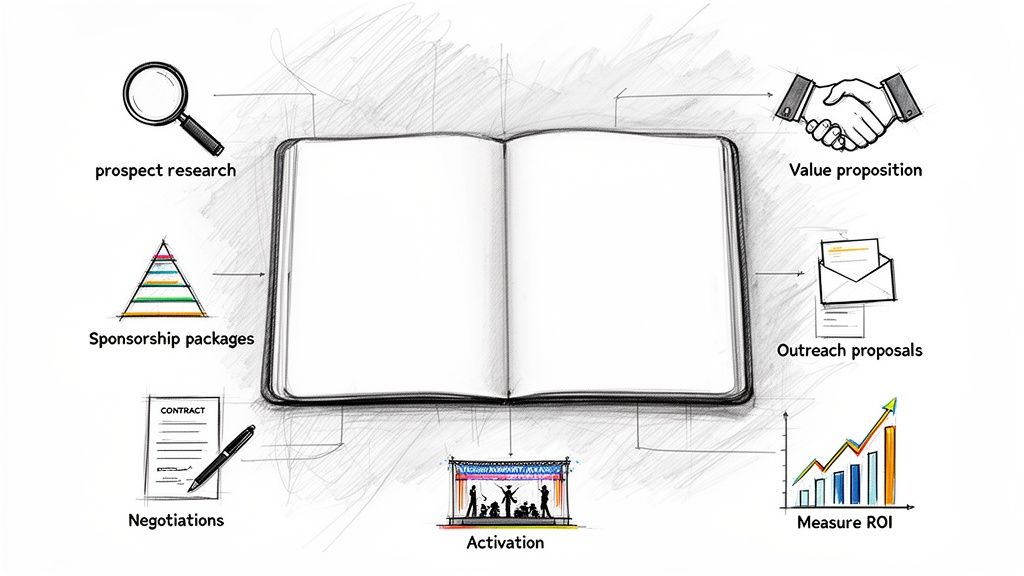
Securing a corporate sponsorship isn't like asking for a donation; it's about forging a strategic partnership. This means you have to stop thinking like a fundraiser and start thinking like a business partner. The secret is finding companies whose target audience perfectly overlaps with your members, proving a clear return on their investment with solid data, and offering real marketing value that goes way beyond a simple logo on a banner.
When you frame your offer this way, you're no longer just asking for money. You're presenting a can't-miss business opportunity.
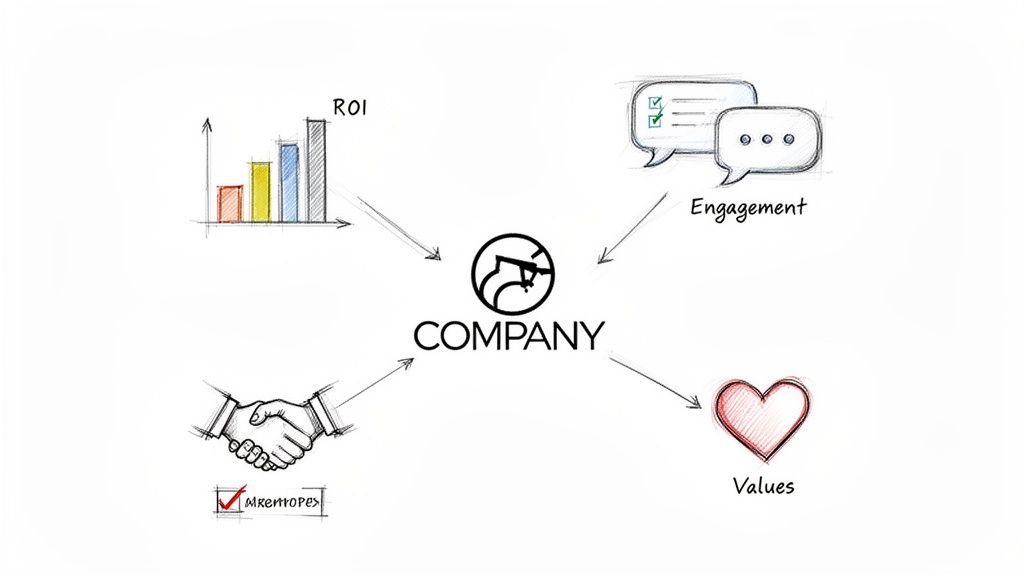
Before you even think about drafting a pitch, it's absolutely crucial to get inside the head of a modern sponsor. The old playbook—offering cookie-cutter bronze, silver, and gold packages filled with passive logo placements—is gathering dust on the shelf. Today's sponsors are sharp marketers, and they see sponsorship as a calculated part of their overall marketing strategy, not as a charitable handout.
These decision-makers are held accountable for every dollar in their budget. They have to justify their spending with results, which means they're hunting for measurable returns, not just fuzzy concepts like "brand awareness." They need to know exactly how partnering with your association or event will help them hit their own business goals.
The game has changed. Sponsors today care a lot less about how many people might see their logo and a whole lot more about how many people interact with their brand. That's a fundamental difference you can't afford to ignore.
What are they really after? Their goals usually boil down to a few key things:
To really see how much things have evolved, let’s compare the old way of thinking with the new.
This table makes it clear: the conversation has moved from "how many people will see us?" to "how many qualified leads can we generate?"
Your winning proposal needs to show that your community is the single most effective way for a sponsor to connect with their target audience in a meaningful way that traditional advertising just can't match. You’re selling direct access and genuine interaction, not just visibility.
If you want to get a "yes" from a corporate sponsor, you have to speak their language. That language is data. They need hard numbers to build a business case and justify the investment to their higher-ups. So, before you ever reach out, you need to get your own analytics in order.
The market you're tapping into is massive. Global brands poured an estimated $97.4 billion into sponsorships back in 2022, and that figure is expected to blow past $100 billion by 2025. This means there's a huge pool of money available, but it also means the competition is fierce. You have to show up prepared.
This means being ready to share metrics like your website traffic, social media engagement rates, email list size and open rates, and—most importantly—detailed audience demographics. The more specific your data, the more powerful your pitch. We dive deeper into this in our complete guide on how to obtain sponsorships from corporations.
Let's be honest: your sponsorship packages are the product you're selling. If you're using a generic, one-size-fits-all approach, you're setting yourself up for rejection. Your real goal is to stop just listing benefits and start building a compelling offer that speaks directly to a sponsor's specific marketing goals and budget. Think of it less like a restaurant menu and more like a strategic investment portfolio you're curating for them.
The most effective way to do this is by creating tiered packages. You’ve seen them before—usually called something like Platinum, Gold, and Silver—and for good reason. This structure gives companies of all sizes a clear entry point while making your top-tier package the undeniable best deal in terms of overall value. Each tier needs to be a cohesive bundle of benefits, not just a random handful of perks thrown together.
Sponsors today want tangible results they can take back to their team, things that help them generate leads and genuinely connect with your members. While putting their logo on a banner still has its place, it should be the bare minimum, not the main attraction. The real value is in the assets that create meaningful interactions.
Here are a few high-value digital assets you should be building into your packages:
For example, here’s how the GroupOS platform lets you feature sponsors and exhibitors directly within your event space, giving them a real home base.
This isn't just a logo slapped on a page. It's a branded space where sponsors can connect with attendees, and you can deliver real, measurable value.
Figuring out how much to charge is where a lot of people get stuck. The biggest mistake is basing your prices solely on your event costs. Your pricing should reflect the immense value you're providing: direct access to a highly targeted, qualified, and often hard-to-reach audience.
Start by calculating the direct costs for each deliverable (like the software cost for running banner ads). Then, assign a fair market value to the exposure and lead-gen potential you’re offering. A good rule of thumb is to make sure each tier offers progressively better value. For example, your Platinum package priced at $15,000 should deliver a bundle of benefits that would clearly cost a sponsor well over $20,000 if they tried to buy them separately.
The key takeaway here is to price your packages based on the sponsor’s potential ROI, not your own expenses. When you frame it as an investment in their marketing pipeline, the price becomes much easier to justify.
While tiered packages give you a solid structure, being too rigid can kill a deal before it even starts. You should always leave the door open for customization by offering some à la carte options. This flexibility is what lets you build a perfect-fit package for a sponsor with very specific goals or a unique budget. It also opens up some really creative activation ideas.
Consider offering some unique, standalone sponsorship opportunities like:
This hybrid approach—structured tiers plus flexible add-ons—is a winning formula. It shows sponsors you’ve thought through their needs while still providing clear, easy-to-buy options. For a much deeper dive into structuring these offers, you might find our guide on creating compelling event sponsorship packages helpful.
The sponsorship landscape is always changing. Today's sponsors demand measurable outcomes and authentic alignment with their brand's purpose. In fact, industry analysis shows that content tied to social causes can generate around 33% more engagement, and social-impact sponsorships saw a growth of about 21% year-over-year in 2024. This trend highlights just how important it is to offer packages that include digital activations and real, data-driven measurement, proving that you’ve moved beyond just counting impressions. To see more on this shift, you can explore detailed findings in these global sponsorship trend reports.
Blasting out a hundred generic proposals is the fastest way to get a hundred rejections. I've seen it happen time and time again. The real secret to securing corporate sponsorship isn't about casting a wider net; it's about fishing in the right pond with the perfect bait. That means ditching the massive spreadsheet of random companies and focusing on a short, highly-targeted list of ideal partners.
Think of it this way: your sponsorship hunt is a lot like building a robust sales pipeline. It demands serious research and a thoughtful approach long before you even think about writing a proposal. You're searching for a genuine fit—a partnership where your audience is the exact group a company is desperate to reach.
Before you can find them, you have to know who you’re looking for. The best place to start is by looking at your own community. Who are your members? What are their job titles, industries, biggest challenges, and passions? Dive into your own data—your member database or a platform like GroupOS can be a goldmine here—to build a detailed audience persona.
This persona is your compass. Once you know exactly who your audience is, you can build a profile of the company that wants to meet them.
The goal isn't just to find companies with deep pockets. It's to find companies that will see a partnership with you as a strategic investment essential to hitting their own growth targets.
With your ideal profile in hand, it's time to play detective and build your prospect list. This goes way beyond a quick Google search. You need to dig into what these companies are actually doing.
Check their social media, read their press releases, and see what the industry news says about them. Are they launching a new product that your members would love? Did their CEO just give a talk about expanding into a market where your community has deep expertise? These are the little details that transform a cold pitch into a compelling, personalized conversation.
This is also where you can start thinking about how to structure your offerings. You'll want to create different levels of engagement for sponsors, giving them a clear path to grow with you.

A tiered model like this, moving from Silver to Platinum, makes it easy for a sponsor to start small and then deepen their investment as they see the value you deliver.
Your time is your most valuable asset. A simple qualification process helps you zero in on the prospects with the highest probability of saying "yes." I recommend creating a straightforward scoring system to rank your potential sponsors.
Sponsor Qualification Checklist:
My rule of thumb? Any prospect scoring above a 15 on this checklist is a high-priority target. Those who score lower can go on a secondary list, but they don't get your prime-time attention. This disciplined approach keeps you focused on building a pipeline of highly qualified partners who are already primed for a partnership.
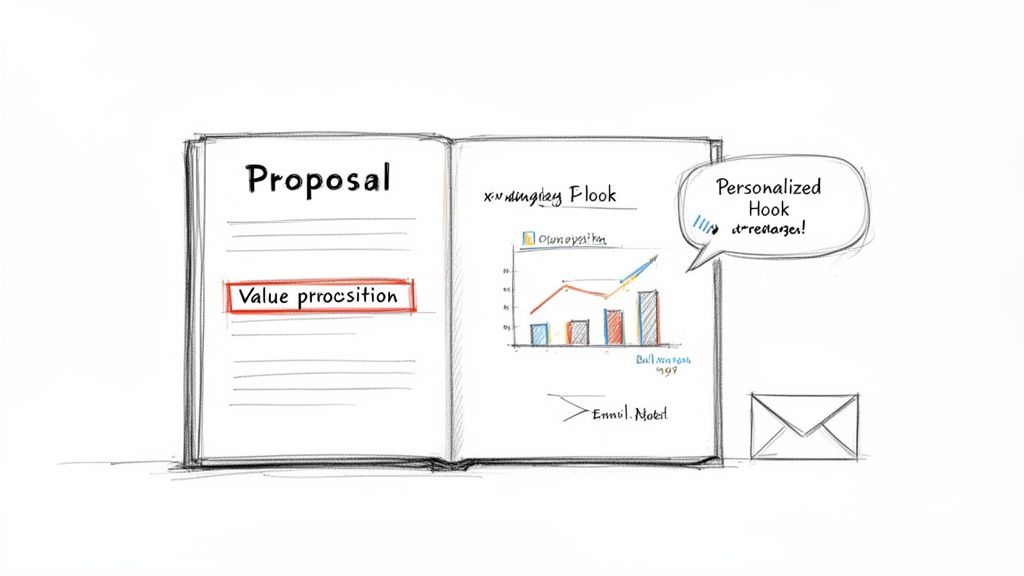
Okay, you’ve done the research and qualified your best prospects. Now comes the moment of truth: the sponsorship proposal. This isn't just a price list; it’s the document that transforms all your hard work into a compelling business case for partnership.
Let’s be blunt: a generic, one-size-fits-all proposal is a one-way ticket to the trash folder. Your mission is to create a document so personalized and insightful that the sponsor feels like you understand their business as well as they do. You need to connect the dots for them, showing exactly how your community’s unique value helps them hit their specific goals.
Whatever you do, don't open with a bland summary of your organization. Your first paragraph is your one real chance to prove you’ve done your homework and that this isn't just another mass email. A strong opening immediately signals this proposal was built just for them.
Reference something specific—a recent company milestone, a new product launch, or even a quote from their CEO. For instance, you could open with: "I saw your recent launch of the 'Eco-Smart Widget' and noticed its target audience of environmentally-conscious millennials aligns perfectly with our community's core demographic."
This small touch changes the entire dynamic. You’re no longer just another person asking for money. You’re a potential strategic partner who sees a real opportunity for them.
This is where the rubber meets the road. Vague promises of "exposure" and "brand awareness" are meaningless. Sponsors need cold, hard numbers to justify the investment to their boss. That audience persona you built earlier? It’s now your most powerful tool.
Lay out your community's demographic and engagement data clearly. Use bullet points and bold text to make the key stats impossible to miss.
Your proposal needs to tell a data-driven story. The narrative should be simple: "Here is exactly who our members are, here is how engaged they are, and here is why they are the perfect audience for your brand."
When you get to your sponsorship packages, don't just list features. Frame every single line item as a solution that delivers tangible value. Instead of saying "Logo on website," reframe it as "Continuous brand visibility to our 15,000 monthly website visitors." See the difference?
Always present your packages (e.g., Platinum, Gold, Silver) in a clean, easy-to-compare table. The goal is to visually guide their eyes to the higher tiers, making it obvious that the Platinum package isn't just the most expensive—it’s the smartest investment for maximum impact.
If you want a head start on structuring this, our comprehensive guide includes a detailed event sponsorship proposal template you can adapt for your own use.
A brilliant proposal is useless if it never gets opened. Your initial email is your foot in the door, and the subject line is everything. Ditch the generic "Sponsorship Opportunity" and try something that sparks curiosity.
A few subject lines that actually work:
Keep the email itself short, personalized, and to the point. Restate your personalized hook, nail your value prop in a single sentence, and then clearly state that you've attached a detailed proposal. The only goal of this email is to get them to open the PDF. Let the proposal do the heavy lifting from there.
Getting that verbal "yes" from a sponsor feels fantastic, but it's not the finish line. It’s actually the starting gun for the most important phase: activation. This is where you move beyond promises on paper and start delivering tangible value that gets sponsors excited to come back year after year.
The entire journey, from the moment the contract is signed to the final ROI report you deliver, directly influences their decision to renew. Let's break down how to nail it.
Before a single banner ad goes live, you need a rock-solid contract. This isn't just a formality; it's the shared playbook for the entire partnership. A great contract eliminates guesswork and sets crystal-clear expectations for both sides.
Your agreement needs to spell out every single deliverable in detail. Don't just say "sponsored push notifications." Instead, specify "three sponsored push notifications, 150-character limit each, with content due 72 hours prior to send." If they get a booth, define its exact dimensions, location, and setup times. Clarity is your best friend.
Make sure your sponsorship agreement includes:
A thorough contract protects everyone and prevents those awkward "I thought we were getting..." conversations down the line. It’s the foundation for a smooth, professional partnership.
Activation is all about making the sponsorship real—it’s how your partner actively and meaningfully engages with your audience. To truly deliver, you have to understand what brand activation truly entails. It’s about creating memorable experiences that forge a genuine connection between their brand and your community.
Put on your project manager hat. The best way to stay on top of everything is to create a master activation schedule. Map out every deliverable, every deadline, and which team member owns it.
For digital benefits, this means precision scheduling is key. If a sponsor bought banner ads in your community platform, use a tool like GroupOS to schedule them during peak traffic hours for maximum impact. Don't just set it and forget it—monitor the performance and be ready to make adjustments.
Physical activations at an in-person event require even more hands-on coordination. This means overseeing booth setup, ensuring their A/V equipment works flawlessly, and having a dedicated point of contact on-site who can solve any problem immediately. A smooth, stress-free experience for the sponsor's on-site team is worth its weight in gold.
A great sponsorship experience is proactive, not reactive. Anticipate your sponsor's needs. Send them friendly deadline reminders, show them a preview of their banner ad before it goes live, and check in on their booth staff with a bottle of water. It’s the little things that make a huge difference.
This is the final, and arguably most important, piece of the puzzle. You have to prove the value of their investment with cold, hard data. A comprehensive post-event ROI report is your single most powerful tool for securing that renewal. It needs to be professional, data-rich, and tied directly to the goals they told you they had from the very beginning.
Move beyond fuzzy metrics like "impressions." Sponsors need to see numbers that connect to real business outcomes.
Key data points to pack into your ROI report:
Using a platform with built-in analytics makes this whole process infinitely easier.
A dashboard like this gives sponsors a clear, visual breakdown of engagement, showing exactly how many members viewed their profile or clicked their ads. This isn't just a summary; it’s undeniable proof of the value you delivered.
Always schedule a debrief meeting to walk your sponsor through the report personally. Use this time to tell the story of their success, celebrate the wins, and immediately start the conversation about what you can achieve together next year. For a deeper dive, check out our complete guide on measuring event ROI and applying those principles directly to your sponsorships.
Even the most buttoned-up sponsorship strategy runs into questions and a few roadblocks along the way. That’s just part of the process. Knowing how to handle these common sticking points with confidence can be the very thing that turns a stalled conversation into a signed contract.
Let's walk through some of the most frequent questions that pop up, so you're ready to answer them like a pro.
This is the big one, the question that keeps so many organizers up at night. But it doesn't have to be so daunting. The most important thing to do is stop thinking about your costs and start thinking about the value you deliver. A sponsor isn't just covering your expenses; they're buying access to an audience they desperately want to reach.
First, get a handle on your direct costs for each deliverable (things like banner printing or the tech fees for digital ads). Then, do a little homework. See what similar events or associations in your space are charging. This gives you a ballpark idea of the market rate.
But here's the real key: you have to quantify the value of your specific audience. A tight-knit community of 5,000 highly engaged professionals can be worth far more to a sponsor than a generic crowd of 50,000. Think about the tangible benefits, like lead generation, and the intangible ones, like the brand halo they get from aligning with your respected community. When you build your tiers (Platinum, Gold, Silver, etc.), make sure the top tier offers the best bang for their buck. This little psychological nudge encourages sponsors to aim higher.
Easy. Sending a generic, one-size-fits-all proposal. Sponsors are drowning in these, and they can spot a copy-and-paste job from a mile away. It immediately tells them you haven't done your homework on their business, their marketing goals, or who they’re trying to sell to.
A generic pitch basically says, "I want your money." A personalized pitch says, "I've found a genuine opportunity for us to create something great together."
Always, always customize your proposal to hit on a sponsor's specific pain points or goals. Mention a recent marketing campaign they launched, connect your event to their company values, or spell out exactly how your audience is the solution to a business objective they’ve mentioned publicly. This shows you see them as a partner, not just another logo for your website.
Honestly, as early as you possibly can. A good rule of thumb is to start your outreach a minimum of 6-9 months before your event or program kicks off. Many large corporations lock in their marketing and sponsorship budgets a full year out. If you knock on their door two months beforehand, the money is likely already gone.
Starting early gives you a massive strategic advantage:
Bottom line: when a sponsor has more time to plan, they can weave the partnership into their own campaigns more effectively, leading to a huge win for both of you.
Sponsors live and breathe data. They need hard numbers that prove you can connect them with their target market and deliver a real, measurable return on their investment. Fluffy promises and vague statements just won't fly.
Your proposal needs to be loaded with specific, relevant metrics.
The more you can back up your claims with solid data, the easier it will be for them to say "yes."
Ready to manage your sponsorships, deliver measurable ROI, and build lasting partnerships with ease? GroupOS provides the all-in-one platform to showcase sponsors with dedicated profiles, run high-visibility banner ads, and track every engagement metric you need to prove your value. Learn more about how GroupOS can help you secure and retain top-tier sponsors.