December 26, 2025
You’ve poured your heart into planning an event, crafted what you think is a killer sponsorship proposal, hit send… and then, crickets. Sound familiar? It’s a frustratingly common story. Most of the time, the problem isn't your event—it's that your pitch reads like a generic fundraising letter instead of a strategic business proposition.
It’s easy to fall into the trap of blasting out a standard proposal to a dozen companies, hoping something sticks. But that shotgun approach is exactly why you're not getting replies. Sponsors can spot a copy-and-paste job from a mile away, and it instantly tells them you haven't bothered to learn anything about their brand. It screams "transaction," not "partnership."
The real issue is a basic misunderstanding of what a sponsor is looking for. They aren't opening their wallets out of charity; they're making a marketing investment. Their first and only question is, "What's in it for us?" When your proposal is all about "supporting our cause" or "helping us make this event possible," you've already lost them.
Any proposal that opens by talking about your needs is headed straight for the digital trash can. A potential sponsor needs to immediately see a clear, undeniable link between your audience and their business goals.
They’re typically trying to solve a few key problems:
If your proposal is just a menu of logo placements on banners and t-shirts, you’re playing an outdated game. Modern sponsors want creative, engaging activations that produce results they can actually measure. They need to see that you get what their brand is about and have ideas for how your event can help them succeed. For a deeper dive on this, our guide on how to ask for sponsorship is a great resource.
Another classic mistake is offering fuzzy, undefined benefits. Phrases like "gain valuable exposure" are completely meaningless on their own. Exposure to who? How many people? In what context?
The proposals that actually get a "yes" are the ones that flip the script. They stop talking about a transaction ("your logo here for $X") and start telling a story about a strategic partnership. They paint a picture of how the sponsor can become a celebrated part of an experience their target audience will genuinely enjoy.
Instead of just listing generic perks, you have to demonstrate concrete value. Don't just offer a "social media shout-out." Propose a "co-branded Instagram Story takeover where you can directly engage with our 25,000 followers in the B2B tech space."
See the difference? That kind of specificity turns a weak ask into a compelling business case. It proves you're thinking like a marketing partner, not just a fundraiser, and are ready to deliver a real, quantifiable return on their investment.
A winning sponsorship proposal isn't just a document; it's a strategic sales tool. It has to tell a compelling story, present data that matters, and frame your event as an unmissable marketing opportunity, not a charity case. To get a sponsor’s attention, you have to fundamentally shift your thinking from "what we need from you" to "what you will gain with us."
Every single section of your proposal needs to work together to answer the sponsor's unspoken question: "So what? Why should my brand care?" The answer is always found by drawing a crystal-clear line between your attendees and their ideal customers. This is where a generic, copy-pasted template falls flat and a well-crafted narrative wins.
Those first 100 words are everything. This isn't the time to share a lengthy, self-congratulatory history of your organization. Your introduction needs to be a concise, powerful hook that immediately shows the sponsor you understand their world and have something of value to offer.
Start with a punchy overview that screams credibility and excitement. Mention your event's mission, who attends, and a key achievement that proves you have real influence. For instance, skip the generic opening and try something that shows you've done your homework.
A Winning Intro Example: "The Annual FinTech Innovators Summit is a two-day event connecting 500+ of the brightest minds in financial technology with forward-thinking enterprise leaders. Last year, our attendees represented over $50 billion in purchasing power, and we're reaching out because your recent 'FuturePay' platform launch aligns perfectly with our audience's focus on scalable payment solutions."
This kind of intro immediately makes you relevant. It shows the sponsor you see them as a strategic partner, not just another name on a cold-call list.
Let's be clear: sponsors aren't buying a logo on a banner. They're buying access to a specific, high-value audience. A simple list of demographics just won't cut it anymore. You need to bring your audience to life and show exactly why they are the people the sponsor needs to reach.
Go way beyond basic numbers and dig into the details that matter.
This level of detail transforms your audience from a dry statistic into a tangible market opportunity. It’s the difference between saying, "We have 1,000 attendees" and "We offer direct access to 1,000 qualified leads who are actively seeking new software solutions this quarter."
To see how top-tier events nail this, check out our deep dive into winning event proposal examples.
It's time to retire the old "Gold, Silver, Bronze" model. It’s tired and says nothing about value. Instead, use creative, descriptive tier names like "Headline Partner," "Innovation Partner," or "Community Champion." They're more engaging and do a much better job of communicating the role a sponsor plays.
More importantly, the benefits listed in each tier have to be concrete and directly tied to a sponsor's marketing goals.
Think about what modern B2B sponsors actually want:
The market validates this strategic approach. Global sponsorship spending hit an incredible $97.5 billion in 2024 and is projected to nearly double to $189 billion by 2030. This boom is fueled by brands that demand targeted exposure and measurable returns from events—your proposal has to speak that language.
To help you structure your thinking, here's a quick-reference guide to the essential sections of a proposal that gets results.
By meticulously crafting each of these sections, you stop asking for a handout and start presenting an irresistible business proposition. This structure provides a clear, compelling narrative that sponsors won't just read, but will be genuinely excited to act on.
Setting the right price for your sponsorship packages is always a tricky balancing act. If you go too high, you can scare off incredible partners. Go too low, and you're not only leaving money on the table, but you're also undervaluing your entire event.
The real secret is to stop thinking in terms of cost ("How much do we need to cover our expenses?") and start thinking about value ("What is this exposure actually worth to a sponsor?"). You're not just selling banner space; you're selling tangible business outcomes like qualified leads, prime brand positioning, and direct access to an audience they desperately want to reach.
To get this right, you first need to know exactly what you have to offer.
Before you can put a price on anything, you need a complete and exhaustive list of your inventory. I mean everything. Think about every single touchpoint where a sponsor's brand could be seen, heard, or experienced by your attendees. Don't dismiss anything as too small.
Get granular with your asset list:
This list is the absolute foundation of your pricing strategy. Every single item has a market value that you can start to pin down.
Okay, you have your inventory. Now it's time to assign a value to each asset. This is where a little bit of homework goes a long way. See what similar events in your industry are charging for comparable benefits. If you can't find a direct one-to-one, start thinking in terms of traditional advertising costs.
For example, what would a brand pay for a sponsored email to an industry publication with 5,000 engaged subscribers? That's a good starting point for valuing your dedicated email blast. A speaking slot can be valued based on what it would cost a company to generate that many high-quality leads through other marketing channels.
A huge mistake I see people make is undervaluing exclusivity. If you offer a "Title Sponsor" the only branding on the main stage, that exclusivity is worth a massive premium compared to a package where their logo is one of five. Always price scarcity.
The data backs this up. For 24.6% of event marketers in 2024, securing sponsorships is their biggest headache, yet 88.4% say it's their most effective revenue stream. A polished, intelligently priced proposal is your key to success in a market where global spend is only projected to grow.
This simple process shows how to build a proposal that really sells that value.
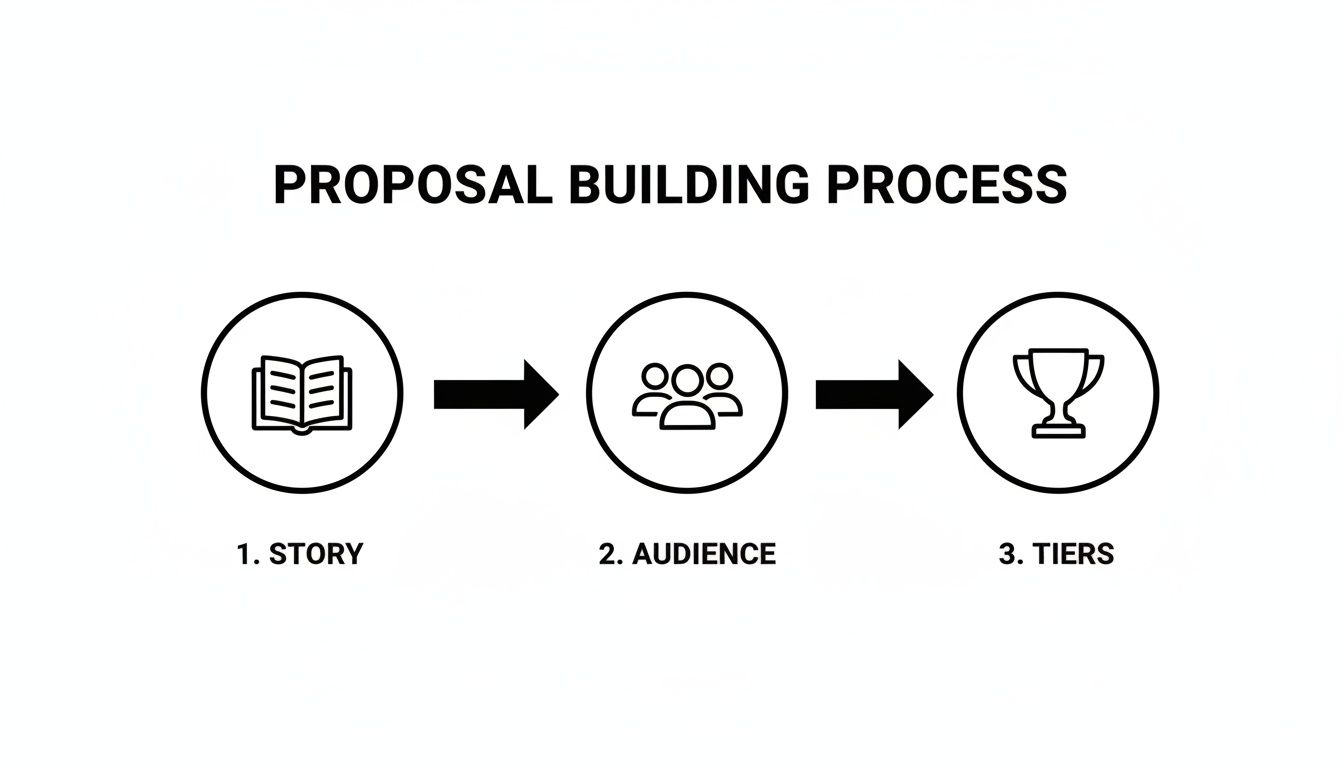
As you can see, you can't just jump to creating tiers. It all starts with a compelling story and a deep understanding of your audience. Only then can you build packages that sponsors will actually want to buy.
With your assets valued, you can finally start building your packages. The classic—and effective—approach is to create three or four tiers designed to make the higher-level options the most appealing. You're creating a clear value ladder that guides sponsors upward.
Here’s a smart way to structure your tiers:
For instance, your $10,000 "Innovation Partner" package might look good, but for just $5,000 more, the $15,000 "Headline Partner" package includes a speaking slot and a dedicated email blast—two assets that are easily worth more than that $5,000 difference on their own. This kind of strategic packaging naturally nudges sponsors toward the higher investment.
For a deeper dive, check out our guide on how to build irresistible event sponsorship packages. By carefully constructing your tiers, you'll do more than just cover costs—you'll drive real profit while presenting a partnership that sponsors see as a smart, strategic investment.
Gone are the days when a logo on a banner and a vague promise of "brand exposure" were enough to land a major sponsor. Today’s sponsors are savvy marketers who live and breathe data. They need to see a clear, measurable return on their investment before they even think about cutting a check.
This is where your event technology stack becomes your secret weapon. It transforms your proposal from a hopeful ask into a compelling, numbers-backed business case. You're no longer just selling space; you're selling quantifiable engagement and a pipeline of qualified leads.
The real magic of event tech is its power to create and measure every single digital interaction. It's time to think beyond physical signage and start integrating features that speak directly to a sponsor's core marketing goals—like generating leads and driving meaningful brand engagement.
Here are a few tech-powered assets you can bake right into your sponsorship packages:
This screenshot shows exactly how a platform like GroupOS presents these digital assets. It’s clean, professional, and makes it incredibly easy for sponsors to see exactly how they can manage their presence and track engagement in real-time.
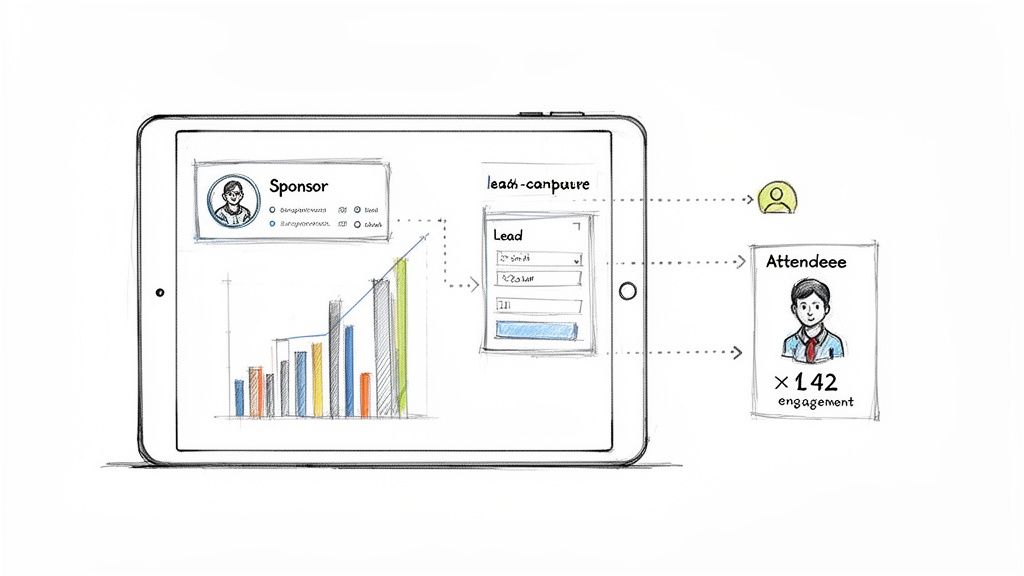
Dropping mockups like this into your proposal is a pro move. It helps potential partners visualize how their brand will look and feel within the event experience, making the opportunity far more tangible and exciting.
Your ultimate goal is to deliver a post-event report filled with hard numbers that scream success. Your proposal needs to promise this from the very beginning. Be explicit about the metrics you will track and deliver—it shows sponsors you’re as invested in their ROI as they are.
Don't just promise exposure—promise proof. The ability to deliver a detailed post-event impact report is a massive competitive advantage. It’s what turns a one-time sponsor into a recurring annual partner.
Your event tech should be your engine for tracking the KPIs that marketing teams truly care about. To really nail this, you need a solid grasp of how to calculate marketing ROI and prove its value. Frame your sponsorship benefits around these specific, bottom-line metrics.
Highlight these kinds of data points in your proposal:
This data-first approach isn't just a "nice-to-have" anymore; it's essential. The events industry is projected to hit $1,346.92 billion in 2025, and hybrid events are a huge part of that growth. In fact, 74.5% of planners now use them to generate 35% more qualified leads, which makes these tech-enabled features non-negotiable for a modern sponsorship package.
When you build these capabilities into your event sponsorship proposal template, it becomes a seriously powerful sales tool. You're not just asking for support anymore. You're offering a sophisticated marketing channel with verifiable results. And remember, smooth execution is everything. Using the right tools, like the best event check-in software, ensures a seamless experience from the moment attendees arrive, which reflects beautifully on both you and your sponsors.
Let’s be real: your perfectly polished proposal is just the beginning. The real work starts the moment you hit "send." Even the most incredible offer means nothing if it’s sitting unread in a crowded inbox. This is where smart, personalized outreach and persistent follow-up make all the difference.
Forget about blasting a generic email to a huge list. That's a rookie mistake. Securing great sponsors is about building relationships, not just making a transaction. These folks get dozens of cookie-cutter requests every single week, so your job is to be the one that feels real.
Personalization is your secret weapon. I'm not just talking about using a mail-merge field for their first name. I mean doing your homework to find a genuine, timely reason to connect with them, specifically.
Spend five minutes on their LinkedIn page or company blog. Look for a hook that shows you’ve actually been paying attention.
Weave that tidbit right into your opening line. An email starting with, "I saw your team just launched the new 'FuturePay' platform—congratulations!" is worlds away from a generic, "I'm writing to ask for sponsorship." It instantly proves you see them as a unique partner, not just another logo on your wish list.
Pro Tip: Keep that first email short and sweet. Your only goal is to pique their interest enough to open the attached proposal and agree to a chat. Don't try to sell them on everything at once.
Most deals are never closed on the first try. In my experience, it takes several touchpoints to get a busy decision-maker's attention. That’s where a thoughtful follow-up plan comes in. The trick is to add value with every single message, not just to send another "just checking in" email.
Beyond that initial outreach, mastering the art of following up on a lead is what separates the pros from the amateurs.
Here’s a simple cadence I’ve used that gets results:
When you finally get a response, it might not be an enthusiastic "yes!" Don't panic. Learning to handle objections gracefully can turn a soft no into a future yes.
Objection: "We just don't have the budget right now."
Objection: "It's not the right fit for our brand."
Every single interaction is a chance to build a bridge. Treat people with respect, and even a "no" today can become a massive "yes" when the timing is right. They’ll remember you as the professional, thoughtful partner who took the time to listen.
Even the most polished proposal will get a few questions. That's a good thing—it means they're paying attention. Knowing how to handle these common queries can be the difference between a "maybe later" and a signed contract. Let's walk through some of the questions I hear all the time from event organizers.
Timing really is crucial. If you're running a major annual conference or a large festival, you need to start the conversation 9-12 months out. Big companies often lock in their marketing budgets in Q3 or Q4 for the following year. If you're not in front of them before they finalize those numbers, you've missed your shot.
For smaller community events or if it's your first time hosting, a 6-8 month window usually works well. This gives you plenty of time for those initial chats, a bit of back-and-forth on the package, and for their team to get the necessary approvals. The last thing you want is to rush them—that’s a fast track to a polite rejection or a much smaller check than you were hoping for.
Hands down, the most common (and fatal) error is making the proposal all about you and your event's needs. Remember, sponsors aren't making a donation. They're making a marketing investment, and they expect a return. They're trying to hit their own goals, whether that's getting more brand recognition, capturing leads, or positioning themselves as industry leaders.
A proposal that says, "We need $5,000 for A/V equipment" is destined for the trash folder. Flip the script and frame everything around what they get. For instance: "Gain direct access to 300 qualified VPs in the tech industry and generate an estimated 100+ new leads." You always have to answer their silent question: "What's in it for me?"
Why not both? I've found a hybrid approach works best. A clean, professional PDF is a must-have. It’s what they'll expect, and it's easy for your contact to forward to their boss or the finance department.
But here’s a pro tip: lead with a link to a digital proposal. Using a tool like DocSend or PandaDoc gives you a massive advantage. You can see when they opened it, how many times they viewed it, and which pages they spent the most time on. Plus, digital versions let you do cool things like:
In your first email, make the digital link the main call to action. You can always mention that a PDF version is attached or available if they need it.
First, celebrate! A request for a custom package is a huge buying signal. It means they’re genuinely interested and see the potential, but none of your standard tiers are a perfect fit. This is your opening to build a real partnership.
Don't just email back a new price. Get them on the phone for a quick call. Your goal is to dig deeper and understand what they're really trying to achieve. Are they launching a new product? Trying to connect with a specific type of attendee?
Once you know their primary objective, you can cherry-pick benefits from your other packages or even create something entirely new that solves their exact problem. This turns the conversation from a simple transaction into a collaborative strategy session, which is exactly where you want to be.
Ready to stop juggling spreadsheets and start building better sponsor relationships? With GroupOS, you can present sponsors, manage packages, track deliverables, and measure impact all from one place. It’s time to streamline your entire sponsorship workflow. Learn more about how GroupOS can help you secure and manage sponsors.